Which of the following statements is FALSE?
A) An investor’s preferences will determine only how much to invest in the tangent or
efficient portfolio versus the risk-free investment.
B) Conservative investors will invest a small amount in the tangent or efficient
portfolio, choosing a portfolio on the line near the risk-free investment
C) Only aggressive investors will choose to hold the portfolio of risky assets, the
tangent or efficient portfolio.
D) Aggressive investors will invest more in the tangent portfolio choosing a portfolio
that is near the tangent portfolio or even beyond it by buying stocks on margin.
Which of the following statements is FALSE?
A) Estimating dividends, especially for the distant future, is difficult.
B) A firm can only pay out its earnings to investors or reinvest their earnings.
C) Successful young firms often have high initial earnings growth rates.
D) According to the constant dividend growth model, the value of the firm depends on
the current dividend level, divided by the equity cost of capital plus the growth rate.
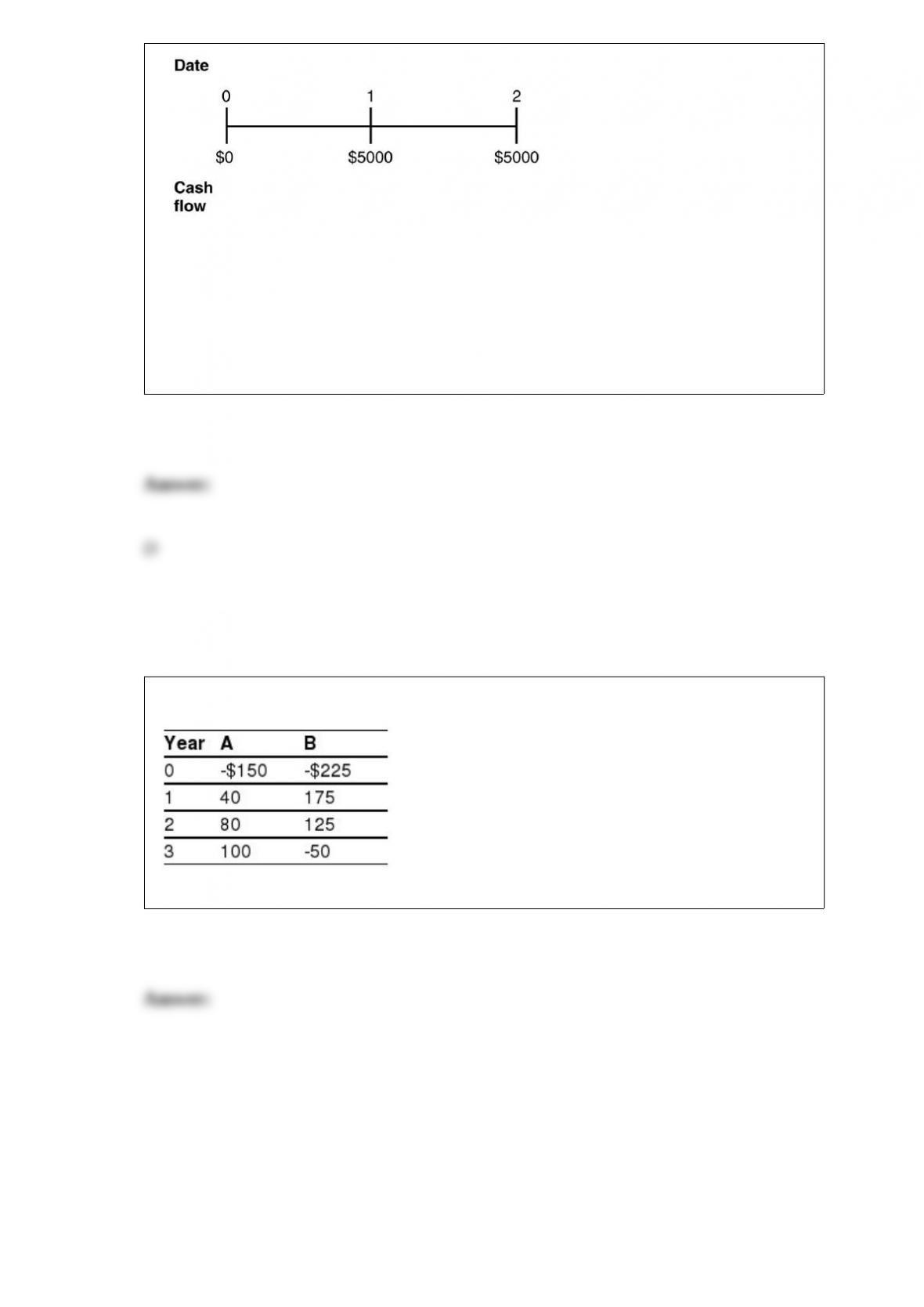
Which of the following statements regarding the timeline is FALSE?
A) Date 1 is the end of the first year.
B) Date 0 is the beginning of the first year.
C) The space between date 0 and date 1 represents the time period between two specific
dates.
D) You will find the timeline most useful in tracking cash flows if you interpret each
point on the timeline as a period or interval of time.
Draw a timeline detailing the cash flows from investment “A.”
Suppose the term structure of risk-free interest rates is given as:
Term 1 year 2 years 3 years 5 years 10 years
Rate 2.25% 2.80% 3.20% 4.10% 6.30%
The present value of an investment that pays $1,000 in two years and $5,000 in ten
years for certain is closest to:
A) $3,660
B) $3,687
C) $3,707
D) $4,292
Consider the following average annual returns:
What is the excess return for the S&P 500?
A) 5.7%
B) 7.0%
C) 0%
D) 8.4%
John Galt is a mutual fund manager at Atlas Asset Management. He can generate an
alpha of 2% a year up to $500 million of invested capital. After that amount his skills
are spread too thin, so he cannot add value and his alpha is zero for all investments over
$500 million. Atlas Asset Management charges a fee of 0.80% on the total amount of
money under management. Assume that there are always investors looking for positive
alpha investments and no investor would invest in a fund with a negative alpha. Assume
that the fund is in equilibrium, meaning that no investor either takes out money or
wishes to invest new money into the fund.
The alpha that investors in Galt’s fund expect to receive is closest to:
A) -.80%
B) 0.0%
C) 0.80%
D) 1.8%
Francisco d’Anconia is considering an investment opportunity that costs $10,000 today
and will pay $11,500 in two years. The IRR of this opportunity is closest to:
A) 7.25%
B) 7.50%
C) 10.00%
D) 15.00%
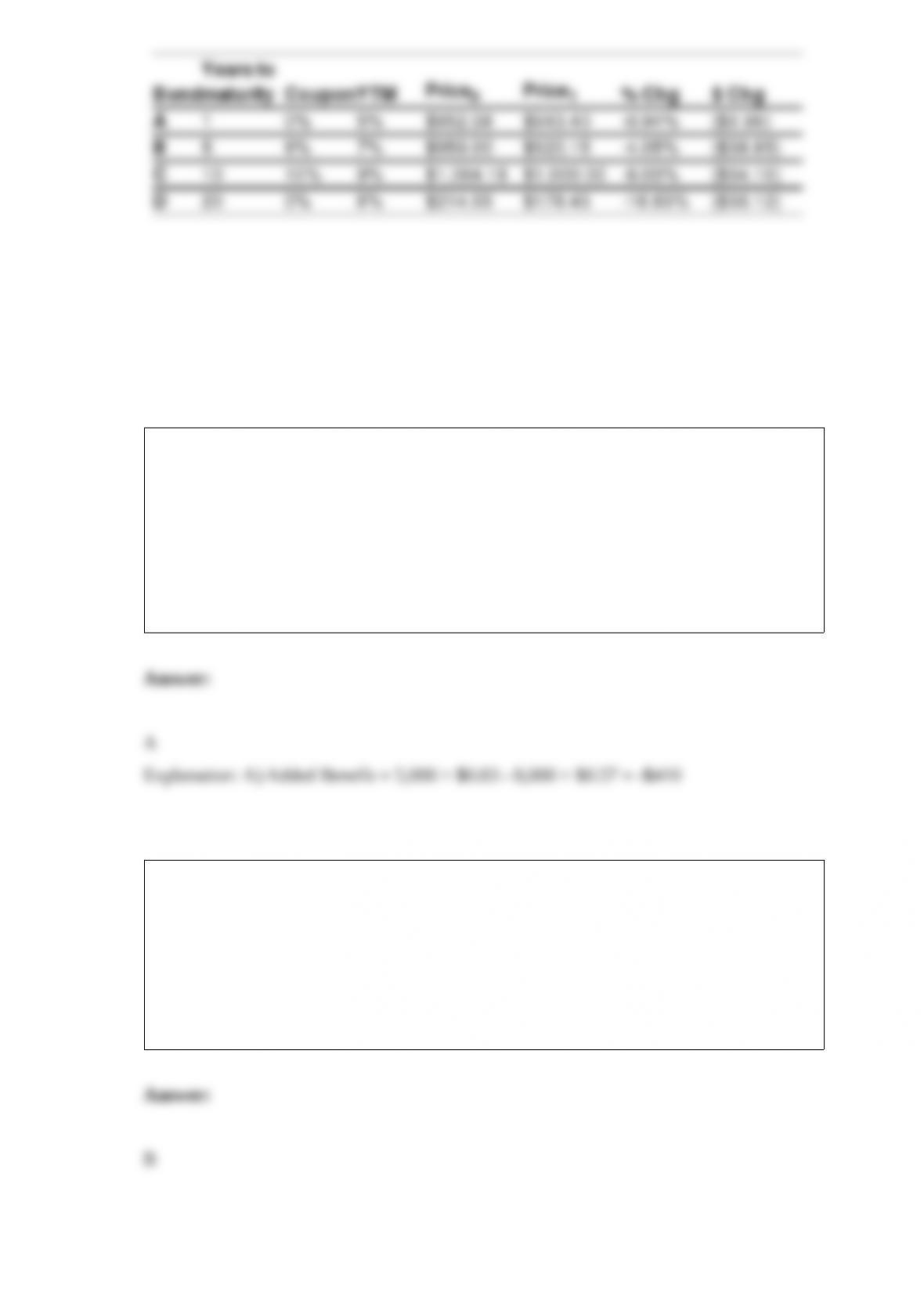
Consider the following four bonds that pay annual coupons:
The percentage change in the price of the bond “C” if its yield to maturity increases
from 9% to 10% is closest to:
A) -17%
B) -6%
C) -4%
D) 4%
Recycle America Inc. has the opportunity to trade 8,000 pounds of plastic pellets made
from recycled soda bottles for 5,000 pounds of aluminum cans. If the current market
price of scrap aluminum is $0.83 per pound and the current market price for plastic
pellets is $0.57 per pound, then the added benefit (cost) of making this trade is:
A) ($410)
B) $410
C) ($780)
D) $780
Which of the following statements is FALSE?
A) The ultimate goal in capital budgeting is to determine the effect of the decision to
take a particular project on the firm’s cash flows.
B) To the extent that overhead costs are fixed and will be incurred in any case, they are
incremental to the project and should be included in the capital budgeting analysis.
C) Unlevered Net Income = (Revenue – Costs – Depreciation) × (1 – Ï„c).
D) Earnings are not cash flows.
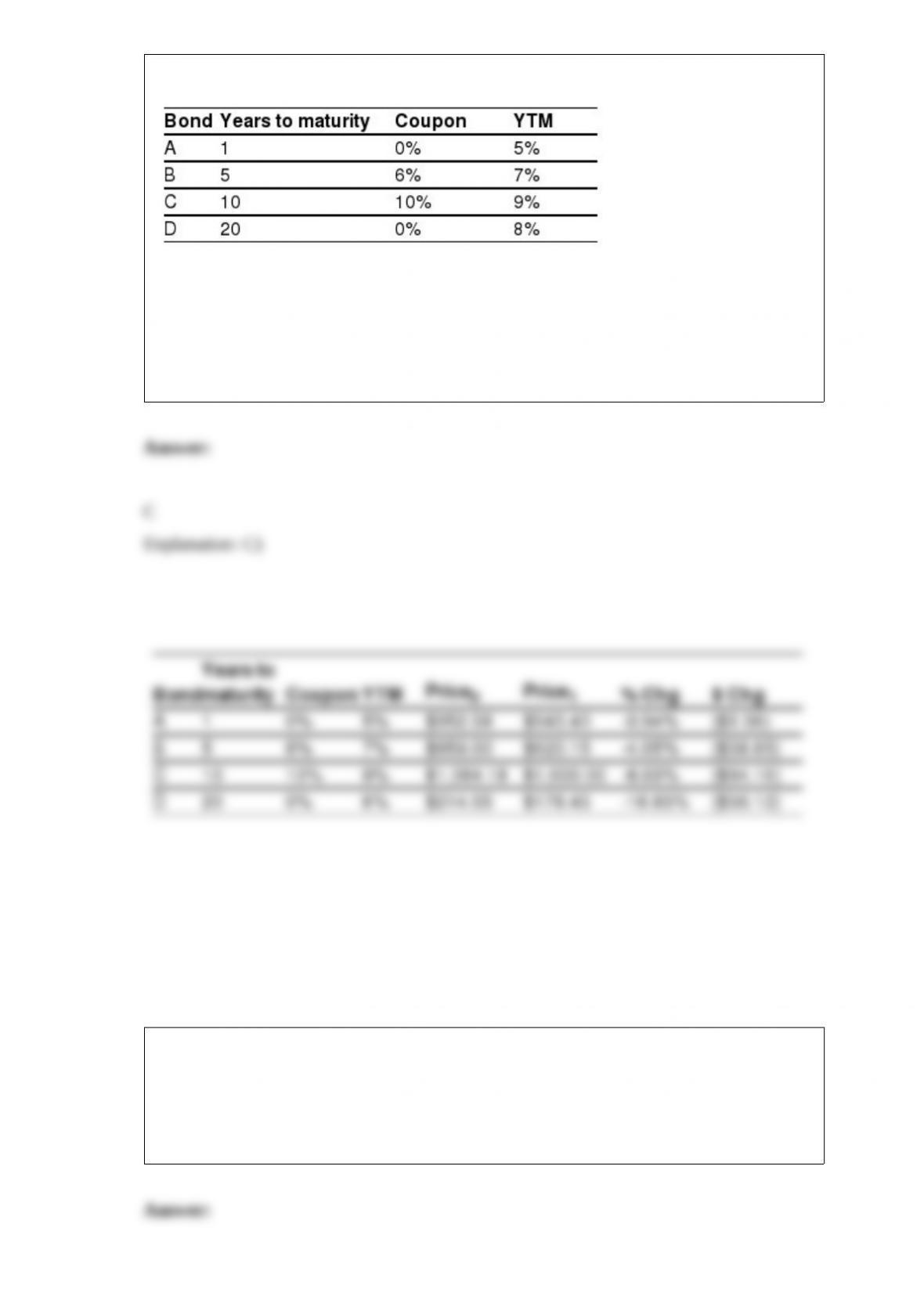
Consider the following four bonds that pay annual coupons:
The percentage change in the price of the bond “A” if its yield to maturity increases
from 5% to 6% is closest to:
A) -4%
B) -6%
C) -1%
D) 4%
Which of the following is NOT a way that a firm can increase its dividend?
A) By increasing its retention rate
B) By decreasing its shares outstanding
C) By increasing its earnings (net income)
D) By increasing its dividend payout rate
Big Cure and Little Cure are both pharmaceutical companies. Big Cure presently has a
potential “blockbuster” drug before the Food and Drug Administration (FDA) waiting
for approval. If approved, Big Cure’s blockbuster drug will produce $1 billion in net
income for Big Cure. Little Cure has 10 separate less important drugs before the FDA
waiting for approval. If approved, each of Little Cure’s drugs would produce $100
million in net income for Little Cure. The probability of the FDA approving a drug is
50%.
What is the standard deviation of Big Cure’s average net income for their new
blockbuster drug?
A) $0
B) $1 billion
C) $100 million
D) $500 million
Taggart Transcontinental is considering a $250 million investment to launch a new rail
line. The project is expected to generate a free cash flow of $32 million per year, and its
unlevered cost of capital is 8%. Taggart’s marginal corporate tax rate is 35%.Assuming
that to fund the investment Taggart will take on $250 million in permanent debt and
ignoring issuance costs, the NPV of Taggart’s new rail line is closest to:
A) $195 million
B) $200 million
C) $235 million
D) $240 million
Big Cure and Little Cure are both pharmaceutical companies. Big Cure presently has a
potential “blockbuster” drug before the Food and Drug Administration (FDA) waiting
for approval. If approved, Big Cure’s blockbuster drug will produce $1 billion in net
income for Big Cure. Little Cure has 10 separate less important drugs before the FDA
waiting for approval. If approved, each of Little Cure’s drugs would produce $100
million in net income for Little Cure. The probability of the FDA approving a drug is
50%.
The standard deviation of Little Cure’s average net income for their ten new drugs is
closest to:
A) $50 million
B) $25 million
C) $16 million
D) $500 million