1) Which of the following is an example of a fixed cost?
A.Paper used in the manufacture of textbooks
B.Property taxes paid by a firm to the City of Los Angeles
C.The wages of part-time workers who are paid $8 per hour
D.Gasoline consumed by salespersons’ cars
E.Surgical supplies used in a hospital’s operating room
2) Imputed interest can best be described as:
A.the company’s weighted average cost of capital
B.the prime interest rate on the date of the transaction
C.the interest rate charged for the company’s bonds
D.the minimum required rate of return on invested capital
E.the after-tax cost of the interest payments on debt
3) Consider the following items of information:
I. The target recovery period.
II. The discount rate.
III. The timing (i.e., year) of a cash flow.
Which of the above items would be needed to calculate the present value of a cash
flow?
A.I only
B.II only
C.I and II
D.II and III
E.I, II, and III
4) An unfavorable labor efficiency variance is created when:
A.actual labor hours worked exceed standard hours allowed
B.actual hours worked are less than standard hours allowed
C.actual wages paid are less than amounts that should have been paid
D.actual units produced exceed budgeted production levels
E.actual units produced exceed standard hours allowed
5) A company’s plan for the acquisition of long-lived assets, such as buildings and
equipment, is commonly called a:
A.pro-forma budget
B.master budget
C.financial budget
D.profit plan
E.capital budget
6) Lawson, Inc. sells a single product for $12. Variable costs are $8 per unit and fixed
costs total $360,000 at a volume level of 60,000 units. Assuming that fixed costs do not
change, Lawson’s break-even point would be:
A.30,000 units
B.45,000 units
C.90,000 units
D.negative because the company loses $2 on every unit sold
E.a positive amount other than the specific amounts given
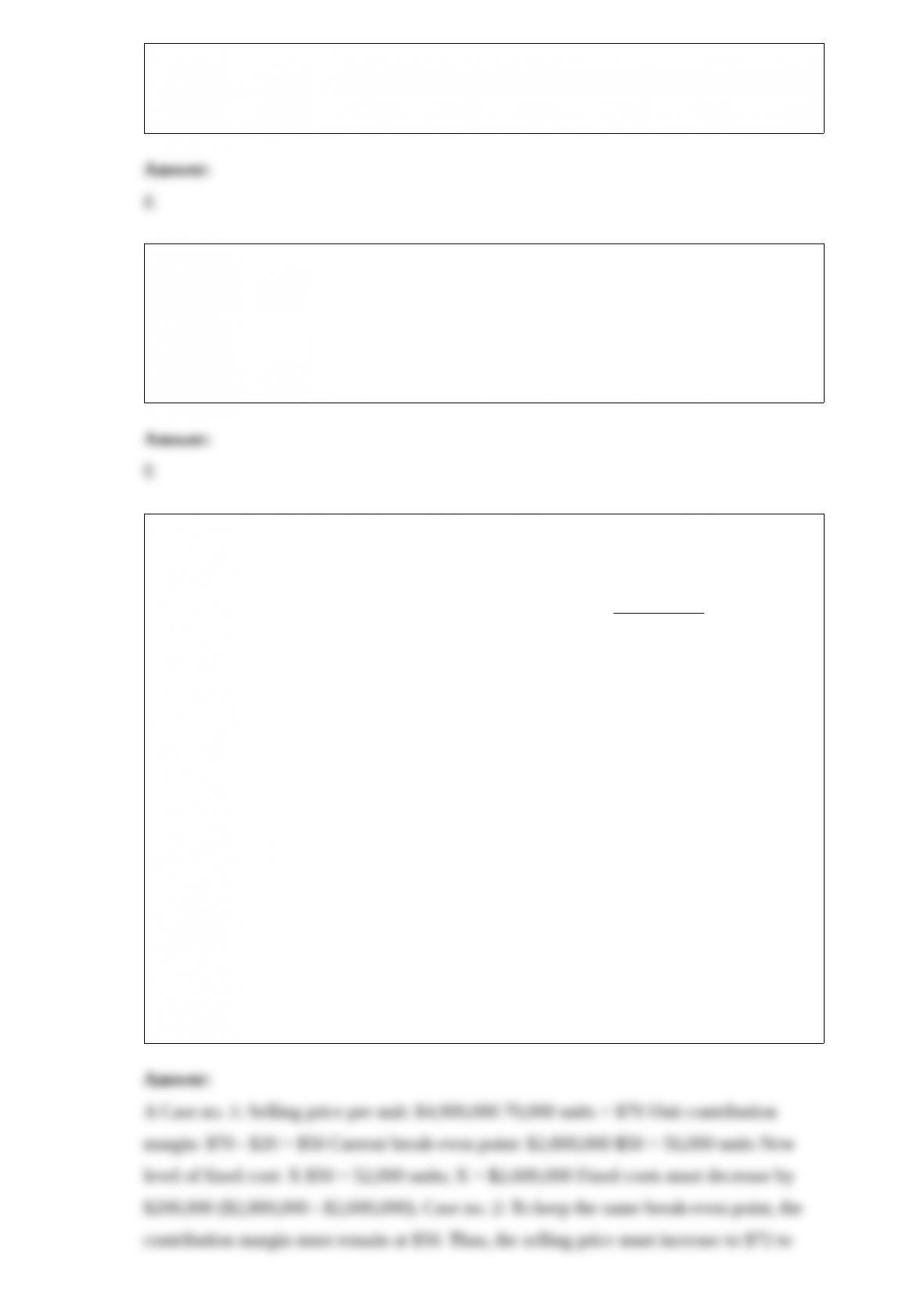
7)
If the cost of goods sold for the year was $427,500, what was the cost of goods
manufactured for the year?
A.$402,100
B.$422,300
C.$417,100
D.$427,500
E.None of the other answers are correct
8) Trackings Corporation has two service departments (Maintenance and Human
Resources) and three production departments (Machining, Assembly, and Finishing).
Maintenance is the larger service department and Assembly is the largest production
department. The two service departments service each other as well as the three
producing departments. On the basis of this information, which of the following cost
allocations would not occur under the direct method?
A.Machining cost would be allocated to Assembly
B.Maintenance cost would be allocated to Finishing
C.Maintenance cost would be allocated to Human Resources
D.Human Resources cost would be allocated to Finishing
E.Both machining cost would be allocated to Assembly and maintenance cost would be
allocated to Human Resources
9) Transfer prices can be based on:
A.variable cost
B.full cost
C.an external market price
D.a negotiated settlement between the buying and selling divisions
E.All of the other answers are correct
10) Elmton recently sold 70,000 units, generating sales revenue of $4,900,000. The
company’s variable cost per unit and total fixed cost amounted to $20 and $2,800,000,
respectively. Management is in the process of studying the dollar impact of various
transactions and events, and desires answers to the following independent cases:
Case no. 1: Management wants to lower the firm’s break-even point to 52,000 units. If
all other costs remain constant, what must happen to fixed costs to achieve this
objective?
Case no. 2: The company anticipates a $2 hike in the variable cost per unit. If all other
costs remain constant and management desires to maintain the firm’s current break-even
point, what must happen to Elmton’s selling price? If selling price remains constant,
what must happen to the firm’s total fixed costs?
Required:
A. Answer the two cases raised by management.
B. Determine the impact (increase, decrease, or no effect) of the following operating
changes on the items cited:
1> An increase in variable selling costs on income.
2> A decrease in direct material cost on the unit contribution margin.
3> A decrease in the number of units sold on the break-even point.
11) The capacity concept that allows for normal occurrences such as machine downtime
and employee fatigue is known as:
A.practical capacity
B.theoretical capacity
C.utilized capacity
D.management capacity
E.capacity maximization
12) Kirsten, Inc. operates a chain of 80 retail stores throughout the Northwest that
specializes in the sale of sports equipment. The following costs relate to store no. 19 in
Seattle, Washington:
1> Salary of store manager: $58,000
2> Allocated corporate overhead: $55,000
3> Cost of goods sold: $2,560,000
4> Landscaping and grounds costs (yearly contract): $6,800
5> Hourly wages of sales clerks: $343,000
6> Local advertising (negotiated by store manager): $76,000
7> Property taxes: $25,800
8> Sales commissions: $221,000
Required:
Which of the preceding costs would be used in computing:
A. Store no. 19’s segment contribution margin?
B. Store no. 19’s controllable profit margin?
C. Store no. 19’s segment profit margin?
D. The net income of Kasten, Inc.?
13) Consider the following statements about absorption costing and variable costing:
I. Variable costing is consistent with contribution reporting and cost-volume-profit

analysis.
II. Variable costing must be used for external financial reporting.
III. A number of companies use both absorption costing and variable costing.
Which of the above statements is (are) true?
A.I only
B.II only
C.III only
D.I and II
E.I and III
14) Resource Consulting is studying the costs of several clients, and has found that the
accompanying graphs appear as follows:
1> A straight line that gradually slopes upward to the right
2> A curvilinear line that gradually slopes upward to the right
3> A straight line that is parallel to the graph’s horizontal axis
4> A straight line that gradually slopes downward to the right
5> A curvilinear line that gradually slopes downward to the right
6> A straight line that gradually slopes upward to the right and then, at a specific point,
flattens out to run parallel to the horizontal axis
7> A series of straight lines that appear to resemble a set of steps
8> A straight line that runs parallel to the graph’s horizontal axis and then, at a specific
point, drops to a lower level
Unless told otherwise, assume that the horizontal axis represents total activity and the
vertical axis represents total cost.
Required:
For items A-F, indicate the number of the graph that best represents the cost behavior
pattern described. Note: Graphs can be used more than once, and not all graphs need be
used.
A. The salary cost of lab technicians employed at a clinic. One technician is needed for
every 1,500 patients serviced.
B. The cost of glass used by a manufacturer of automobile windshields.
C. A profit-sharing bonus that is paid to the associate director of a firm that conducts
professional-development courses for executives. The bonus is based on revenues from
courses that are being run, subject to a maximum amount each year.
D. Flood insurance premiums that are paid by Reliable Manufacturing, which operates
a production facility close to a river.
E. The paper cost that is used in the production of a textbook. Note: Assume that for
this part only, the graph’s vertical axis represents the cost per unit rather than total cost.
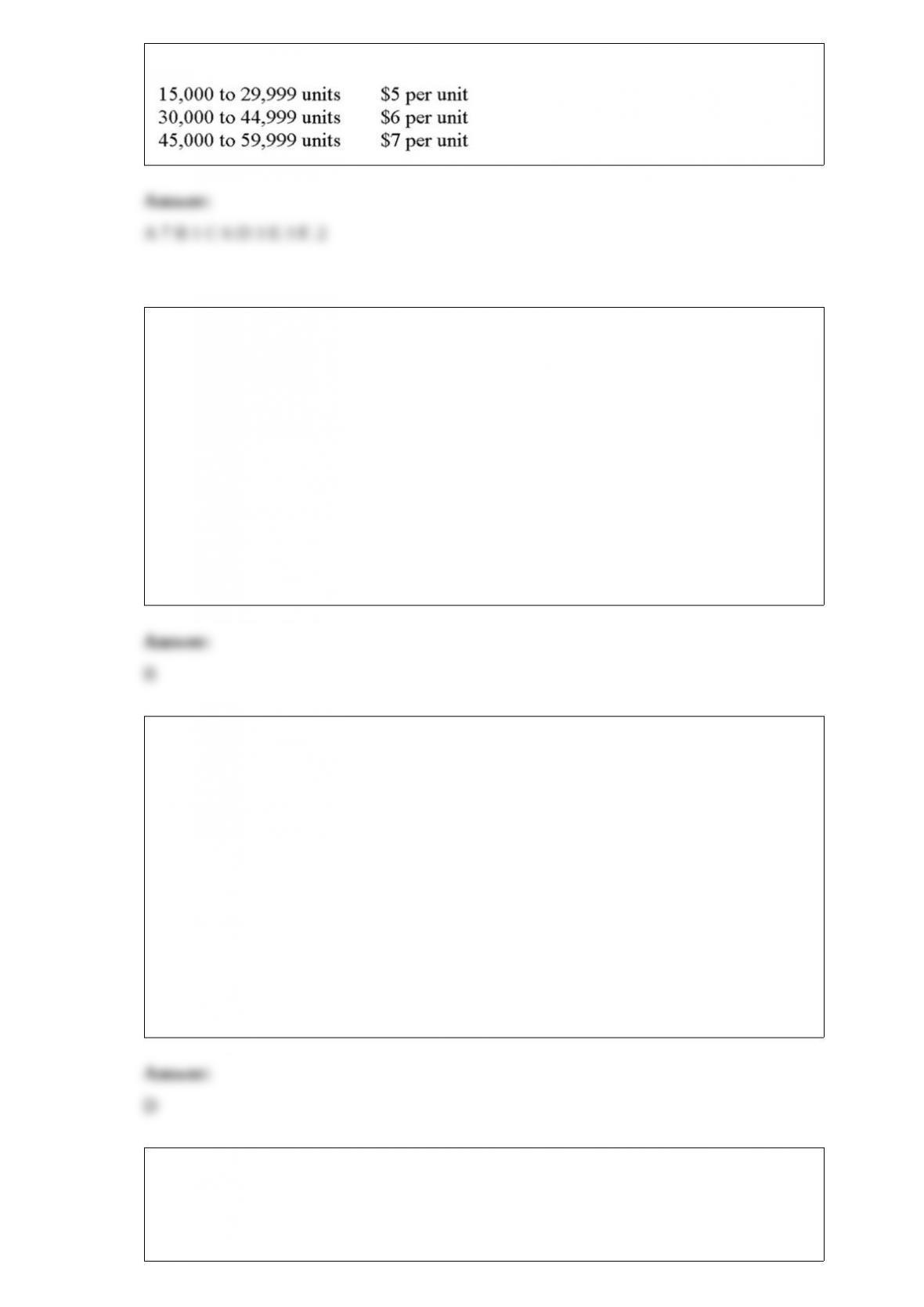
F. Tariffs that are paid on products shipped overseas. For one particular country, if
fewer than 15,000 units are shipped, the client must pay $4 per unit. The tariff is raised
by $1 according to the following schedule:
15) Cartwright Graphics uses a special purpose paper on 80% of its jobs. The paper is
purchased in 100-sheet packages at a cost of $100 per package. Management estimates
that the cost of placing and receiving a typical order is $15, and the annual cost of
carrying a package in inventory is $1.50. Cartwright uses 2,600 packages each year.
Production is constant, and the lead time to receive an order is 1 week.
The reorder point is:
A.25 packages
B.50 packages
C.100 packages
D.203 packages
E.225 packages
16) Porschia is considering the acquisition of new machinery that will produce uniform
benefits over the next eight years. The following information is available:
Annual savings in cash operating costs: $350,000
Annual depreciation expense: $250,000
If the company is subject to a 30% tax rate, what denominator should be used to
compute the machinery’s payback period?
A.$70,000
B.$170,000
C.$245,000
D.$320,000
E.None of the other answers are correct
17) Activity-based costing systems:
A.use a single, volume-based cost driver
B.assign overhead to products based on the products’ relative usage of direct labor
C.often reveal products that were under- or over-costed by traditional costing systems
D.typically use fewer cost drivers than more traditional costing systems
E.have a tendency to distort product costs
18) Which of the following elements is not used when calculating the weighted-average
cost of capital?
A.Before-tax cost of debt capital
B.After-tax cost of debt capital
C.Cost of equity capital
D.Market value of debt capital
E.Market value of equity capital
19) Consider the following statements about the investment in working capital in a
capital budgeting analysis:
I. Working capital often increases as the result of higher balances in accounts receivable
or inventory necessary to support a project.
II. Working capital increases are sources of cash and should be included in a
discounted-cash-flow analysis.
III. The time 0 cash investment in working capital is included in a discounted-cash-flow
analysis as a cash outflow.
Which of the above statements is (are) correct?
A.I only
B.II only
C.III only
D.I and II
E.I and III
20) A manager who wants to determine the percentage impact on income of a given
percentage change in sales would multiply the percentage increase/decrease in sales
revenue by the:
A.contribution margin
B.gross margin
C.operating leverage factor
D.safety margin
E.contribution-margin ratio
21) Underwood Company uses cost-based transfer pricing. Its Food Processing
Division has a standard variable cost of $8.50 per case and allocated fixed overhead of
$2.25. The Processing Division, which has excess capacity, sells its output to external
customers for $12.00 per case. If Underwood uses full (or absorption) cost as its base,
the transfer price charged to its Retail Division should be:
A.$14.25
B.$12.00
C.$10.75
D.$8.50 plus a markup
E.negotiated between the managers of the Processing and Retail Divisions
22) Which of the following business models considers financial, customer, internal
operating, and other measures in the evaluation of performance?
A.Deterministic simulation
B.Balanced scorecard
C.Payoff matrix
D.Decision tree
E.Chart of operating performance (COP)
23) A computer manufacturer recently shipped several laptops to a customer (cost:
$25,000) and billed the customer $30,000. Which of the following options correctly
expresses the accounts that are debited and credited to record this transaction?
A.Debits: Accounts Receivable, Finished-Goods Inventory; credits: Sales Revenue,
Cost of Goods Sold
B.Debits: Accounts Receivable, Cost of Goods Sold; credits: Sales Revenue,
Finished-Goods Inventory
C.Debits: Sales Revenue, Cost of Goods Sold; credits: Accounts Receivable,
Finished-Goods Inventory
D.Debits: Sales Revenue, Finished-Goods Inventory; credits: Accounts Receivable,
Cost of Goods Sold
E.Debits: Accounts Receivable; credits: Finished-Goods Inventory, Profit on Sale
24) Switzer, Inc., which sells books to college bookstores and individuals, uses
activity-based costing and activity-based management. The following information is
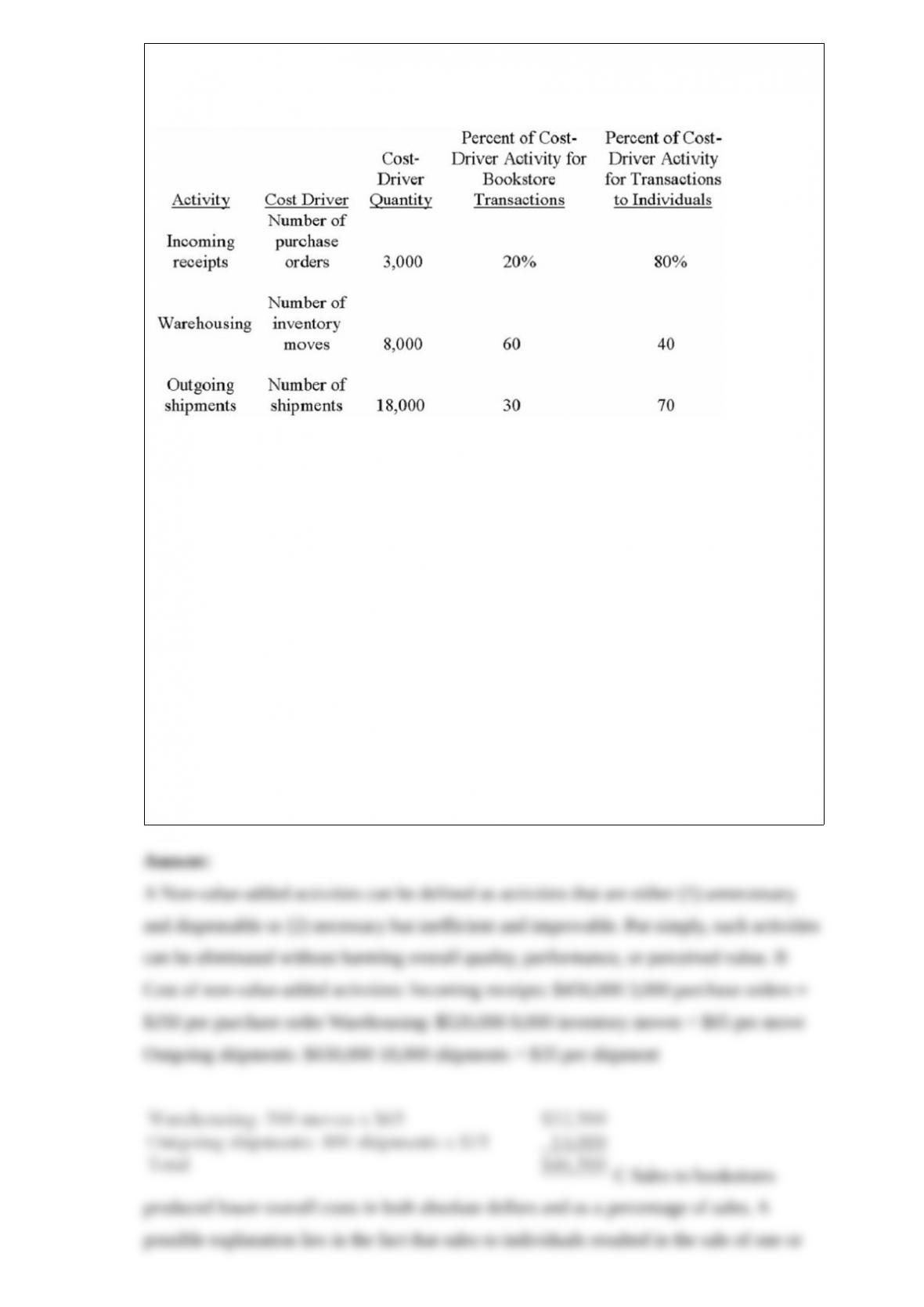
available for the company’s three cost pools:
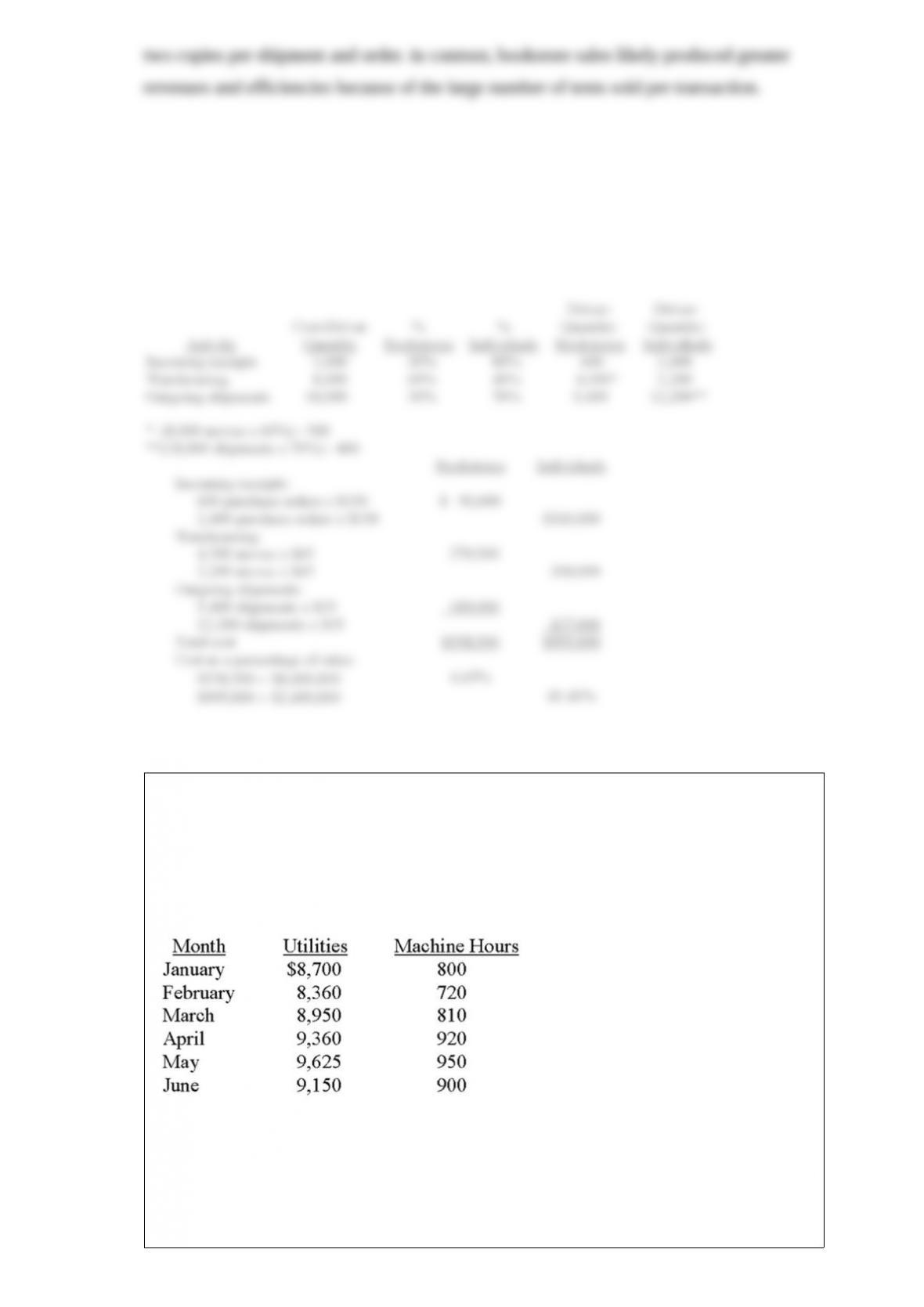
Bookstore sales totaled $8,400,000, and sales to individuals amounted to $2,400,000.
Costs for the three activities were: Incoming receipts, $450,000; warehousing,
$520,000; and outgoing shipments, $630,000. A review of the company’s activities
found various inefficiencies with respect to the warehousing of textbooks (acquired for
eventual sale to bookstores) and outgoing shipments to individuals. These inefficiencies
resulted in an extra 500 moves and 400 shipments, respectively.
Required:
A. What is a non-value-added activity?
B. How much did non-value-added activities cost Switzer this past year?
C. Which of the two marketssales to bookstores or sales to individualsresulted in lower
overall costs for incoming receipts, warehousing, and outgoing shipments? Evaluate
these costs in both absolute dollars and as a percentage of sales. In addition, present a
possible explanation for your results. Note: Exclude costs that arose from inefficient
operations.
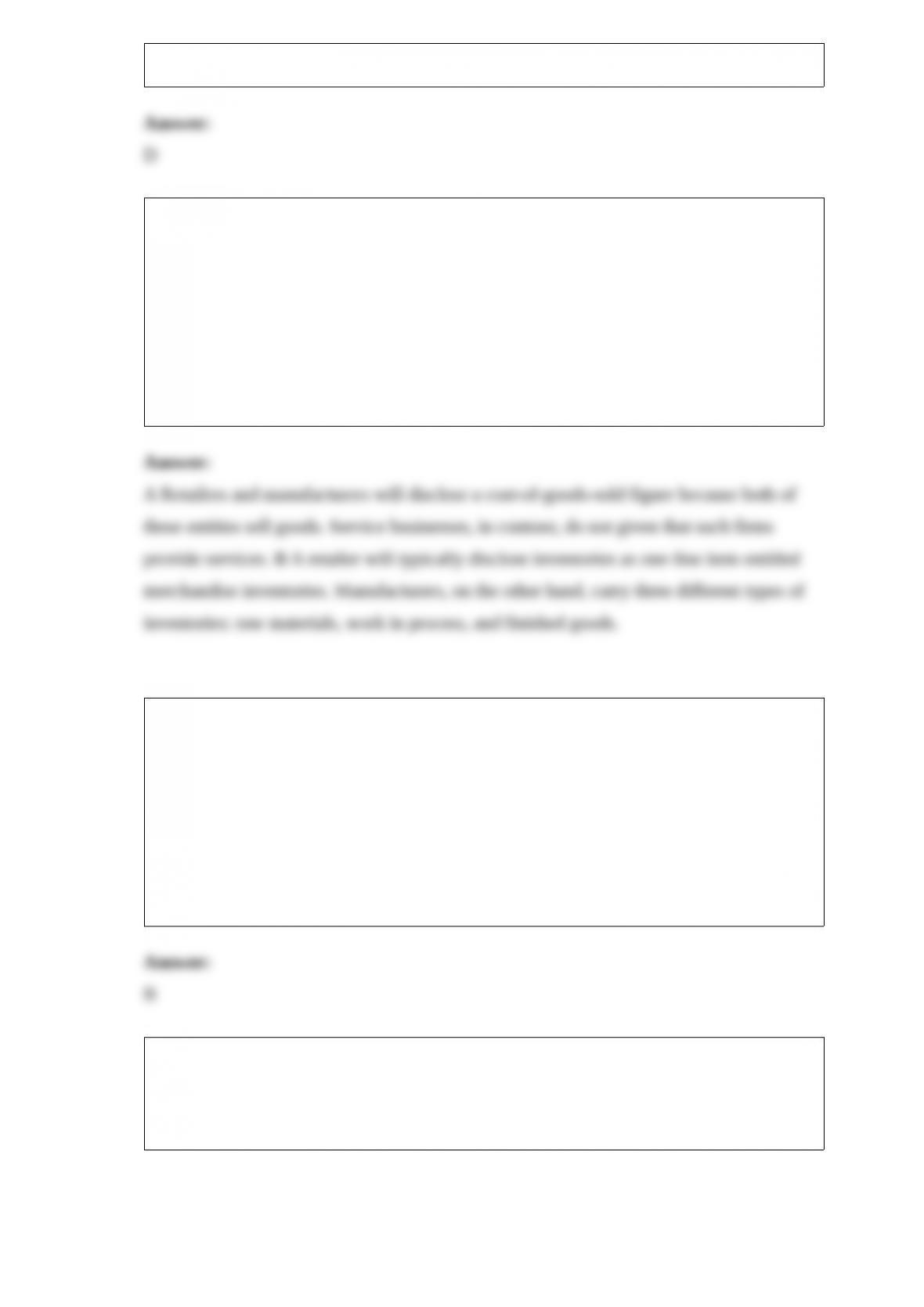
25) Hot’lanta, Inc., which uses the high-low method to analyze cost behavior, has
determined that machine hours best explain the company’s utilities cost. The company’s
relevant range of activity varies from a low of 600 machine hours to a high of 1,100
machine hours, with the following data being available for the first six months of the
year:
The variable utilities cost per machine hour is:
A.$0.18
B.$4.50
C.$5.00
D.$5.50
E.None of the other answers is correct
26) The income statements and balance sheets of service, retailing, and manufacturing
businesses tend to differ.
Required:
A. Which of these businesses will disclose a cost-of-goods-sold figure on the income
statement? Why?
B. Briefly describe the difference between a retailing firm and manufacturer’s disclosure
of inventories on the balance sheet.
27) Sanderson sells a single product for $50 that has a variable cost of $30. Fixed costs
amount to $5 per unit when anticipated sales targets are met. If the company sells one
unit in excess of its break-even volume, profit will be:
A.$15
B.$20
C.$50
D.an amount that cannot be derived based on the information presented
E.an amount other than $15, $20, or $50 and one that can be derived based on the
information presented
28) Which type of fixed cost (1) tends to be more long-term in nature and (2) can be cut
back more easily in bad economic times without doing serious harm to organizational
goals and objectives?
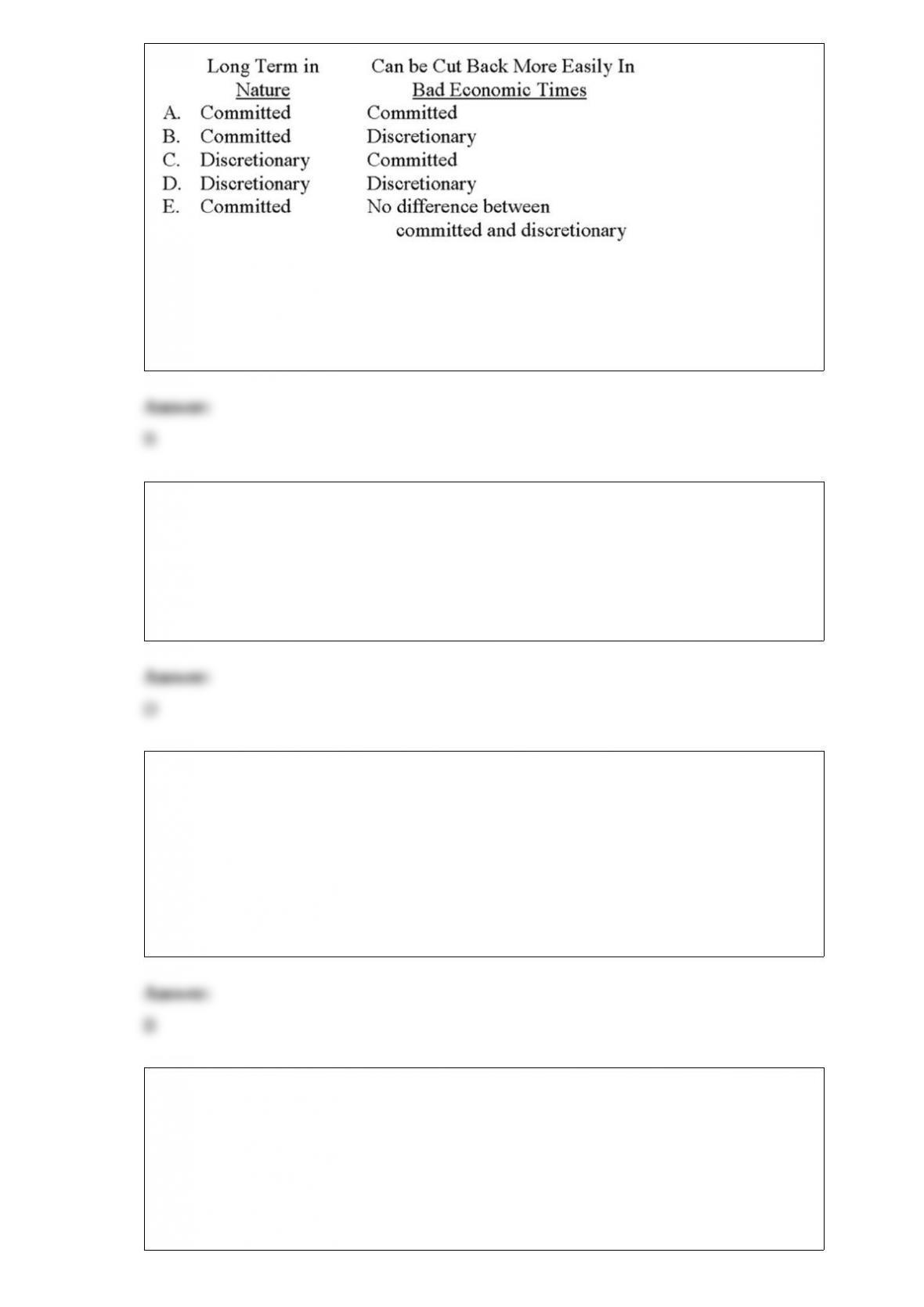
A.Choice A
B.Choice B
C.Choice C
D.Choice D
E.Choice E
29) The high-low method and least-squares regression are used by accountants to:
A.evaluate divisional managers for purposes of raises and promotions
B.choose among alternative courses of action
C.maximize output
D.estimate costs
E.control operations
30) Bird plans to sell 5,000 units each quarter next year. During the first two quarters
each unit will sell for $12; during the last two quarters the sales price will increase
$1.50 per unit. What is Bird’s estimated sales revenue for next year?
A.$240,000
B.$255,000
C.$270,000
D.$244,000
E.None of the other answers are correct
31) Hammett has a single production department, and uses a process-costing system.
The balance in its Work-in-Process account on January 1 was $68,000. The account was
charged with direct materials, direct labor, and manufacturing overhead of $450,000
throughout the year. If a review of the accounting records determined that $86,000 of
goods were still in production at year-end, Hammett should make a journal entry on
December 31 that includes:
A.a debit to Cost of Goods Sold for $432,000
B.a debit to Finished-Goods Inventory for $432,000
C.a debit to Work-in-Process Inventory for $432,000
D.a debit to Finished-Goods Inventory for $86,000
E.a credit to Work-in-Process Inventory for $86,000
32) Narchie sells a single product for $50. Variable costs are 60% of the selling price,
and the company has fixed costs that amount to $400,000. Current sales total 16,000
units.
If Narchie sells 24,000 units, its safety margin will be:
A.$200,000
B.$400,000
C.$1,000,000
D.$1,200,000
E.None of the other answers is correct
33) Mueller has been approached about providing a new service to its clients. The
company will bill clients $140 per hour; the related hourly variable and fixed operating
costs will be $75 and $18, respectively. If all employees are currently working at full
capacity on other client matters, the per-hour opportunity cost of being unable to
provide this new service is:
A.$0
B.$47
C.$65
D.$93
E.$140
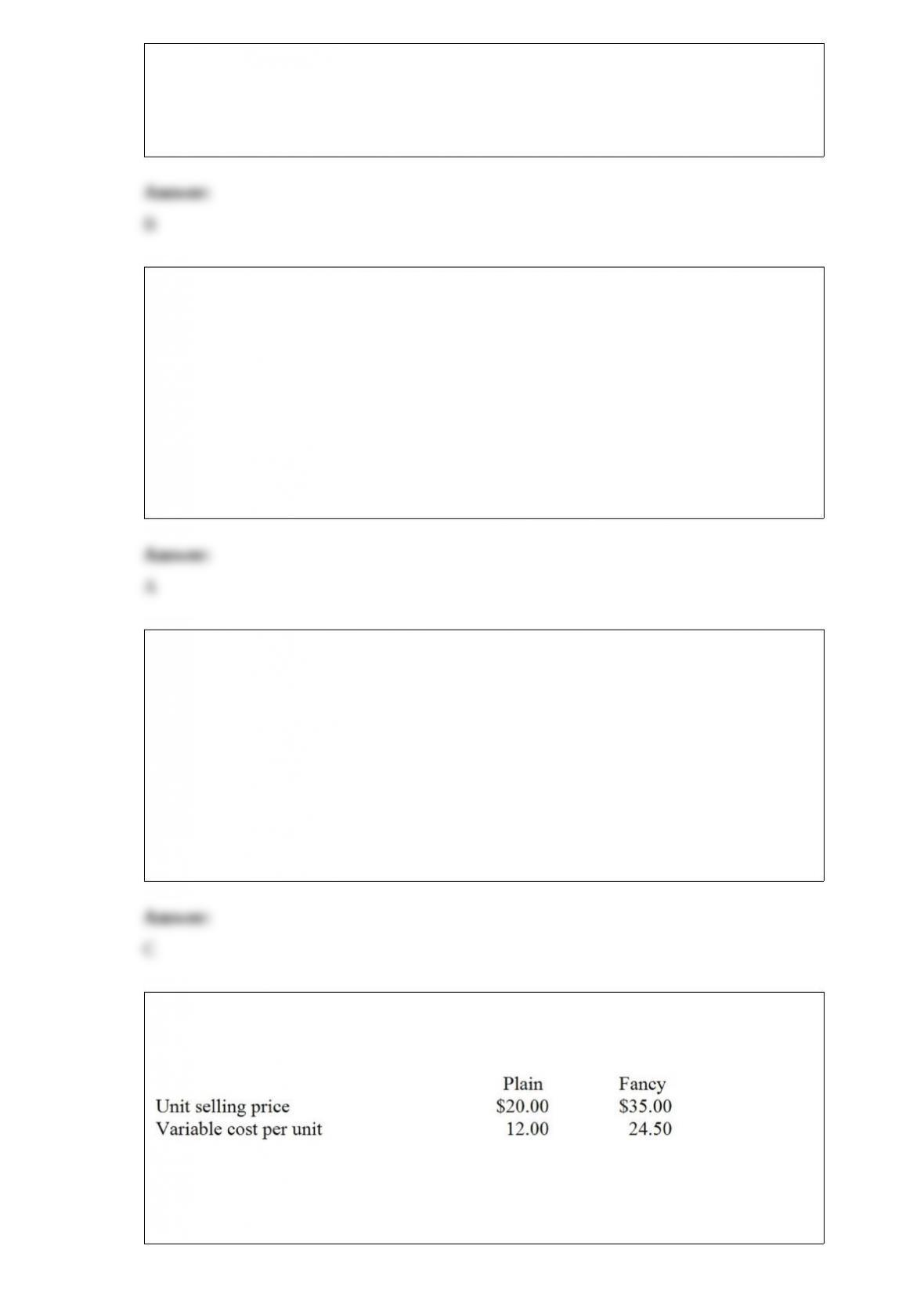
34) Jamal & Co. makes and sells two types of shoes, Plain and Fancy. Data concerning
these products are as follows:
Sixty percent of the unit sales are Plain, and annual fixed expenses are $45,000.
The weighted-average unit contribution margin is:
A.$4.80
B.$9.00
C.$9.25
D.$17.00
E.None of the other answers is correct
35) Rich Company, which uses a standard cost system, budgeted $800,000 of fixed
overhead when 50,000 machine hours were anticipated. Other data for the period were:
Actual units produced: 10,600
Actual machine hours worked: 51,800
Actual variable overhead incurred: $475,000
Actual fixed overhead incurred: $790,100
Standard variable overhead rate per machine hour: $8.50
Standard production time per unit: 5 hours
Rich’s fixed-overhead budget variance is:
A.$9,900U
B.$9,900F
C.$28,800U
D.$28,800F
E.None of the other answers are correct
36) The controller for Wofford Machining has established the following overhead cost
pools and cost drivers:
Order no. 715 has the following production requirements:
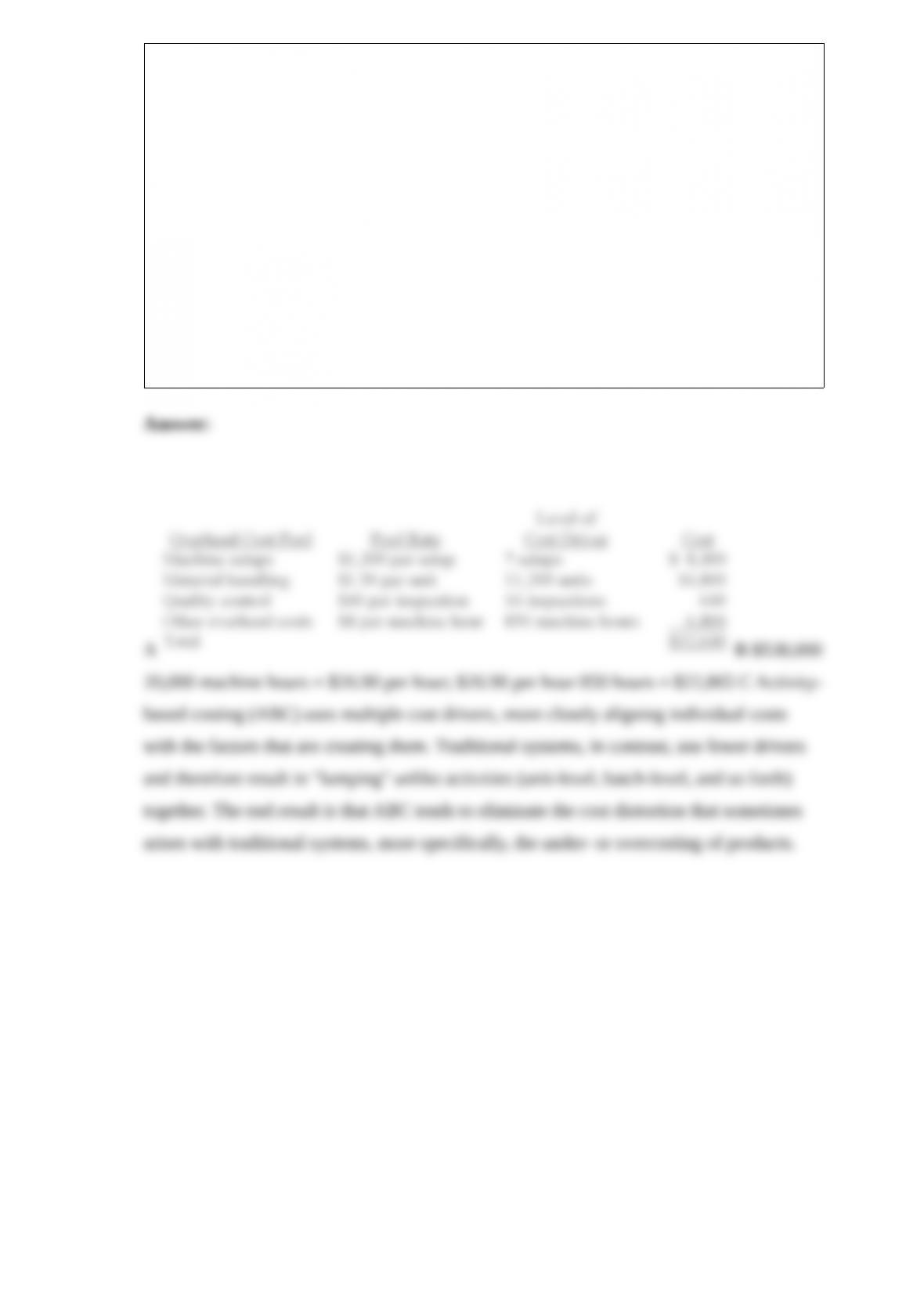
Machine setups: 7
Raw material: 11,200 units
Inspections: 16
Machine hours: 850
Required:
A. Compute the total overhead that should be assigned to order no. 715 by using
activity-based costing.
B. Suppose that Wofford were to use a single, predetermined overhead rate based on
machine hours. Compute the rate per hour and the total overhead assigned to order no.
715 .
C. Discuss the merits of an activity-based costing system in comparison with a
traditional costing system.
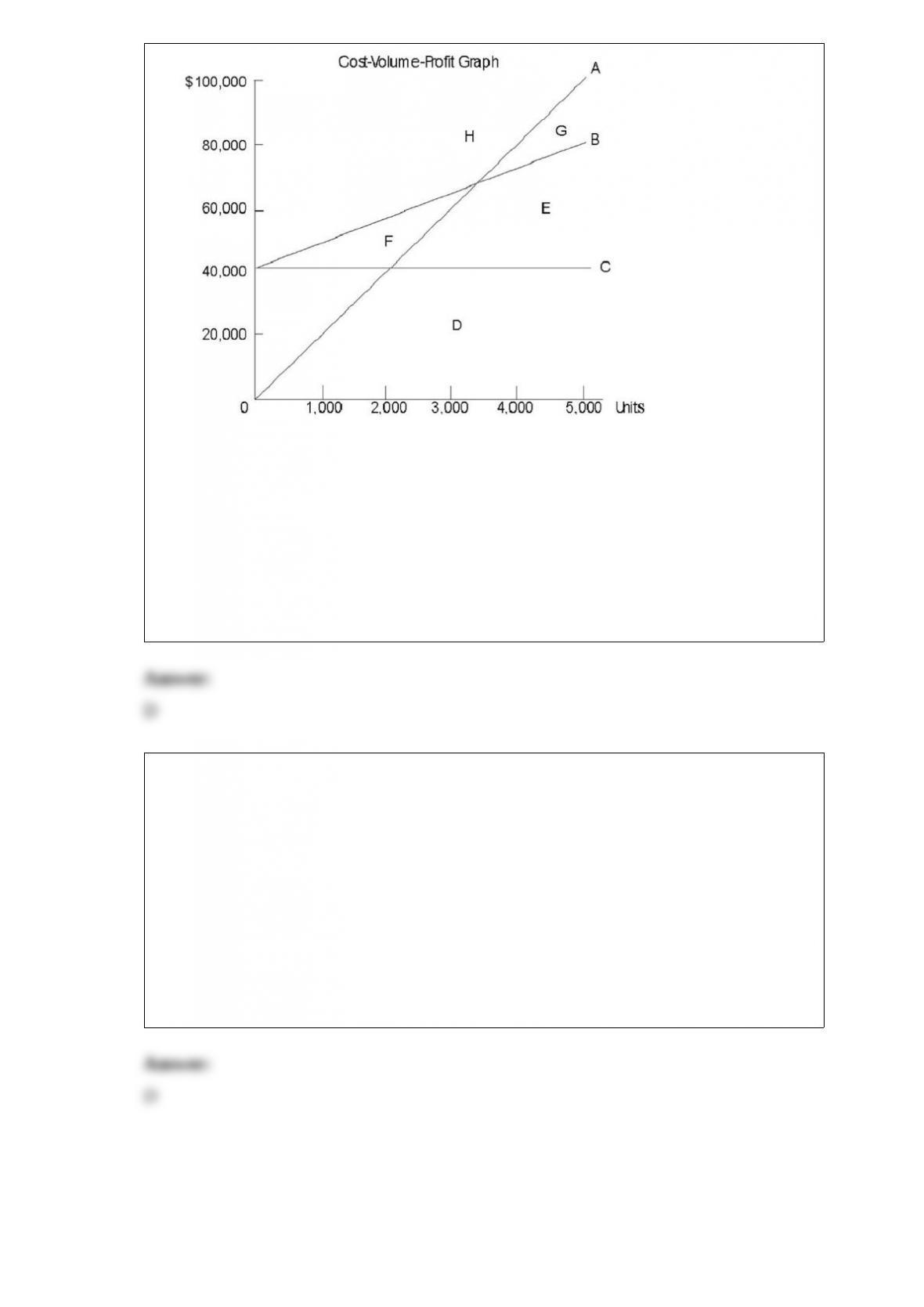
37)
Refer to the figure above. Assume that the company whose cost structure is depicted in
the figure expects to produce a profit for the upcoming accounting period. The profit
would be shown on the graph by the letter:
A.D
B.E
C.F
D.G
E.H
38) Chen Corporation, a new company, adds material at the beginning of its production
process; conversion cost, in contrast, is incurred evenly throughout manufacturing.
During May, the firm completed 15,000 units and had ending work in process of 2,000
units, 60% complete. Equivalent-unit costs were: materials, $15; conversion, $22.
The cost of Chen’s completed production is:
A.$225,000
B.$330,000
C.$333,000
D.$555,000
E.None of the answers is correct