
1) if da > kdl, then falling interest rates will cause the market value of equity to rise.
2) business loans have dropped in importance since 1987 as measured by the proportion
of these loans on the bank balance sheet.
3) suppose two bonds of equivalent risk and maturity have different prices such that one
is a premium bond and one is a discount bond. the premium bond must have a greater
expected return than the discount bond.
4) the fear that liquidity problems at one bank may cause depositors to worry about the
solvency of other banks is called the disease effect.
5) maintaining a diversified loan portfolio helps a bank reduce systematic credit risk.
6) if a bank’s brokered deposits increase $3 million and their savings accounts decrease
$1 million, then core deposits decreased.
7) offshore hedge funds are not subject to taxation on fund distributions nor to u.s.
estate taxes.

8) stock splits change the divisor in a price-weighted index but do not result in any net
change in the divisor of a value-weighted index.
9) although an investor can write checks on a cash management account held with a
broker, regulations prevent the use of atms or debit cards on these accounts.
10) loans to consumers and to individuals are jointly termed c&i loans on a bank’s
balance sheet.
11) for a given interest rate change, a 20-year bond’s price change will be twice that of a
10-year bond’s price change.
12) banks are generally prohibited from making loans exceeding more than 15% of
their own equity capital to any one company or borrower.
13) a type of absentee ballot that allows a representative to vote on behalf of the
stockholder is called a proxy.
14) money markets are the markets for securities with an original maturity of 1 year or
less.
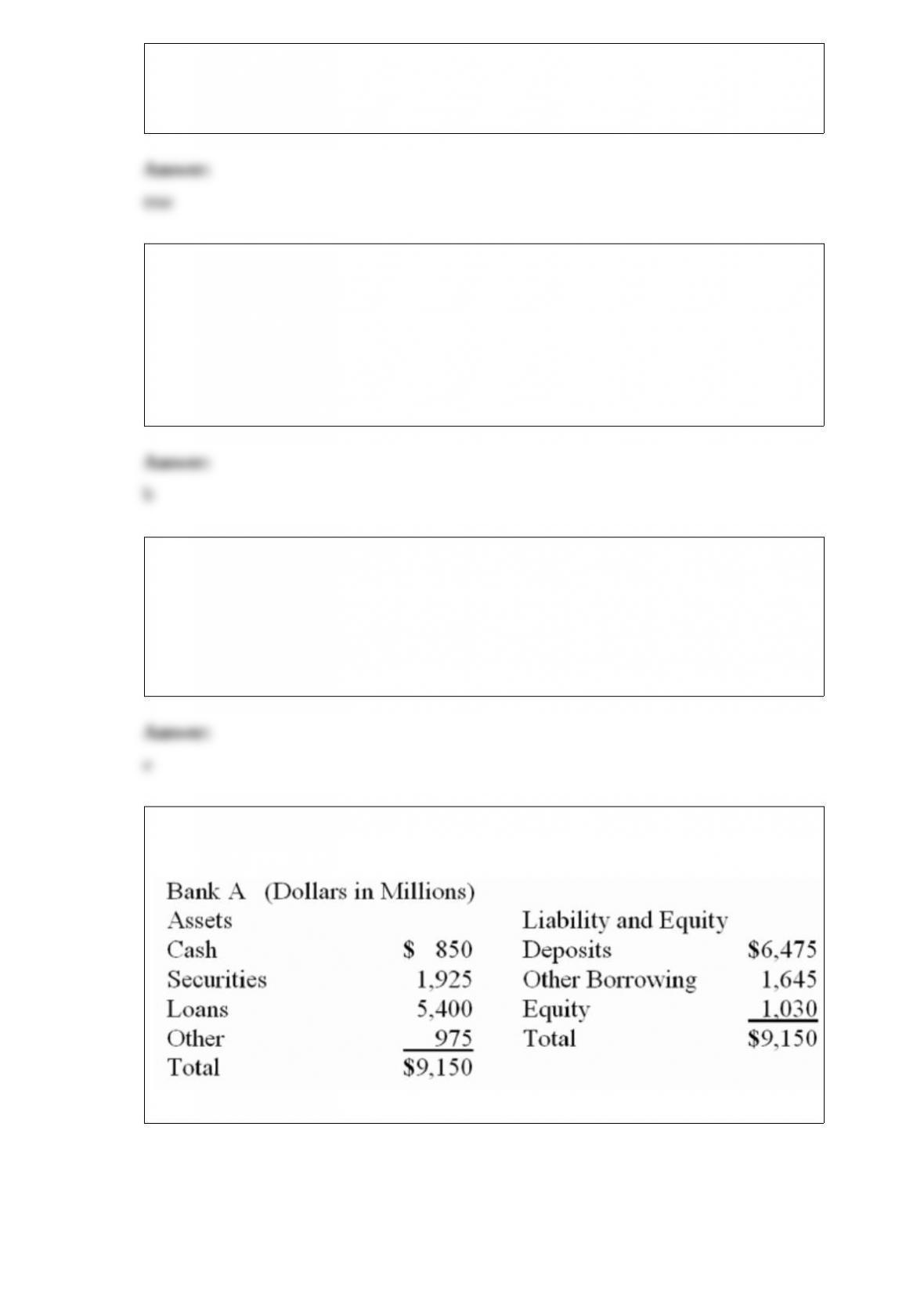
15) in a bank’s three-month maturity bucket, a 30-year arm with a rate reset in six
months would be considered a fixed rate asset, but in its one-year maturity bucket, this
arm would be considered a rate-sensitive asset.
16) bank assets tend to have _____________ maturities and _____________ liquidity
than/as bank liabilities.
a.longer; greater
b.longer; lower
c.shorter; greater
d.shorter; lower
e.equal; equal
17) nyse listing has traditionally benefited a firm by
a.improving the stock’s price
b.generating increased publicity for the firm
c.providing easier access to primary market capital
d.b and c only
e.a, b, and c
18) figure 12-1

the bank’s roa is
a.1.31%
b.1.78%
c.1.26%
d.0.89%
e.none of the above
19) commercial paper is
a.a time draft payable to a seller of goods, with payment guaranteed by a bank
b.a loan to an individual or business to purchase a home, land, or other real property
c.short-term funds transferred between financial institutions usually for no more than
one day
d.a marketable bank issued time deposit that specifies the interest rate earned and a
fixed maturity date
e.a short-term unsecured promissory note issued by a company to raise funds for a short
time period
20) by type of fund, there are more ______________ funds than any other.
a.equity
b.bond
c.taxable money market
d.tax-exempt money market
e.hybrid

21) figure 2-1
yield curve for zero coupon bonds rated aa
assume that there are no liquidity premiums.
according to the liquidity premium theory of interest rates,
a.long-term spot rates are higher than the average of current and expected future
short-term rates
b.investors prefer certain maturities and will not normally switch out of those maturities
c.investors are indifferent between different maturities if the long-term spot rates are
equal to the average of current and expected future short-term rates
d.the term structure must always be upward sloping
e.long-term spot rates are totally unrelated to expectations of future short-term rates
22) a european investor can earn a 4.75% annual interest rate in europe or 2.75% per
year in the united states. if the spot exchange rate is $1.58 per euro, at what one-year
forward rate would an investor be indifferent between the u.s. and japanese
investments?
a.$1.5484
b.$1.6108
c.$1.5335
d.$1.5498
e.$1.5977
23) when an investment banker purchases an offering from a bond issuer and then
resells it to the public this is known as a
a.rights offering
b.private placement
c.firm commitment
d.best efforts
e.standby offering

24) a swiss bank converted 1 million swiss francs to euros to make a euro loan to a
customer when the exchange rate was 1.85 francs per euro. the borrower agreed to
repay the principle plus 3.75% interest in 1 year. the borrower repaid euros at loan
maturity and when the loan was repaid the exchange rate was 1.98 francs per dollar.
what was the bank’s franc rate of return?
a.7.75%
b.11.04%
c.9.94%
d.-2.82%
e.5.71%
25) a married couple each has an ira and deposits at a bank. the couple also has one
child. if they had the money, what is the total amount of their accounts that could be
insured at one bank?
a.$250,000
b.$750,000
c.$1,250,000
d.$1,500,000
e.$2,000,000
26) why do employees increasingly prefer defined contribution plans to defined benefit
plans?
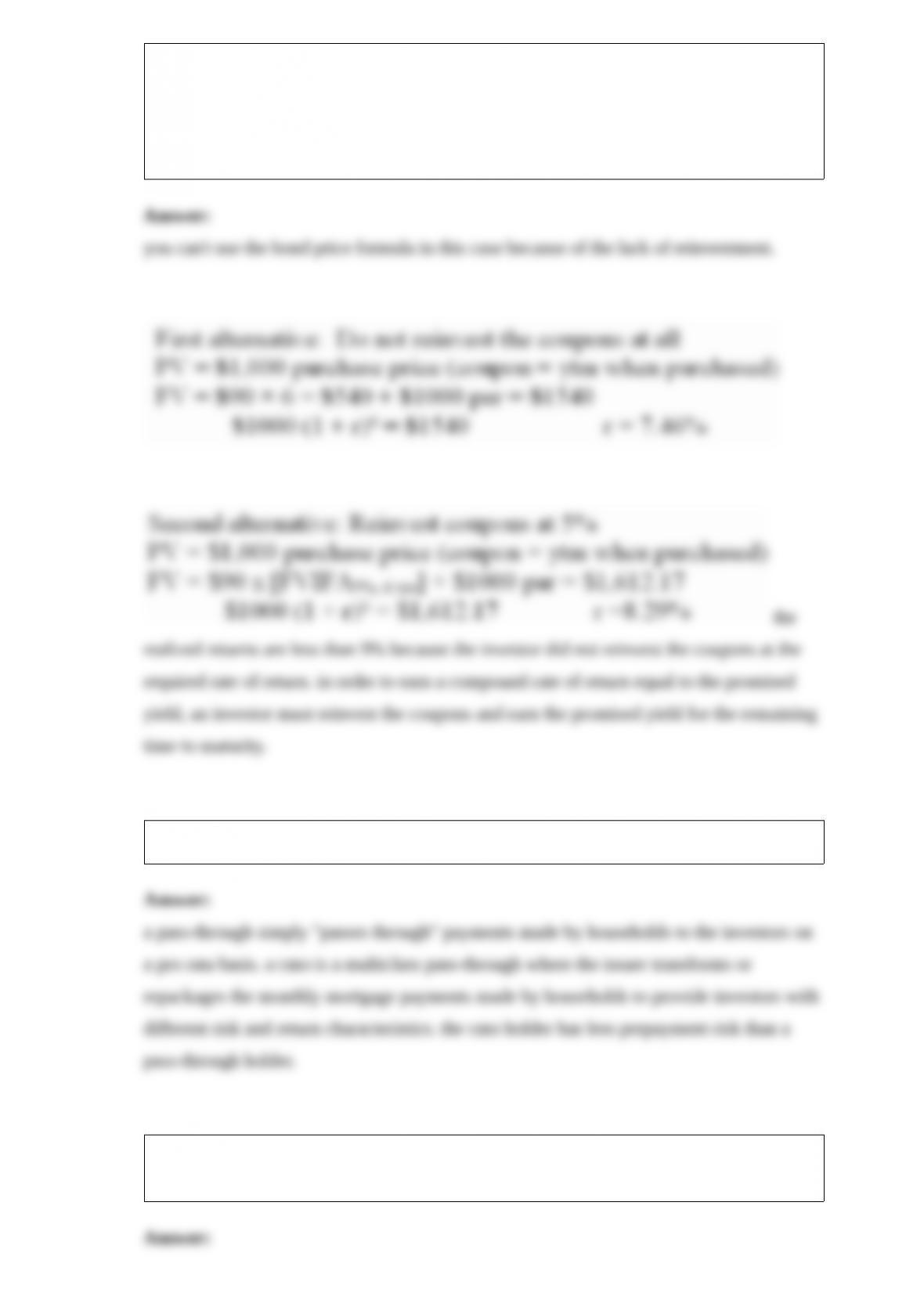
27) an investor owned a 9% annual payment coupon bond for 6 years that was
originally purchased at a 9% required return. she did not reinvest any coupons (she kept
the money under her mattress). she redeemed the bond at par. what was her annual
realized rate of return? what if she did reinvest the coupons but only earned 5% on each
coupon? why are your answers not equal to 9%?
28) how does a mortgage pass-through differ from a cmo?
29) has the importance of foreign non-bank financial lending been increasing or
decreasing in recent years? provide some examples to back up your answer.

30) what ratings comprise investment-grade bonds and what ratings are used for junk
bonds? what are the primary differences between the two? in particular, why are
investment-grade bonds more marketable and why are junk bonds issued at all?
31) the fed now operates the discount window differently than it used to. what are the
major changes?

32) discuss the major differences between large banks and small banks. which have had
higher roas? why?
33) what are ecns? how are they changing trading in the traditional markets?
34) what did the sarbanes-oxley act do to try and prevent additional scandals at
corporations? what more needs to be done to prevent additional scandals among
investment bankers?