
1) Which of the following statements is CORRECT?
a.If a firm’s assets are growing at a positive rate, but its retained earnings are not
increasing, then it would be impossible for the firm’s AFN to be negative
b.If a firm increases its dividend payout ratio in anticipation of higher earnings, but
sales and earnings actually decrease, then the firm’s actual AFN must, mathematically,
exceed the previously calculated AFN
c.Higher sales usually require higher asset levels, and this leads to what we call AFN.
However, the AFN will be zero if the firm chooses to retain all of its profits, i.e., to have
a zero dividend payout ratio
d.Dividend policy does not affect the requirement for external funds based on the AFN
equation
e.The sustainable growth rate is the maximum achievable growth rate without the firm
having to raise external funds. In other words, it is the growth rate at which the firm’s
AFN equals zero
2) Which of the following statements is CORRECT?
a.If a firm that sells on terms of net 30 changes its policy to 2/10 net 30, and if no
change in sales volume occurs, then the firm’s DSO will probably increase
b.If a firm sells on terms of 2/10 net 30, and its DSO is 30 days, then the firm probably
has some past-due accounts
c.If a firm sells on terms of net 60, and if its sales are highly seasonal, with a sharp peak
in December, then its DSO as it is typically calculated (with sales per day = Sales for
past 12 months/365) would probably be lower in January than in July
d.If a firm changed the credit terms offered to its customers from 2/10 net 30 to 2/10 net
60, then its sales should increase, and this should lead to an increase in sales per day,
and that should lead to a decrease in the DSO
e.Other things held constant, the higher a firm’s days sales outstanding (DSO), the
better its credit department
3) Assume that your cousin holds just one stock, Eastman Chemical Bonding (ECB),
which he thinks has very little risk. You agree that the stock is relatively safe, but you
want to demonstrate that his risk would be even lower if he were more diversified. You
obtain the following returns data for Wilder’s Creations and Buildings (WCB). Both
companies have had less variability than most other stocks over the past 5 years.

Measured by the standard deviation of returns, by how much would your cousin’s risk
have been reduced if he had held a portfolio consisting of 60% in ECB and the
remainder in WCB? (Hint: Use the sample standard deviation formula.)
YearECBWCB
2007 40.00% 40.00%
2008-10.00% 15.00%
2009 35.00% -5.00%
2010 -5.00%-10.00%
2011 15.00% 35.00%
Average return = 15.00% 15.00%
Standard deviation = 22.64% 22.64%
a.3.29%
b.3.46%
c.3.65%
d.3.84%
e.4.03%
4) Which of the following procedures best accounts for the relative risk of a proposed
project?
a.Adjusting the discount rate downward if the project is judged to have above-average
risk
b.Reducing the NPV by 10% for risky projects
c.Picking a risk factor equal to the average discount rate
d.Ignoring risk because project risk cannot be measured accurately
e.Adjusting the discount rate upward if the project is judged to have above-average risk

5) Last year Swensen Corp. had sales of $303,225, operating costs of $267,500, and
year-end assets of $195,000. The debt-to-total-assets ratio was 27%, the interest rate on
the debt was 8.2%, and the firm’s tax rate was 37%. The new CFO wants to see how the
ROE would have been affected if the firm had used a 45% debt ratio. Assume that sales
and total assets would not be affected, and that the interest rate and tax rate would both
remain constant. By how much would the ROE change in response to the change in the
capital structure?
a. 2.08%
b. 2.32%
c. 2.57%
d. 2.86%
e. 3.14%

6) Which of the following statements is CORRECT?
a.All else equal, an increase in a company’s stock price will increase its marginal cost of
reinvested earnings (not newly issued stock), rs
b.All else equal, an increase in a company’s stock price will increase its marginal cost of
new common equity, re
c.Since the money is readily available, the after-tax cost of reinvested earnings (not
newly issued stock) is usually much lower than the after-tax cost of debt
d.If a company’s tax rate increases but the YTM on its noncallable bonds remains the
same, the after-tax cost of its debt will fall
e.When calculating the cost of preferred stock, a company needs to adjust for taxes,
because preferred stock dividends are deductible by the paying corporation
7) Which of the following factors should be included in the cash flows used to estimate
a project’s NPV?
a.Interest on funds borrowed to help finance the project
b.The end-of-project recovery of any working capital required to operate the project
c.Cannibalization effects, but only if those effects increase the project’s projected cash
flows
d.Expenditures to date on research and development related to the project, provided
those costs have already been expensed for tax purposes
e.All costs associated with the project that have been incurred prior to the time the
analysis is being conducted
8) Kiley Electronics is considering a project that has the following cash flow data. What
is the project’s IRR? Note that a project’s IRR can be less than the WACC (and even
negative), in which case it will be rejected.
Year0123
Cash flows-$1,100$450$470$490
a.9.70%
b.10.78%
c.11.98%
d.13.31%
e.14.64%
9) Rappaport Corp.’s sales last year were $320,000, and its net income after taxes was
$23,000. What was its profit margin on sales?
a. 6.49%
b. 6.83%
c. 7.19%
d. 7.55%
e. 7.92%
10) Which of the following statements is CORRECT?
a.The percentage flotation cost associated with issuing new common equity is typically
smaller than the flotation cost for new debt
b.The WACC as used in capital budgeting is an estimate of the cost of all the capital a
company has raised to acquire its assets
c.There is an “opportunity cost” associated with using reinvested earnings, hence they
are not “free”
d.The WACC as used in capital budgeting would be simply the after-tax cost of debt if
the firm plans to use only debt to finance its capital budget during the coming year
e.The WACC as used in capital budgeting is an estimate of a company’s before-tax cost
of capital
11) Refer to Exhibit 15.2. Now assume that VF is considering changing from its
original zero debt capital structure to a new capital structure with even more debt. This
results in changes in the cost of debt and equity, and thus to a new WACC and a new
value of operations. Assume VF raises the amount of new debt indicated below and
uses the funds to purchase and hold T-bills until it makes the stock repurchase. What is

the stock price per share immediately after issuing the debt but prior to the repurchase?
Debt/Value =40%Value of new debt =$213,333
Equity/Value =60%New WACC =9.0%
a.$50.67
b.$53.33
c.$56.00
d.$58.80
e.$61.74
12) Assume that the current corporate bond yield curve is upward sloping. Under this
condition, then we could be sure that
a.The economy is not in a recession
b.Long-term bonds are a better buy than short-term bonds
c.Maturity risk premiums could help to explain the yield curve’s upward slope
d.Long-term interest rates are more volatile than short-term rates
e.Inflation is expected to decline in the future
13) Last year, Michelson Manufacturing reported $10,250 of sales, $3,500 of operating
costs other than depreciation, and $1,250 of depreciation. The company had no
amortization charges, it had $3,500 of bonds outstanding that carry a 6.5% interest rate,
and its federal-plus-state income tax rate was 35%. This year’s data are expected to
remain unchanged except for one item, depreciation, which is expected to increase by
$725. By how much will the depreciation change cause the firm’s net after-tax income
and its net cash flow to change? Note that the company uses the same depreciation
calculations for tax and stockholder reporting purposes.
a.-$383.84; $206.68
b.-$404.04; $217.56
c.-$425.30; $229.01
d.-$447.69; $241.06
e.-$471.25; $253.75

14) Carby Hardware has an outstanding issue of perpetual preferred stock with an
annual dividend of $7.50 per share. If the required return on this preferred stock is
6.5%, at what price should the preferred stock sell?
a.$104.27
b.$106.95
c.$109.69
d.$112.50
e.$115.38

15) If 10-year T-bonds have a yield of 6.2%, 10-year corporate bonds yield 8.5%, the
maturity risk premium on all 10-year bonds is 1.3%, and corporate bonds have a 0.4%
liquidity premium versus a zero liquidity premium for T-bonds, what is the default risk
premium on the corporate bond?
a.1.90%
b.2.09%
c.2.30%
d.2.53%
e.2.78%
16) Which of the following statements is CORRECT?
a.A change in the personal tax rate should not affect firms’ capital structure decisions
b.”Business risk” is differentiated from “financial risk” by the fact that financial risk
reflects only the use of debt, while business risk reflects both the use of debt and such
factors as sales variability, cost variability, and operating leverage
c.The optimal capital structure is the one that simultaneously (1) maximizes the price of
the firm’s stock, (2) minimizes its WACC, and (3) maximizes its EPS
d.If changes in the bankruptcy code make bankruptcy less costly to corporations, then
this would likely reduce the debt ratio of the average corporation
e.If corporate tax rates were decreased while other things were held constant, and if the
Modigliani-Miller tax-adjusted tradeoff theory of capital structure were correct, this
would tend to cause corporations to decrease their use of debt
17) Watts Co. is considering a project that has the following cash flow and WACC data.
What is the project’s MIRR? Note that a project’s MIRR can be less than the WACC
(and even negative), in which case it will be rejected.
WACC:10.00%
Year01234
Cash flows-$850$300$320$340$360
a.14.08%

b.15.65%
c.17.21%
d.18.94%
e.20.83%
18) The free cash flows (in millions) shown below are forecast by Parker & Sons. If the
weighted average cost of capital is 11% and FCF is expected to grow at a rate of 5%
after Year 2, what is the Year 0 value of operations, in millions? Assume that the ROIC
is expected to remain constant in Year 2 and beyond (and do not make any half-year
adjustments).
Year:12
Free cash flow:-$50$100
a.$1,456
b.$1,529
c.$1,606
d.$1,686
e.$1,770

19) Data on Nathan Enterprises for the most recent year are shown below, along with
the days sales outstanding of the firms against which it benchmarks. The firm’s new
CFO believes that the company could reduce its receivables enough to reduce its DSO
to the benchmarks’ average. If this were done, by how much would receivables decline?
Use a 365-day year.
Sales$110,000
Accounts receivable$16,000
Days sales outstanding (DSO)53.09
Benchmark days sales outstanding (DSO)20.00
a.$8,078
b.$8,975
c.$9,973
d.$10,970
e.$12,067
20) A stock is expected to pay a year-end dividend of $2.00, i.e., D1 = $2.00. The
dividend is expected to decline at a rate of 5% a year forever (g = -5%). If the company
is in equilibrium and its expected and required rate of return is 15%, which of the
following statements is CORRECT?
a.The company’s dividend yield 5 years from now is expected to be 10%
b.The constant growth model cannot be used because the growth rate is negative
c.The company’s expected capital gains yield is 5%
d.The company’s expected stock price at the beginning of next year is $9.50
e.The company’s current stock price is $20
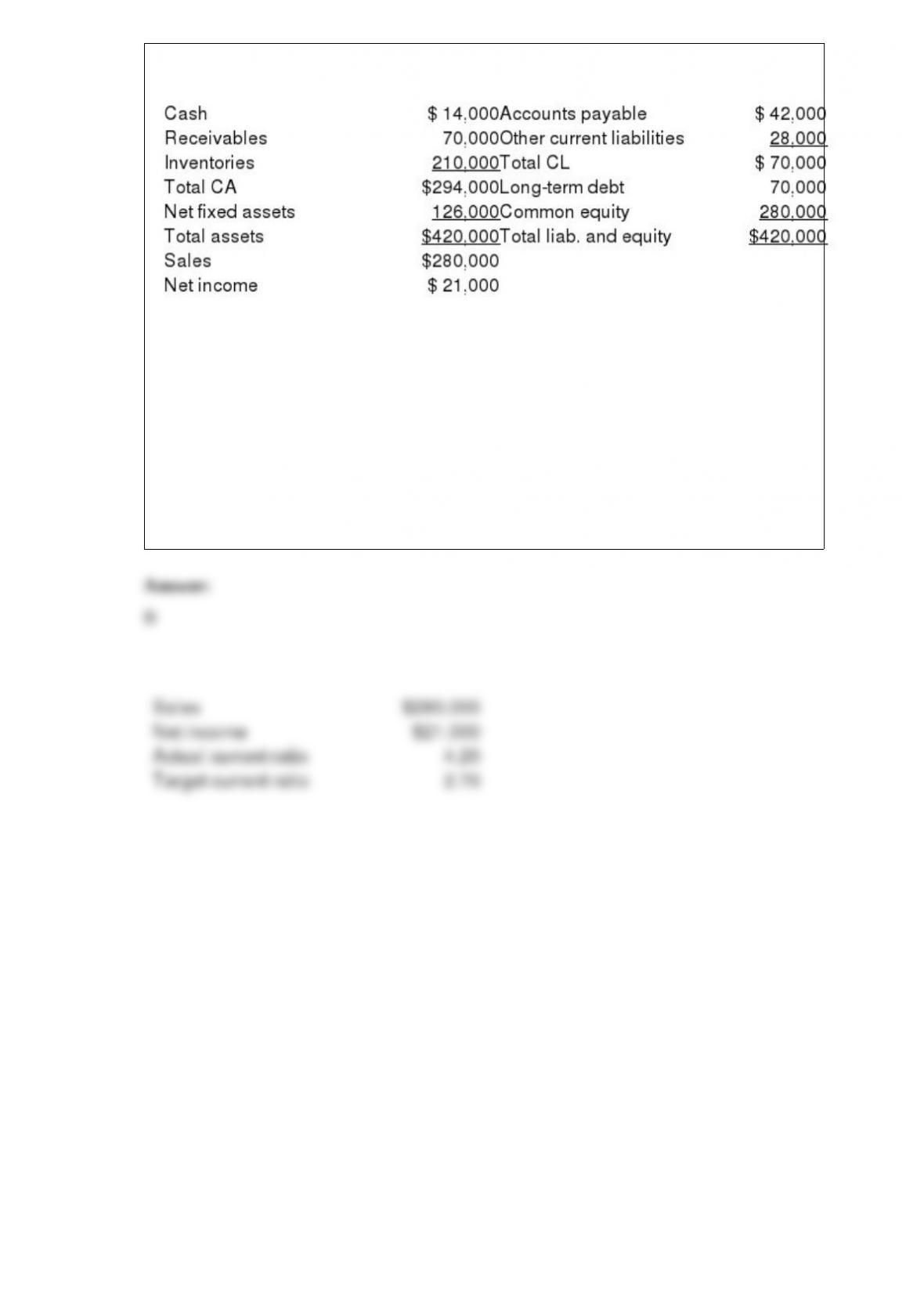
21) Muscarella Inc. has the following balance sheet and income statement data:
The new CFO thinks that inventories are excessive and could be lowered sufficiently to
cause the current ratio to equal the industry average, 2.70, without affecting either sales
or net income. Assuming that inventories are sold off and not replaced to get the current
ratio to the target level, and that the funds generated are used to buy back common
stock at book value, by how much would the ROE change?
a. 4.28%
b. 4.50%
c. 4.73%
d. 4.96%
e. 5.21%

22) The president and CFO of Spellman Transportation are having a disagreement about
whether to use market value or book value weights in calculating the WACC.
Spellman’s balance sheet shows a total of noncallable $45 million long-term debt with a
coupon rate of 7.00% and a yield to maturity of 6.00%. This debt currently has a market
value of $50 million. The company has 10 million shares of common stock, and the
book value of the common equity (common stock plus retained earnings) is $65
million. The current stock price is $22.50 per share; stockholders’ required return, rs, is
14.00%; and the firm’s tax rate is 40%. The CFO thinks the WACC should be based on
market value weights, but the president thinks book weights are more appropriate. What
is the difference between these two WACCs?
a.1.55%
b.1.72%
c.1.91%
d.2.13%
e.2.36%

23) Brothers Breads has the following data. What is the firm’s cash conversion cycle?
Inventory conversion period =50 days
Average collection period =17 days
Payables deferral period =25 days
a.31 days
b.34 days
c.38 days
d.42 days
e.46 days
24) A 10-year bond with a 9% annual coupon has a yield to maturity of 8%. Which of
the following statements is CORRECT?
a.The bond is selling below its par value
b.The bond is selling at a discount
c.If the yield to maturity remains constant, the bond’s price one year from now will be
lower than its current price
d.The bond’s current yield is greater than 9%
e.If the yield to maturity remains constant, the bond’s price one year from now will be
higher than its current price

25) In a portfolio of three randomly selected stocks, which of the following could NOT
be true; i.e., which statement is false?
a.The standard deviation of the portfolio is greater than the standard deviation of one or
two of the stocks
b.The beta of the portfolio is lower than the lowest of the three betas
c.The beta of the portfolio is equal to one of the three stock’s betas
d.The beta of the portfolio is equal to 1
e.The standard deviation of the portfolio is less than the standard deviation of each of
the stocks if they were held in isolation
26) If markets are in equilibrium, which of the following conditions will exist?
a.Each stock’s expected return should equal its required return as seen by the marginal
investor
b.All stocks should have the same expected return as seen by the marginal investor
c.The expected and required returns on stocks and bonds should be equal
d.All stocks should have the same realized return during the coming year
e.Each stock’s expected return should equal its realized return as seen by the marginal
investor
27) TSW Inc. had the following data for last year: Net income = $800; Net operating
profit after taxes (NOPAT) = $700; Total assets = $3,000; and Total operating capital =
$2,000. Information for the just-completed year is as follows: Net income = $1,000; Net
operating profit after taxes (NOPAT) = $925; Total assets = $2,600; and Total operating
capital = $2,500. How much free cash flow did the firm generate during the
just-completed year?
a.$383
b.$425
c.$468
d.$514
e.$566

28) The world-famous discounter, Fernwood Booksellers, specializes in selling
paperbacks for $7 each. The variable cost per book is $5. At current annual sales of
200,000 books, the publisher is just breaking even. It is estimated that if the authors’
royalties are reduced, the variable cost per book will drop by $1. Assume authors’
royalties are reduced and sales remain constant; how much more money can the
publisher put into advertising (a fixed cost) and still break even?
a.$600,000
b.$466,667
c.$333,333
d.$200,000
e.None of the above
29) Which of the following would, generally, indicate an improvement in a company’s
financial position, holding other things constant?
a. The total assets turnover decreases
b. The TIE declines
c. The DSO increases
d. The EBITDA coverage ratio increases
e. The current and quick ratios both decline
30) Which of the following statements is CORRECT?
a.One drawback of the regular payback is that this method does not take account of
cash flows beyond the payback period
b.If a project’s payback is positive, then the project should be accepted because it must
have a positive NPV
c.The regular payback ignores cash flows beyond the payback period, but the
discounted payback method overcomes this problem
d.One drawback of the discounted payback is that this method does not consider the
time value of money, while the regular payback overcomes this drawback
e.The shorter a project’s payback period, the less desirable the project is normally
considered to be by this criterion
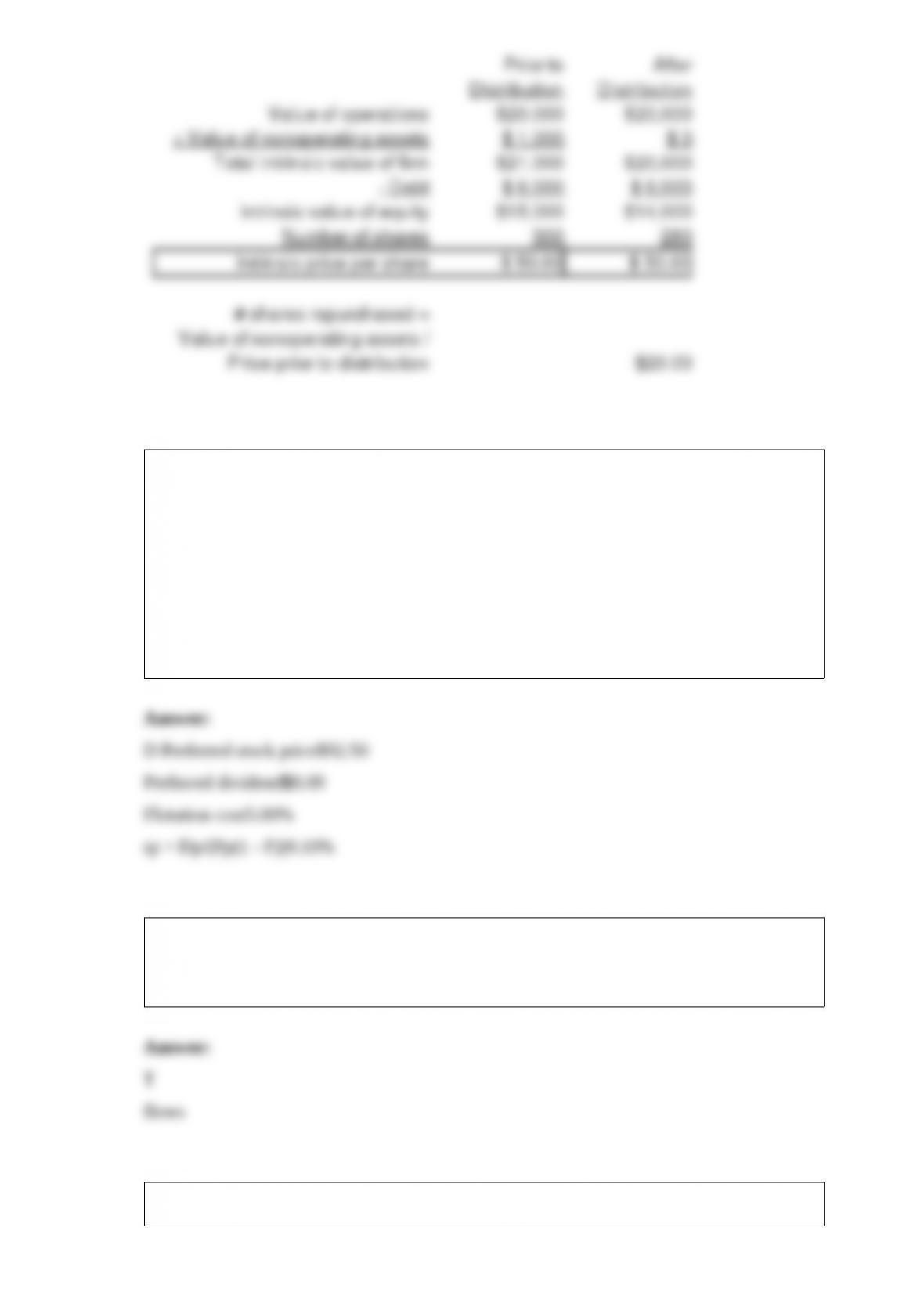
31) The following data apply to Elizabeth’s Electrical Equipment:
The company plans on distributing $50 million by repurchasing stock. What will the
intrinsic per share stock price be immediately after the repurchase?
a. $47.50
b. $50.00
c. $52.50
d. $55.13
e. $57.88
32) A company’s perpetual preferred stock currently sells for $92.50 per share, and it
pays an $8.00 annual dividend. If the company were to sell a new preferred issue, it
would incur a flotation cost of 5.00% of the issue price. What is the firm’s cost of
preferred stock?
a.7.81%
b.8.22%
c.8.65%
d.9.10%
e.9.56%
33) One of the first steps in arriving at a firm’s forecasted financial statements is a
review of industry-average operating ratios relative to these same ratios for the firm to
determine whether changes to the ratios need to be made.
34) Whenever a firm borrows money, it is using financial leverage.

35) The desire for floating-rate bonds, and consequently their increased usage, arose out
of the experience of the early 1980s, when inflation pushed interest rates up to very
high levels and thus caused sharp declines in the prices of outstanding bonds.
36) One key value of limited liability is that it lowers owners’ risks and thereby
enhances a firm’s value.
37) The income statement shows the difference between a firm’s income and its
costsi.e., its profitsduring a specified period of time. However, not all reported income
comes in the form or cash, and reported costs likewise may not correctly reflect cash
outlays. Therefore, there may be a substantial difference between a firm’s reported
profits and its actual cash flow for the same period.
38) One implication of the bird-in-the-hand theory of dividends is that a given reduction
in dividend yield must be offset by a more than proportionate increase in growth in
order to keep a firm’s required return constant, other things held constant.