
Stock X has a beta of 0.7 and Stock Y has a beta of 1.3. The standard deviation of each
stock’s returns is 20%. The stocks’ returns are independent of each other, i.e., the
correlation coefficient, r, between them is zero. Portfolio P consists of 50% X and 50%
Y. Given this information, which of the following statements is CORRECT?
a.Portfolio P has a standard deviation of 20%.
b.The required return on Portfolio P is equal to the market risk premium (rM – rRF).
c.Portfolio P has a beta of 0.7.
d.Portfolio P has a beta of 1.0 and a required return that is equal to the riskless rate, rRF.
e.Portfolio P has the same required return as the market (rM).
Which of the following statements is CORRECT? (Assume that the risk-free rate is a
constant.)
a.If the market risk premium increases by 1%, then the required return will increase for
stocks that have a beta greater than 1.0, but it will decrease for stocks that have a beta
less than 1.0.
b.The effect of a change in the market risk premium depends on the slope of the yield
curve.
c.If the market risk premium increases by 1%, then the required return on all stocks will
rise by 1%.
d.If the market risk premium increases by 1%, then the required return will increase by
1% for a stock that has a beta of 1.0.
e.The effect of a change in the market risk premium depends on the level of the
risk-free rate.
Which of the following statements is CORRECT?
a.The capital structure that maximizes expected EPS also maximizes the price per share
of common stock.
b.The capital structure that minimizes the interest rate on debt also maximizes the
expected EPS.
c.The capital structure that minimizes the required return on equity also maximizes the
stock price.
d.The capital structure that minimizes the WACC also maximizes the price per share of
common stock.
e.The capital structure that gives the firm the best bond rating also maximizes the stock
price.
Which of the following statements is CORRECT?
a.Beta is measured by the slope of the security market line.
b.If the risk-free rate rises, then the market risk premium must also rise.
c.If a company’s beta is halved, then its required return will also be halved.
d.If a company’s beta doubles, then its required return will also double.
e.The slope of the security market line is equal to the market risk premium, (rM – rRF).
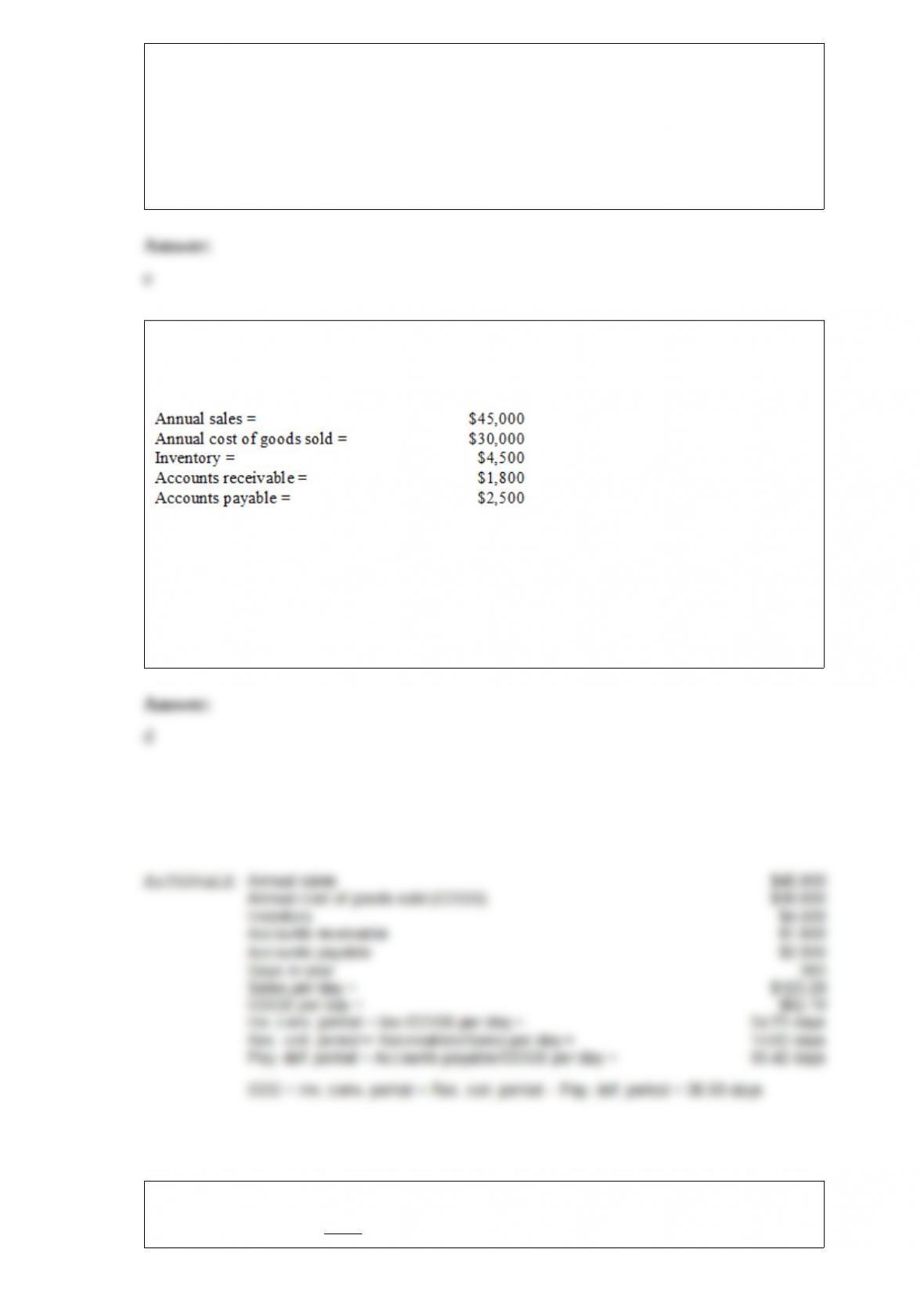
Desai Inc. has the following data, in thousands. Assuming a 365-day year, what is the
firm’s cash conversion cycle?
a.28 days
b.32 days
c.35 days
d.39 days
e.43 days
A swap is a method used to reduce financial risk. Which of the following statements
about swaps, if any, is NOT CORRECT?

a.A swap involves the exchange of cash payment obligations.
b.The earliest swaps were currency swaps, in which companies traded debt
denominated in different currencies, say dollars and pounds.
c.Swaps are very often arranged by a financial intermediary, who may or may not take
the position of one of the counterparties.
d.A problem with swaps is that no standardized contracts exist, which has prevented the
development of a secondary market.
e.Swaps can involve side payments in order to get the counterparty to agree to the swap.
Which of the following statements is CORRECT?
a.If a company’s beta doubles, then its required rate of return will also double.
b.Other things held constant, if investors suddenly become convinced that there will be
deflation in the economy, then the required returns on all stocks should increase.
c.If a company’s beta were cut in half, then its required rate of return would also be
halved.
d.If the risk-free rate rises by 0.5% but the market risk premium declines by that same
amount, then the required rates of return on stocks with betas less than 1.0 will decline
while returns on stocks with betas above 1.0 will increase.
e.If the risk-free rate rises by 0.5% but the market risk premium declines by that same
amount, then the required rate of return on an average stock will remain unchanged, but
required returns on stocks with betas less than 1.0 will rise.
Assume that investors have recently become more risk averse, so the market risk
premium has increased. Also, assume that the risk-free rate and expected inflation have
not changed. Which of the following is most likely to occur?
a.The required rate of return for an average stock will increase by an amount equal to
the increase in the market risk premium.
b.The required rate of return will decline for stocks whose betas are less than 1.0.
c.The required rate of return on the market, rM, will not change as a result of these
changes.
d.The required rate of return for each individual stock in the market will increase by an
amount equal to the increase in the market risk premium.
e.The required rate of return on a riskless bond will decline.
Which of the following is NOT directly reflected in the cash budget of a firm that is in
the zero tax bracket?
a.Payments lags.

b.Depreciation.
c.Cumulative cash.
d.Repurchases of common stock.
e.Payment for plant construction.
An increase in accounts payable represents an increase in net cash provided by
operating activities just like borrowing money from a bank. An increase in accounts
payable has an effect similar to taking out a new bank loan. However, these two items
show up in different sections of the statement of cash flows to reflect the difference
between operating and financing activities.
a.True
b.False
One year ago, a U.S. investor converted dollars to yen and purchased 100 shares of
stock in a Japanese company at a price of 3,150 yen per share. The stock’s total
purchase cost was 315,000 yen. At the time of purchase, in the currency market 1 yen
equaled $0.00952. Today, the stock is selling at a price of 3,465 yen per share, and in
the currency market $1 equals 130 yen. The stock does not pay a dividend. If the
investor were to sell the stock today and convert the proceeds back to dollars, what
would be his realized return on his initial dollar investment from holding the stock?
a.13.51%
b.12.87%
c.12.26%
d.11.67%
e.11.12%
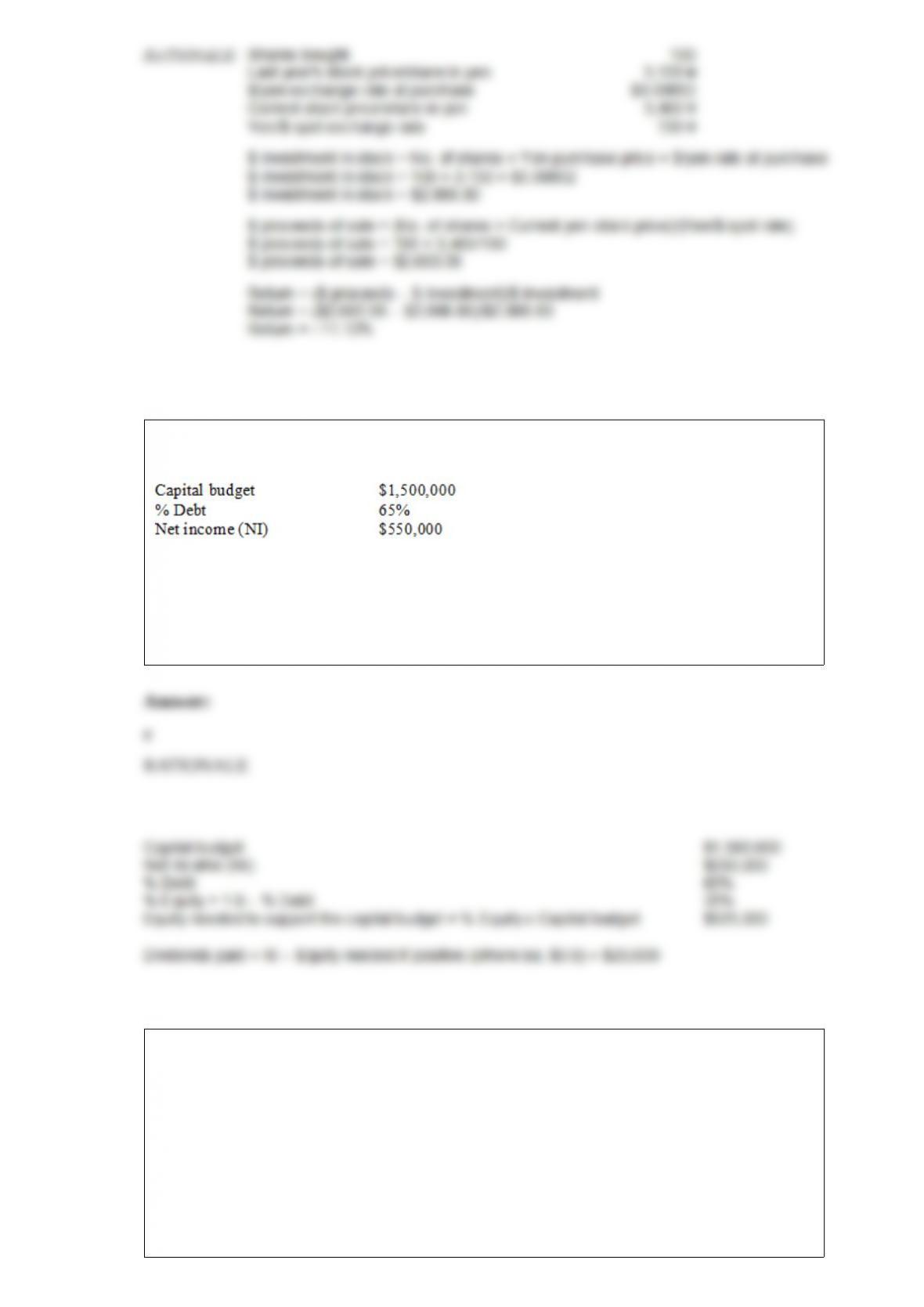
NY Fashions has the following data. If it follows the residual dividend model, how
much total dividends, if any, will it pay out?
a.$20,363
b.$21,434
c.$22,563
d.$23,750
e.$25,000
A commercial bank recognizes that its net income suffers whenever interest rates
increase. Which of the following strategies would protect the bank against rising
interest rates?
a.Buying inverse floaters.
b.Entering into an interest rate swap where the bank receives a fixed payment stream,
and in return agrees to make payments that float with market interest rates.
c.Purchase principal only (PO) strips that decline in value whenever interest rates rise.
d.Enter into a short hedge where the bank agrees to sell interest rate futures.
e.Sell some of the bank’s floating-rate loans and use the proceeds to make fixed-rate
loans.
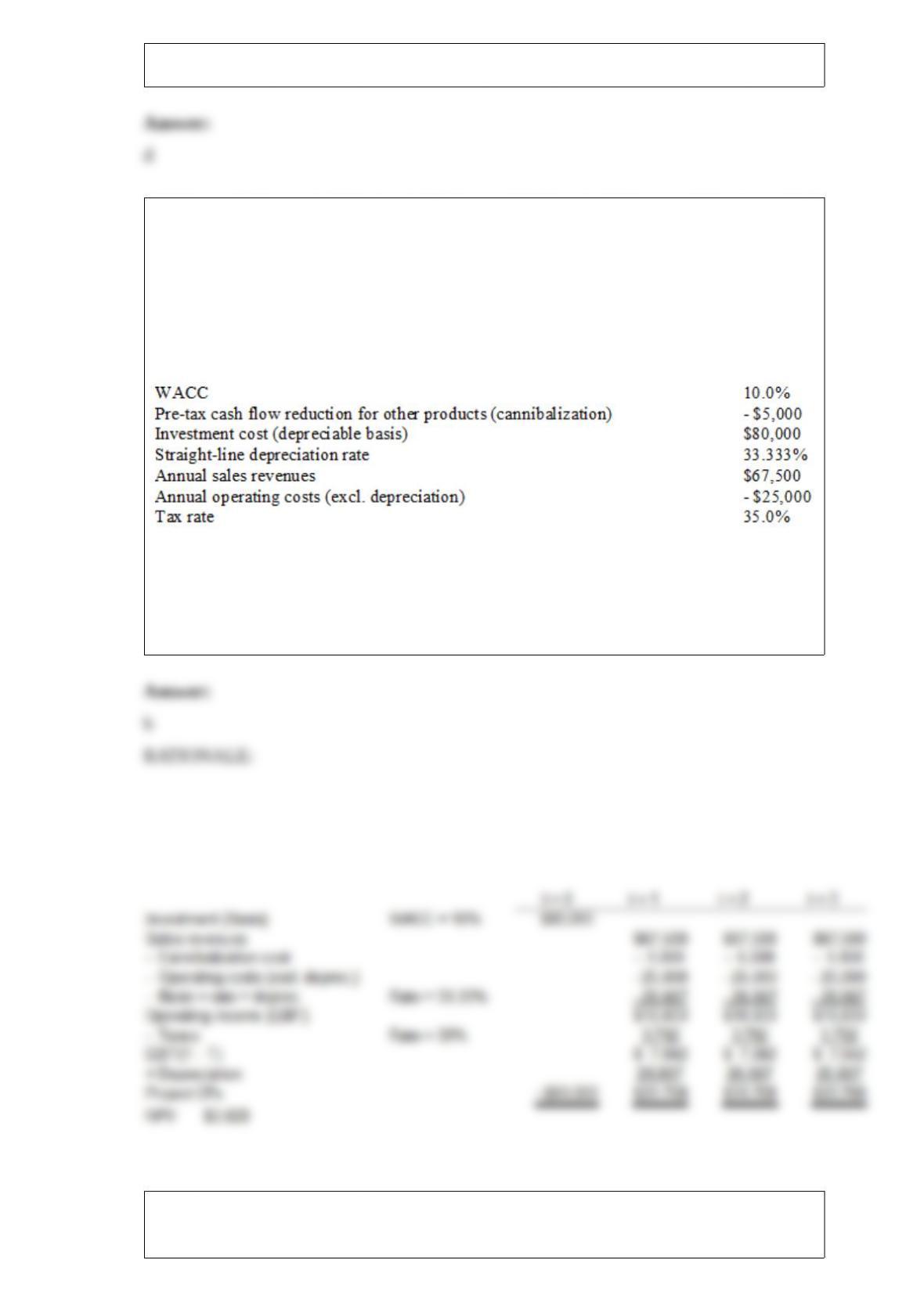
TexMex Food Company is considering a new salsa whose data are shown below. The
equipment to be used would be depreciated by the straight-line method over its 3-year
life and would have a zero salvage value, and no change in net operating working
capital would be required. Revenues and other operating costs are expected to be
constant over the project’s 3-year life. However, this project would compete with other
TexMex products and would reduce their pre-tax annual cash flows. What is the
project’s NPV? (Hint: Cash flows are constant in Years 1-3.)
a.$3,636
b.$3,828
c.$4,019
d.$4,220
e.$4,431
Which of the following statements is CORRECT?
a.If one firm has a higher total debt to total capital ratio than another, we can be certain

that the firm with the higher total debt to total capital ratio will have the lower TIE
ratio, as that ratio depends entirely on the amount of debt a firm uses.
b.A firm’s use of debt will have no effect on its profit margin.
c.If two firms differ only in their use of debt-i.e., they have identical assets, identical
total invested capital, sales, operating costs, interest rates on their debt, and tax rates-but
one firm has a higher total debt to total capital ratio, the firm that uses more debt will
have a lower profit margin on sales and a lower return on assets.
d.The total debt to total capital ratio as it is generally calculated makes an adjustment
for the use of assets leased under operating leases, so the debt ratios of firms that lease
different percentages of their assets are still comparable.
e.If two firms differ only in their use of debt-i.e., they have identical assets, identical
total invested capital, operating costs, and tax rates-but one firm has a higher total debt
to total capital ratio, the firm that uses more debt will have a higher operating margin
and return on assets.
In Japan, 90-day securities have a 4% annualized return and 180-day securities have a
5% annualized return. In the United States, 90-day securities have a 4% annualized
return and 180-day securities have an annualized return of 4.5%. All securities are of
equal risk, and Japanese securities are denominated in terms of the Japanese yen.
Assuming that interest rate parity holds in all markets, which of the following
statements is most CORRECT?
a.The yen-dollar spot exchange rate equals the yen-dollar exchange rate in the 90-day
forward market.
b.The yen-dollar spot exchange rate equals the yen-dollar exchange rate in the 180-day
forward market.
c.The yen-dollar exchange rate in the 90-day forward market equals the yen-dollar
exchange rate in the 180-day forward market.
d.The yen-dollar exchange rate in the 180-day forward market equals the yen-dollar
exchange rate in the 90-day spot market.
e.The relationship between spot and forward interest rates cannot be inferred.
Which of the following statements is CORRECT?
a.A firm can use retained earnings without paying a flotation cost. Therefore, while the
cost of retained earnings is not zero, its cost is generally lower than the after-tax cost of
debt.

b.The capital structure that minimizes a firm’s weighted average cost of capital is also
the capital structure that maximizes its stock price.
c.The capital structure that minimizes the firm’s weighted average cost of capital is also
the capital structure that maximizes its earnings per share.
d.If a firm finds that the cost of debt is less than the cost of equity, increasing its debt
ratio must reduce its WACC.
e.Other things held constant, if corporate tax rates declined, then the Modigliani-Miller
tax-adjusted theory would suggest that firms should increase their use of debt.