
The method for figuring out the loan rate wherein the interest amount owed on a loan is
added to the principal amount of the loan to determine a borrowing customer’s required
installment payments is known as: A. simple interest.
B. APR.
C. discount rate.
D. add-on rate.
E. None of the options is correct.
Answer:
A bank has a concern because they feel that a firm has an excessive amount of assets.
They do not feel that the firm is efficient in generating sales from their current level of
assets. What ratio are they most likely to examine to answer this question?
A. Selling and administrative expenses/Net sales
B. Net sales/Total assets
C. Current assets – Current liabilities
D. Net income/Total assets
E. Long-term debt/(Long-term debt + Net worth)
Answer:

Mark Green is considering buying a new Honda Accord. The purchase price of the car
is $21,000 but Mark has a trade-in worth $4,500. Mark needs a loan to buy the car and
knows that his local bank requires him to put down 10 percent of the purchase price
after the value of the trade-in is considered. Mark also knows that bank will charge 8
percent for the loan and require monthly payments over the next 4 years.
What is the size of Mark’s monthly payments if he makes the minimum down payment
on the car? A. $362.53
B. $301.67
C. $512.67
D. $402.81
E. None of the options is correct
Answer:
The 1994 law that allowed bank holding companies to acquire banks anywhere in the
U.S. is:
A. the Glass-Steagall Act.
B. the Federal Deposit Insurance Corporation Improvement Act.
C. the National Bank Act.
D. the Riegle-Neal Interstate Banking and Branching Efficiency Act.
E. None of the options are correct.

Answer:
Which of the following is a characteristic of a swap buyer?
A. Prefers floating rate loans
B. Generally has a higher credit rating
C. Often has a positive duration gap
D. Generally has a large holding of short-term assets
E. All of the options are correct
Answer:
Suppose Brazil decides to restrict the export of the real by international banks so that
the real does not leave the country and reduce currency reserves for repayment of
Brazilian debt. This would be in support of which reason for regulating international
banks?
A. Protecting the safety of depositor funds
B. Promoting stable growth in money and credit
C. Providing foreign currency controls
D. Protecting domestic financial institutions
E. Restricting the outflow of scarce capital

Answer:
A bond is selling in the market for $950 and has a duration of 6 years. Market interest
rates are 9 percent and are expected to decrease to 7 percent in the near future. What
will this bond’s price be after the change in market interest rates?
A. $969
B. $931
C. $1,055
D. $854
E. $950
Answer:
The law that made bank and nonbank depository institutions more alike in the services
they could offer and allowed banks and thrifts to more fully compete with other
financial institutions is:
A. the National Banking Act.
B. the Federal Reserve Act.

C. the Garn-St Germain Depository Institutions Act.
D. the Riegle-Neal Interstate Banking and Branching Efficiency Act.
E. the Gramm-Leach-Bliley Act (Financial Services Modernization Act).
Answer:
A bank currently has $50 million in stable deposits against which they want to keep
10% reserves, $100 in vulnerable deposits against which they want to keep 40%
reserves, and they have $50 million in “hot money” deposits against which they want to
keep 90% reserves. The legal reserves for this bank are 10% of all deposits. What is the
bank’s liability liquidity reserve?
A. $90 million
B. $81 million
C. $70 million
D. $20 million
E. None of the options is correct
Answer:

Securitized assets carry a unique form of risk called:
A. default risk.
B. inflation risk.
C. interest-rate risk.
D. prepayment risk.
E. None of the options is correct.
Answer:
A bank is required to maintain an average daily balance at the Fed of $700 million. On
the first day of the maintenance period it maintains a balance of $750 million, the next
two days it maintains a balance of $725 million, the next three days it maintains a
balance of $625 million, the next three days it maintains a balance of $775 million, the
next two days it maintains a balance of $700 million, and the next two days it maintains
a balance of $675 million. What does its balance at the Fed has to be on the last day of
the maintenance period in order to have a zero cumulative reserve deficit?
A. $700 million
B. $650 million
C. $750 million
D. $325 million
E. None of the options is correct
Answer:
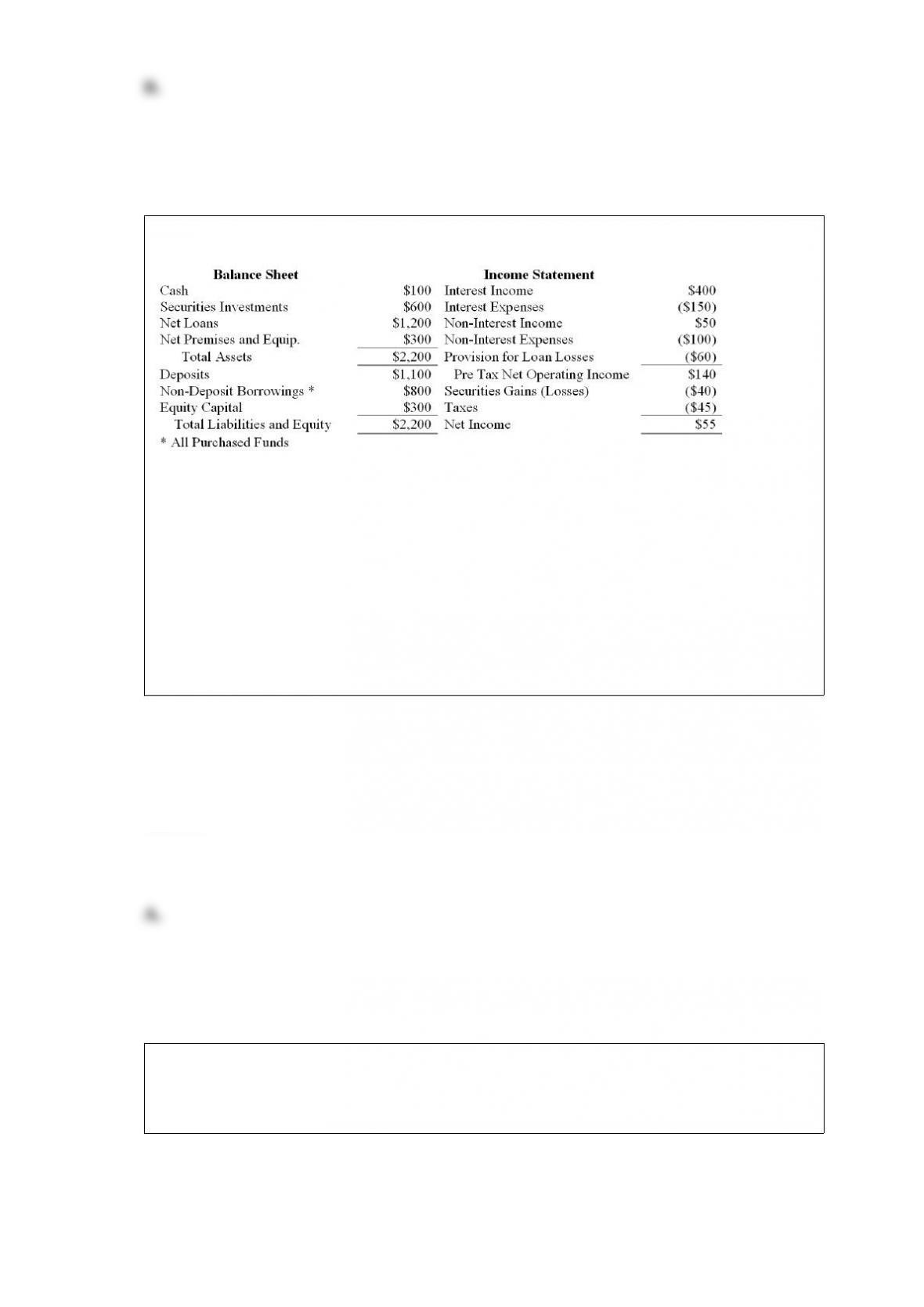
Following data pertains to Castle State Bank.
What is the bank’s asset utilization ratio? A. 20.45%
B. 18.33%
C. 12.22%
D. 7.33%
E. 2.5%
Answer:
According to the Community Reinvestment Act, selected lenders must make an
“affirmative effort” to provide loans and other services to all credit-worthy borrowers in
their chosen service area.

Answer:
Banks and other financial firms continue to substantially consolidate and converge,
resulting in more diverse service providers. This is because of: A. the Foreign Bank
Supervision Enhancement Act.
B. introduction of depository receipts.
C. increase in currency swaps.
D. increased consolidation and convergence.
E. the Basel Agreement.
Answer:
Sean Carter has an excellent credit rating. Which of the 6 Cs of lending would this
piece of information belong to?
A. Character
B. Capacity
C. Cash
D. Collateral

E. Conditions
Answer:
Which of the following is a characteristic of a swap seller?
A. Prefers fixed-rate loans
B. Generally has a lower credit rating
C. Often has a positive duration gap
D. Generally has a large holding of short-term assets
E. All of the options are correct
Answer:
All of the following interest-rate futures contracts are traded on exchanges, except:
A. Eurodollar futures contract.
B. Treasury bond futures contract.
C. Eurodollar time deposit futures contract.

D. Federal funds futures contract.
E. Corporate bond futures contract.
Answer:
A bank that wants to examine the operating efficiency of a borrower would most likely
examine which of the following ratios?
A. Cost of goods sold ÷ Average inventory
B. Income before interest and taxes ÷ Interest payments
C. Cost of goods sold ÷ Net sales
D. Current assets ÷ Current liabilities
E. All of the options are correct.
Answer:
The risk that a customer with whom the bank has entered into a contract with, will fail
to pay or to perform, forcing the bank to find a replacement contract with another party
that may be less satisfactory is what form of risk listed below?

A. Counterparty risk
B. Interest-rate risk
C. Operating risk
D. Credit risk
E. Liquidity risk
Answer:
There are three banks in East Panhandle. First National Bank which currently has 40
percent of the deposits in the area, Second State Bank which currently has 30 percent of
the deposits, and New State Bank and Trust which also has 30 percent of the deposits.
What is the Herfindahl-Hirschman Index for East Panhandle?
A. 100
B. 1,200
C. 3,400
D. 2,400
E. None of the options is correct
Answer:

A foreign currency contract that obligates the holder of the contract to take delivery of a
foreign currency sometime in the future is called a:
A. call currency option.
B. put currency option.
C. long-hedge currency futures contract.
D. short-hedge currency futures contract.
E. None of options is correct.
Answer:
Which of the following is in the 50 percent risk-weight (moderate credit risk) category?
A. Cash
B. General obligation municipal bonds
C. Residential mortgage loans
D. Credit card loans
E. None of the options is correct.
Answer:
Which of the following acts created a Financial Stability Oversight Council to dampen
systemic risk?
A. The Dodd-Frank Regulatory Reform Act
B. The Sarbanes-Oxley Act
C. The Garn-St Germain Depository Institutions Act
D. The Gramm-Leach-Bliley Act
E. The Financial Institutions Reform, Recovery and Enforcement Act
Answer:
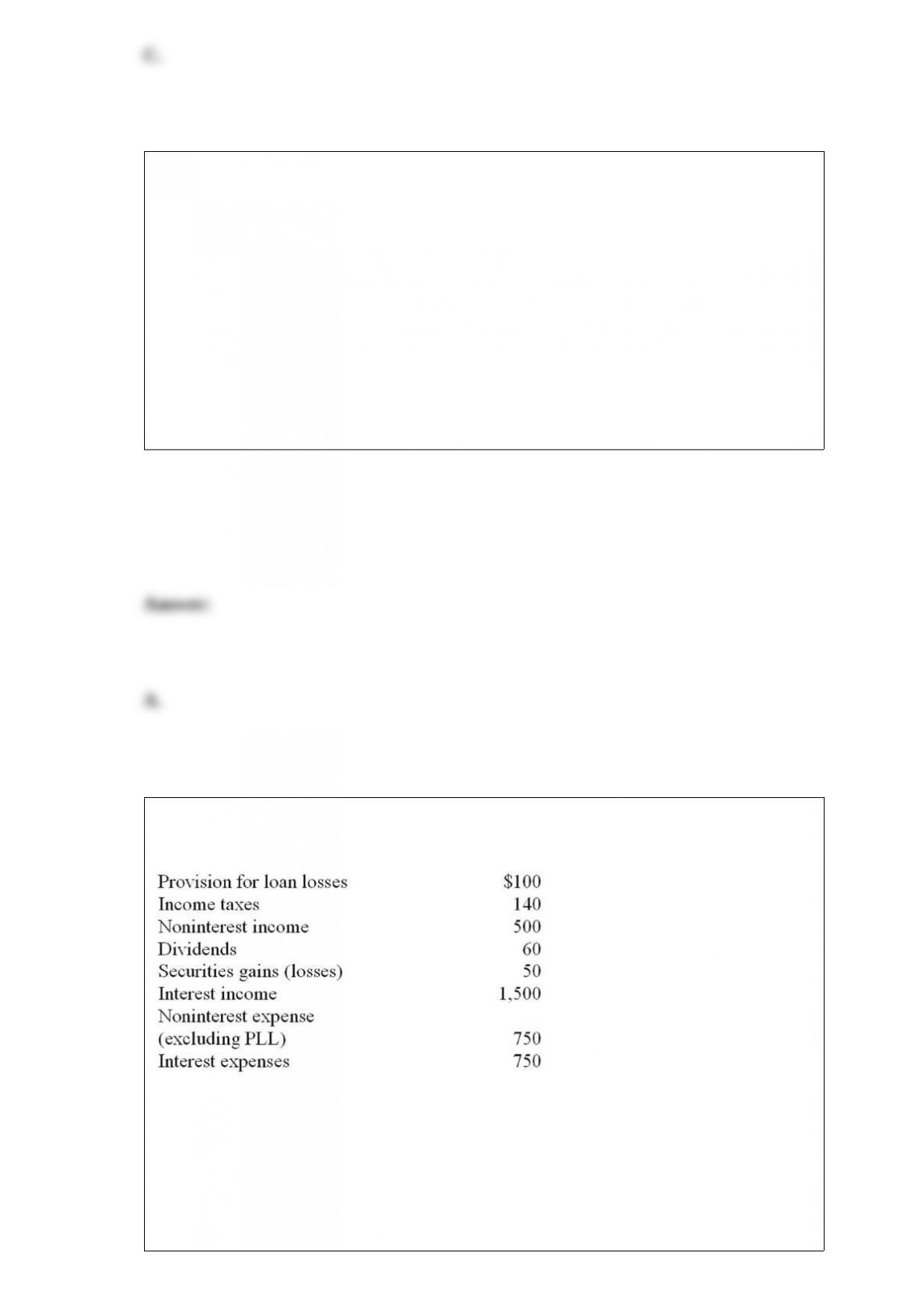
You know the following information about the Taylor National Bank:
Given this information, what is the value of this firm’s net noninterest income?
A. $150
B. $210

C. $400
D. ($350)
E. $750
Answer:
FASB Rule 115 focuses primarily on:
A. deposit sources.
B. investments in marketable securities.
C. derivatives trading.
D. loan-loss reserves.
E. hedging activities.
Answer:
A swap where the notional amount is constant is called:
A. a quality swap

B. a bullet swap
C. an amortizing swap
D. an accruing swap
E. None of the options are correct
Answer:
Bank equipment leasing activity involves:
A. a bank leasing its office facilities instead of buying.
B. a bank buying equipment and then leasing the item to a customer.
C. a customer buying equipment and then leasing it to a bank.
D. a bank leasing computer equipment.
E. None of the options are correct.
Answer:

The tax-management efficiency ratio consists of:
A. total tax liabilities over net income.
B. tax-exempt assets over taxable assets.
C. net income over pre-tax net operating income.
D. taxes owed over total liabilities of a bank.
E. None of the options is correct.
Answer:
FICO credit scoring system provides credit scores in the range of:
A. 0 to 10
B. 0 to 1000
C. 100 to 1000
D. 300 to 850
E. 20 to 80
Answer:

A bond has six years to maturity and has a coupon rate of 7.5 percent. Coupon
payments are made annually and the bond has a face value of $1,000. The bond is
currently selling in the market for $1,127. What is the yield-to-maturity on this bond?
A. 7.5 percent
B. 5 percent
C. 11.5 percent
D. 2.5 percent
E. None of the options is correct
Answer:
Timothy Gartner, an employee in the Bank of Trust and Faith, has requested for a loan
of $200,000 to buy a private cruise. The bank has an unimpaired capital and surplus of
$38 million and $75 million in total time and savings deposits. Average revenue for the
bank in the last three years is $18.5 million and a net interest income of $5.2 million.
What is the maximum amount of loan the bank can grant to Timothy?
A. $950,000
B. $200,000
C. $25,000
D. $100,000
E. The bank cannot make loans to its own employees
Answer:

The process of resolving a troubled loan so that a lender can recover its funds is called:
A. loan review.
B. written loan policy.
C. loan workout.
D. loan commitment agreement.
E. None of the options is correct.
Answer:
The largest component of capital among commercial banks is ___________.
Answer:

For a bank, sources of funds like Eurodollars, Fed funds, repurchase agreements, and
large CDs are categorized as ____________________.
Answer:
_________ are financial instruments that derive their value from some underlying
asset.
Answer:
Under the terms of Bank Merger Act, federal regulating agencies must give top priority
to the ______________________ of a proposed merger.
Answer:

The danger that a bank in need of funds will not be able to find someone willing to
grant a loan at a reasonable rate, is known as _________________________ risk.
Answer:
Research suggests that a depository institution’s location is most important to _____
-income consumers.
Answer:
When a bank has a negative duration gap, a parallel decrease in the interest rates on the
assets and liabilities of the bank will lead to a(n) _________________________ in the
bank’s net worth.
Answer:

_________________ risk measures are being developed to be used when Basel III takes
effect.
Answer:
The ____________________ issues charters for new state banks.
Answer:
______________________ are designed to fund long-term investments such as the
purchase of equipment. Money is borrowed in one lump sum and repayments are
generally made in installments.
Answer:

A(n) _________________________ is an interest bearing receipt for funds issued by a
bank with a minimum denomination of $100,000.
Answer:
The __________________________ is the rate of return on a financial instrument
using a 360-day year relative to the instrument’s face value.
Answer:
_________________________ is the risk that the economy of the market area in which
a bank service, may take a down turn in the future.
Answer:

____________ models measure a lender’s exposure to defaults or credit downgrades.
Answer:
__________________ is the weighted average maturity for a stream of future cash
flows.
Answer:
A(n) _________________________ protects the holder from rising market interest
rates. It sets the maximum interest rate that a lender can charge on a floating-rate loan.
Answer: