
1) The accrual basis needs numerous adjustments at the end of the accounting period.
2) In 2007, the Securities and Exchange Commission announced that it would accept
financial statements from foreign private issues without reconciliation to U.S. GAAP if
they are prepared using IFRS as issued by the International Accounting Standards
Board.
3) The statement of changes in net worth is required when presenting personal financial
statements.
4) The balance sheet pension liability considers the projected benefit obligation.
5) A defined benefit plan shifts the risk to the employee as to whether the pension funds
will grow to provide for a reasonable pension payment upon retirement.
6) All important events that influence the prospects for the entity are recorded and
therefore are reflected in the financial statements.
7) An ESOP is a qualified stock-bonus or combination stock-bonus and
money-purchase pension plan designed to invest primarily in stock, other than the
employer’s securities.

8) An income statement is a summary of revenues and expenses and gains and losses,
ending with net income for a particular period of time.
9) Using the direct write-off method, the bad debt expense is recorded when a specific
customer’s account is determined to be noncollectible.
10) Payment of cash dividends is an operating activity.
11) The balance sheet is presented with the assets equal to liabilities plus equity. When
this presentation is presented side by side, it is called the account form.
12) According to the second Financial Accounting Concept, those characteristics of
information that make it a desirable commodity can be viewed as a hierarchy of
qualities, with understandability and usefulness for decision making of most
importance.
13) Presenting an item after tax, with the related tax deducted, is called net-of-tax
presentation.
14) After posting, the general ledger accounts contain the same information as in the
journals, but the information has been summarized by account.

15) At the end of the fiscal year, an adjusting entry is made that increases both interest
expense and interest payable. This entry is an application for which accounting
principle?
a. Full disclosure
b. Materiality
c. Matching
d. Going concern
e. Realization
16) Which of the following would be classified as an extraordinary item on the income
statement?
a. Loss on disposal of a segment of business
b. Cumulative effect of a change in accounting principle
c. A sale of land
d. An error correction that relates to a prior year
e. A loss from a flood in a location that would not be expected to flood
17) Smith Company had retained earnings of $60,000 at the end of the current year. For
the current year, income was $30,000 and dividends $10,000. What was the balance in
retained earnings at the end of the prior year?
a. $30,000
b. $40,000
c. $60,000
d. $30,000
e. $70,000
18) Required:
Indicate the effect of each of the following transactions on cash and working capital.
Use + to indicate an increase, – to indicate a decrease, and 0 for no effect.
Working
Cash Capital
a. Collect accounts receivable
b. Recognize depreciation expense
c. Pay taxes payable
d. Purchase fixed assets for cash
e. Sell common stock
f. Realize cash surrender value of officer’s life insurance
g. Increase deferred income taxes (long-term liability)
h. Amortize of premium on bonds payable
19) Net profit margin measures return on:
a. sales
b. owners’ equity
c. productive assets
d. total assets
e. inventory
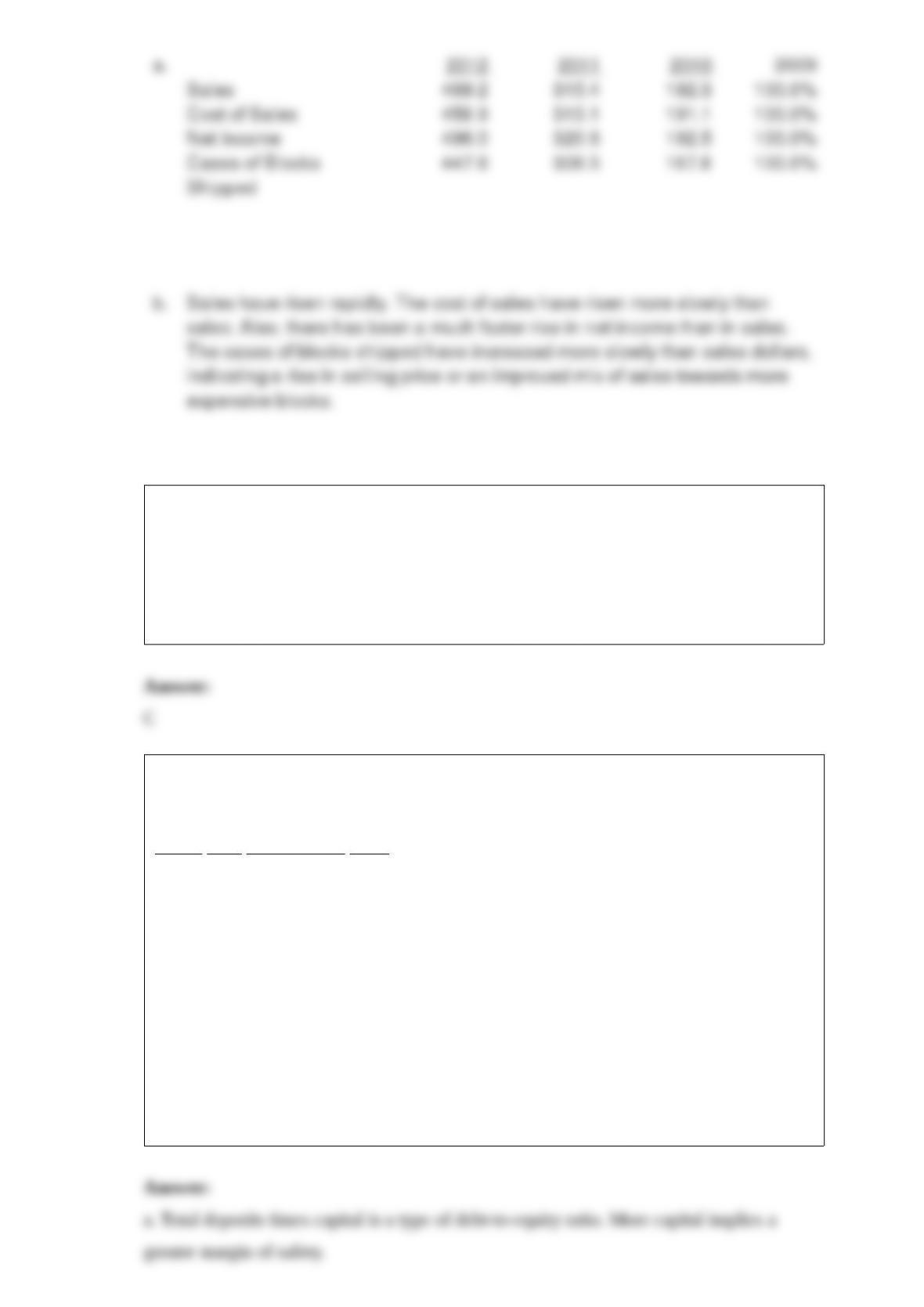
20) Toledo Toy, a manufacturer of infants’ blocks, presented the following data in its
last annual report. This trend analysis begins with the year of formation, 2009 .
Required:
21) Which of the following is a current liability?
a. Prepaid insurance
b. Retained earnings
c. Unearned rent revenue
d. Bonds payable
e. Common stock
22) The controller of Central Bank has computed certain ratios for the bank and a
competitor, Southern County Bank. These activities are presented below.
Southern County
Ratios Year Central Bank Bank
a. Total deposits
times capital 2012 12.1 times 11.6 times
2011 12.2 times 11.5 times
b. Loans to
total deposits 2012 71.4% 67.2%
2011 70.1% 67.0%
c. Capital funds
to total assets 2012 7.3% 8.1%
2011 7.4% 8.0%
Required:
Briefly explain the meaning of each ratio and then compare the firms for each ratio.
How do the firms compare overall?
23) Which of the following will be disclosed in the reconciliation of retained earnings?
a. Adjustment for an error of a prior period
b. Net income
c. Net loss
d. Dividends
e. All of the answers are correct
24) Patricia Company owns 25% of Sandra Company and accounts for the investment
on the equity basis and does not consolidate. At the beginning of 2012, the investment
in Sandra Company was $180,000. In 2012, Sandra Company earned $70,000 and paid
dividends of $10,000.
Required:
a. How much will Patricia Company report as equity in earnings of Sandra Company in
2012?
b. How much cash flow will Patricia Company receive from Sandra Company in 2012?
c. Why does recognition of equity earnings cause problems in analysis?

25) Which of the following is not a type of earning asset for a bank?
a. Cash
b. Loans
c. Leases
d. Investment securities
e. Money market assets
26) Match the definitions to the terms.
a. Appropriations
b. Debt service
c. Capital projects
d. Special assessments
e. Internal services
f. Enterprises
g. Proprietary funds
h. General fund
i. Fiduciary funds
j. Encumbrances
1>Cash receipts and disbursements related to the payment of interest and principal on
long-term debt.
2>Cash receipts and disbursements related to improvements or services for which
special property assessments have been levied.
3>Service centers that supply goods or services to other governmental units on a cost
reimbursement basis.
4>Intention is to maintain the fund’s assets through cost reimbursement by users or
partial cost recovery from users and periodic infusion of additional assets.
5>Future commitments for expenditure.
6>Provide necessary resources and the authority for their disbursements.
7>Cash receipts and disbursements related to the acquisition of long-lived assets.
8>Operations that are similar to private businesses where service users are charged fees.
9>All cash receipts and disbursements not required to be accounted for in another fund.
10>The principal of these funds must remain intact. Typically, revenues earned may be
distributed.
27) There are many definitions or descriptions given to financial failure. Which of the
following does not appear to be a reasonable definition or description:
a. refinancing of bonds payable
b. liquidation
c. deferment of payments to short-term creditors
d. deferment of payments of interest on bonds
e. deferment of payments of principal on bonds
28) Required:
Indicate the effect of the transactions listed below on each of the following: working
capital, current ratio, debt ratio, net income, and stockholders’ equity. Use + to indicate
an increase, – to indicate a decrease, and 0 to indicate no effect. Assume an initial
current ratio of more than 1 to 1 .
Working Current Debt Net Stockholders’
Transaction Capital Ratio Ratio Income Equity
a. A cash dividend is declared and paid.
b. Cash is obtained through long-term bank loans. (Do not consider interest.)
c. Equipment is purchased with short-term notes. (Do not consider interest.)
d. Merchandise is purchased on credit.
e. A fixed asset is sold for more than book value.
f. A stock split takes effect.
g. Current operating expenses not previously recognized are paid.
h. A firm makes a long-term cash investment in the stock of a consolidated subsidiary.
i. A firm recognizes depreciation expense.
j. A firm refinances short-term notes with long-term notes. (Ignore interest.)
29) Dawn Alive reported the following for 2012.
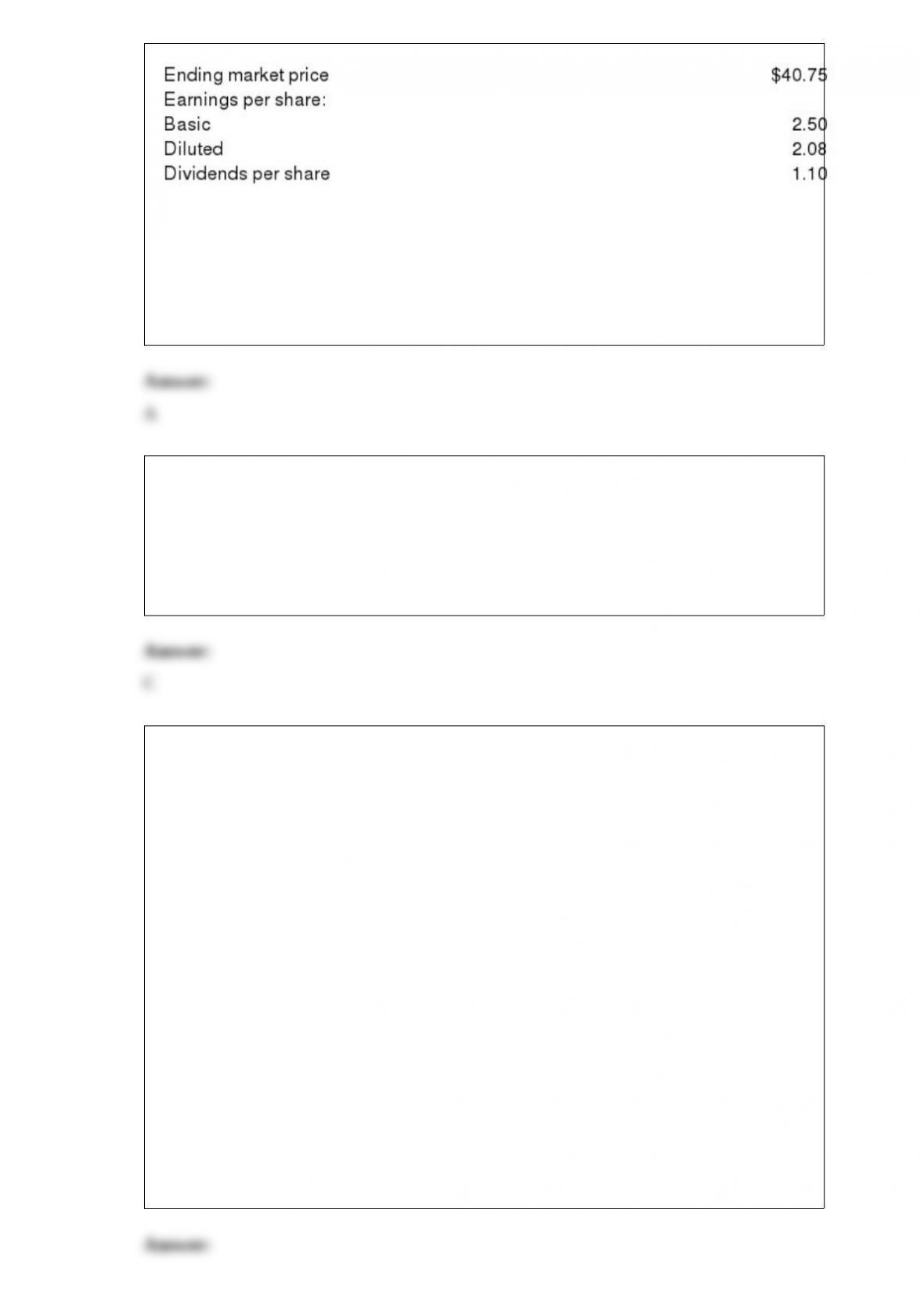
The price/earnings ratio and dividend payout were:
a. 19.59 and 52.88%
b. 16.30 and 52.88%
c. 16.30 and 44.00%
d. 19.59 and 44.00%
e. 37.04 and 52.88%
30) The business being separate and distinct from the owners is an integral part of the:
a. time period assumption
b. going concern assumption
c. business entity assumption
d. realization assumption
e. None of the answers are correct
31) Below is a list of terms related to trend analysis and other types of financial
information and services.
Required:
Match each term to its best description or definition.
a. Full or partial statements expressed in percentages of a given base.
b. Requires full financial statements on a quarterly basis.
c. All statement figures are expressed as a percentage of a base figure from that year’s
statement.
d. A breakdown by major lines of business, only required in SEC reporting.
e. A breakdown by major lines of business.
f. All statement figures are expressed as a percentage of base-year figures.
g. Requires estimation of some expense items.
h. A comparison of financial data over time.
i. Visual aids to understanding financial data.
1>Vertical, common-size statement
2>Segment reporting
3>Interim reporting
4>Trend analysis
5>Common size
6>Horizontal
32) Which of these statements is false?
a. Many companies will not clearly fit into any one industry
b. A financial service uses its best judgment as to which industry the firm best fits
c. The analysis of an entity’s financial statements can be more meaningful if the results
are compared with industry averages and with results of competitors
d. When using industry averages, it is often necessary to use an industry that the firm
best fits
e. A company comparison should not be made with industry averages if the company
does not clearly fit into any one industry
33) All but one of the following statements indicates a difference between the Financial
Accounting Standards Board (FASB) and prior approaches. Select the one that is not a
difference.
a. The FASB is independent of the
b. The size of the board is much smaller
c. The FASB has broader representation
d. The FASB is the primary board for the development of generally accepted accounting
principles
e. Members of the FASB serve on a full-time basis
34) The following data are taken from the financial statements of Motorise, Inc., for
2012 and 2011 .
Required:
a. Compute the following ratios for both years, using total net income and assets. Use
ending balance sheet figures.
1> net profit margin
2> return on total assets (use year-end total assets)
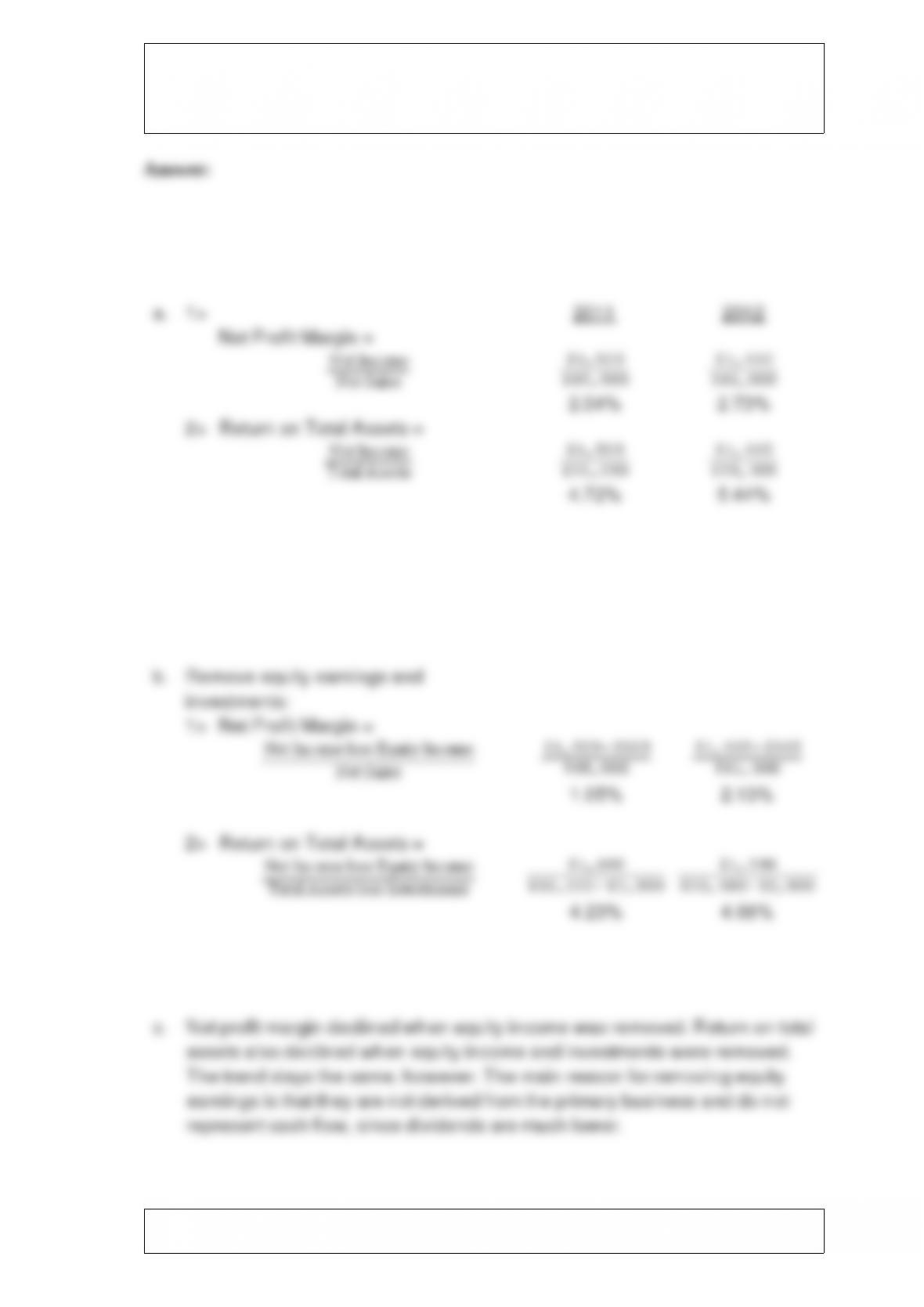
b. Recompute the ratios, removing the effect of equity income on investments. (For
return on total assets, use year-end total assets.)
c. Discuss the change. Why is it advisable to remove equity earnings in this case?
35) Match each account to the proper account description; not all letters will be used.

a. Stocks and bonds of other companies held for the purpose of exercising control.
b. An accumulation of the sum of the expense since the beginning of the benefit period.
c. Outside ownership in the equity of consolidated subsidiaries.
d. Machinery and tools, valued at historical cost.
e. Monies due because expenses, such as salaries, are incurred in a different period than
when the cash outlay occurs.
f. The most liquid of assets, it may also include savings accounts.
g. Goods on hand.
h. A potential liability created by differing tax and reporting methods.
i. Ownership and debt instruments readily converted to cash.
j. An expenditure made in advance of the use of the service or good.
k. Monies due from customers arising from sale or service rendered.
l. The capital stock of residual owners.
m. Bonds that can be exchanged for stock at the option of the holder.
n. Undistributed earnings of the corporation.
o. Shares of the firm’s own stock that have been repurchased.
p. Monies due for goods bought for use or resale.
q. Excess over legal par paid at time of sale.
r. Nondepreciable real estate.
s. Collections in advance of service.
t. Securities that give the holder the right to buy additional shares of common stock at a
fixed price.
1>Accounts Payable
2>Accounts Receivable
3>Accrued Liabilities
4>Accumulated Depreciation
5>Cash
6>Common Stock
7>Convertible Debentures
8>Deferred Income Taxes (liability)
9>Equipment
10>Inventory
11>Land
12>Marketable Securities
13>Noncontrolling Interest
14>Paid-In Capital in Excess of Par
15>Retained Earnings
16>Treasury Stock
NOTE: Account description as a, j, s and t are not used.
36) In 2011, Firm X has net income of $182,000, income tax of $80,000, and interest
expense of $31,000.
Required:
a. Compute the degree of financial leverage.
b. In 2012, if earnings before interest and tax increase by 10%, what should be the
change in net income?
c. In 2012, if earnings before interest and tax decline by 50%, what should be the
change in net income?
37) Which of the following is not an acceptable inventory costing method?
a. Specific identification
b. Last-In, First-Out (LIFO)
c. First-In, First-Out (FIFO)
d. Average cost
e. Next-In, First-Out (NIFO)
38) Which of the following would not be a reasonable suggestion for reviewing the
Statement of Financial Condition?
a. Determine unrealized increases in net worth
b. Determine the personal net worth amount
c. Determine the amounts of the assets that are very liquid
d. Determine the due period of liabilities
e. Compare specific assets and specific liabilities, indicating net investment in assets
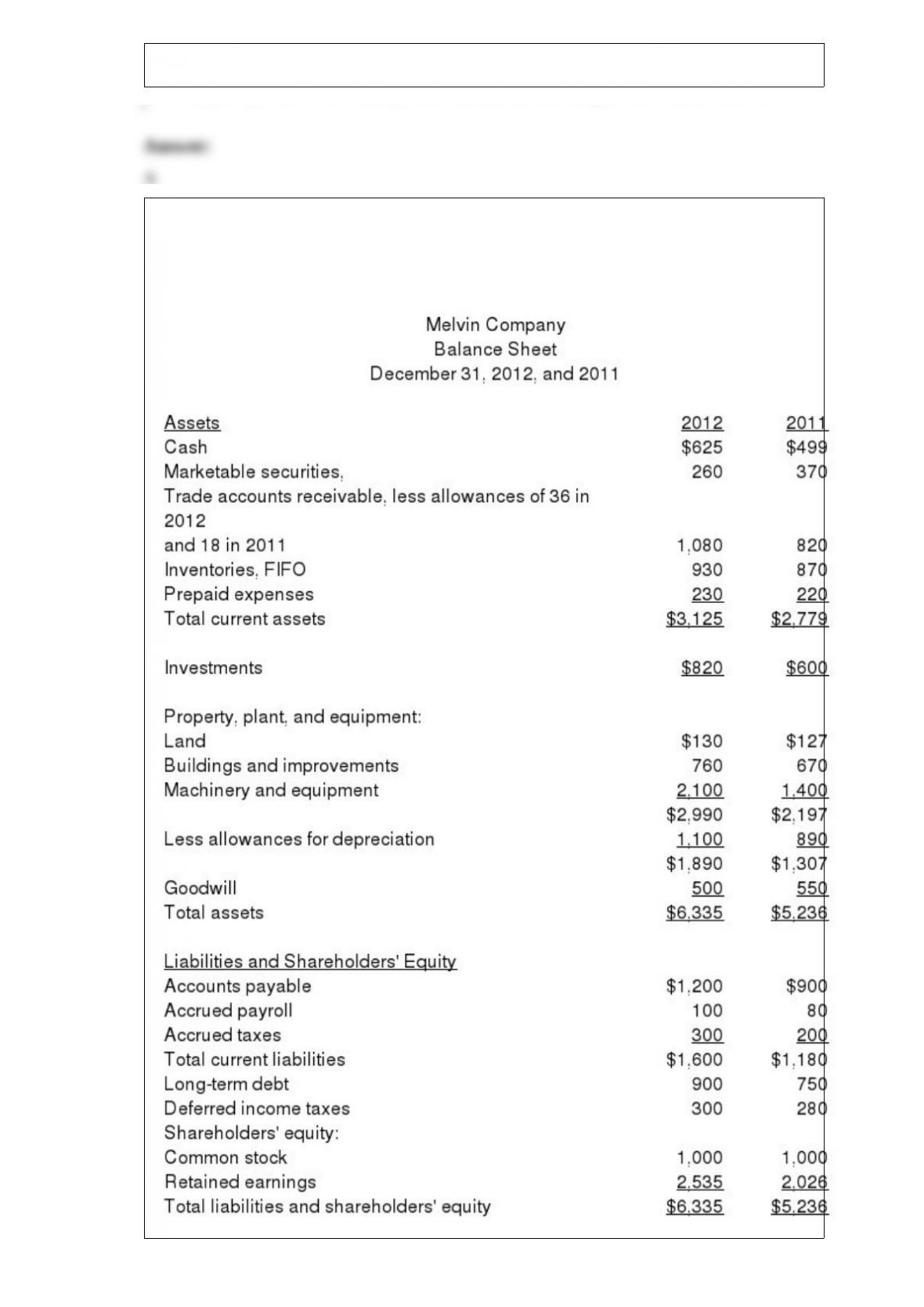
39) The following statements are presented for Melvin Company.
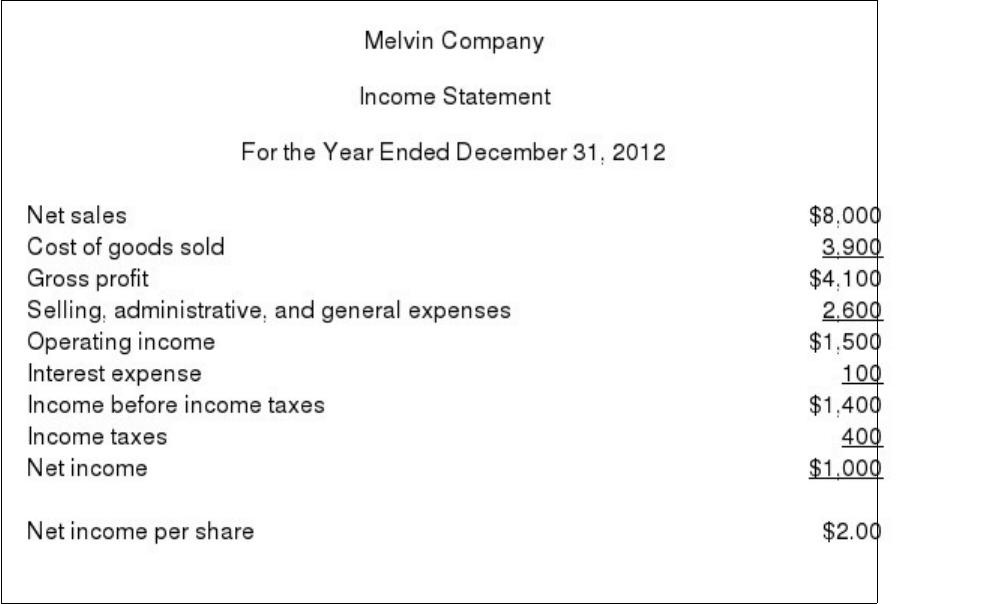
Note: 500 shares of common stock were outstanding.
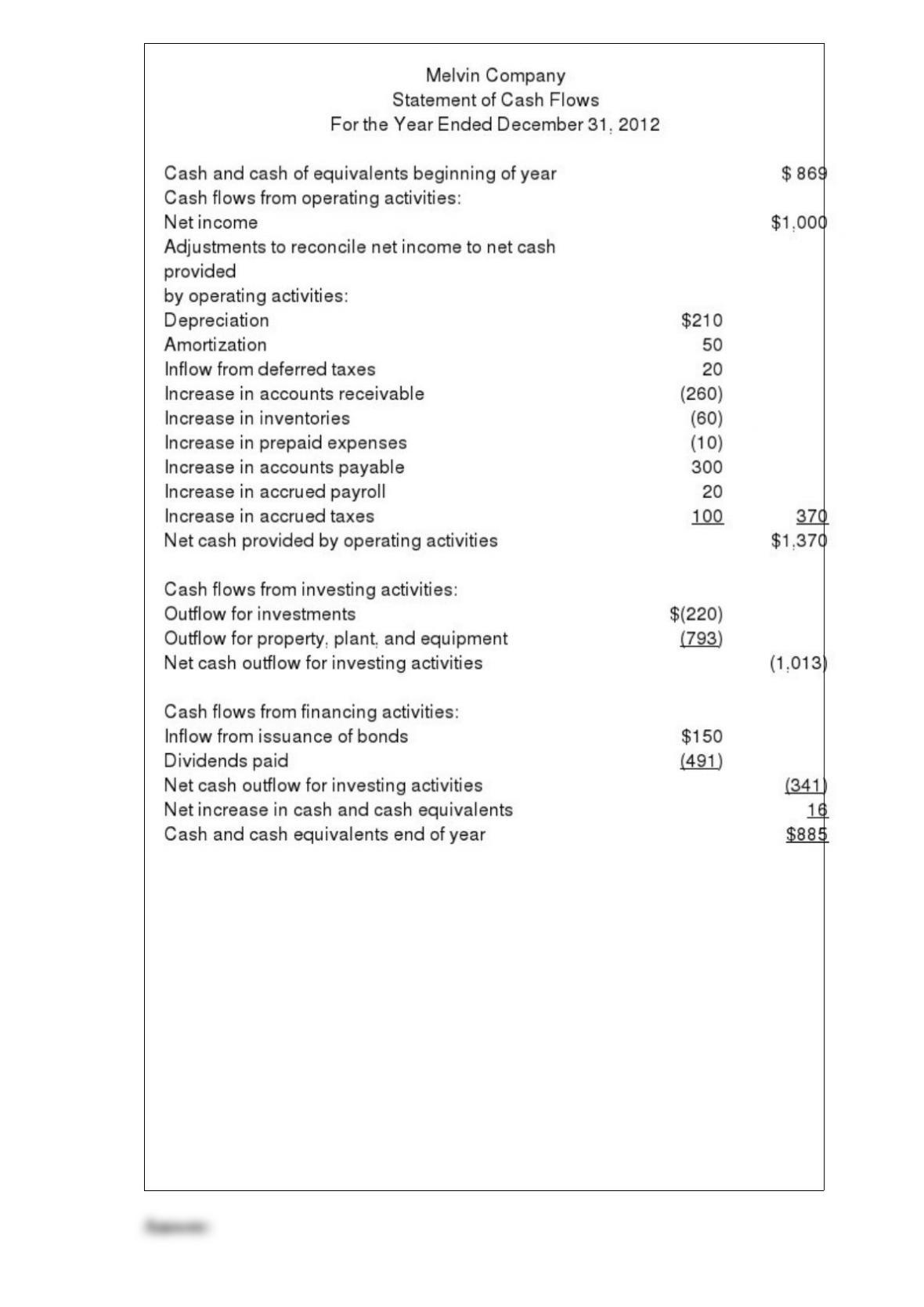
Required:
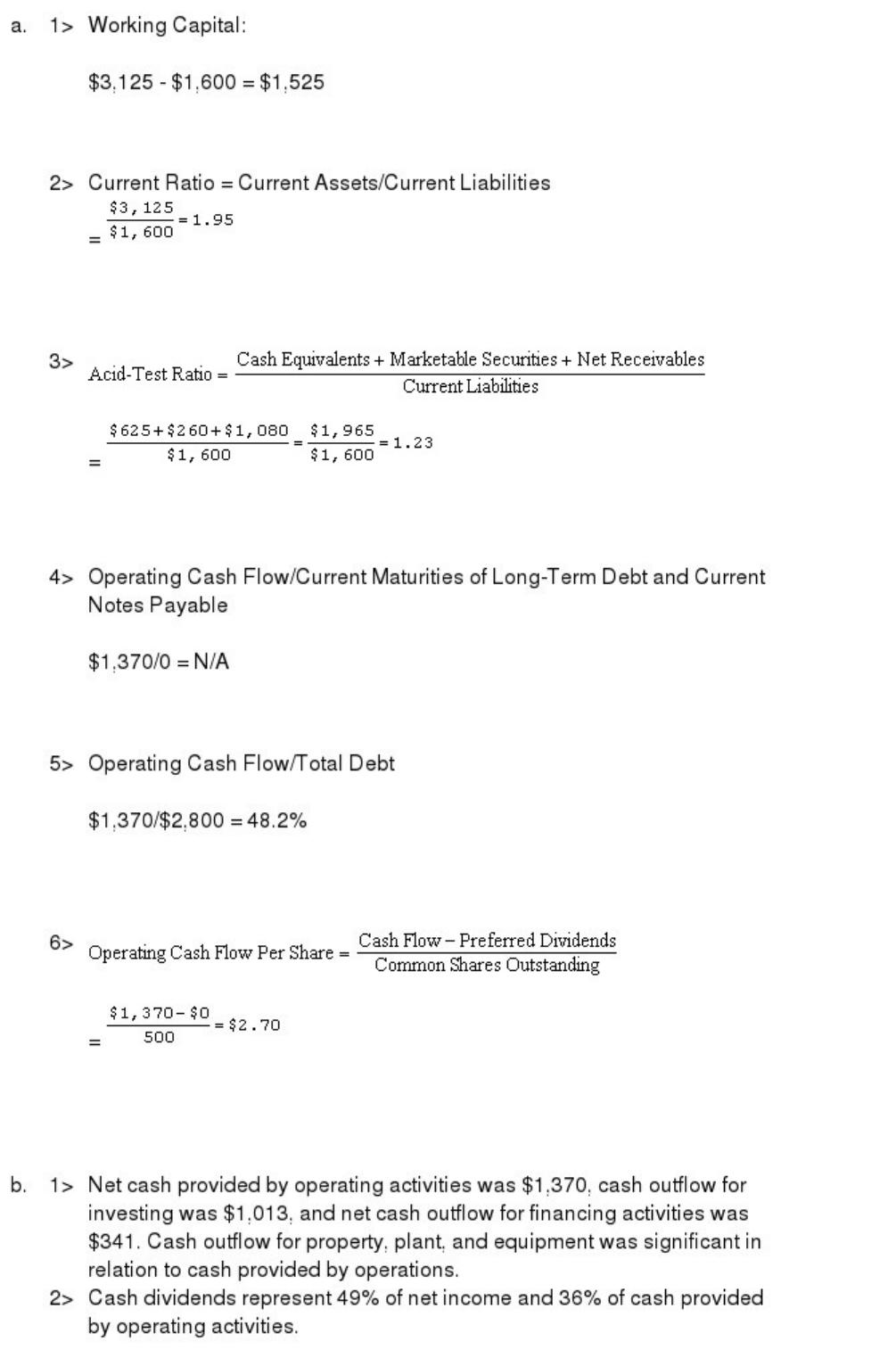
a. Compute the following for 2012:
1> working capital
2> current ratio
3> acid-test ratio (conservative)
4> operating cash flow/current maturities of long-term debt and current notes payable
5> operating cash flow/total debt
6> operating cash flow per share
b. 1> Review the statement of cash flows and comment on significant items.
2> Comment on cash dividends in relation to net income and net cash provided by
operating activities.
c. 1> Which items appearing on the cash flow statement do not directly represent cash
flow?
2> Why are these items disclosed on the cash flow statement?
40) The Financial Accounting Standards Board has issued statements between:
a. 1960-1973
b. 1939-1959
c. 1973-present
d. 1966-1976
e. None of the answers are correct
41) Noncontrolling interest share of earnings is:
a. the total earnings of unconsolidated subsidiaries
b. earnings based on the percent of holdings by parent company of unconsolidated
subsidiaries
c. the total earnings of consolidated subsidiaries
d. earnings based on the percent of holdings by outside owners of consolidated
subsidiaries
e. none of the answers are correct
42) Which of the following is not a true statement regarding stock options?
a. They may cause dilution of earnings per share
b. They generally allow the purchase of common stock at favorable terms
c. They involve a compensation expense
d. Exercise improves the short-term liquidity and debt position of the issuing firm
e. The potential dilution can be disregarded in financial analysis
43) In financial accounting, which of the following assets is not considered to be an
intangible asset?
a. Goodwill
b. Patents

c. Copyrights
d. Trademarks
e. Accounts receivable