
1) Statutory restrictions may prevent a company from paying dividends if the firm’s
assets are less than the firm’s liabilities.
2) The decision to forgo the discount available to those customers who pay early has an
advantage as well as a disadvantage.
3) Jones Blanket Company sells blankets for $25 each. The variable cost of each
blanket is $10. If fixed cost is $4,500,000 then the break-even point is 300,000 units.
4) According to the bird-in-the-hand dividend theory, investors value a dollar of
expected capital gain more highly than a dollar of expected dividends because capital
gains are more unpredictable than dividends.
5) Under cumulative voting a 10% shareholder will likely be able to elect 10% of the
board of directors.
6) A general partnership, unlike a limited partnership, is an entity that legally functions
separate and apart from its owners.
7) The root cause of agency problems is conflicts of interest.

8) Common stock valuation can be based on the present value of future dividends or
alternatively on the present value of the firm’s future quarterly net income.
9) Over-the-counter markets include all security markets, with the exception of
organized exchanges.
10) Investment A and Investment B both have the same expected return, but Investment
A is more risky than Investment B. In the technical jargon of modern portfolio theory,
Investment A is said to “dominate” Investment B.
11) A typical decision rule used in simulation is to accept the project if the probability is
sufficiently high that the net present value is positive.
12) When an unexpected change in dividend policy develops, investors may attach
informational content to the events.
13) If you want to have $5,000 in 10 years, how much money must you put in a savings
account today? (Assume that the savings account pays 4% and it is compounded daily;
round to the nearest $1).
A) $3,352
B) $3,370
C) $4,102
D) $4,207
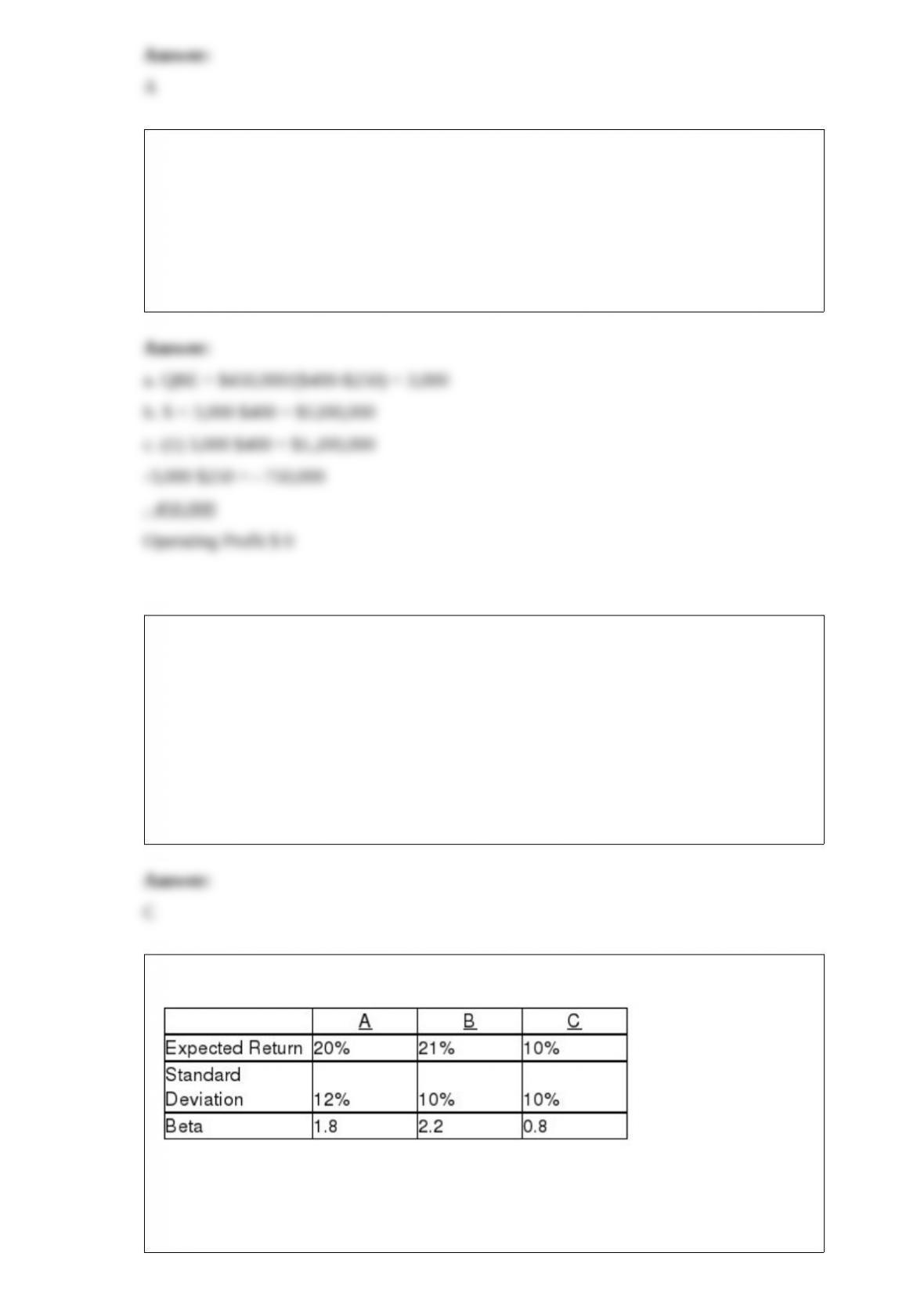
14) Voellers Upholstery Co. produces inexpensive leather chairs. The average selling
price for one of the chairs is $400. The variable cost per chair is $250. Voellers’ has
average fixed costs per year of $450,000.
a.What is the break-even point in units?
b.What is the break-even point in dollar sales?
c.What would be the operating profit or loss associated with the production and sale of
(1) 3,000 chairs, (2) 4,000 chairs?
15) Lithium, Inc. is considering two mutually exclusive projects, A and B. Project A
costs $95,000 and is expected to generate $65,000 in year one and $75,000 in year two.
Project B costs $120,000 and is expected to generate $64,000 in year one, $67,000 in
year two, $56,000 in year three, and $45,000 in year four. Lithium, Inc.’s required rate
of return for these projects is 10%. The internal rate of return for Project B is
A) 29.74%
B) 30.79%
C) 35.27%
D) 36.77%
16) Answer the questions below using the following information on stocks A, B, and C.
Assume the risk-free rate of return is 3% and the expected market return is 12%
a.Calculate the required return for stocks A, B, and C.
b.Assuming an investor with a well-diversified portfolio, which stock would the
investor want
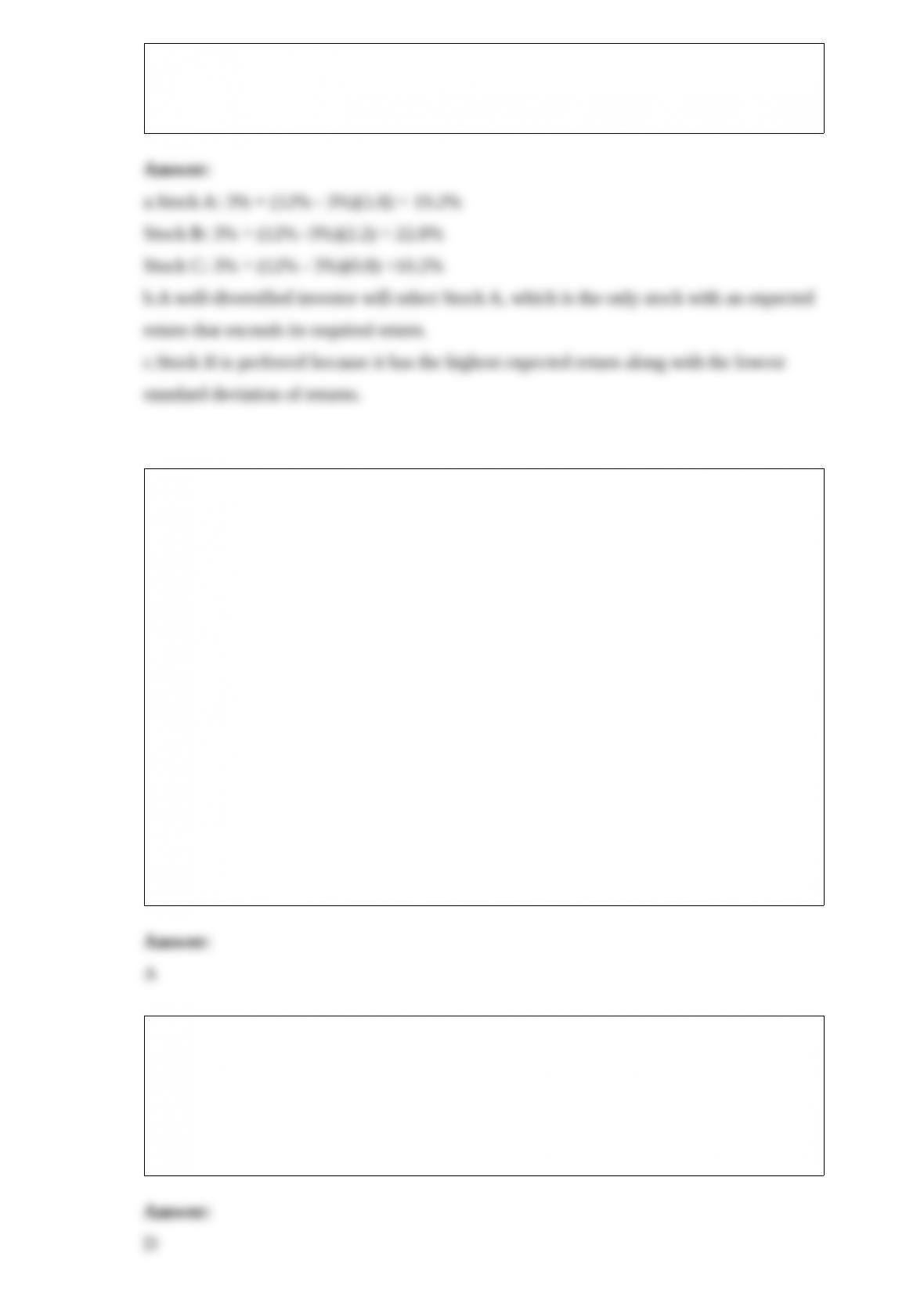
to add to his portfolio?
c.Assuming an investor who will invest all of his money into one security, which stock
will the investor choose?
17) Fielding Wilderness Outfitters had projected its sales for the first six months of
2010 to be as follows:
Jan.$250,000April$300,000
Feb.$340,000May$350,000
Mar.$280,000June$380,000
Cost of goods sold is 60% of sales. Purchases are made and paid for two months prior
to the sale. 40% of sales are collected in the month of the sale, 40% are collected in the
month following the sale, and the remaining 20% in the second month following the
sale. Total other cash expenses are $40,000/month. The company’s cash balance as of
March 1st, 2010 is projected to be $40,000, and the company wants to maintain a
minimum cash balance of $15,000. Excess cash will be used to retire short-term
borrowing (if any exists). Fielding has no short-term borrowing as of March 1st, 2010.
Assume that the interest rate on short-term borrowing is 1% per month. What is
Fielding’s projected total receipts (collections) for April?
A) $124,000
B) $180,000
C) -$4,000
D) $36,000
18) Which of the following is the most important goal that a corporation should strive
for?
A) maximize current profits
B) maximize market share
C) maximize revenue
D) maximize shareholder wealth

19) John calls his stockbroker and instructs him to purchase 100 shares of Microsoft
Corporation common stock. This transaction occurs in the
A) secondary market
B) primary market
C) credit market
D) futures market
20) What method is used for calculation of the accounting beta?
A) simulation
B) regression analysis
C) sensitivity analysis
D) both A and C
21) HighLev Incorporated borrows heavily and uses the leverage to boost its return on
equity to 30% this year, nearly 10% higher than the industry average. However,
HighLev’s stock price decreases relative to its industry counterparts. How is this
possible?
A) Markets are inefficient and fail to recognize the benefits of leverage
B) The increased debt resulted in interest payments that made HighLev’s operating
income drop even though return on equity increased
C) Shareholders are not interested in return on equity
D) the high levels of debt increased the riskiness of HighLev relative to its competitors
22) A Bristal Boats, Inc. reports sales of $4,000,000, variable costs of $500,000, fixed
operating costs of $1,250,000, and interest expense of $350,000. The corporation’s
EBIT is $3,250,000 and its marginal tax rate is 30%. If the corporation is able to
increase its sales by 25%, then
A) its EBIT will increase by 25% and its EPS will increase by 25%
B) its EBIT will increase by more than 25% and its EPS will increase by less than 25%
C) its EBIT and EPS will both increase, but less than 25% due to fixed costs and taxes
D) its EBIT will increase by more than 25% and its EPS will increase by more than the
percentage increase in EBIT

23) The risk free rate of return is 2.5% and the market risk premium is 8%. Rogue
Transport has a beta of 2.2 and a standard deviation of returns of 28%. Rogue
Transport’s marginal tax rate is 35%. Analysts expect Rogue Transport’s dividends to
grow by 6% per year for the foreseeable future. Using the capital asset pricing model,
what is Rogue Transport’s cost of retained earnings?
A) 16.4%
B) 17.7%
C) 19.6%
D) 20.1%
24) Spandra Electronics wants to raise money by selling stock. After talking to several
investment banking firms, Spandra decides to hire Goldman Sachs to sell 5 million
shares of its common stock. Goldman sells 4.5 million shares and returns the rest to
Spandra. This is an example of
A) a privileged subscription with a standby agreement
B) a commission or best-efforts agreement
C) a privileged subscription with a standby agreement
D) a competitive bid purchase
25) The financial manager selecting one of two projects of differing risk should
A) select the project with the larger risk-adjusted net present value
B) choose the project with the least relative risk
C) choose the project with greater return even if that project has greater risk
D) choose the project with less risk even though that project has less return
26) Which of the following causes a firm’s cost of capital (WACC) to differ from an
investor’s required rate of return on the company’s common stock?
A) the fact that the risk free rate of interest has increased
B) the incurrence of flotation costs when new securities are issued
C) The market risk premium exceeds 12%
D) None of the above the WACC and required return are the same
27) A company borrows $2,000,000 and uses the money to purchase high technology

machinery for its operations. These are examples of
A) cash flow from financing and cash flow from operations
B) cash flow from investing and cash flow from operations
C) cash flow from financing and cash flow from investing
D) cash flow from investing and cash flow from financing
28) Plantain, Inc. declared a dividend of $1 per share on March 1. The ex-dividend date
is March 15th, and the payment date is April 1st. The most likely record date is
A) February 27th
B) March 17th
C) March 13th
D) March 29th
29) LPD Logistics, Inc.’s projected sales for the first six months of 2010 are given
below.
Jan.$300,000April$350,000
Feb.$350,000May$500,000
Mar.$475,000June$400,000
20% of sales are collected in the month of the sale, 75% are collected in the month
following the sale, and 5% are written off as uncollectible. Cost of goods sold is 80% of
sales. Purchases are made the month prior to the sales and are paid during the month the
purchases are made (i.e. goods sold in March are bought and paid for in February).
Total other cash expenses are $35,000/month. The company’s cash balance as of
February 1, 2010 will be $30,000. Excess cash will be used to retire short-term
borrowing (if any). LPD has no short term borrowing as of February 28, 2010. Assume
that the interest rate on short-term borrowing is 1% per month. The company must have
a minimum cash balance of $20,000 at the beginning of each month. What is LPD’s
projected gross profit for April?
A) ($50,000)
B) $70,000
C) $100,000
D) $110,550
30) You hold a portfolio with the following securities:
PercentExpected
Securityof PortfolioBetaReturn
Able Corporation20%3.2036.0%

Baker Corporation40%1.6020.0%
Charlie Corporation40%.206.0%
What is the expected return for the market, according to the CAPM?
A) 14.0%
B) 13.8%
C) 12.0%
D) 10.0%
31) Jiffy Co. expects to pay a dividend of $3.00 per share in one year. The current price
of Jiffy common stock is $60 per share. Flotation costs are $3.00 per share when Jiffy
issues new stock. What is the cost of internal common equity (retained earnings) if the
long-term growth in dividends is projected to be 8 percent indefinitely?
A) 13 percent
B) 14 percent
C) 15 percent
D) 16 percent
32) Which of the following statements about investment banking in the United States is
MOST correct?
A) Investing banking is dominated by a few, very large, stand-alone investment banking
firms, such as Bear Stearns
B) The investment banking industry is dominated by large banks that are also
investment bankers
C) The top five banks involved in investment banking account for less than 25% of the
industry’s total market share
D) The investment banking industry became more competitive following the financial
crisis in 2007 and 2008
33) Your company is considering an investment in one of two mutually exclusive
projects. Project one involves a labor intensive production process. Initial outlay for
Project 1 is $1,495 with expected after tax cash flows of $500 per year in years 1-5.
Project two involves a capital intensive process, requiring an initial outlay of $6,704.
After tax cash flows for Project 2 are expected to be $2,000 per year for years 1-5. Your
firm’s discount rate is 10%. If your company is not subject to capital rationing, which
project(s) should you take on?
A) Project 1
B) Project 2

C) Projects 1 and 2
D) Neither project is acceptable
34) The one-year interest rate is 4%. The interest rate for a two-year security is 6%. The
one-year interest rate one year from now is 8.34%. According to the liquidity preference
theory, the risk premium for the second one-year investment is
A) 0.50%
B) 0.34%
C) 0.30%
D) 1.66%
35) The true owners of the corporation are the
A) holders of debt issues of the firm
B) preferred stockholders
C) board of directors of the firm
D) common stockholders
36) Which of the following loans provide the least amount of security to the lender?
A) chattel mortgage
B) factoring
C) floating lien
D) terminal warehouse agreement
37) A firm’s optimal capital structure occurs where?
A) EPS are maximized, and WACC is minimized
B) Stock price is maximized, and EPS are maximized
C) Stock price is maximized, and WACC is maximized
D) WACC is minimized, and stock price is maximized

38) The effective annual cost of not taking advantage of the 1/10, net 60 terms offered
by a supplier is
A) 1.50%
B) 5.37%
C) 6.69%
D) 7.27%
39) Lithium, Inc. is considering two mutually exclusive projects, A and B. Project A
costs $95,000 and is expected to generate $65,000 in year one and $75,000 in year two.
Project B costs $120,000 and is expected to generate $64,000 in year one, $67,000 in
year two, $56,000 in year three, and $45,000 in year four. Lithium, Inc.’s required rate
of return for these projects is 10%. The internal rate of return for Project A is
A) 31.43%
B) 29.42%
C) 25.88%
D) 19.45%
40) Which of the following statements about the corporate form of business
organization is true?
A) The corporate form has the disadvantage of double taxation relative to a sole
proprietorship
B) The corporate form is preferred over the sole proprietorship because a corporation is
easier to form and faces less regulation
C) Sole proprietorships are the most common form of business organization because
liability is limited to the amount invested in the business by the sole proprietor
D) The corporate form has the advantage of unlimited liability
41) Documents uncovered after the Exxon Valdez oil spill in Alaska revealed that
Exxon could have used double-hulled oil tankers that would have prevented the spill,
but the cost of refitting their fleet of single-hulled tankers was considered too high.
Exxon determined that the cost of cleaning up an oil spill would be less than the cost of
refitting the ships, thus increasing shareholder value. Several years after the oil spill,
however, Exxon was fined billions of dollars for the spill. How do the costs of the clean
up and the fines pertain to a discussion of maximizing shareholder value and ethical
responsibility?
42) Use the following data:
Market risk premium = 10%
Risk free rate = 2%
Beta of XYZ stock = 1.6
Beta of PDQ stock = 2.4
Investment in XYZ stock = $15,000
Investment in PDQ stock = $60,000
You have no assets other than your investments in XYZ and PDQ stock.
What is the expected return of your portfolio? Show all work.
43) You just invested $50,000 into an account that earns 7 percent compounded
annually. At the end of each year you can withdraw $4,971. How many years can you
continue to make the withdrawals?
44) An investor buys a 20-year BBB-rated corporate bond with a nominal annual rate of
return of 10%. The average inflation rate is expected to be 2%. The default risk
premium is expected to be 5% and the maturity premium is 4%. Calculate the real rate
of interest.
45) The Bike Store orders $2000 worth of supplies every 30 days. If they take
advantage of the 3/10 net 30 discount offered by their supplier, how much would they
save over the year? Assume a 360-day year.
46) If Neal O’Danny preferred stock pays an annual dividend of $2.80, and investors
require a 9% return, what is the value of O’Danny’s preferred stock today?
47) Today is your 30th birthday and you must choose between two retirement options.
The first option will provide you with 10 equal annual payments of $100,000 beginning
on your 65th birthday. The second option will provide you with one payment of
$1,000,000 on your 70th birthday. If the interest rate is 6 percent per year and you are
assured of living to at least 80 years of age, which option is better?
48) Security A has an expected rate of return of 29.8 percent and a beta of 3.1. Security
B has a beta of 1.70. If the Treasury bill rate is 5 percent, what is the expected rate of

return for Security B?