
Use the information for the question(s) below.
Consider a project with free cash flows in one year of $90,000 in a weak economy or
$117,000 in a strong economy, with each outcome being equally likely. The initial
investment required for the project is $80,000, and the project’s cost of capital is 15%.
The risk-free interest rate is 5%.
Suppose that you borrow only $60,000 in financing the project. According to MM
proposition II, the firm’s equity cost of capital will be closest to:
A) 45%
B) 30%
C) 25%
D) 35%
Answer:
The firm’s revenues and expenses over a period of time are reported on the firm’s
A) income statement or statement of financial performance.
B) income statement or statement of financial position.

C) balance sheet or statement of financial performance.
D) balance sheet or statement of financial position.
Answer:
You are offered an investment opportunity in which you will receive $23,750 today in
exchange for paying $25,000 in one year. Suppose the risk-free interest rate is 6% per
year. Should you take this project? The NPV for this project is closest to:
A) Yes; NPV = $165
B) No; NPV = $165
C) Yes; NPV = -$165
D) No; NPV = -$165
Answer:
Use the information for the question(s) below.
LCMS Industries has $70 million in debt outstanding. The firm will pay only interest on
this debt (the debt is perpetual). LCMS’ marginal tax rate is 35% and the firm pays a
rate of 8% interest on its debt.

LCMS’ annual interest tax shield is closest to:
A) $2.8 million
B) $2.0 million
C) $3.6 million
D) $5.6 million
Answer:
Which of the following statements is false?
A) The IRR investment rule will identify the correct decision in many, but not all,
situations.
B) By setting the NPV equal to zero and solving for r, we find the IRR.
C) If you are unsure of your cost of capital estimate, it is important to determine how
sensitive your analysis is to errors in this estimate.
D) The simplest investment rule is the NPV investment rule.
Answer:
Which of the following investments offered the lowest overall return over the past
eighty years?
A) Small stocks
B) Treasury Bills
C) S&P 500
D) Corporate bonds
Answer:
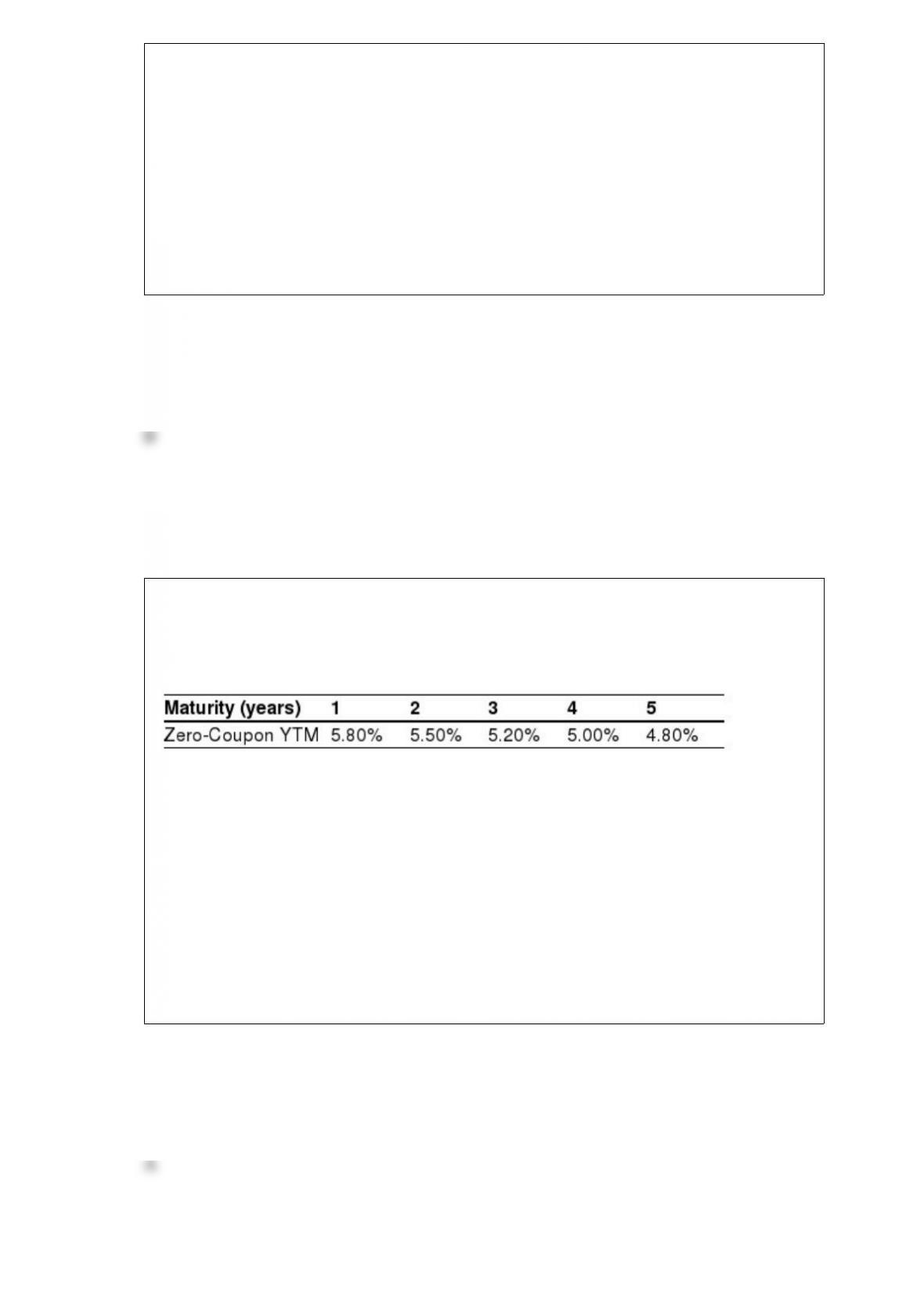
Use the table for the question(s) below.
Consider the following zero-coupon yields on default free securities:
The forward rate for year 5 (the forward rate quoted today for an investment that begins
in four years and matures in five years) is closest to:
A) 4.0%
B) 3.8%
C) 4.8%
D) 4.2%
Answer:

Use the information for the question(s) below.
The current price of KD Industries stock is $20. In the next year the stock price will
either go up by 20% or go down by 20%. KD pays no dividends. The one year risk-free
rate is 5% and will remain constant.
Using the binomial pricing model, the calculated price of a one-year put option on KD
stock with a strike price of $20 is closest to:
A) $2.00
B) $1.45
C) $2.40
D) $2..15
Answer:

Which of the following statements is false?
A) A significant fraction of investors might care about aspects of their portfolios other
than expected return and volatility, and so would be unwilling to hold inefficient
investment portfolios.
B) Although the true market portfolio of all invested wealth might be efficient, the
proxy portfolio might not track the actual market very well.
C) We might be using the wrong proxy portfolio when we calculate alphas.
D) The true market portfolio consists of all traded investment wealth in the economy.
Answer:
Use the information for the question(s) below.
Suppose that a young couple has just had their first baby and they wish to ensure that
enough money will be available to pay for their child’s college education. Currently,
college tuition, books, fees, and other costs, average $12,500 per year. On average,
tuition and other costs have historically increased at a rate of 4% per year.
Assuming that college costs continue to increase an average of 4% per year and that all
her college savings are invested in an account paying 7% interest, then the amount of
money she will need to have available at age 18 to pay for all four years of her
undergraduate education is closest to:
A) $97,110

B) $107,532
C) $101,291
D) $50,000
Answer:
Use the table for the question(s) below.

If the risk-free interest rate is 10%, then of the four projects listed, which project would
you never want to invest in?
A) Eenie
B) Meenie
C) Mighty
D) Moe
Answer:
Use the following information to answer the question(s) below.
Wyatt Oil is considering an investment in a new project with an unlevered cost of
capital of 11%. Wyatt’s marginal corporate tax rate is 35% and its debt cost of capital is
6%. The project has free cash flows of $25 million per year which are expected to
decline by 3% per year.
If Wyatt adjusts its debt continuously to maintain a constant debt-equity ratio of 50%,
then the appropriate WACC for this new project is closest to:
A) 7.5%
B) 8.6%
C) 10.3%
D) 10.8%

Answer:
Which of the following statements is false?
A) The most familiar stock index in the United States is the Dow Jones Industrial
Average (DJIA).
B) A portfolio in which each security is held in proportion to its market capitalization is
called a price-weighted portfolio.
C) The Dow Jones Industrial Average (DJIA) consists of a portfolio of 30 large
industrial stocks.
D) The Dow Jones Industrial Average (DJIA) is a price-weighted portfolio.
Answer:
Use the following information to answer the question(s) below.
Suppose the current zero-coupon yield curve for risk-free bonds is as follows:
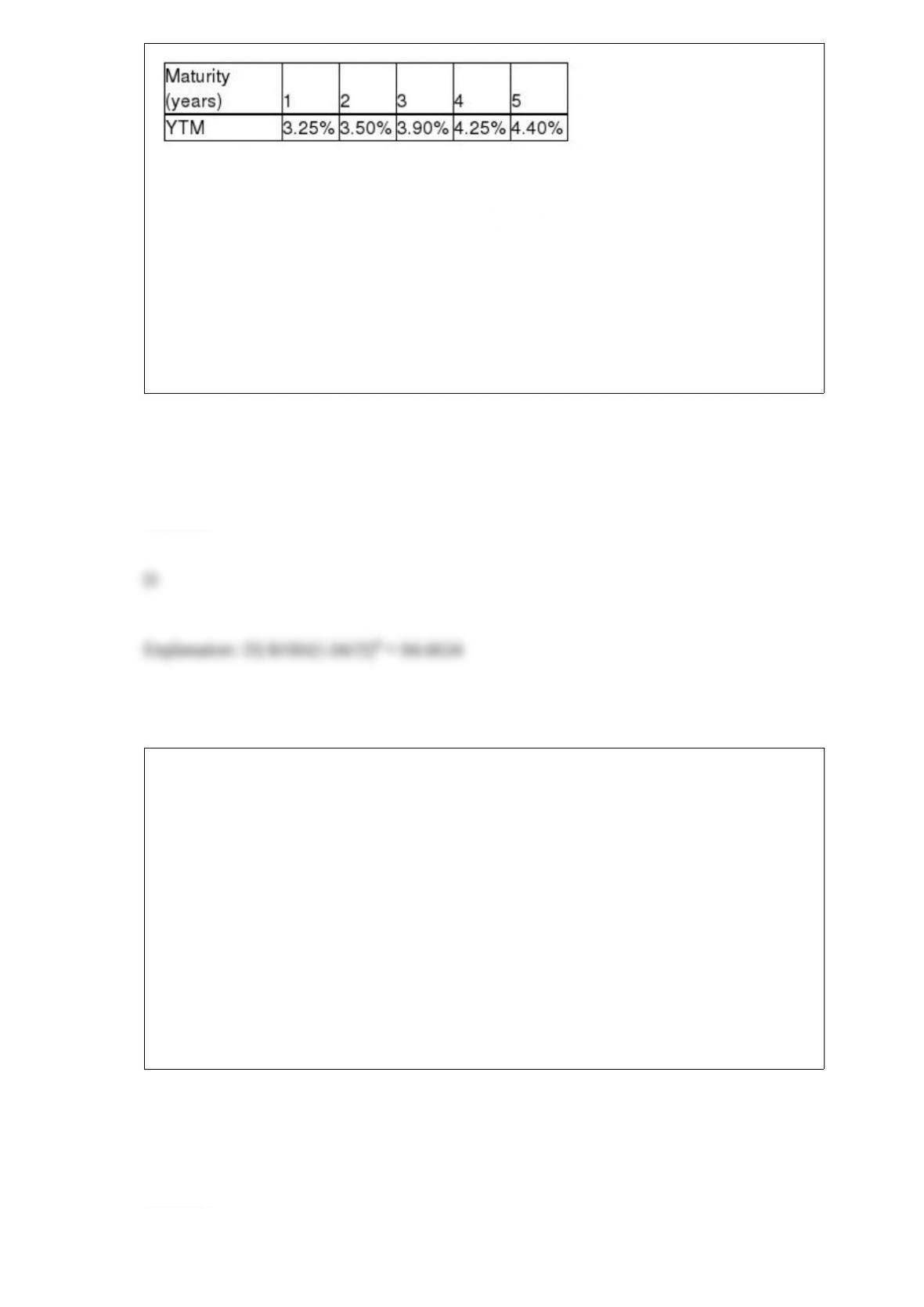
The price per $100 face value of a four-year, zero-coupon, risk-free bond is closest to:
A) $90.06
B) $89.16
C) $86.39
D) $84.66
Answer:
Which of the following statements is false?
A) In a share repurchase, the firm uses excess cash to buy back its own stock.
B) The discounted free cash flow model begins by determining the value of the firm’s
equity.
C) The discounted free cash flow model focuses on the cash flows to all of the firm’s
investors, both debt and equity holders, and allows us to avoid estimating the impact of
the firm’s borrowing decisions on earnings.
D) In recent years an increasing number of firms have replaced dividend payouts with
share repurchases.
Answer:

Consider the following equation:
C = P + S – PV(K)– PV(Div)
In this equation the term S refers to
A) the payoff of a zero coupon bond.
B) the strike price of the option.
C) the value of the call option.
D) the stocks current price.
Answer:
Consider the following equation:
the term D in this equation is
A) the dollar amount of debt.
B) the required rate of return on equity.
C) the required rate of return on debt.
D) the dollar amount of equity.
Answer:
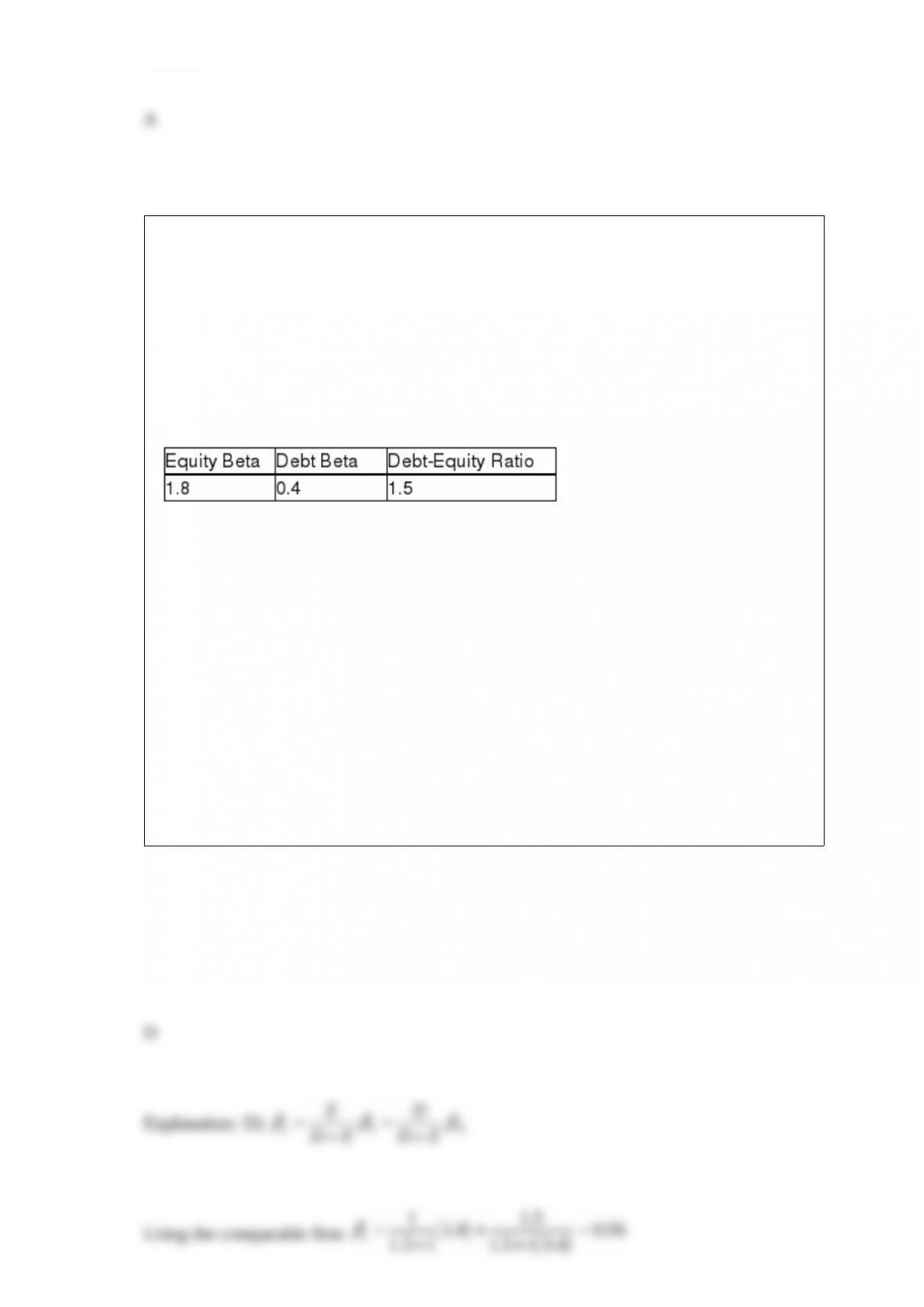
Use the following information to answer the question(s) below.
Nielson Motors (NM) is a newly public firm with 25 million shares outstanding. You
are doing a valuation analysis of Nielson and you estimate its free cash flow in the
coming year to be $40 million. You expect the firm’s free cash flows to grow by 4% per
year in subsequent years. Because the firm has only been listed on the stock exchange
for a short time, you do not have an accurate assessment of Nielson’s equity beta.
However, you do have the following data for another firm in the same industry:
Nielson has a much lower debt-equity ratio of .5, which is expected to remain stable,
and Nielson’s debt is risk free. Nielson’s corporate tax rate is 40%, the risk-free rate is
5%, and the expected return on the market portfolio is 10%.
Nielson’s estimated equity beta is closest to:
A) 0.95
B) 1.00
C) 1.25
D) 1.45
Answer:

Use the following information to answer the question(s) below.
Galt Industries has 50 million shares outstanding and a market capitalization of $1.25
billion. It also has $750 million in debt outstanding. Galt Industries has decided to
delever the firm by issuing new equity and completely repaying all the outstanding
debt. Assume perfect capital markets.
Suppose you are a shareholder in Galt industries holding 100 shares, and you disagree
with this decision to delever the firm. You can undo the effect of this decision by
A) borrowing $1500 and buying 60 shares of stock.
B) selling 32 shares of stock and lending $800.
C) borrowing $1000 and buying 40 shares of stock.
D) selling 40 shares of stock and lending $1000.
Answer:

Consider the following equation:
B =
In this equation, the term B, represents
A) the bid price for the option.
B) the position in bonds for the replicating portfolio.
C) the highest price at which it is advantageous to buy the option.
D) the number of shares of stock to buy for the replicating portfolio.
Answer:
An independent film maker is considering producing a new movie. The initial cost for
making this movie will be $20 million today. Once the movie is completed, in one year,
the movie will be sold to a major studio for $25 million. Rather than paying for the $20
million investment entirely using its own cash, the film maker is considering raising
additional funds by issuing a security that will pay investors $11 million in one year.
Suppose the risk-free rate of interest is 10%.
What is the NPV of this project if the film maker invests his own money and does not
issue the new security? What is the NPV if the film maker issues the new security?
A) $1.7 million; $1.7 million
B) $1.7 million; $2.7 million
C) $2.7 million; $1.7 million
D) $2.7 million; $2.7 million
Answer:

The effective annual rate (EAR) for a loan with a stated APR of 8% compounded
monthly is closest to:
A) 7.72%
B) 8.00%
C) 8.30%
D) 8.66%
Answer:
Which of the following statements is false?
A) The costs of selling assets below their value are greatest for firms with assets that
lack competitive, liquid markets.
B) Firms in financial distress tend to have difficulty collecting money that is owed to
them.
C) Suppliers may be unwilling to provide a firm with inventory if they fear they will
not be paid.

D) The loss of customers is likely to be large for producers of raw materials (such as
sugar or aluminum), as the value of these goods, once delivered, depends on the seller’s
continued success.
Answer:
Use the information for the question(s) below.
Suppose you invest $20,000 by purchasing 200 shares of Abbott Labs (ABT) at $50 per
share, 200 shares of Lowes (LOW) at $30 per share, and 100 shares of Ball Corporation
(BLL) at $40 per share.
Suppose over the next year Ball has a return of 12.5%, Lowes has a return of 20%, and
Abbott Labs has a return of -10%. The weight on Lowes in your portfolio after one year
is closest to:
A) 20.0%
B) 34.8%
C) 30.0%
D) 36.0%
Answer:

Use the following information to answer the question(s) below.
(Include the MACRS Table from the Appendix.)
Casa Grande Farms is considering purchasing multiple tractors for a total purchase
price of $540,000. These tractors are expected to generate EBITDA of $250,000 for
each of the next three years. Casa Grande Farms has a 35% tax rate and has a cost of
capital of 10%.
Assuming that Casa Grande Farms depreciates these tractors using MACRS
depreciation method for three-year property starting immediately, then the annual
depreciation tax shield in year 2 is closest to:
A) 20,785
B) 27,991
C) 84,000
D) 180,000
Answer:

Use the information for the question(s) below.
You founded your own firm three years ago. You initially contributed $200,000 of your
own money and in return you received 2 million shares of stock. Since then, you have
sold an additional 1 million shares of stock to angel investors. You are now considering
raising capital from a venture capital firm. This venture capital firm would invest $5
million and would receive 2 million newly issued shares in return.
Assuming that this is the venture capitalist’s first investment in your firm, what
percentage of the firm will the venture capitalist own?
A) 50%
B) 40%
C) 25%
D) 33%
Answer:
The firm’s asset turnover measures
A) the value of assets held per dollar of shareholder equity.

B) the return the firm has earned on its past investments.
C) the firm’s ability to sell a product for more than the cost of producing it.
D) how efficiently the firm is utilizing its assets to generate sales.
Answer:
Hammond Motors is considering using a public warehouse loan as part of its short-term
financing. The firm will require a loan of $2 million for three months. Interest on the
loan will be 12% (APR, compounded quarterly) to be paid at the end of the quarter. The
warehouse charges 1% of the face value of the loan, payable at the beginning of the
quarter. The effect annual rate on this loan is closest to:
A) 9.3%
B) 11.3%
C) 15.2%
D) 17.1%
Answer:

Which of the following statements is false?
A) When we relax the assumption of a constant debt-equity ratio, the FTE method is
relatively straightforward to use and is therefore the preferred method with alternative
leverage policies.
B) When debt levels are set according to a fixed schedule, we can discount the
predetermined interest tax shields using the debt cost of capital, rD.
C) With a constant interest coverage policy, the value of the interest tax shield is
proportional to the project’s unlevered value.
D) When the firm keeps its interest payments to a target fraction of its FCF, we say it
has a constant interest coverage ratio.
Answer:
Consider the following income statement and other information:
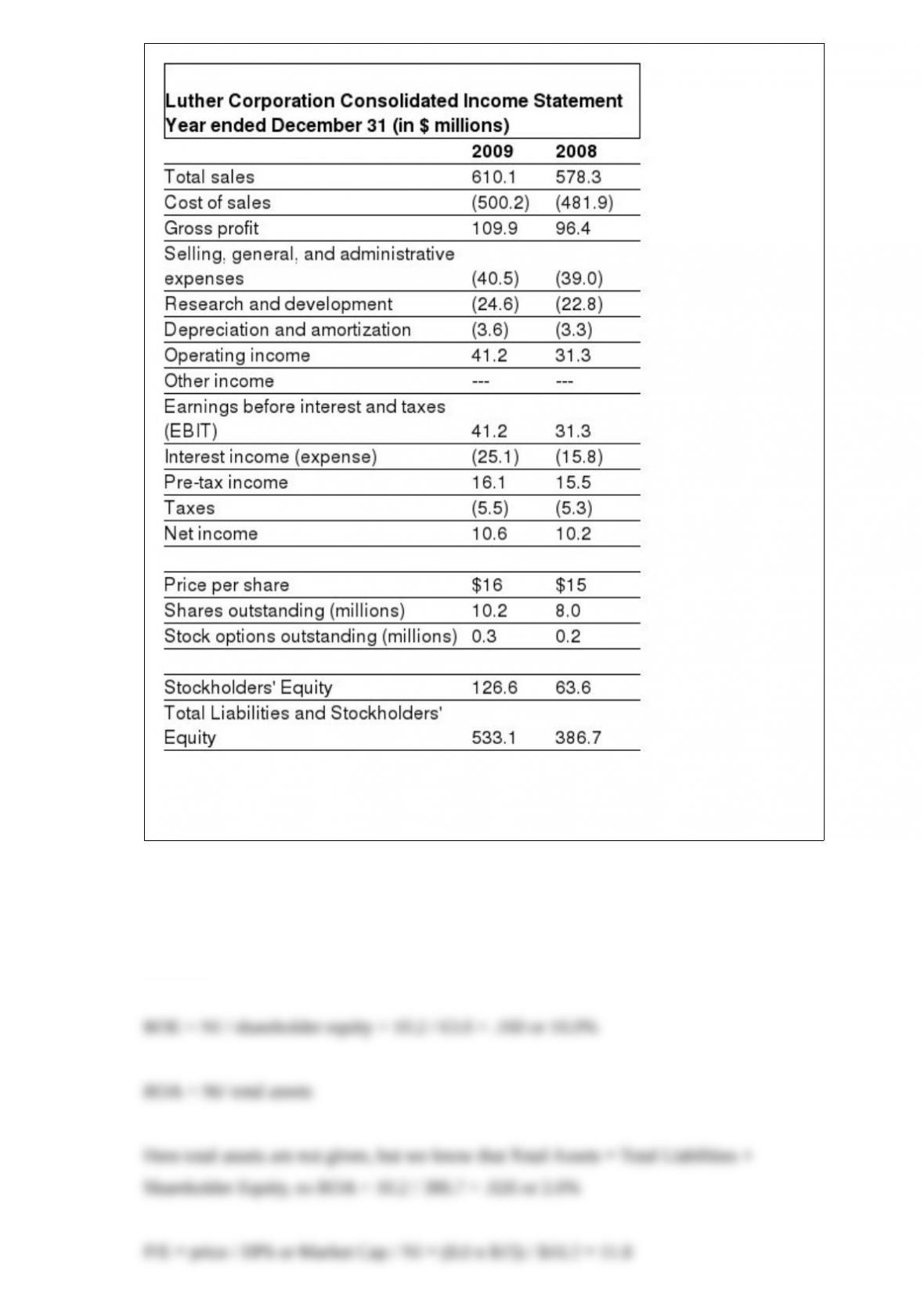
Calculate Luther’s return of equity (ROE), return of assets (ROA), and price-to-earnings
ratio (P/E) for the year ending December 31, 2008.
Answer:

Which of the following statements regarding vertical integration is false?
A) Vertically integrated companies may be large, but unlike other large corporations,
since they remain focused in one industry they are easy to run.
B) A company might not be happy with how its products are being distributed, so it
might decide to take control of its distribution channels.
C) A company might conclude that it can enhance its product if it has direct control of
the inputs required to make the product.
D) The principal benefit of vertical integration is coordination. By putting two
companies under central control, management can ensure that both companies work
toward a common goal.
Answer:
Use the information for the question(s) below.
Flagstaff Enterprises expected to have free cash flow in the coming year of $8 million,
and this free cash flow is expected to grow at a rate of 3% per year thereafter. Flagstaff
has an equity cost of capital of 13%, a debt cost of capital of 7%, and it is in the 35%
corporate tax bracket.
If Flagstaff maintains a .5 debt to equity ratio, then Flagstaff’s pre-tax WACC is closest
to:
A) 10.5%
B) 11.0%
C) 9.0%
D) 10.0%

Answer:
Which of the following statements is false?
A) The CAPM remains the predominant model use in practice to determine the equity
cost of capital.
B) Low beta stocks have tended to perform somewhat better than the CAPM predicts.
C) The empirically estimated security market line is somewhat steeper than that
predicted by the CAPM.
D) Some evidence suggests that the market risk premium has declined over time.
Answer:
An exchange traded fund (ETF) is a security that represents a portfolio of individual
stocks. Consider an ETF for which each share represents a portfolio of two shares of
International Business Machines (IBM), three shares of Merck (MRK), and three shares
of Citigroup Inc. (C). Suppose the current market price of each individual stock are
shown below:
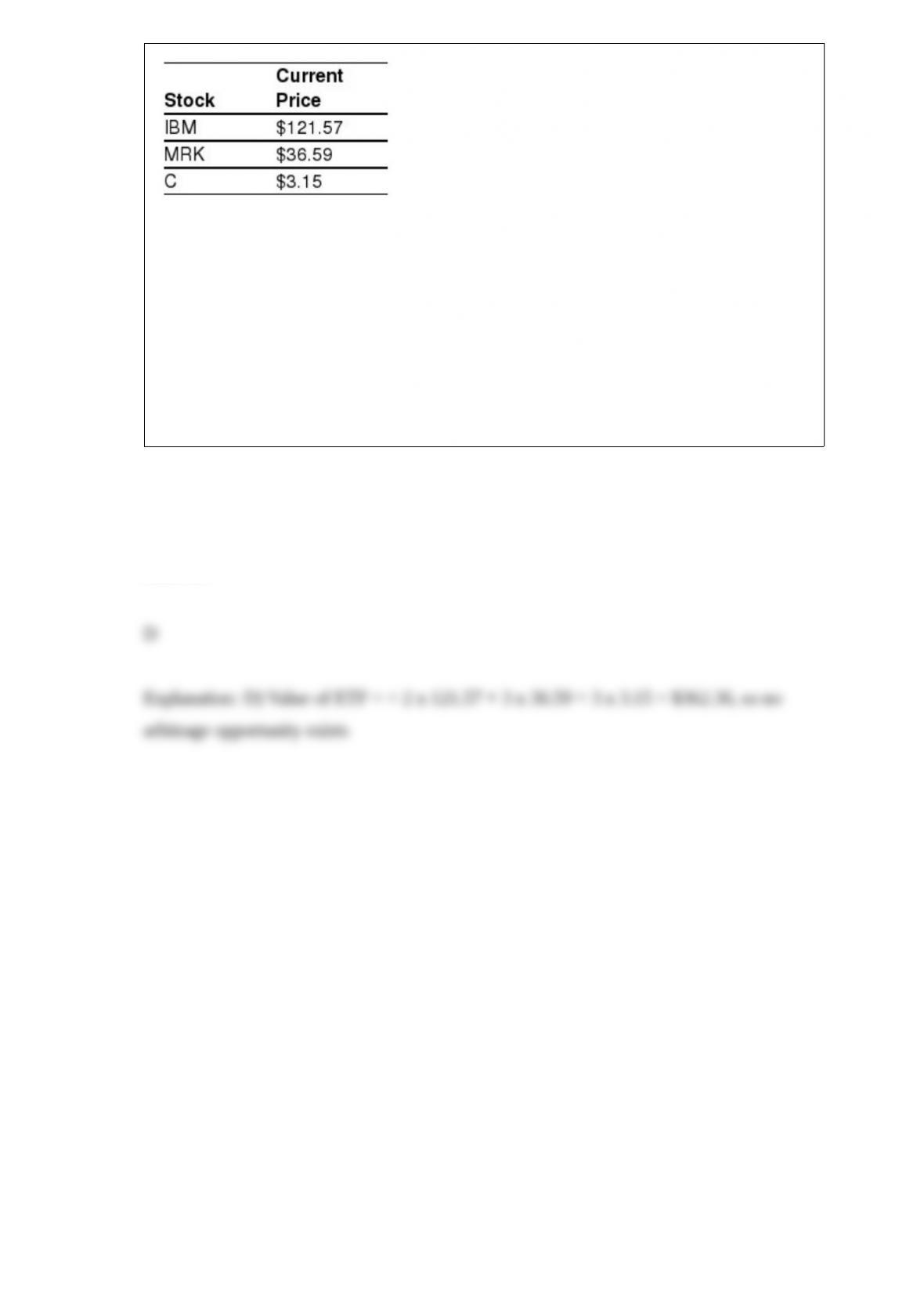
Suppose that the ETF is trading for $362.36; you should
A) sell the EFT and buy 2 shares of IBM, 3 shares of MRK, and 3 shares of C.
B) sell the EFT and buy 3 shares of IBM, 2 shares of MRK, and 3 shares of C.
C) buy the EFT and sell 2 shares of IBM, 3 shares of MRK, and 3 shares of C.
D) do nothing, no arbitrage opportunity exists.
Answer: