
Chinese walls are barriers within organizations that limit the flow of confidential
information between departments of business areas.
Answer:
Catastrophe futures are designed to hedge extreme losses of natural disasters for
property-casualty insurance companies.
Answer:
Operational risk has increased to a point that the Bank for International Settlements
(BIS) will require DIs to account for it in the capital adequacy standards under Basel II.
Answer:
A natural consequence of the effects of realized liquidity risk across several institutions
is the ability to recognize capital gains on the sale of assets in the attempt to generate

cash.
Answer:
During the decade of the 1990s the asset quality of U.S. banks continued to improve.
Answer:
The duration of a portfolio of assets can be found by calculating the book value
weighted average of the durations of the individual assets.
Answer:
Sales finance institutions provide financing to customers of specific retailers.

Answer:
Money center banks rely more heavily on wholesale and borrowed funds as sources of
liability funding than do community banks.
Answer:
Sovereign country risk is largely independent of the credit standing of the foreign
borrower.
Answer:
The function of capital to serve as a source of funds is critical to regulators in setting
risk-based deposit insurance premiums.
Answer:

Mutual funds are required to hire chief compliance officers whose job is to monitor
whether the mutual fund company follows exchange and regulatory rules.
Answer:
Banks have been permitted to acquire existing investment banks since 199
Answer:
A distinction between distressed and non-distressed is usually made when selling highly
leveraged transactions loans (HLTs).
Answer:

The Internet has allowed individual investors to purchase securities while benefiting
from decreased transactions costs.
Answer:
Liquidation of a mutual fund causes assets to be liquidated and funds received to the
dispersed to shareholders on a first come, first served basis.
Answer:
As of 2012, real estate loans dominated the assets of finance companies.
Answer:

The notational value of derivative contracts for the top 25 derivative users was less than
the total credit exposure as of June 2012.
Answer:
Pricing a fixed-floating rate swap agreement to meet no-arbitrage conditions requires
that the expected present value of the cash flow payments made by the fixed-rate seller
should equal the expected value of the cash flow payments made by the variable-rate
buyer.
Answer:
The number of bank failures in the period of 1933-79 was less than the number of
failures from 1980-1989.
Answer:

In determining the risk-adjusted value of the on-balance-sheet credit equivalent
amounts of the contingent guaranty contracts, the risk weights are determined by the
credit rating of the underlying counterparty of the off-balance-sheet activity.
Answer:
A foreign bank subsidiary in the U.S. is restricted to using only funds borrowed on the
wholesale and money markets.
Answer:
Because the economies of the U.S. and other overseas countries have become more
integrated, the risks of financial intermediation have decreased.
Answer:
Because a compensating balance is the proportion of a loan that must be kept on deposit

at the lending institution, the actual return to the lender on the usable portion of these
loans is higher.
Answer:
Which of the following observations is NOT TRUE?A. The use of electronic methods
of payment is far higher in major developed countries other than the United States.
B. E-money payments are virtually nonexistent in the United States.
C. Money stored in e-money accounts and cards is covered by deposit insurance.
D. U.S. FIs have been slow in adopting and using online banking and electronic
payment methods extensively.
E. All of the above.
Answer:
More FIs fail due to credit risk exposure than exposure to either interest rate risk or
foreign exchange risk.
Answer:

In estimating price sensitivity, the RiskMetrics model prefers to use modified duration
over the present value of cash flow changes.
Answer:
The future liquidity position of a DI cannot be forecasted.
Answer:
Which of the following is NOT TRUE?A. The finance company industry tends to be
very concentrated.
B. Twenty of the largest finance companies account for more than 65% of the industry
assets.
C. Many of the largest finance companies tend to be wholly owned or are captive
subsidiaries of major manufacturing firms.
D. Finance companies specialize only in consumer loans and do not make business
loans.

E. Finance companies often provide captive financing for the purchase of products
manufactured by their parent company.
Answer:
Which of the following observations concerning floating-rate loans is NOT TRUE?A.
They have less credit risk than fixed-rate loans.
B. They better enable FIs to hedge the cost of rising interest rates on liabilities.
C. They pass the risk of interest rate changes onto borrowers.
D. In rising interest rate environments, borrowers may find themselves unable to pay
the interest on their floating-rate loans.
E. The loan rate can be periodically adjusted according to a formula.
Answer:
In a forward contract agreement, the quantity of product to be traded, the time of the
actual trade and the price are determined at the time of the agreement.

Answer:
Price volatility of a bond can be estimated by multiplying the bond’s modified duration
by the adverse daily yield move.
Answer:
The economic meaning of duration is the interest elasticity of a financial assets price.
Answer:
Foreign exchange risk is that the value of assets and liabilities may change because of
changes in the foreign exchange rate between two countries.
Answer:

Matching the maturities of assets and liabilities supports the asset transformation
function of FIs.
Answer:
Regulators have proposed that operational risk should be measured for the purpose of
meeting overall capital adequacy.
Answer:
Purchased liquidity risk management usually involves purchased funds such as fed
funds, repurchase agreements and CDs.
Answer:

The following information is from First Yaupon Savings Association.
What is
the repricing gap over the 1-year maturity bucket? A. +$100 million.
B. -$500 million.
C. -$100 million.
D. +$500 million.
E. -$900 million.
Answer:
What must be the spot exchange rate to eliminate the preference for the yen loans if the
forward rate remains $0.62/×? A. $0.6416/×.
B. $0.5798/×.
C. $0.6118/×.
D. $0.5991/×.
E. Insufficient information.

Answer:
Eveningstar open-end fund has 1,000 shares outstanding and has the following assets in
its portfolio: 100 shares of Procter & Gamble (P&G) priced at $30.00, 300 shares of
Intel priced at $50.00 and 200 shares of Microsoft priced at $60.00. The Morningstar
closed-end fund has the following stocks in its portfolio: 300 shares of P&G and 300
shares of Microsoft. It has a total of 500 shares outstanding.
If the price of P&G shares rises to $35 and the price of Microsoft falls to $40.00, what
is the new NAV of both funds? A. $26.50 and $45.00.
B. $13.25 and $13.00.
C. $39.75 and $22.50.
D. $53.00 and $45.00.
E. $26.50 and $22.50.
Answer:

The deposit insurance programs of the National Credit Union Administration (NCUA)
is modeled after the programs offered by the FDIC.
Answer:
Prior to the financial crisis that began in 2007, finance companies A. had experienced
slow asset growth because of the upcoming economic slowdown.
B. had found subprime lending to be a risk-free method to achieve growth.
C. had experienced strong profit and loan growth, especially those companies that lend
to less risky customers.
D. had experienced strong success in the area of electronic lending.

E. had avoided takeover attempts by other financial institutions.
Answer:
The number of futures contracts that an FI should buy or sell in a macrohedge depends
on the A. size of its interest rate risk exposure.
B. direction of its interest rate risk exposure.
C. return risk trade-off from fully hedging that risk.
D. return risk trade-off from selectively hedging that risk.
E. All of the above.
Answer:
Consider the following discrete probability distributions of payoffs for 3 securities that
are held in a DI’s trading portfolio (payoff amounts shown are in $millions):
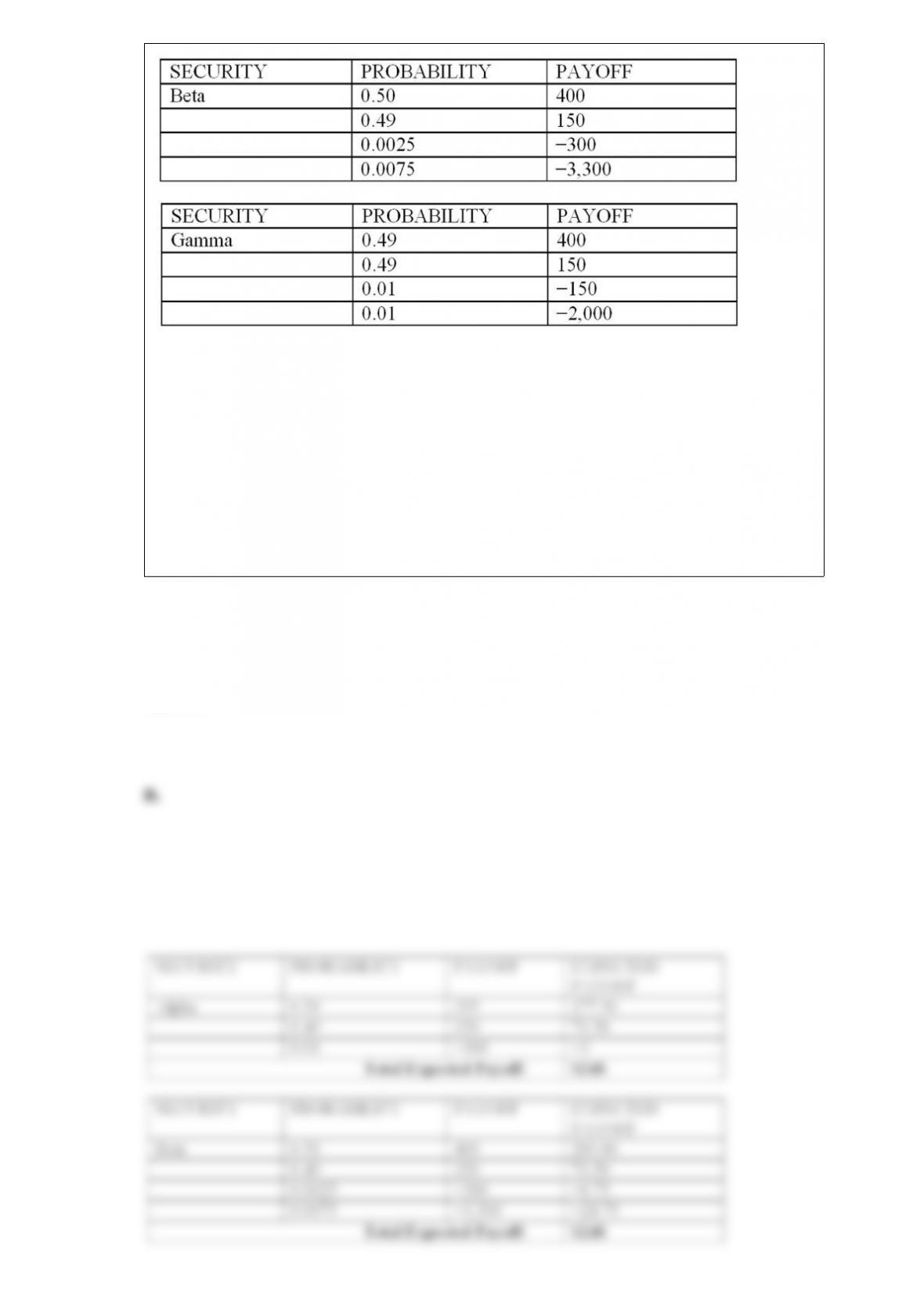
What
are the expected returns for securities Alpha and Beta, respectively (in millions)? A.
-$248 and +$248
B. +$248 and +$248
C. -$300 and +$400
D. +$300 and -$3,300
E. none of the above
Answer:

A bank with total assets of $271 million and equity of $31 million has a leverage
adjusted duration gap of +0.21 years. One-year maturity notes are currently priced at
par and are paying 4.5 percent annually. Two-year maturity notes are currently priced at
par and are paying 5 percent annually. The terms of a swap of $100 million notional
value of liabilities’ payments are 4.95 percent annual fixed payments in exchange for
floating rate payments tied to the annual discount yield.
What is the forward one-year discount yield expected next year? A. 5.013 percent.
B. 5.530 percent.
C. 4.500 percent.
D. 5.000 percent.
E. 4.950 percent.
Answer:
You start an annuity with $1million and expect to receive 12 equal payments beginning
at the end of the first year. The guaranteed annual interest rate is 6 percent. The annual
payments that you expect to collect are A. $88,333.33.
B. $119,277.03.
C. $59,638.51.
D. $56,262.75.

E. $112,525.50.
Answer:
In the derivatives markets, the credit risk exposure is greatest for A. options.
B. futures.
C. forwards.
D. swaps.
E. currencies.
Answer:
A DI has two assets: 50 percent in one-month Treasury bills and 50 percent in real
estate loans. If the DI must liquidate its T-bills today, it receives $98 per $100 of face
value; if it can wait to liquidate them on maturity (in one month’s time), it will receive

$100 per $100 of face value. If the DI has to liquidate its real estate loans today, it
receives $90 per $100 of face value liquidation at the end of one month will produce
$92 per $100 of face value. The one-month liquidity index value for this DI’s asset
portfolio is A. .973.
B. .940.
C. .979.
D. 1.06.
E. 1.10.
Answer:
What is the total DEAR of Sumitomo’s trading portfolio if the correlation among assets
is assumed to be -1.0? A. -$100,000.
B. -$291,548.
C. -$350,000.
D. -$380,789.
E. -$400,000.
Answer:

Each of the following is a function of capital EXCEPT A. funding the branch and other
real investments to provide financial services.
B. protecting the insurance fund and the taxpayers.
C. assuring the highest possible return on equity for the shareholders.
D. protecting uninsured depositors in the event of insolvency and liquidation.
E. absorbing losses in a manner that allows the FI to continue as a going concern.
Answer:
The Financial Services Modernization Act allowed forA. the creation of financial
services holding companies.
B. the replacement of all previous regulatory agencies with one super regulator.
C. the placement of some securities underwriting in bank subsidiaries.
D. All of the above.

E. Answers A and C only.
Answer:
Which is NOT a key economic ratio in credit scoring models to estimate sovereign
country risk exposure? A. The debt service ratio.
B. The import ratio.
C. The variance of export revenue.
D. The discount on rescheduled debt.
E. Domestic money supply growth.
Answer:
If the cumulative mortality rate in year 3 is 3.46 percent for the B-rated loan, what is its
yearly mortality rate in year 3?A. 1.25 percent.
B. 1.21 percent.
C. 1.00 percent.

D. 0.90 percent.
E. 0.875 percent.
Answer:
12b-1 fees A. are determined as a small percentage of the fund’s investable assets.
B. are annual fees to cover distribution and marketing costs of the fund.
C. have been approved by the SEC.
D. are capped at a maximum 0.25 percent for no-load funds.
E. All of the above.
Answer:

Variable universal life insurance policies A. have fixed premiums and a fixed benefit
payout.
B. have fixed premiums, but allow the benefit payout to vary with investment returns.
C. have a fixed benefit payout, but allow the premium to vary with investment returns.
D. allow both the premium and benefit payout to vary with investment returns.
E. allow both the premium and benefit payout to vary with investment returns, but have
a fixed maturity date.
Answer:
An open-end bond mutual fund is holding a three-year, $1 million face value 5 percent
annual coupon bond selling at par. What is the impact on the total asset value of the
fund of a 1 percent decrease in interest rates? A. A decrease of $10,000.
B. An increase of $10,000.
C. A decrease of $26,730.
D. An increase of $27,751.
E. The answer depends upon the number of mutual funds shares outstanding.
Answer:

What does a high proportion of brokered deposits indicate?A. Total risk-based capital
ratio of the DI is less than 10 percent.
B. Above average risk, and thus an increased potential for failure.
C. Less informed savers are protected against a reduction in wealth.
D. Reduced insolvency risk as brokered deposits are covered under deposit insurance.
E. Lower levels of credit risk.
Answer:
Under historical accounting methods for the market value of capital, FIs A. must write
down the value of their assets to fully reflect market values.
B. have a great deal of discretion in timing the write downs of problem loans.
C. must conform to regulatory write-down schedules.
D. have an incentive to fully reflect problems in the asset portfolio as they become
known.
E. invest in expensive computerized bookkeeping systems.

Answer:
An advantage FIs have over individual household investors is that they are able to
diversify away credit risk by holding a large portfolio of loans to different entities. This
reduces A. firm-specific credit risk.
B. systematic credit risk.
C. interest rate risk.
D. market risk.
E. political risk.
Answer:
In the NAIC model for life insurance companies, this risk measures the liquidity of
liabilities for given rate changes.A. Interest rate risk
B. Business risk
C. Asset risk
D. Foreign exchange risk
E. Insurance risk

Answer:
Which of the following wholesale services offered by FIs to businesses allows the FI to
combine the e-mail capabilities of the internet with the FIs ability to process payments
electronically through the interbank payment networks? A. Electronic data exchange.
B. E-commerce facilitation.
C. Electronic billing.
D. Electronic funds transfer.
E. Account reconciliation.
Answer:
The asymmetric return distribution (relatively high probability of anticipated return;
lower probability of default) on risky debt exposes the FI to A. technology risk.
B. interest rate risk.
C. credit risk.
D. foreign exchange risk.
E. off-balance-sheet risk.

Answer:
An insurance company collected $31.0 million in premiums and disbursed $28 million
in losses. Loss adjustment expenses amounted to $5.0 million. The firm is profitable A.
if dividends paid to policyholders is $4 million and income generated on investments is
$4 million.
B. if dividends paid to policyholders is $10 million and income generated on
investments is $14 million.
C. if dividends paid to policyholders is $6 million and income generated on
investments is $2 million.
D. if dividends paid to policyholders is $10 million and income generated on
investments is $4 million.
E. if dividends paid to policyholders is $4 million and income generated on
investments is $2 million.
Answer:

Using present value bond valuation techniques, calculate the exact price of the bond
after the interest rate increase of 20 basis points. A. $1,007.94.
B. $992.02.
C. $992.06.
D. $996.01.
E. $1,003.99.
Answer:
The following question are based on material in Appendix 8B
Which theory of term structure states that long-term rates are equal to the geometric
average of current and expected short-term rates plus a risk premium that increases with
the maturity of the security? A. The unbiased expectations theory.
B. The liquidity premium theory.

C. The loanable funds theory.
D. The market segmentation theory.
E. None of the above.
Answer:
What is the change in the value of its assets if all interest rates decrease by 1 percent?
A. Approximately $1.613 million.
B. Approximately $2.297 million.
C. Approximately -$1.937 million.
D. Approximately $2.209 million.
E. Approximately $2.524 million.
Answer:

What is the nominal payment paid or received by the U.S. bank over the three year
period? A. The U.S. bank received $2 million over the three year period.
B. The U.S. bank received $1 million over the three year period.
C. The U.S. bank paid $0 over the 3 year period.
D. The U.S. bank paid $1 million over the three period.
E. The U.S. bank paid $2 million over the three period.
Answer: