Benchmarks are required to evaluate a company’s performance.
If the total dollar value of credits to an account exceeds the total dollar value of debits
to that account, the ending balance of the account will be a debit balance.
The fraud triangle identifies incentive, opportunity, and benchmarks as the requirements
for a fraud to occur.
Companies within the same industry do not always use the same depreciation method,
but will use the same expected useful life for the same piece of equipment.
Common Stock is reported as an asset on the balance sheet.
Because it is an expense account, the Sales Returns & Allowances account balance is
deducted from the Sales Revenue account balance in determining net sales.
The calculation for depletion of natural resources is similar to the calculation for
depreciation when the units-of-production method is used.
Depreciation is a measure of the decline in market value of an asset.
Under the allowance method for uncollectible accounts, the write-off of a specific
account will not affect total assets.
Credit card companies charge a fee to the seller that accepts the credit cards. This fee is
recorded by the seller as a non-operating expense on its income statement.
In a periodic inventory system, the cost of goods sold is recorded as each sale occurs.
Using the T-account approach to preparing the statement of cash flows, an increase in
Accounts Payable would appear on the debit side of the Cash account.
Unearned Revenue is reported on the balance sheet as a liability.
Which of the following actions would be considered unethical?
A) A company does not distribute any of its profits to stockholders.
B) A company rounds the revenues and expenses that it reports on the income
statement.
C) An unintentional mistake made by a new accountant.
D) Receiving a paycheck for double the amount due to you and not reporting it to your
employer.
Which of the following statements about the interpretation of the receivables turnover
ratio is not correct?
A) Analysts often interpret a sudden increase in the receivables turnover ratio as a
signal of a developing problem.
B) The smaller the receivables turnover ratio the larger the days to collect will be.
C) A change in the receivables turnover ratio may indicate a change in the company’s
credit granting policies.
D) A change in the receivables turnover ratio may indicate a change in economic
conditions.
Your company places an order with suppliers for inventory for delivery in two weeks.
A) This is an internal event and it does not affect the balance sheet.
B) This is an activity that does not affect the balance sheet.
C) This is an internal event that affects the balance sheet.
D) This is an external exchange and it affects the balance sheet.
Use the information above to answer the following question. What was the amount of
cash paid for purchases of equipment during the year?
A) $40,000
B) $43,000
C) $50,000
D) $31,000
Which of the following statements about revenues and expenses is correct?
A) Credits increase both revenues and expenses.
B) Credits increase expenses and decrease revenues.
C) Credits increase revenues and decrease expenses.
D) Credits decrease both revenues and expenses.
A company issues 1 million shares of preferred stock with a par value of $2 at its
market price of $26 per share. The issuance should be recorded with a debit to Cash for:
A) $26 million and a credit to Preferred Stock for $26 million.
B) $2 million and a credit to Preferred Stock for $2 million.
C) $26 million, a credit to Additional Paid-in Capital for $2 million, and a credit to
Preferred Stock for $24 million.
D) $26 million, a credit to Preferred Stock for $2 million, and a credit to Additional
Paid-in Capital for $24 million.
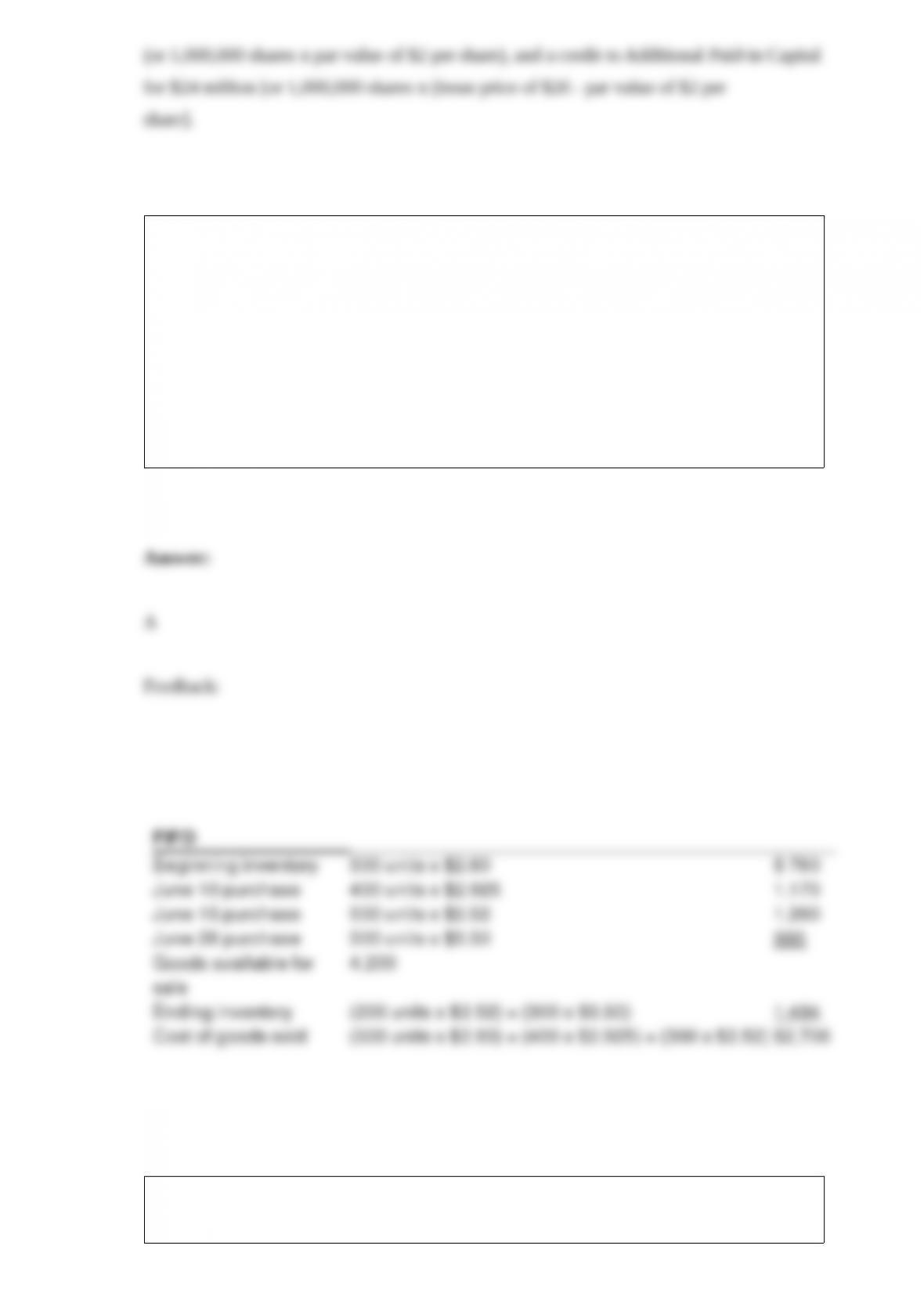
Use the information above to answer the following question. If Bailey Company uses
the FIFO costing method, what is the cost of its ending inventory?
A) $1,494
B) $2,290
C) $2,580
D) $2,706
A company had 300,000 shares of $10 par value common stock outstanding. The
amount of additional paid-in capital is $1,500,000, and Retained Earnings is
$450,000.The company issues a 2-for-1 stock split. The market price of the stock is
$13. What is the balance in the Common Stock account after this issuance?
A) $6,000,000
B) $6,900,000
C) $3,000,000
D) $4,500,000
The income statement would report the amount of:
A) cash at the end of the year.
B) supplies used up during the current year.
C) dividends distributed to owners during the current year.
D) unpaid employee wages at the end of the year.
Your company has previously averaged about 26% of its accounts receivable in the
“over 90 days past due” category. This year, the company hired a new collections
manager and, as a result, management forecasts that only 18% of its accounts receivable
will be in this category at the end of the current year. The company uses the aging of
accounts receivable method of estimating Bad Debt Expense. If the total of credit sales
and year-end balance in accounts receivable remain unchanged from the previous year
and no write offs were made during the current year, this year’s bad expense will:
A) increase over the estimate for previous months.
B) decrease over the estimate for previous months.
C) not change.
D) will depend on the percentage of credit sales deemed uncollectible.
In a retail business that uses a perpetual inventory system, scanning a bar code does not:
A) calculate the amount owed by the customer.
B) identify the item sold to be removed from the Inventory account.
C) identify the item sold to be recorded in the Cost of Goods Sold account.
D) calculate the gross profit.
Which of the following would not affect a company’s net income?
A) A change in the company’s income taxes
B) Changing the selling price of a company’s product
C) Paying a dividend to stockholders
D) Advertising a new product
Following are seven items (a) through (g) that would cause Coyle Company’s book
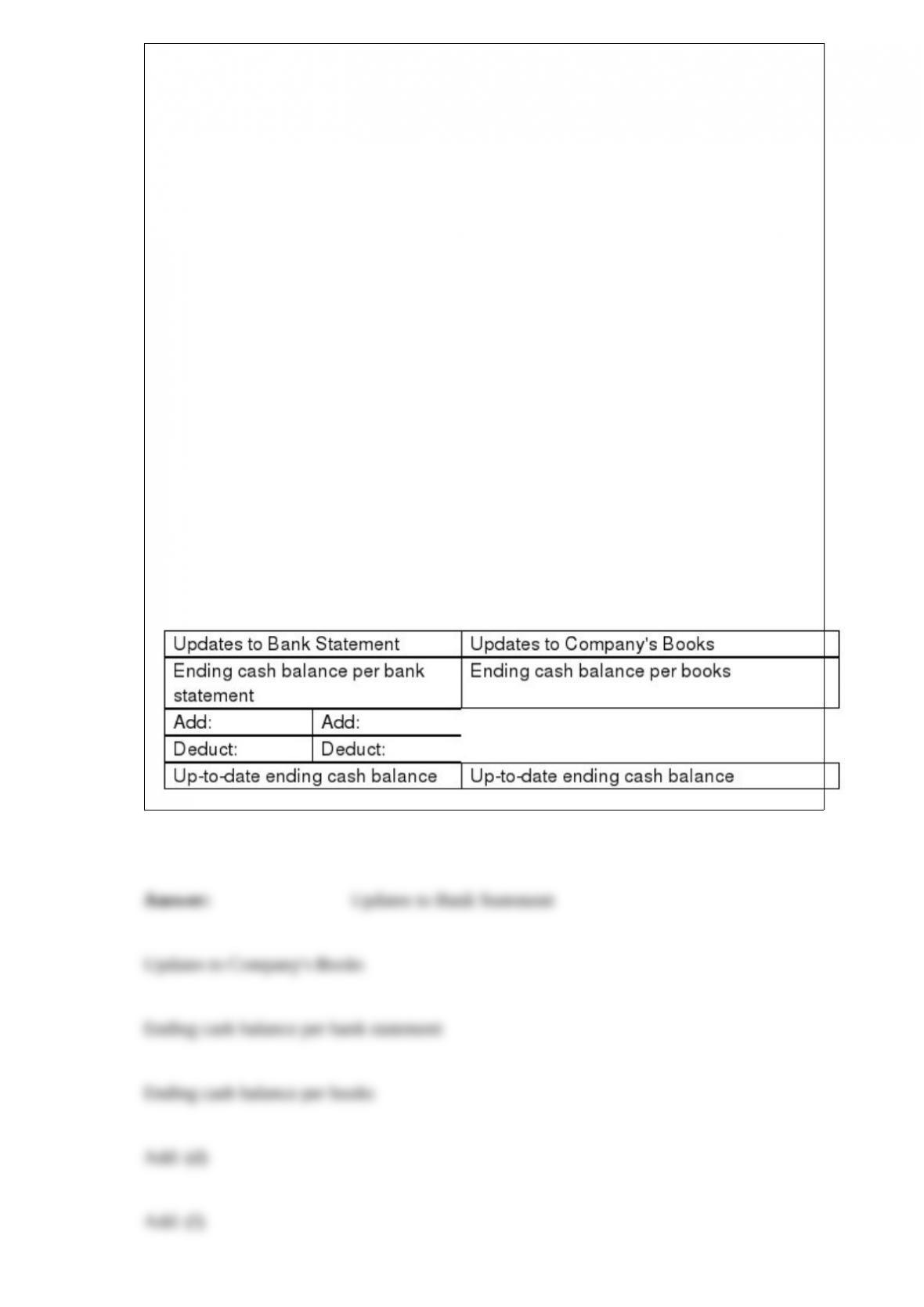
balance of cash to differ from its bank statement balance of cash.
(a) A service charge imposed by the bank.
(b) A check listed as outstanding on the previous period’s reconciliation and still
outstanding at the end of this month.
(c) A customer’s check returned by the bank is marked “Not Sufficient Funds. (NSF)”
(d) A deposit that was mailed to the bank on the last day of the current month and is
unrecorded on this month’s bank statement.
(e) A check paid by the bank at its correct $190 amount was recorded in error in the
company’s Check Register at $109.
(f) An unrecorded credit memorandum indicated that bank had collected a note
receivable for Xavier Company and deposited the proceeds in the company’s account.
(g) A check was written in the current period that is not yet paid or returned by the
bank.
Indicate where each item (a) through (g) would appear on Coyle’s bank reconciliation
by placing its identifying letter in the parentheses in the proper section of the form
below.

Allsop Company had no beginning inventory. The company purchases 300 units of
inventory in January at $5 each, 500 units at $4 each in August, and 200 units at $6
each in November. The company sells 150 units during the year. Allsop uses a periodic
inventory system and the LIFO inventory costing method. What is the cost of goods
sold?
A) $600
B) $934
C) $750
D) $900
Vesuvius Company has net sales revenue of $780,000, cost of goods sold of $343,200,
net income of $119,200, and preferred dividends of $10,000 during the current year. At
the beginning of the year, 503,000 shares of common stock were outstanding, and, at
the end of the year, 537,000 shares of common stock were outstanding. A total of 1,000
preferred shares were outstanding throughout the year. The company’s earnings per
share for the current year is closest to:
A) $1.50.
B) $0.84.
C) $0.21.
D) $0.87.
A corporate charter specifies that the company may sell up to 20 million shares of
stock. The company issues 12 million shares to investors and later repurchases 3 million
shares. The number of issued shares after these transactions have been accounted for is:
A) 12 million shares.
B) 11 million shares.
C) 9 million shares.
D) 5 million shares.
Assets:
A) represent the amounts earned by a company.
B) must equal the liabilities of a company.
C) must equal the stockholders’ equity of the company.
D) represent the resources presently controlled by a company.