
A treasury bill currently sells for $9,845, has a face value of $10,000 and has 46 days to
maturity. What is the bank discount rate on this security?
A. 12.49 percent
B. 12.13 percent
C. 12.30 percent
D. 2 percent
E. None of the options is correct.
Answer:
Which of following contingent liabilities may be required to be recorded on a balance
sheet and not to be hidden as a footnote?
A. Environmental liabilities
B. Limiting regulations
C. Unfunded pension liabilities
D. Litigation or pending lawsuits against firms
E. Underfunded pension liabilities
Answer:

Examples of imperfections in the financial system which allow banks to exist include
which of the following?
A. Informational asymmetry
B. Efficiency of markets
C. Divisibility of assets
D. Adequate liquidity
E. All of the examples are of the imperfections that exist.
Answer:
The noncash expense item on a bank’s Report of Income designed to shelter a bank’s
current earnings from taxes and to help prepare for bad loans is called:
A. short-term debt interest.
B. noninterest expense.
C. provision for taxes.
D. provision for possible loan losses.
E. None of the options are correct.
Answer:
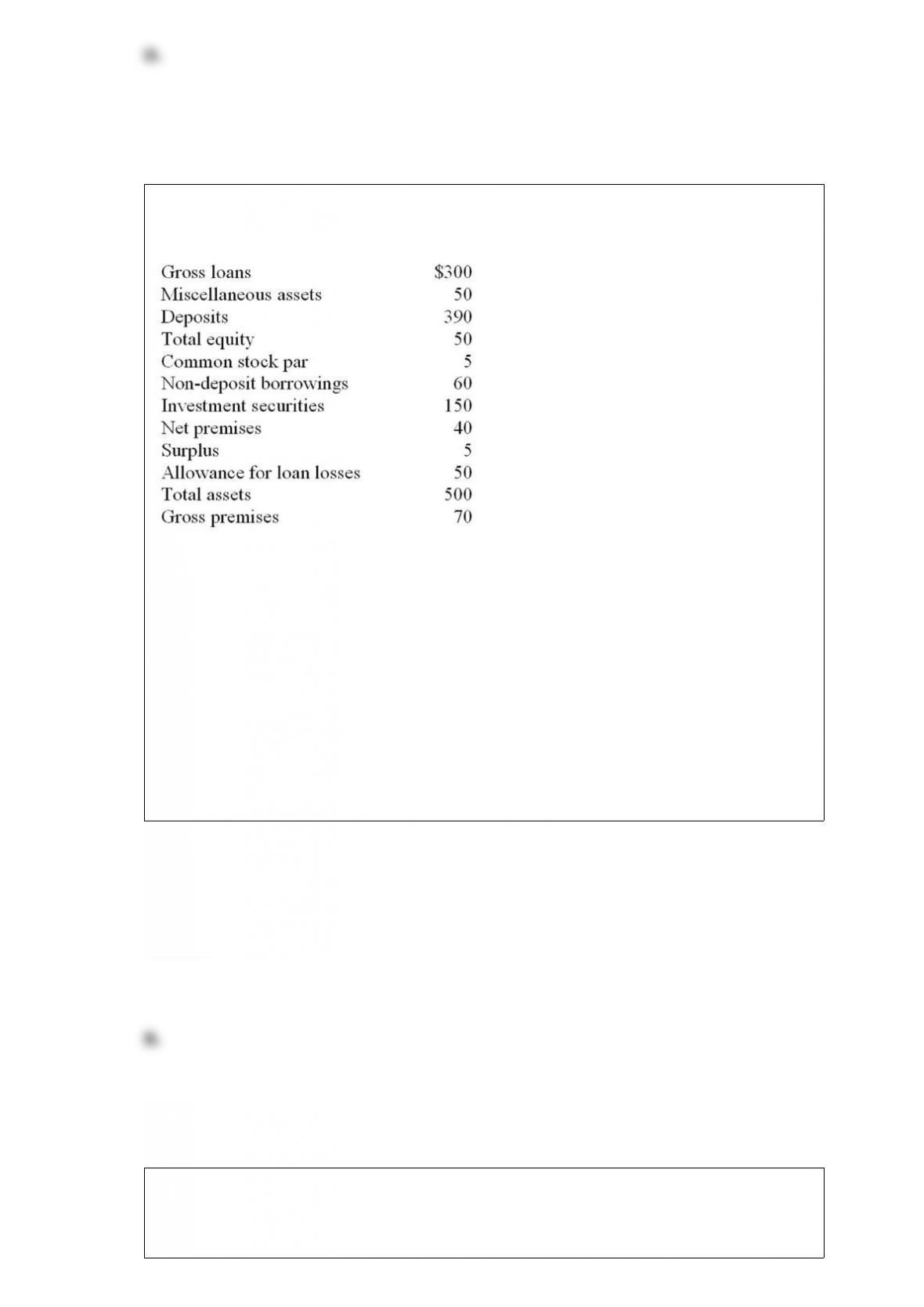
You know the following information about the Miller State Bank:
Given this information, what is the value of this firm’s depreciation?
A. $250
B. $30
C. $70
D. $40
E. $110
Answer:
The Third National Bank of Wichita makes a loan so that Tim Bridges can buy 1,000
shares of Coca Cola stock. Which category of loans would this loan fit in best?

A. Financial institution loan
B. Commercial and industrial loan
C. Loan to an individual
D. Miscellaneous loan
E. Lease financing receivables
Answer:
When an issuer of securitized loans sets aside a cash reserve to cover loan defaults, they
are providing an:
A. internal credit enhancement.
B. external credit enhancement.
C. internal liquidity enhancement.
D. external liquidity enhancement.
E. None of the options is correct
Answer:

The Third State Bank of Laramie has opened an office in Morocco. This office does not
take deposits but makes commitments to make loans, issues letters of credit, and
provides technical assistance to companies in Morocco. What type of office has the
Third State Bank of Laramie opened in Morocco?
A. A representative office
B. An agency office
C. A branch office
D. A subsidiary
E. An export trading company
Answer:
An additional charge on a home mortgage loan that a borrower may be asked to pay up
front is referred to as:
A. loan interest owed.
B. points.
C. loading.
D. tax equity.
E. None of the options is correct.
Answer:

The Caldwell National Bank has purchased a bond that pays a coupon rate of 10.5%. It
is a little concerned because it believes rates will decrease in the future and they will
not be able to reinvest the coupon payments at the same rate. What type of risk are they
concerned about?
A. Credit risk
B. Reinvestment risk
C. Business risk
D. Call risk
E. Prepayment risk
Answer:
Which of the following is a challenge faced by a virtual bank?
A. Ability to verify real time account balances
B. Ability to confirm that deposits of funds have been received
C. Ability to submit applications for loans and credit cards
D. Ability to move funds instantly from one account to another
E. Ability to prevent identity theft
Answer:

When a bank is expecting that the overall risk of FHC will be reduced when they
combine investment banking services with the traditional banking services, what type
of effect are they expecting?
A. Product-line diversification effect
B. Market diversification effect
C. Income diversification effect
D. Geographic diversification effect
E. None of the options is correct.
Answer:
Which of the following aspects of a customer’s loan application should a bank’s real
estate loan officer consider carefully when making a home mortgage?
A. The amount and stability of the borrower’s income
B. The borrower’s available savings and where the down payment is coming from
C. The borrower’s track record in caring for and managing property
D. The outlook for real estate sales in the local market area
E. All of the options are factors that need to be looked into carefully

Answer:
Current selling price on a futures contract reflects what investors in the market expect
cash prices to be:
A. at the end of the day.
B. at the end of the week.
C. at the end of the month.
D. at the end of the year.
E. at the time of delivery.
Answer:
The Taylor Treadwell Bank has just calculated the ratio of its demand deposits to total
time deposits. Which liquidity indicator is this?
A. Deposit composition ratio
B. Liquid securities indicator
C. Net federal funds and repurchase agreement position
D. Capacity ratio
E. None of the options is correct

Answer:
A time deposit that allows for a periodic upward adjustment to the promised rate is
called a:
A. negotiable CD.
B. bump-up CD.
C. step-up CD.
D. liquid CD.
E. None of the options is correct.
Answer:
Second National Bank is considering adding 5 new ATM machines. Each machine costs
$25,000 and installation costs are $15,000 per machine. Second National Bank expects
the new machines to save $0.33 per transaction on 250,000 transactions per year on the
new machines. It also expects the new machines to last for 15 years. If the bank needs
to earn 14 percent return on this investment, what is the net present value of this
investment?
A. $506,729

B. $306,729
C. $272,269
D. $381,729
E. $424,228
Answer:
There are 10 banks in a particular market area, all with a market share of 10 percent.
Two of the banks plan to merge and the Herfindahl-Hirschman Index moves from 1,000
to 1,200. The Justice Department:
A. will treat this market as unconcentrated.
B. will not be concerned and no further review is likely.
C. may raise competitive concerns depending on the circumstances.
D. will treat the market as highly concentrated.
E. will block the merger by filing a suit.
Answer:

________ in a swap refers to the risk arising from the difference in the interest rate
defined in the terms of a swap and the interest rates of the assets and liabilities held by
the parties to swap.
A. Default risk
B. Liquidity risk
C. Interest rate risk
D. Basis risk
E. Transaction risk
Answer:
The law that prevents individuals from being denied credit because of race, sex,
religious affiliation, age or receipt of public assistance is called:
A. The Sarbanes-Oxley Act.
B. The Community Reinvestment Act.
C. The Equal Credit Opportunity Act.
D. The Truth in Lending Act.
E. None of the options is correct.
Answer:

A bank that wants to examine the liquidity of a borrower would most likely examine
which of the following ratios?
A. Costs of goods sold ÷ Average inventory
B. Income before interest and taxes ÷ Interest payments
C. Cost of goods sold ÷ Net sales
D. Current assets ÷ Current liabilities
E. All of the options are correct.
Answer:
Which of the following is a factor that affects a bank’s decision as to which nondeposit
sources of funds to use to cover its projected funds gap?
A. The relative cost of raising the funds.
B. The length of time the funds will be required.
C. The risk associated with each source of funds.
D. The size of the bank.
E. All of the options are correct.
Answer:

A financial institution has estimated that its growth rate in deposits over the last ten
years has averaged 6 percent per year. This is the _________________________ of
estimating future deposits.
A. trend component
B. seasonal component
C. cyclical component
D. stationary component
E. None of the options is correct
Answer:
Which of the following is(are) reason(s) that many bank mergers do not work?
A. Ill-prepared management
B. A mismatch of corporate cultures
C. Excessive price paid by the acquirer
D. A failure to take into account customers’ feelings and concerns
E. All of the options are reasons bank mergers do not work.
Answer:
Which of the following would be an example of Tier 1 capital?
A. Subordinated debt capital instruments with an original maturity of at least 5 years
B. Allowance for loan and lease losses
C. Minority interest in the equity accounts of consolidated subsidiaries
D. Intermediate-term preferred stock
E. All of the options are correct.
Answer:
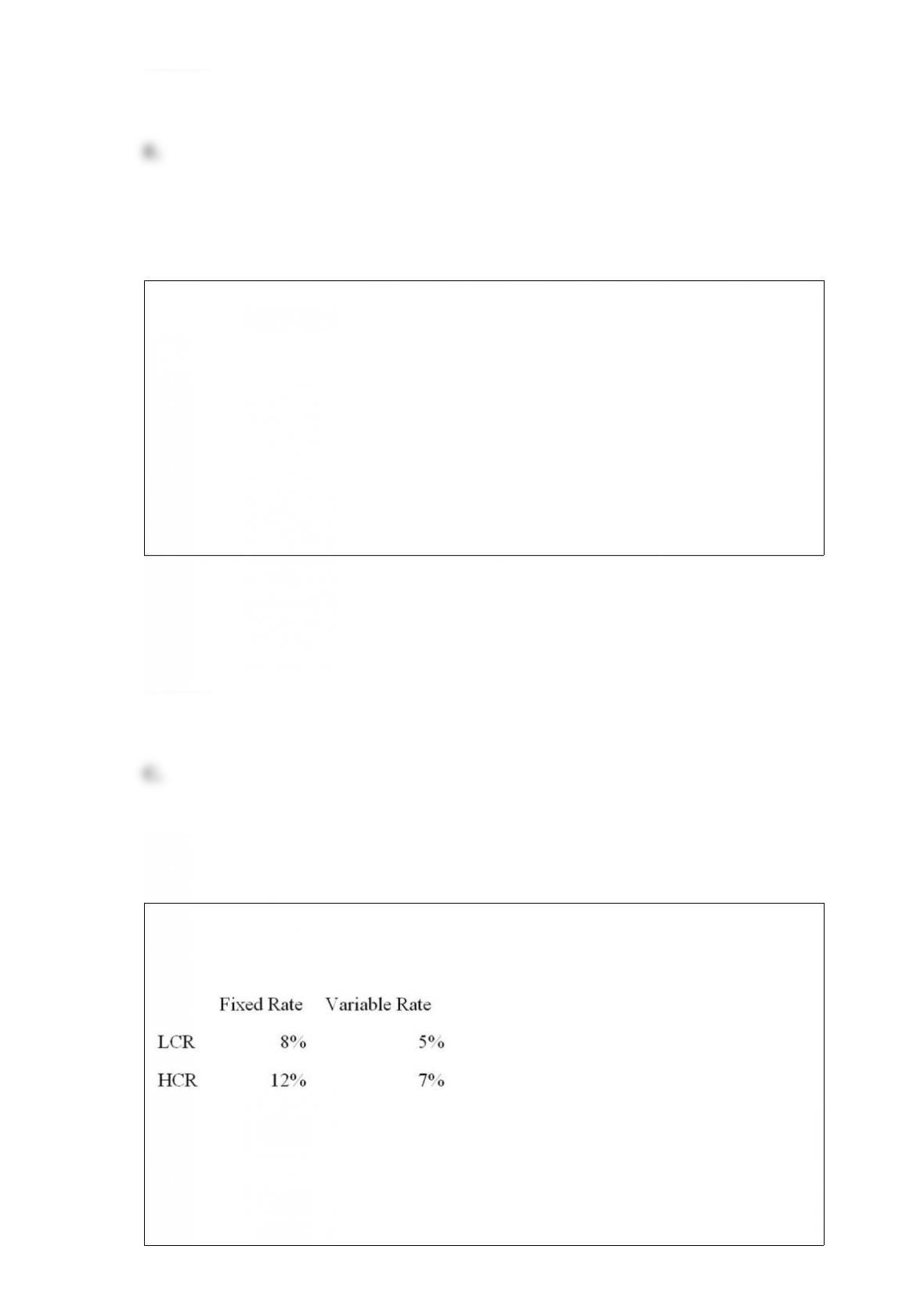
Assume that two firms, one considered a high credit risk (HCR) and the other a low
credit risk (LCR), are considering an interest rate swap. Each can borrow at the
following rates:
An interest rate swap would be beneficial to both parties if: A. the LCR firm wants to
borrow at the fixed rate and the HCR firm wants to borrow at the variable rate.
B. the HCR firm wants to borrow at the fixed rate and the LCR firm wants to borrow at
the variable rate.

C. both firms want to borrow at the variable rate.
D. both firms want to borrow at the fixed rate.
E. an interest rate swap would be never beneficial in this situation.
Answer:
Suppose Bank of America holds assets denominated in yen of 150 million and liabilities
denominated in yen of 90 million. They also have yen purchases of 70 million and yen
sales of 50 million. What is Bank of America’s net exposure to currency risk?
A. + 150 million yen
B. + 60 million yen
C. + 80 million yen
D. – 80 million yen
E. – 60 million yen
Answer:

Which of the following is a strength of the price leadership loan pricing method?
A. It considers the competition from other lenders.
B. It allows the bank to compete more aggressively with the commercial paper market.
C. It considers the cost of loanable funds and the operating costs of running the bank.
D. It takes the whole customer relationship into account.
E. None of the options is correct.
Answer:
A bond has eight years to maturity and a coupon rate of 6.5 percent. Coupon payments
are made annually and the bond has a face value of $1,000. The bond is currently
selling in the market for $862. If this bond is sold at the end of four years for $1046
(ex-interest), what is the holding period return on this bond?
A. 6.5 percent
B. 12 percent
C. 9 percent
D. 6 percent
E. None of the options is correct
Answer:

Which of the following ratios would be a measure of market risk?
A. Nonperforming Loans/Net Loans
B. Net Loans/Total Assets
C. Cash and equivalents/Total assets
D. Equity Capital/Total Assets
E. None of the options is correct
Answer:
Major trends affecting the performance of financial firms today include all of these
except: A. greater product-line diversification.
B. reduced branching.
C. geographic diversification.
D. convergence.
E. increasing automation.
Answer:

The Carey State Bank has purchased a bank-qualified municipal bond with a coupon
rate of 6%. The bank has had to borrow funds to make this purchase at a cost of 5.25%.
The bank is in the 40% tax bracket. What is the net after-tax return on this
bank-qualified municipal bond?
A. 6.00%
B. 0.75%
C. 2.85%
D. 2.43%
E. None of the options is correct
Answer:
A bank has an average asset duration of 5 years and an average liability duration of 9
years. This bank has total assets of $1,000 million and total liabilities of $850 million.
Currently, market interest rates are 5 percent. What will be this bank’s leverage-adjusted
duration gap?
A. -4 years
B. 4 years
C. 2.65 years
D. -2.65 years
E. 3.65 years

Answer:
A(n) ______________________ combines a computer terminal, record keeping system,
and vault cash in one unit allowing customers to withdraw money, check deposit
balances, and other limited services 24 hours a day.
Answer:
A third financial statement, used in addition to the income statement and balance sheet
by lenders, is the __________. It is required by FASB and is usually readily available
from borrowers.
Answer:
The federal bank regulatory agency which examines the most banks is the
_____________.

Answer:
A device which aids customers in selling goods abroad is known by the acronym
_________ and was originally developed by the Japanese.
Answer:
A(n) _________________________ occurs when two banks agree to exchange a
portion or all of the loan repayments of their customers.
Answer:
The ___________________________ is a landmark act which allows financial service
providers to offer an expanded menu of financial services for the customer. This law
allows banks to truly become conglomerate financial service providers.

Answer:
The policy of FDIC to levy fixed insurance premiums regardless of the risk involved,
led to a/an _____________ problem among banks. The fixed premiums encouraged
banks to accept greater risk.
Answer:
If total legal reserves held are greater than required reserves, a bank has
____________.
Answer:
A(n) __________________________ is a deposit account which pays an interest rate
competitive with money market mutual funds and which generally has limited check

writing ability.
Answer:
_________________________ are instruments which have less than one year to reach
maturity.
Answer:
____________ models attempt to measure price or market risk of a portfolio of assets
and attempt to determine the maximum loss they might sustain over a designated period
of time.
Answer:

The European Commission has emerged as a key arbiter for mergers involving
European businesses. The commission is principally against the doctrine of
_________________.
Answer:
The interest rate on most consumer loans is based on the cost of loanable funds to the
bank, plus nonfunding cost, plus premiums for default and time to maturity, and also
includes the desired profit margin on the loan. This method of pricing loans is known as
_____________________.
Answer:
When a merger takes place, some banks have been asked by the regulators to
__________________ themselves of some of their branches to avoid anticompetitive
activities. Many of these are sold to third parties.
Answer:

______________________ is a basic method for calculating the interest owed on a loan
that adjusts for declining balances and the time remaining on the loan.
Answer:
________________________ include credit to finance the purchase of automobiles,
mobile homes, appliances, and other retail goods and services purchased by
consumers.
Answer:
Customers of financial-service companies may _____________________ of having
their private information shared with a third party, such as a telemarketer. However, in
order to do this, they must tell the financial-services company in writing that they do
not want their personal information shared with outside parties.
Answer:

______________________ refers to the protection afforded to creditors of a firm based
on the amount of the firm’s earnings.
Answer: