
1) the risk that a security cannot be sold at a predictable price with low transaction costs
at short notice is called liquidity risk.
2) primary markets are markets where users of funds raise cash by selling securities to
funds’ suppliers.
3) a cmo is a multiclass pass-through that helps investors choose the amount of
prepayment risk they will face.
4) if you can convert 150 swiss francs to $90, the exchange rate is 1.67 francs per
dollar.
5) a u.s. bank has made £12 million worth of loans and £10 million worth of deposits in
britain. the bank would benefit from a drop in the value of the pound against the dollar.
6) swaps are usually the best hedging tool to use to hedge long-term risks of 4 or 5
years or more.
7) a $25,000 face value gnma pass-through quote sheet lists a spread to average life of
103, psa of 220, and a price of 101-09 . this means that
i. the pass-through yield is 103 basis points above the comparable maturity treasury
bond.

ii. the pass-through is being prepaid more quickly than standard psa.
iii. the pass-through is priced at $25,272.50.
a.i, ii, and iii are correct
b.i and ii only
c.i and iii only
d.ii and iii only
e.iii only
8) for the finance company industry as a whole, the largest single loan type is
a.business loans
b.consumer loans
c.real estate loans
d.high-risk consumer loans
e.credit card loans
9) all banks located in the european union offer deposits that are insured for
__________ euros, although depositors are subject to a _________________ in the
event of loss.
a.100,000; 2.5% insurance premium
b.50,000; 95% recovery rate
c.50,000; 10% deductible
d.45,000; 5% fine
e.75,000; 90% recovery rate
10) etfs have several advantages over index funds including the ability to:
i. trade throughout the day at continuously updated prices.
ii. purchase etf shares on margin.
ii. sell etf shares short.
iv. sell the shares back to the fund.
a.i, ii, and iii only
b.i, iii, and iv only
c.ii, iii, and iv only
d.ii and iii only
e.i, ii, iii, and iv

11) figure 24-1
a bank originates $150,000,000 worth of 30-year single-family mortgages funded by
demand deposits and the required amount of capital. reserve requirements are 10% and
the bank pays 32 basis points in deposit insurance premiums. the bank is earning a
6.25% coupon on the mortgages. the mortgages are priced at par and total monthly
payments on the mortgages are $923,576.
how much capital is required to back the mortgages if the minimum risk-based capital
requirement is 8%?
a.$75.0 million
b.$37.5 million
c.$12.0 million
d.$3.0 million
e.$6.0 million
12) if the fed wishes to stimulate the economy it could
i. buy u.s. government securities
ii. raise the discount rate
iii. lower reserve requirements
a.i and iii only
b.ii and iii only
c.i and ii only
d.ii only
e.i, ii, and iii
13) the fdic is required to collect additional insurance premiums from insured
institutions if the bif reserves fall below ________________ of insured deposits.
a.1.00%
b.1.15%
c.1.50%
d.1.75%
e.2.00%

14) explain the relationship between each of the following ratios and liquidity risk.
a) loan-to-deposit ratio
b) borrowed funds to total assets
c) loan commitments to total assets
15) two competing fully electronic derivatives markets in the united states are
a.cme globex and eurex
b.philadelphia exchange and amex
c.nyse and abs
d.cme and pacific exchange
e.d-trade and imm
16) a contingent item that may eventually be placed on the right-hand side of the
balance sheet or expensed on the income statement is a(n)
a.loan commitment
b.off-balance-sheet liability
c.off-balance-sheet asset
d.net charge-off
e.loan sold without recourse
17) discuss the major macro benefits of financial intermediaries. what role does the
government have in the credit allocation process?
18) what is sovereign risk? how is this different from credit risk on a domestic loan?
how can sovereign risk be limited?
19) a bank wishes to hedge its $25 million face value bond portfolio (currently priced at
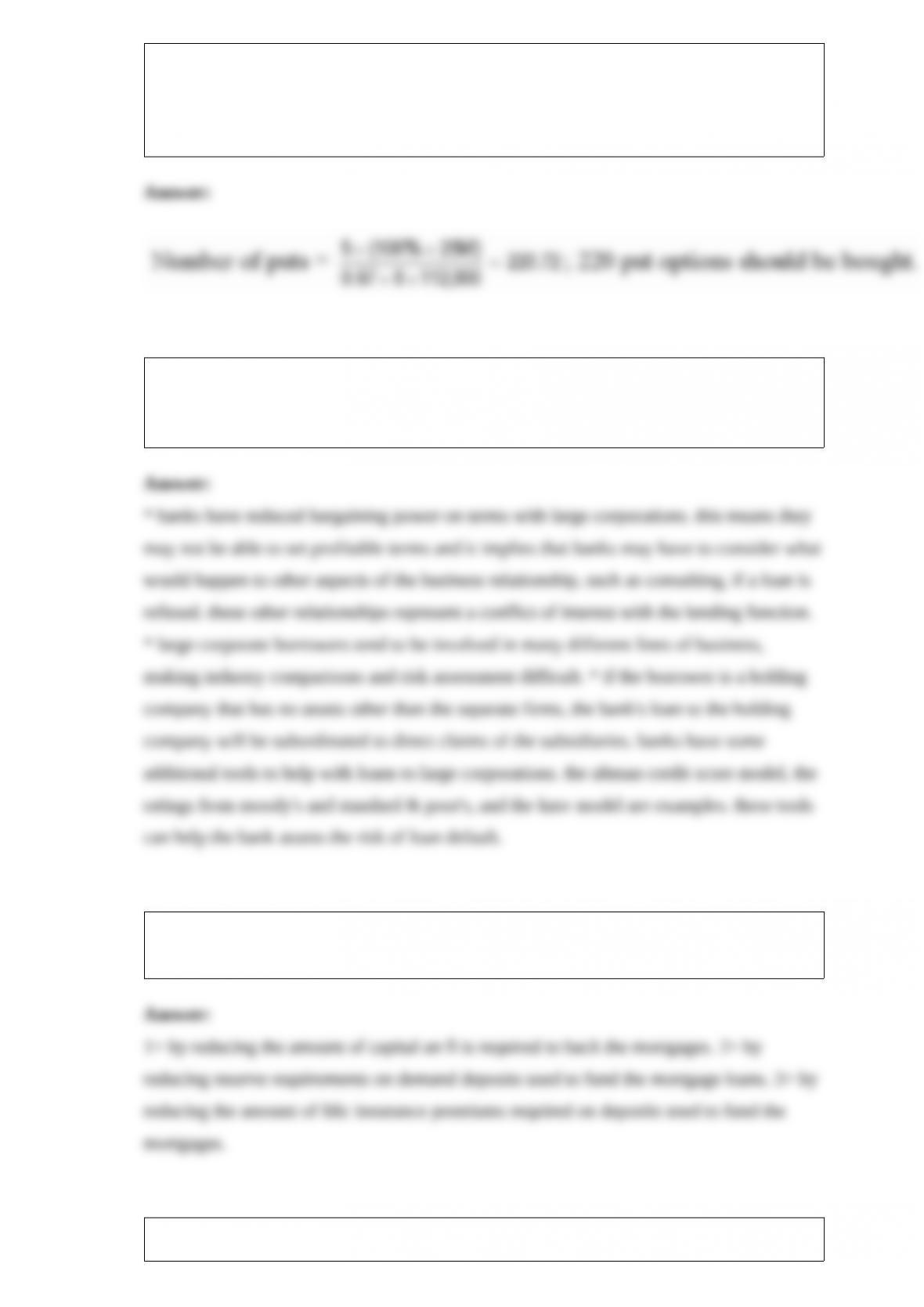
106% of par). the bond portfolio has a duration of 5 years. they will hedge with put
options that have a delta of 0.67. the bond underlying the option contract has a market
value of $112,000 and a duration of 8 years. how many put options are needed? assume
that there is no basis risk on the hedge.
20) why is bank lending to large corporations more difficult than making loans to small
or mid-size firms? what additional factors are involved? do banks have some additional
tools to help in assessing credit risk of large firms? what are some examples?
21) how does mortgage securitization reduce the regulatory tax burden of a depository
institution?
22) what are the five cs of credit? briefly describe each.

23) discuss the benefits to funds’ suppliers of using a financial intermediary asset
transformer in place of directly purchasing claims such as stocks or bonds. what is the
major disadvantage?
24) characterize each of the following according to the type of risk it primarily
represents:
i. loan default
ii. unexpected deposit withdrawals
iii. losses on foreign currency holdings
iv. losses on standby letters of credit
v. reduction in earnings after an interest rate increase
indicate which of the risks could cause insolvency of the fi.
25) cite one law or regulation per each of the following categories:
safety and soundness regulation
monetary policy regulation
credit allocation regulation

consumer protection regulation
investor protection regulation