1) if relatively capital-abundant country a opens trade with relatively labor-abundant
country b and the trade takes place in accordance with the heckscher-ohlin theorem,
what would be the consequence for factor prices (w/r) in the two countries?
a. (w/r) rises in a and falls in b
b. (w/r) rises in a and also rises in b
c. (w/r) falls in a and rises in b
d. (w/r) falls in a and also falls in b
2) if two countries remove all tariffs on each others products and establish a common
set of tariffs against the rest of the world, but take no further steps toward economic
integration, these two countries have formed
a. a free-trade area
b. a customs union
c. a common market
d. an economic union
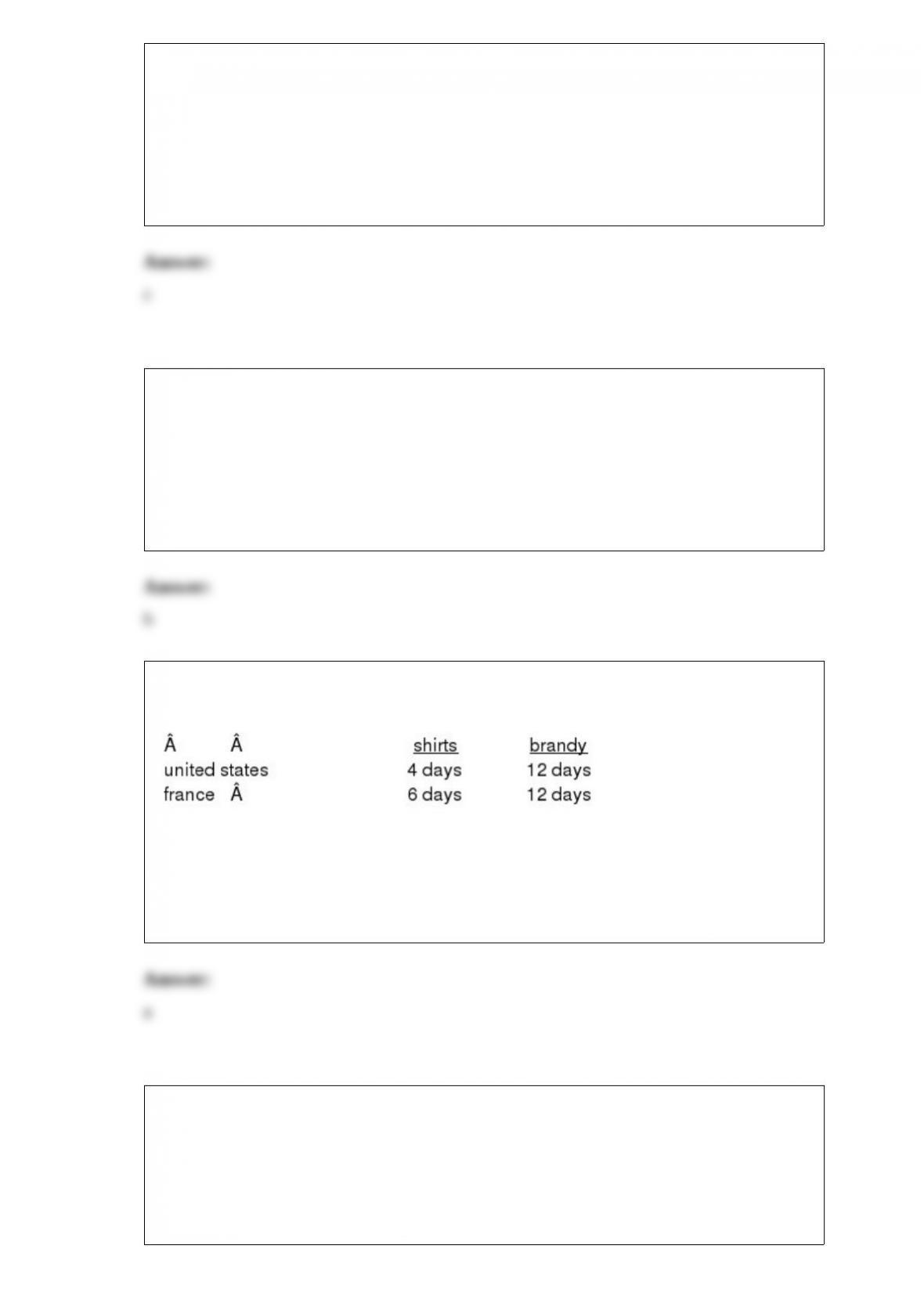
3) given the following ricardo-type table shows the labor input required per unit of
output in each of the two industries in each of the two countries:
which one of the following statements is correct?
a. frances pretrade price ratio is 1 brandy = 2 shirts
b. the u.s. pretrade price ratio is 1 shirt = 3 brandy
c. the united states has an absolute advantage in both goods
d. france will export shirts after trade begins
4) if, in a demand curve/supply curve graph with the quantity of u.s. imports plotted on
the horizontal axis and the price of u.s. imports in dollars plotted on the vertical axis,
suppose that, from an initial equilibrium position, there is now a depreciation of the u.s.
dollar relative to other currencies. (assume that the supply curve is horizontal.) other
things equal, this depreciation of the dollar would cause the __________.
a. demand curve to shift to the left (or vertically downward)

b. demand curve to shift to the right (or vertically upward)
c. supply curve to shift vertically downward
d. supply curve to shift vertically upward
5) if increased heckscher-ohlin-type trade were the major factor leading to increased
income inequality in the united states, then one would expect that the relative prices of
skilled labor-intensive goods to unskilled labor-intensive goods would have
__________ and that nontraded goods industries would have __________ their use of
unskilled labor relative to skilled labor.
a. risen; decreased
b. risen; increased
c. fallen; decreased
d. fallen; increased
6) which of the following findings would not be consistent with the product cycle
theory?
a. a finding that developing countries export older manufactured products
b. a finding that the united states exports new products
c. a finding that u.s. export industries are heavily engaged in research and development
(r&d) activities
d. a finding that the united states exports goods catering mainly to low income tastes
rather than high income tastes
7) which expression below indicates the relationship between product price (p),
marginal cost (mc), and the price elasticity of demand facing a firm (ed, which is
negative) when the firm is pricing in order to maximize profit?
a. p = mc [(ed + 1)/(ed)]
b. p = mc [(ed)/(ed + 1)]
c. mc = p [ed/(ed – 1)]
d. p – mc = [ed/(ed + 1)]
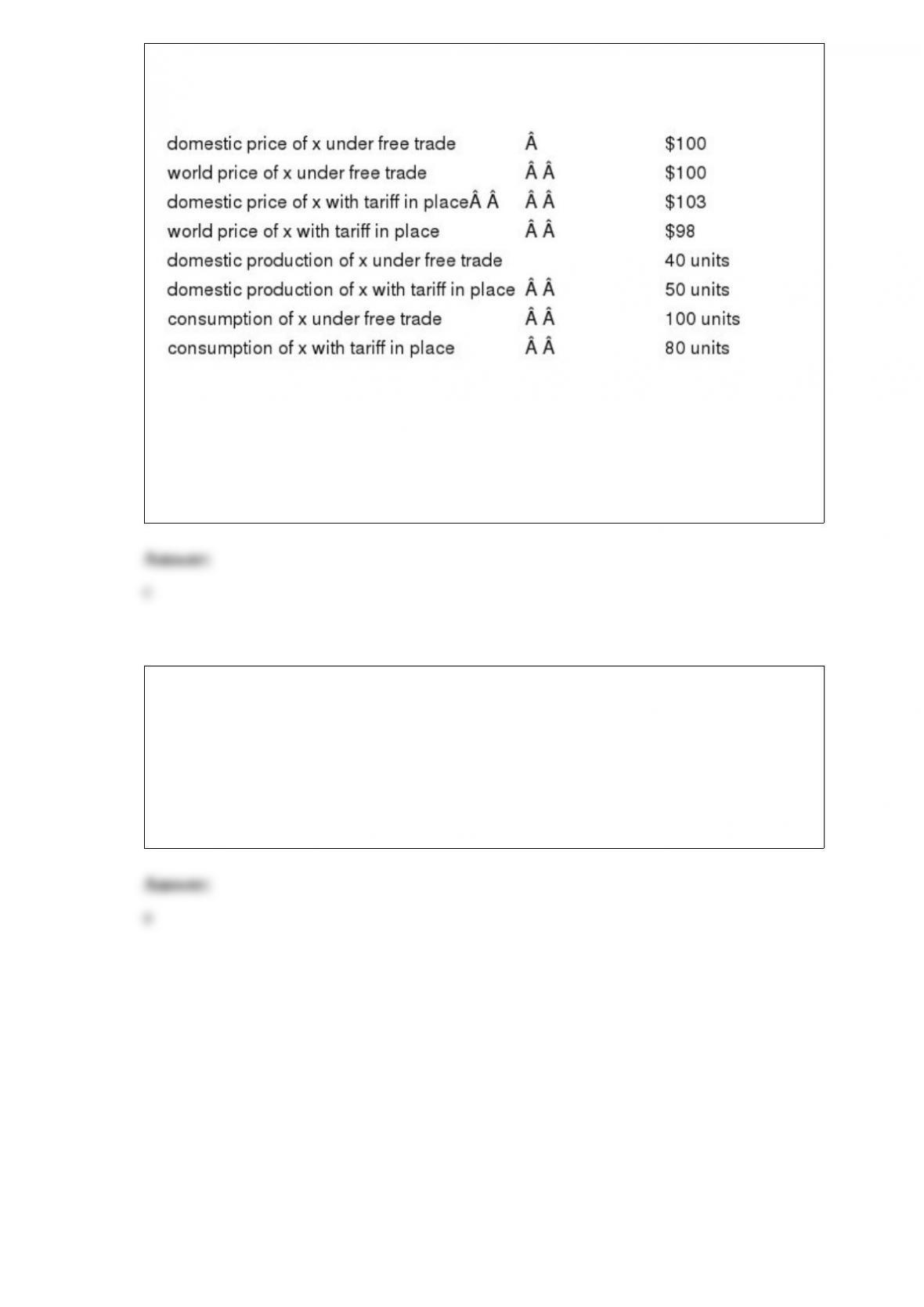
8) given the following information pertaining to large country a with respect to good x
under free trade and with a tariff in place:
what is the loss of consumer surplus in country a that occurs because of the imposition
of the tariff?
a. $45
b. $150
c. $270
d.. $300
9) in the linder theory of trade, a country sends goods to other countries which
__________, and the greatest trade of a country is expected to be with countries which
have per capita income levels __________ that of the original country.
a. also produce those goods; similar to
b. also produce those goods; very different from
c. do not produce those goods; similar to
d. do not produce those goods; very different from
country a has the following constant-opportunity-costs production-possibilities frontier
(ppf):
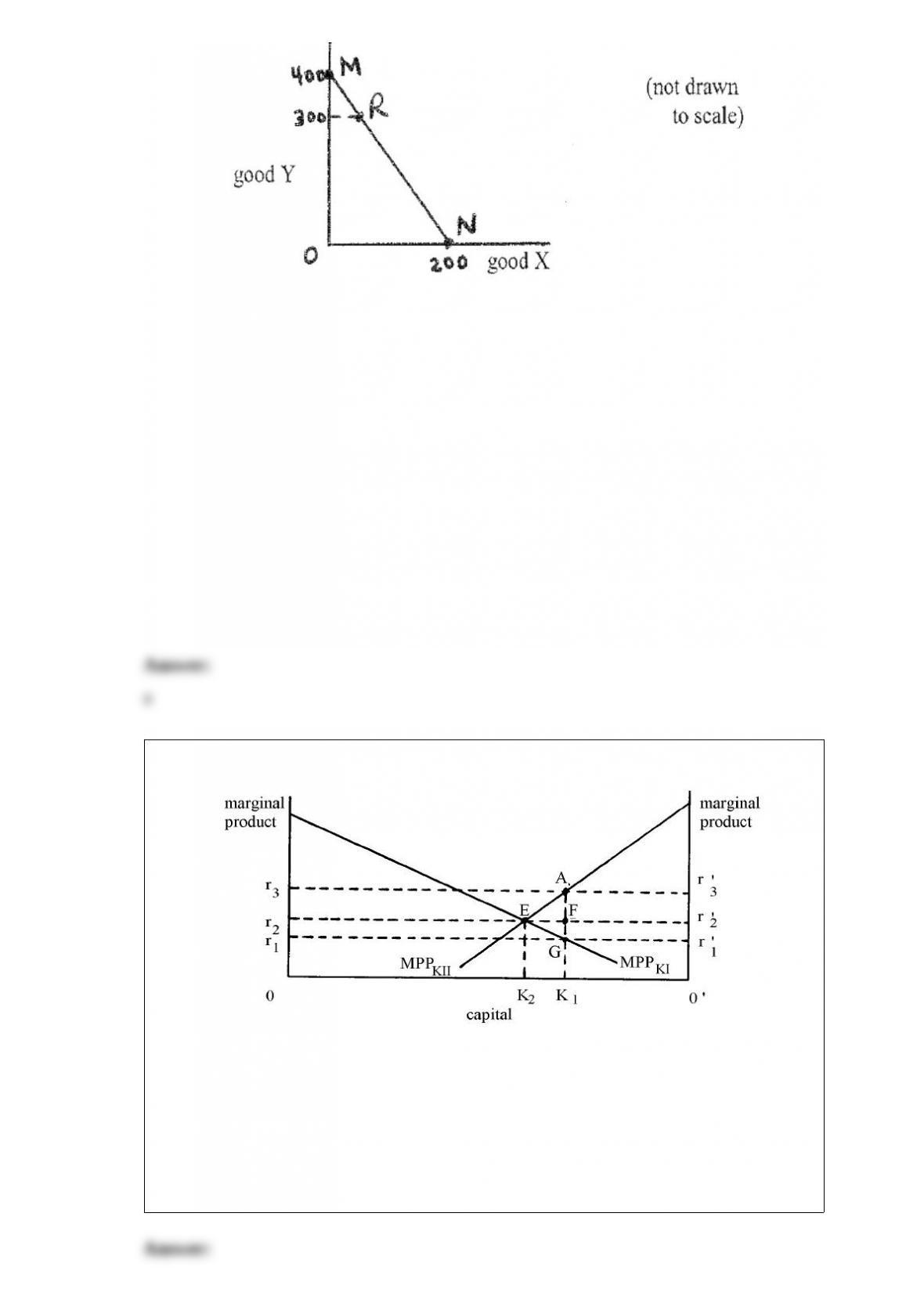
10) suppose that this country in autarky is located at point r on its ppf, where it is
producing 300 units of good y and __________ of good x. suppose that country a is now
opened to trade and can trade at a terms of trade of 1x:3y. assuming complete
specialization in production, the country will now produce at __________.
a. 50 units; point n and will export good x and import good y
b. 150 units; point n and will export good x and import good y
c. 50 units; point m and will export good y and import good x
d. 150 units; point m and will export good y and import good x
11)
in the diagram above, if restrictions on capital flows were removed and capital was
allowed to flow freely from the low-return country to the high-return country, then
national income (i.e., gnp) in country ii would rise by the amount of area __________.
a. eaf
b. efg
c. eag
d. k2eak1

12) in the price-specie-flow mechanism, there is a gold __________ a country with a
balance-of-trade surplus, and this gold flow ultimately leads to __________ in the
surplus countrys exports.
a. inflow into; an increase
b. inflow into; a decrease
c. outflow from; an increase
d. outflow from; a decrease
13) the situation in the united states (and other developed countries) whereby an import
good faces a lower tariff if the good comes from a developing country than if the good
comes from a developed country is known as __________.
a. gsp treatment
b. mfn (or ntr) treatment
c. oap treatment
d. erp treatment
14) if there is diminishing marginal productivity of labor in production (with other
inputs held constant), an outmigration of labor from low-wage country a to higher-wage
country b will lead, other things equal and if trade is taking place in accordance with the
heckscher-ohlin analysis, to __________ production effect in the capital-abundant
country.
a. an ultra-antitrade
b. an antitrade
c. a neutral
d. an ultra-protrade
15) in the portfolio balance model, other things equal, the issuance of new bonds by a

home corporation will __________ the domestic interest rate and, especially if home
and foreign bonds are very good substitutes for each other, will lead to __________ of
the home currency.
a. decrease; a depreciation
b. decrease; an appreciation
c. increase; a depreciation
d. increase; an appreciation
16) in the krugman model with economies of scale and monopolistic competition (with
l = amount of labor hired by the firm, q = quantity of output of the firm, w = wage rate
for labor, p = price of the firms product, and a and b are constants), the equation that
states the labor requirement of the firm is __________. in the model, the existence of
zero profits for the firm in long-run equilibrium can be stated as __________.
a. l = bq; pq = w(a + bq)
b. l = bq; pq – (a + bq) = 0
c. l = a + bq; pq = w(a + bq)
d. l = a + bq; pq – (a + bq) = 0
17) if ms is the money supply, br = reserves of commercial banks (depository
institutions), c = currency held by the nonbank public, and a = the money multiplier,
then
a. ms = abr + c
b. ms = a(br + c)
c. br = ms – c
d. ac = ms – br
18) other things equal, an export quota agreement to stabilize the price of a good on the
world market will be more effective, the __________ the percentage of producer
countries that take part in the agreement and the __________ it is for countries to store
(or stockpile) the good.
a. larger; easier
b. larger; more difficult

c. smaller; easier
d. smaller; more difficult