
1) Whitewater Co. is a U.S. company with sales to Canada amounting to C$8 million.
Its cost of materials attributable to the purchase of Canadian goods is C$6 million. Its
interest expense on Canadian loans is C$4 million. Given these exact figures above, the
dollar value of Whitewater’s “earnings before interest and taxes” would ____ if the
Canadian dollar appreciates; the dollar value of Whitewater’s cash flows would ____ if
the Canadian dollar appreciates.
a. increase; increase
b. decrease; increase
c. decrease; decrease
d. increase; decrease
e. increase; be unaffected
2) Assume that your firm is an importer of Mexican chairs denominated in pesos. Your
competition is mainly U.S. producers of chairs. You wish to assess the relationship
between the percentage change in its stock price (SPt) and the percentage change in the
peso’s value relative to the dollar (PESOt). SPt is the dependent variable. You apply the
regression model to an earlier subperiod and a more recent subperiod. In the recent
subperiod, you increased your importing volume. You should expect that the regression
coefficient in the PESOt variable would be ____ in the first subperiod and ____ in the
second subperiod.
a. negative; positive
b. positive; positive
c. positive; negative
d. negative; negative
3) The ideal time to purchase a foreign company is when the spot rate of that company’s
currency is perceived to be very high and is expected to decrease over time.
a. True
b. False
4) If a currency’s forward rate exhibits a discount, the currency is forced to appreciate.
a. True
b. False

5) A foreign project generates a negative cash flow in year 1 and positive cash flows in
years 2 through 5. The NPV for this project will be higher if the foreign currency ____
in year 1 and ____ in years 2 through 5.
a. depreciates; depreciates
b. appreciates; appreciates
c. depreciates; appreciates
d. appreciates; depreciates
6) The international money market primarily concentrates on:
a. short-term lending (one year or less)
b. medium-term lending
c. long-term lending
d. placing bonds with investors
e. placing newly issued stock in foreign markets
7) When a country’s risk-free rate rises, the cost of equity to an MNC in that country
_____, and the cost of debt to an MNC in that country ____, other things held constant.
a. increases; increases
b. increases; is not affected
c. is not affected; increases
d. is not affected; is not affected
8) To hedge a receivable position with a currency option hedge, an MNC would buy a
put option.
a. True
b. False
9) Premiums required to entice a target’s board of directors to approve an acquisition
are usually between 1 and 3 percent of the target’s market price.
a. True

b. False
10) U.S. firms can attempt to hedge their translation exposure of their European
subsidiaries with a forward purchase of euros.
a. True
b. False
11) Which of the following is not true regarding electronic communications networks
(ECNs)?
a. They have a visible trading floor
b. Trades are executed by a computer network
c. They have been created in many countries to match orders between buyers and sellers
d. They allow investors to place orders on their computers
e. All of the above are true
12) As far as the managerial talent of the target is concerned:
a. the manner in which the acquirer plans to deal with the managerial talent will affect
the estimated cash flows to be generated by the target
b. downsizing will reduce expenses and increase productivity and revenues
c. governments of some countries are likely to intervene and prevent the acquisition if
downsizing is anticipated
d. all of the above
e. A and C only
13) U.S. firms acquire more target firms in ____ than in any other country.
a. Spain
b. Italy
c. Belgium
d. United Kingdom

14) The price of a futures contract will generally vary significantly from that of a
forward contract.
a. True
b. False
15) Assume that Mill Corporation, a U.S.-based MNC, has applied the following
regression model to estimate the sensitivity of its cash flows to exchange rate
movements:
PCFt = a0 + a1et + mt
where the term on the left-hand side is the percentage change in inflation-adjusted cash
flows measured in the firm’s home currency over period t, and et is the percentage
change in the exchange rate of the currency over period t. The regression model
estimates a coefficient of a1 of 2. This indicates that:
a. if the foreign currency appreciates by 1%, Mill’s cash flows will decline by 2%
b. if the foreign currency appreciates by 1%, Mill’s cash flows will decline by .2%
c. if the foreign currency depreciates by 1%, Mill’s cash flows will increase by 2%
d. if the foreign currency depreciates by 1%, Mill’s cash flows will decline by 2%
e. none of the above
16) The most risky method(s) by which firms conduct international business is (are):
a. Franchising
b. The acquisitions of existing operations
c. The establishment of new subsidiaries
d. All of the above
e. B and C only
17) Diz Co. is a U.S.-based MNC with net cash inflows of euros and net cash inflows of
Swiss francs. These two currencies are highly correlated in their movements against the
dollar. Yanta Co. is a U.S.-based MNC that has the same level of net cash flows in these
currencies as Diz Co. except that its euros represent net cash outflows. Which firm has
a higher exposure to exchange rate risk?
a. Diz Co
b. Yanta Co
c. the firms have about the same level of exposure
d. neither firm has any exposure
18) An irrevocable L/C obligates the issuing bank to honor all drawings presented in
conformity with the terms of the L/C.
a. True
b. False
19) The Basel Accord is an agreement among the major European countries to make
regulations more uniform across European countries and to reduce taxes on goods
traded between these countries.
a. True
b. False
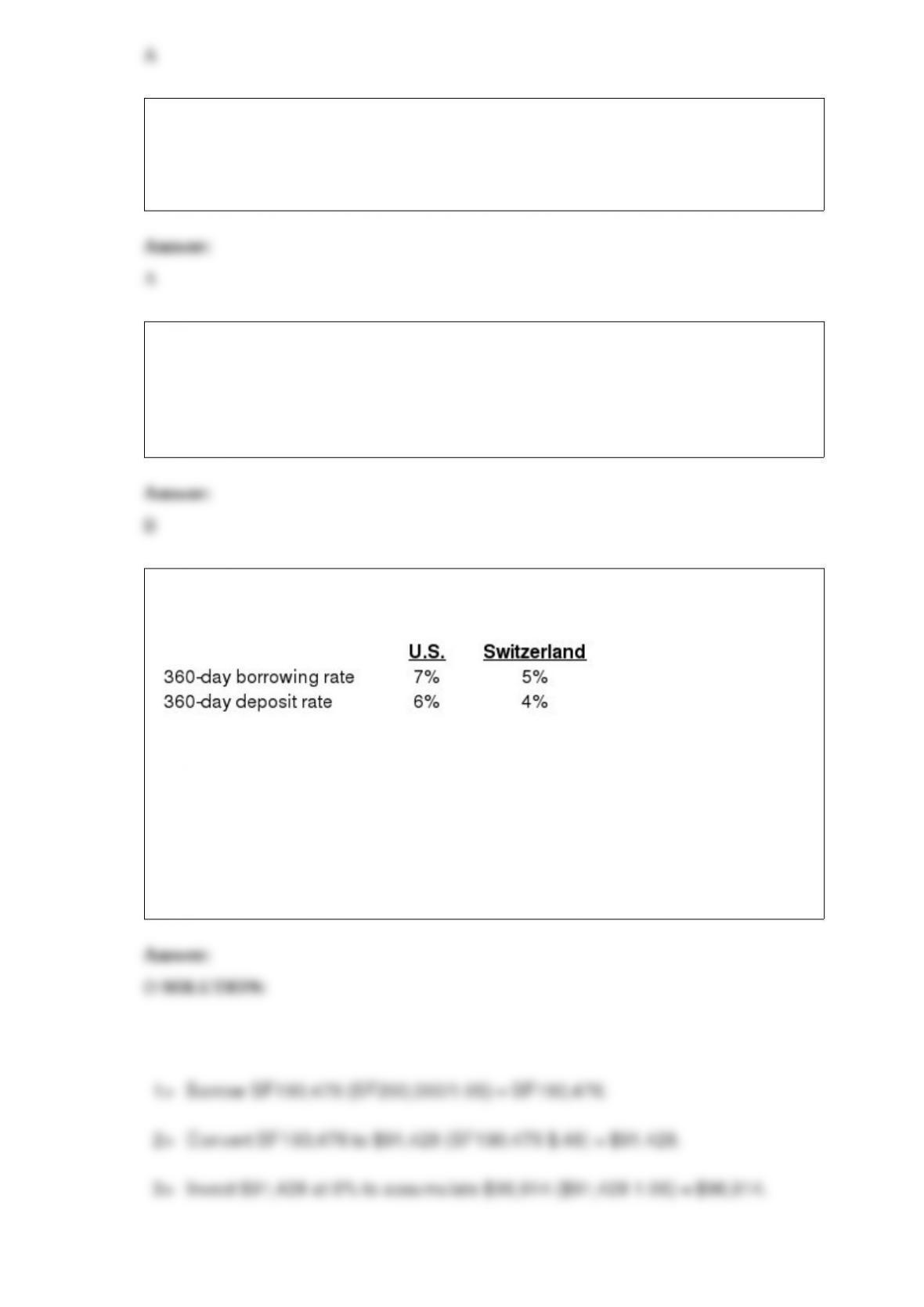
20) Assume that Parker Company will receive SF200,000 in 360 days. Assume the
following interest rates:
Assume the forward rate of the Swiss franc is $.50 and the spot rate of the Swiss franc
is $.48. If Parker Company uses a money market hedge, it will receive ____ in 360
days.
a. $101,904
b. $101,923
c. $98,769
d. $96,914
e. $92,307

21) A centralized management style for an MNC results in relatively high agency costs.
a. True
b. False
22) Assume that Live Co. has expected cash flows of $200,000 from domestic
operations, SF200,000 from Swiss operations, and 150,000 euros from Italian
operations at the end of the year. The Swiss franc’s value and euro’s value are expected
to be $.83 and $1.29 respectively, at the end this year. What are the expected dollar cash
flows of Live Co?
a. $200,000
b. $559,500
c. $582,500
d. $393,500
23) A banker’s acceptance is a draft drawn on and accepted by a(n) ____.
a. bank
b. importer
c. exporter
d. none of the above
24) Quasik Corporation will be receiving 300,000 Canadian dollars (C$) in 90 days.
Currently, a 90-day call option with an exercise price of $.75 and a premium of $.01 is
available. Also, a 90-day put option with an exercise price of $.73 and a premium of
$.01 is available. Quasik plans to purchase options to hedge its receivable position.
Assuming that the spot rate in 90 days is $.71, what is the net amount received from the
currency option hedge?
a. $219,000
b. $222,000
c. $216,000
d. $213,000

25) One of the most prevalent factors conflicting with the realization of the goal of an
MNC is the existence of agency problems.
a. True
b. False
26) All MNCs are subject to transaction exposure.
a. True
b. False
27) Translation losses are ____, while gains on forward contracts used to hedge
translation exposure are ____.
a. tax deductible; not taxed
b. not tax deductible; not taxed
c. not tax deductible; taxed
d. tax deductible; taxed
28) ____ is (are) not a limitation of hedging translation exposure.
a. Inaccurate stock price forecasts
b. Inadequate forward contracts for some currencies
c. Taxation on gains from forward contracts
d. Increased transaction exposure
29) For the MNC, agency costs are typically:
a. non-existent
b. larger than agency costs of a small purely domestic firm
c. smaller than agency costs of a small purely domestic firm
d. the same as agency costs of a small purely domestic firm

30) Developing countries are mostly targeted because they have advanced technology.
a. True
b. False
31) The European Central Bank is responsible for monetary policy in all countries that
adopted the euro as its currency.
a. True
b. False
32) Which of the following is probably not a scenario under which a U.S.-based MNC
would consider short-term foreign financing?
a. Canadian dollars offer a lower interest rate than available in the U.S. and are
expected to appreciate over the maturity of the loan
b. Australian dollars offer a lower interest rate than available in the U.S. and are
expected to depreciate over the maturity of the loan
c. A U.S. firms has net receivables in Cyprus pounds
d. A and C
e. None of the above
33) Since yield curves are identical across countries, MNCs rarely consider them when
deciding on the maturity of bonds denominated in a foreign currency.
a. True
b. False
34) If a foreign project is financed with a subsidiary’s retained earnings, the subsidiary’s
investment could be viewed as an opportunity cost, since the funds could be remitted to
the parent rather than invested in the foreign project.
a. True
b. False

35) The all-in-rate a bank charges its customer(s) for accepting drafts includes both the
discount rate and the acceptance commission.
a. True
b. False
36) Country risk analysis is important because it:
a. focuses on whether to hedge contractual transactions
b. focuses on the competitor firms in its industry
c. can be used to improve the analysis used to make long-term investing decisions
d. all of the above
37) International trade:
a. is a relatively conservative approach to foreign market penetration
b. entails minimal risk
c. does not require large amount of investment
d. all of the above
38) A callable swap gives the ____ payer the right to terminate the swap; the MNC
would exercise this right if interest rates ____ substantially.
a. floating-rate; rise
b. floating-rate; fall
c. fixed-rate; rise
d. fixed-rate; fall
e. none of the above
39) The greater the uncertainty about a project’s forecasted cash flows, the larger should
be the discount rate applied to cash flows, other things being equal.
a. True
b. False

40) Which of the following is not a forecasting technique mentioned in your text?
a. accounting-based forecasting
b. technical forecasting
c. fundamental forecasting
d. market-based forecasting