Taggart Transcontinental currently has a bank loan outstanding that requires it to make
three annual payments at the end of the next three years or to skip making the next two
payments in lieu of making one large payment at the end of the loan’s term in three
years in the amount of $3,184,000. If the interest rate on the loan is 6%, then the annual
payment the bank will require to make Taggart Transcontinental indifferent between the
two forms of payments is closest to:
A) $2,673,000
B) $2,000,000
C) $1,673,000
D) $1,000,000
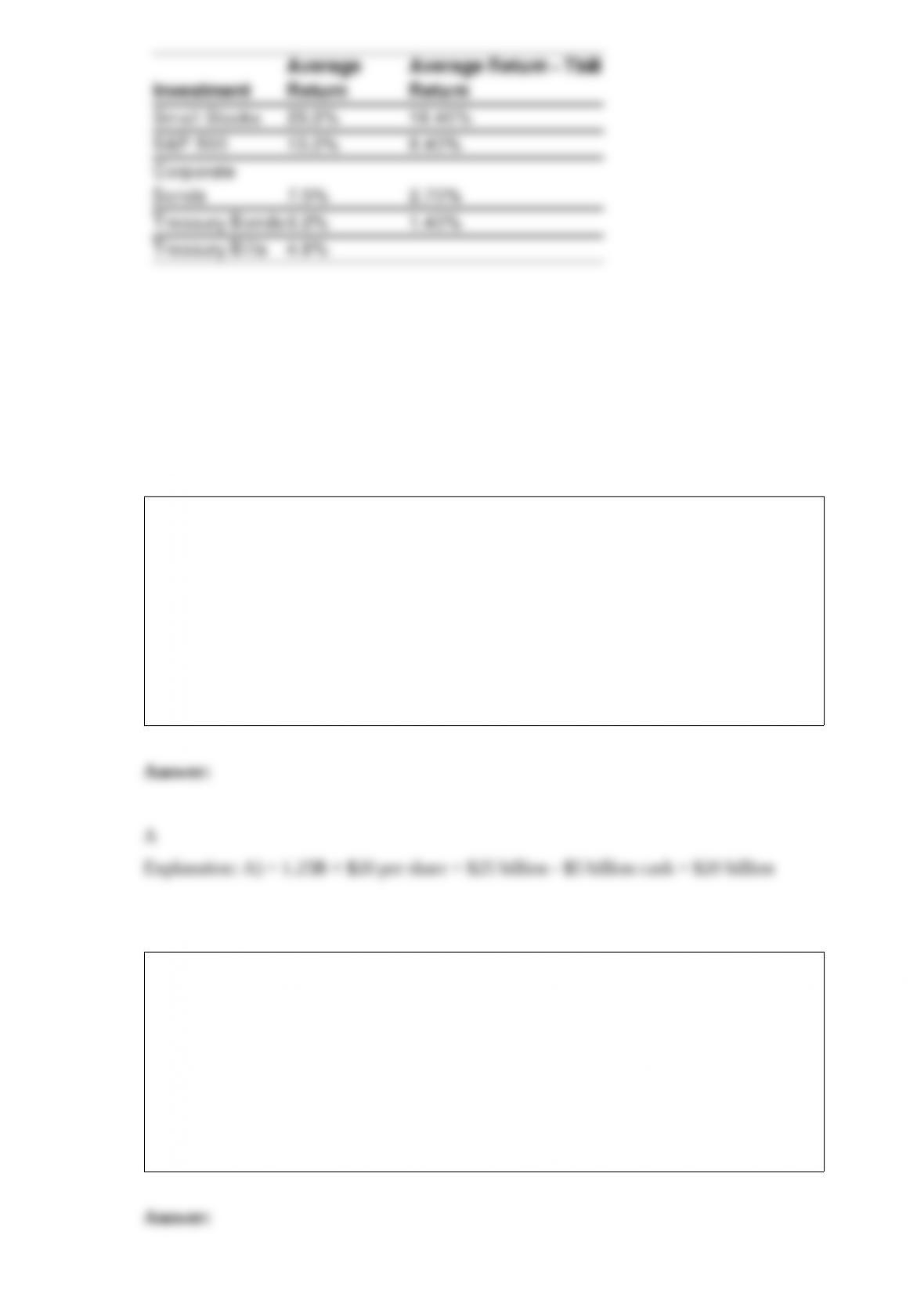
Consider the following average annual returns:
What is the excess return for corporate bonds?
A) 2.7%
B) 1.3%
C) -5.7%
D) 0%
Luther is a successful logistical services firm that currently has $5 billion in cash.
Luther has decided to use this cash to repurchase shares from its investors, and has
already announced the stock repurchase plan. Currently Luther is an all equity firm with
1.25 billion shares outstanding. Luther’s shares are currently trading at $20 per share.
The market value of Luther’s non-cash assets is closest to:
A) $20 billion
B) $19 billion
C) $25 billion
D) $24 billion
Consider the following linear regression model:
(Ri– rf) = ai+ bi(RMkt– rf) + ei
The aiin the regression
A) measures the sensitivity of the security to market risk.
B) measures the deviation from the best fitting line and is zero on average.
C) measures the diversifiable risk in returns.
D) measures the historical performance of the security relative to the expected return
predicted by the SML.
John Galt is a mutual fund manager at Atlas Asset Management. He can generate an
alpha of 2% a year up to $500 million of invested capital. After that amount his skills
are spread too thin, so he cannot add value and his alpha is zero for all investments over
$500 million. Atlas Asset Management charges a fee of 0.80% on the total amount of
money under management. Assume that there are always investors looking for positive
alpha investments and no investor would invest in a fund with a negative alpha. Assume
that the fund is in equilibrium, meaning that no investor either takes out money or
wishes to invest new money into the fund.
The amount of money that Galt’s fund will have under management is closest to:
A) $500 million
B) $600 million
C) $1,000 million
D) $1,250 million
Suppose that the risk-free rate is 5% and the market portfolio has an expected return of
13% with a volatility of 18%. Monsters Inc. has a 24% volatility and a correlation with
the market of .60, while California Gold Mining has a 32% volatility and a correlation
with the market of -.7. Assume the CAPM assumptions hold.Suppose that Monsters’
expected return is 12%. Then Monsters’ alpha is closest to:
A) -2.0%
B) -1.0%
C) 1.0%
D) 0.5%
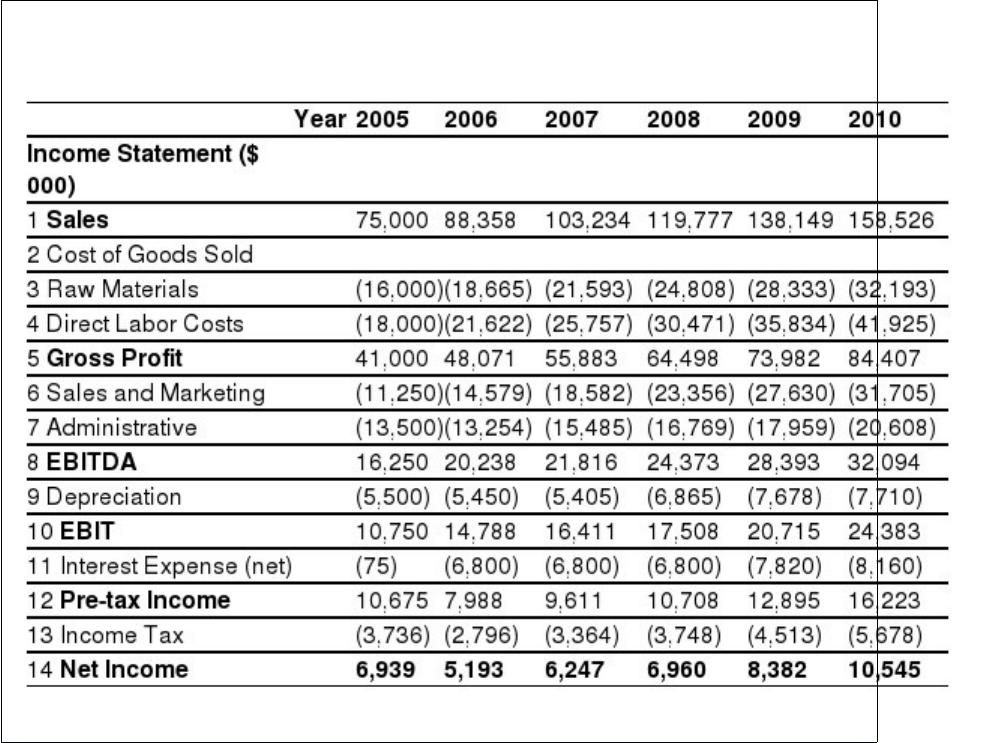
Pro Forma Income Statement for Ideko, 2005-2010
Pro Forma Balance Sheet for Ideko, 2005-2010
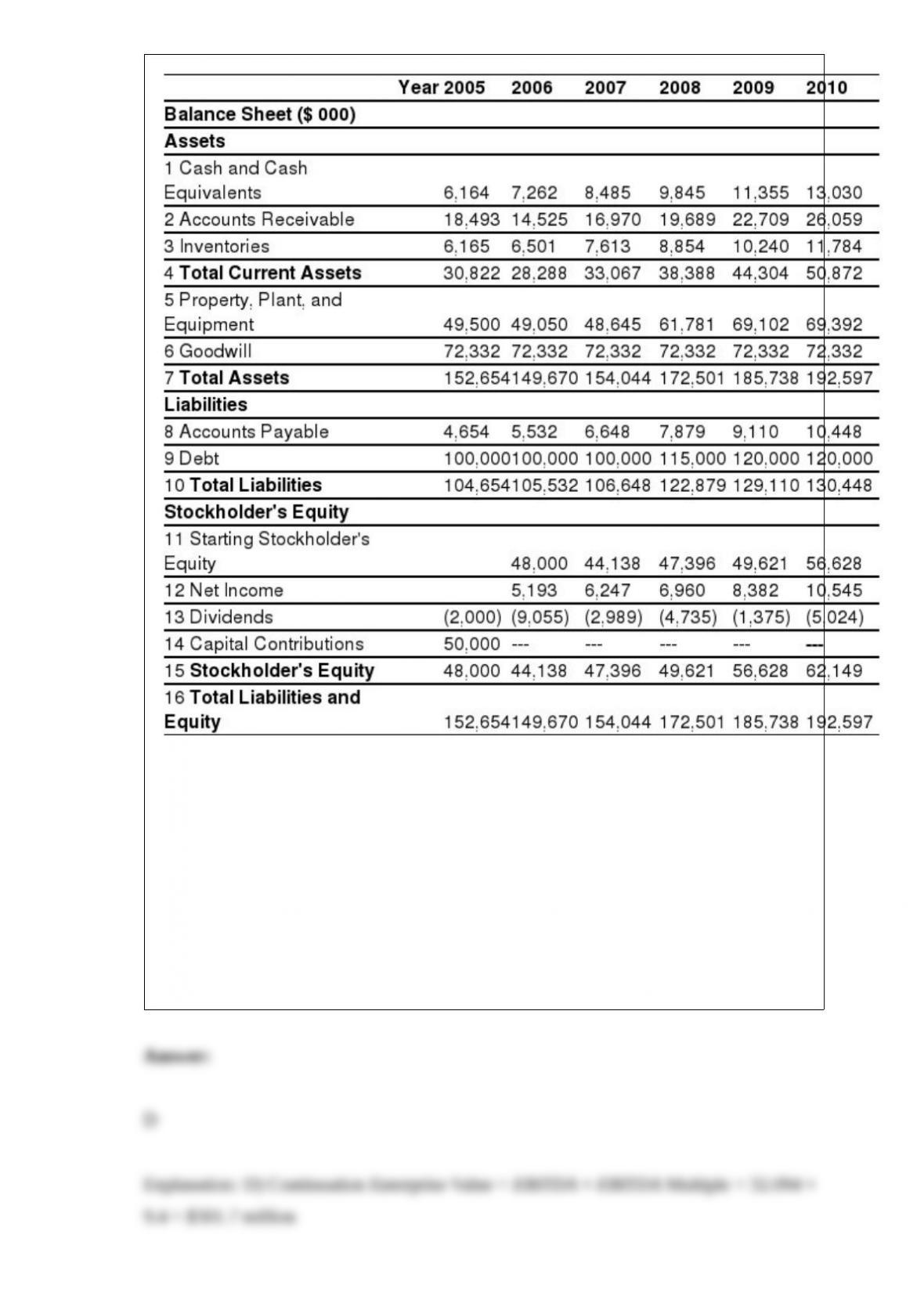
Assuming that Ideko has a EBITDA multiple of 9.4, then the continuation unlevered
P/E ratio of Ideko in 2010 is closest to:
A) 17.2
B) 16.4
C) 14.5
D) 19.4
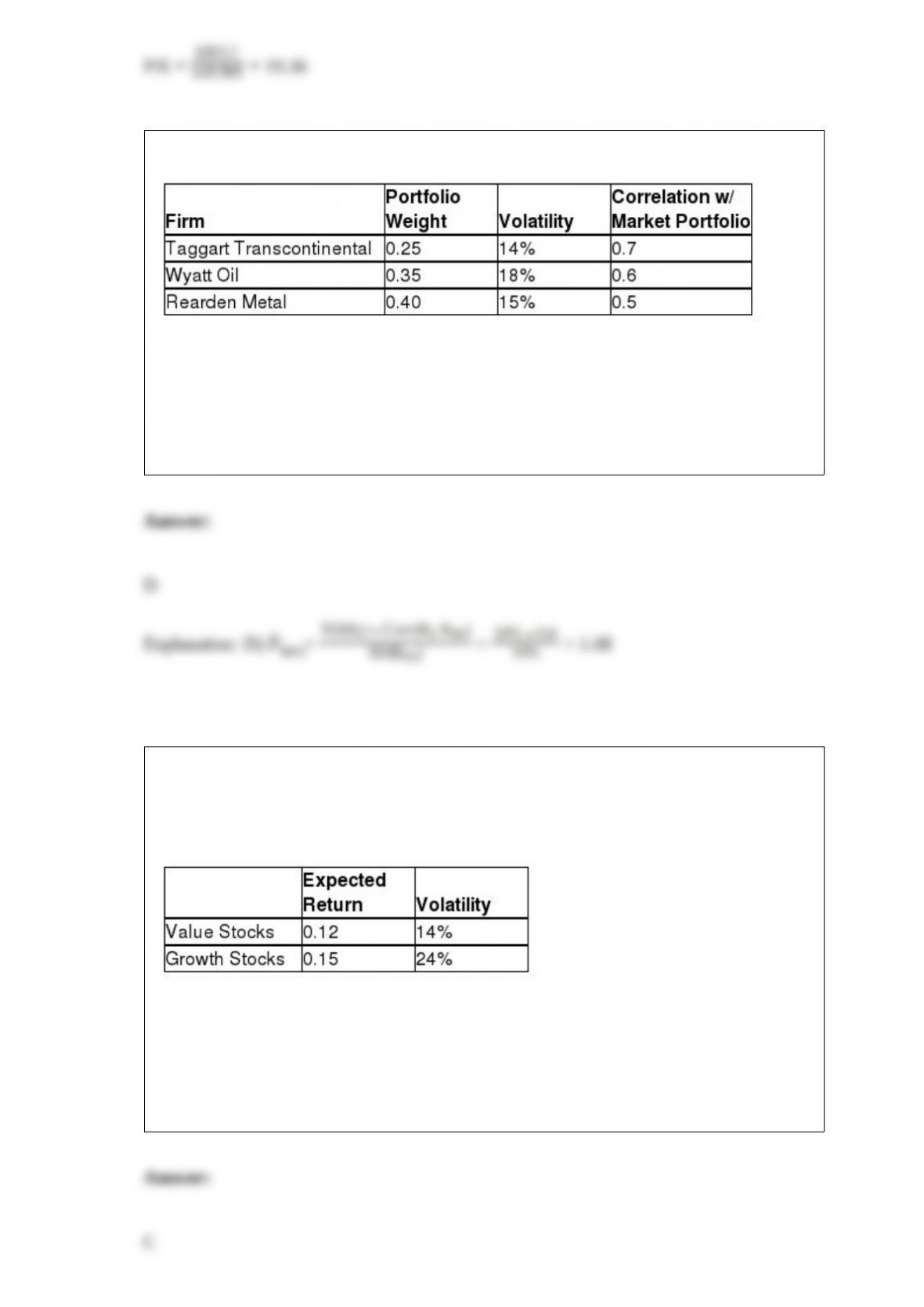
The volatility of the market portfolio is 10%, the expected return on the market is 12%,
and the risk-free rate of interest is 4%The beta for Wyatt Oil is closest to:
A) 0.75
B) 0.80
C) 1.00
D) 1.10
Suppose that all stocks can be grouped into two mutually exclusive portfolios (with
each stock appearing in only one portfolio): growth stocks and value stocks. Assume
that these two portfolios are equal in size (market value), the correlation of their returns
is equal to 0.6, and the portfolios have the following characteristics:
The risk free rate is 3.5%.
The Sharpe ratio for the value stock portfolio is closest to:
A) .53
B) .58
C) .61
D) .79
The Sisyphean Company has a bond outstanding with a face value of $1000 that
reaches maturity in 15 years. The bond certificate indicates that the stated coupon rate
for this bond is 8% and that the coupon payments are to be made semiannually.
Assuming that this bond trades for $1,112, then the YTM for this bond is closest to:
A) 8.0%
B) 3.4%
C) 6.8%
D) 9.2%
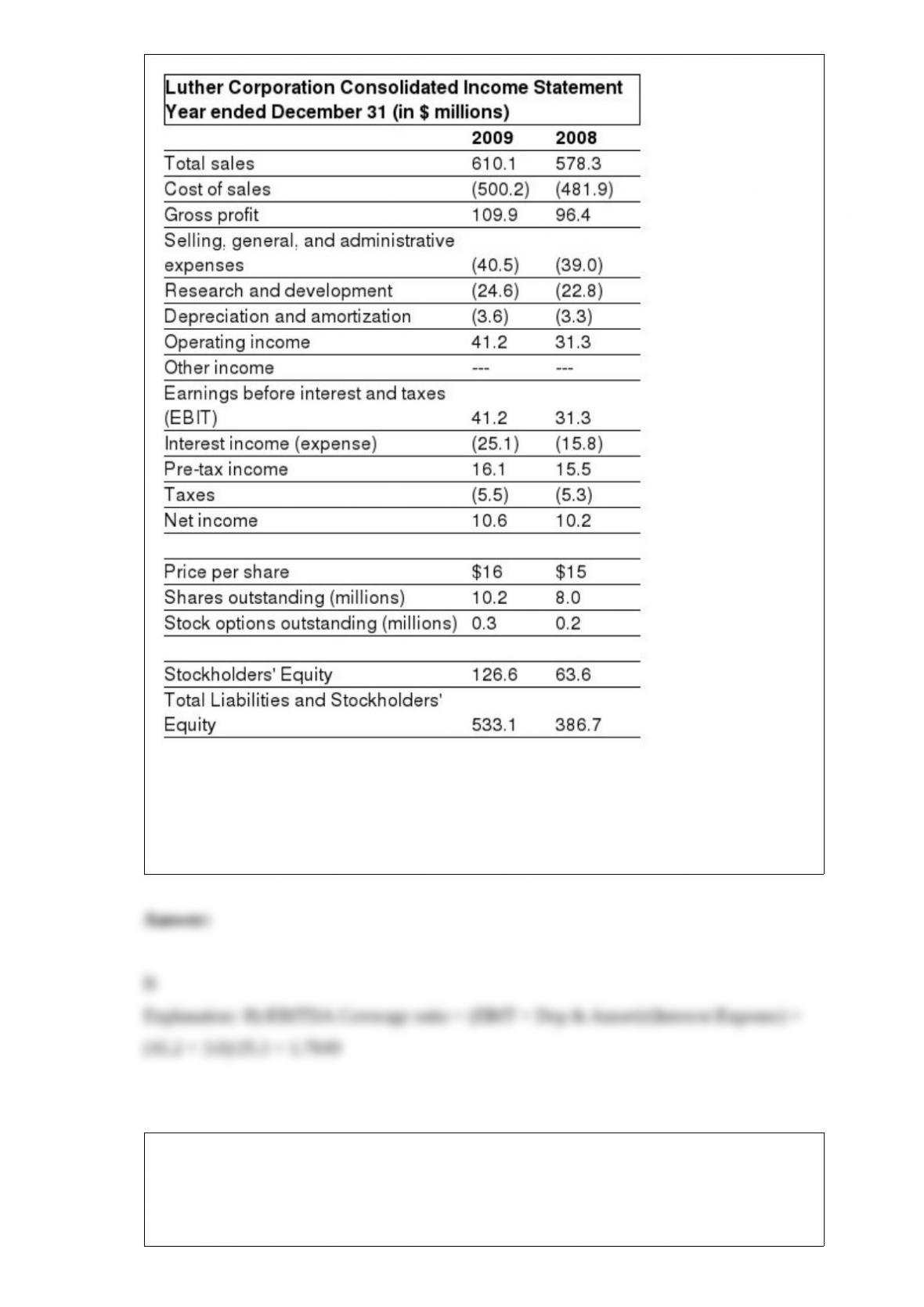
Luther’s EBITDA coverage ratio for the year ending December 31, 2009 is closest to:
A) 1.64
B) 1.78
C) 1.98
D) 2.19
In a world with taxes, which of the following is the rate we should use to evaluate a
project with the same risk and the same financing as the firm itself?
A) The weighted-average cost of capital
B) The pre-tax WACC

C) The cost of equity
D) The cost of debt
Which of the following costs would you consider when making a capital budgeting
decision?
A) Sunk cost
B) Opportunity cost
C) Interest expense
D) Fixed overhead cost
An individual’s desire for intense risk-taking experiences is known as:
A) phenomenon seeking.
B) herd seeking.
C) sensation seeking.
D) rational expectations seeking.
Which of the following is NOT a step in the adjusted present value method?
A) Deducting costs arising from market imperfections
B) Calculating the unlevered value of the project
C) Calculating the after-tax WACC
D) Calculating the value of the interest tax shield

Which of the following statements is FALSE?
A) While firms do still pay dividends, substantial evidence shows that many firms have
recognized their tax disadvantage.
B) The fact that firms continue to issue dividends despite their tax disadvantage is often
referred to as the dividend puzzle.
C) At the end of the 1990s dividend payments exceeded the value of repurchases for
U.S. industrial firms.
D) While evidence is indicative of the growing importance of share repurchases as a
part of firms’ payout policies, it also shows that dividends remain a key form of payouts
to shareholders.
Omicron Technologies has $50 million in excess cash and no debt. The firm expects to
generate additional free cash flows of $40 million per year in subsequent years and will
pay out these future free cash flows as regular dividends. omicrons unlevered cost of
capital is 10% and there are 10 million shares outstanding. Omicron’s board is meeting
to decide whether to pay out its $50 million in excess cash as a special dividend or to
use it to repurchase shares of the firm’s stock.
Assume that Omicron uses the entire $50 million in excess cash to pay a special
dividend. Omicron’s cum-dividend price is closest to:
A) $50.00
B) $40.00
C) $5.00
D) $45.00
) Consider an economy with two types of firms, S and I. S firms always move together,
but I firms move independently of each other. For both types of firm there is a 70%
probability that the firm will have a 20% return and a 30% probability that the firm will
have a -30% return.
The standard deviation for the return on an portfolio of 20 type I firms is closest to:
A) 5.25%
B) 5.10%
C) 15.0%
D) 23.0%