
Nielson Motors (NM) has no debt. Its assets will be worth $600 million in one year if
the economy is strong, but only $300 million if the economy is weak. Both events are
equally likely. The market value today of Nielson’s assets is $400 million.
The expected return for Nielson Motors stock without leverage is closest to:
A) -25.0%
B) -17.5%
C) -12.5%
D) 12.5%
Von Bora Corporation is expected pay a dividend of $1.40 per share at the end of this
year and a $1.50 per share at the end of the second year. You expect Von Bora’s stock
price to be $25.00 at the end of two years. Von Bora’s equity cost of capital is 10%.
Suppose you plan to hold Von Bora stock for only one year. Your dividend yield from
holding Von Bora stock for the first year is closest to:
A) 6.0%
B) 4.0%
C) 6.5%
D) 5.5%

Which of the following statements is FALSE?
A) Modigliani and Miller’s conclusion verified the common view, which stated that
even with perfect capital markets, leverage would affect a firm’s value.
B) We can evaluate the relationship between risk and return more formally by
computing the sensitivity of each security’s return to the systematic risk of the economy.
C) Investors in levered equity require a higher expected return to compensate for its
increased risk.
D) Leverage increases the risk of equity even when there is no risk that the firm will
default.
Food For Less (FFL), a grocery store, is considering offering one hour photo
developing in their store. The firm expects that sales from the new one hour machine
will be $150,000 per year. FFL currently offers overnight film processing with annual
sales of $100,000. While many of the one hour photo sales will be to new customers,
FFL estimates that 60% of their current overnight photo customers will switch and use
the one hour service.
Suppose that of the 60% of FFL’s current overnight photo customers, half would start
taking their film to a competitor that offers one hour photo processing if FFL fails to
offer the one hour service. The level of incremental sales in this case is closest to:
A) $60,000
B) $150,000
C) $90,000
D) $120,000

You are considering purchasing a new truck that will cost you $34,000. The dealer
offers you 1.9% APR financing for 48 months (with payments made at the end of the
month). Assuming you finance the entire $34,000 and finance through the dealer, your
monthly payments will be closest to:
A) $708
B) $725
C) $736
D) $1,086
The Sisyphean Company is planning on investing in a new project. This will involve
the purchase of some new machinery costing $450,000. The Sisyphean Company
expects cash inflows from this project as detailed below:
The appropriate discount rate for this project is 16%.
The NPV for this project is closest to:
A) $176,270
B) $123,420
C) $450,000
D) $179,590

d’Anconia Copper is an all-equity firm with 60 million shares outstanding, which are
currently trading at $20 per share. Last month, d’Anconia announced that it will change
its capital structure by issuing $300 million in debt. The $200 million raised by this
issue, plus another $200 million in cash that d’Anconia already has, will be used to
repurchase existing shares of stock. Assume that capital markets are perfect.
The market capitalization of d’Anconia Copper after this transaction takes place is
closest to:
A) $800 million
B) $900 million
C) $1,100 million
D) $1,200 million
Galt Motors currently produces 500,000 electric motors a year and expects output levels
to remain steady in the future. It buys armatures from an outside supplier at a price of
$2.50 each. The plant manager believes that it would be cheaper to make these
armatures rather than buy them. Direct in-house production costs are estimated to be
only $1.80 per armature. The necessary machinery would cost $700,000 and would be
obsolete in 10 years. This investment would be depreciated to zero for tax purposes
using a 10-year straight line depreciation. The plant manager estimates that the
operation would require additional working capital of $40,000 but argues that this sum
can be ignored since it is recoverable at the end of the ten years. The expected proceeds
from scrapping the machinery after 10 years are estimated to be $10,000. Galt Motors
pays tax at a rate of 35% and has an opportunity cost of capital of 14%.
The incremental cash flow that Galt Motors will incur in year 10 if they elect to
manufacture armatures in house is closest to:
A) 40,000
B) 335,000
C) 375,000
D) 415,000

If the interest rate is 7%, the NPV of alternative #2 is closest to:
A) $350,000
B) $357,196
C) $370,561
D) $401,121
Wyatt Oil issued $100 million in perpetual debt (at par) with an annual coupon of 7%.
Wyatt will pay interest only on this debt. Wyatt’s marginal tax rate is expected to be
40% for the foreseeable future.
Assume that five years have passed since Wyatt issued this debt. While tax rates have
remained at 40%, interest rates have dropped so that Wyatt’s current cost of debt capital
is now only 4%. Wyatt’s annual interest tax shield is now closest to:
A) $2.8 million
B) $4.2 million
C) $40.0 million
D) $60.0 million
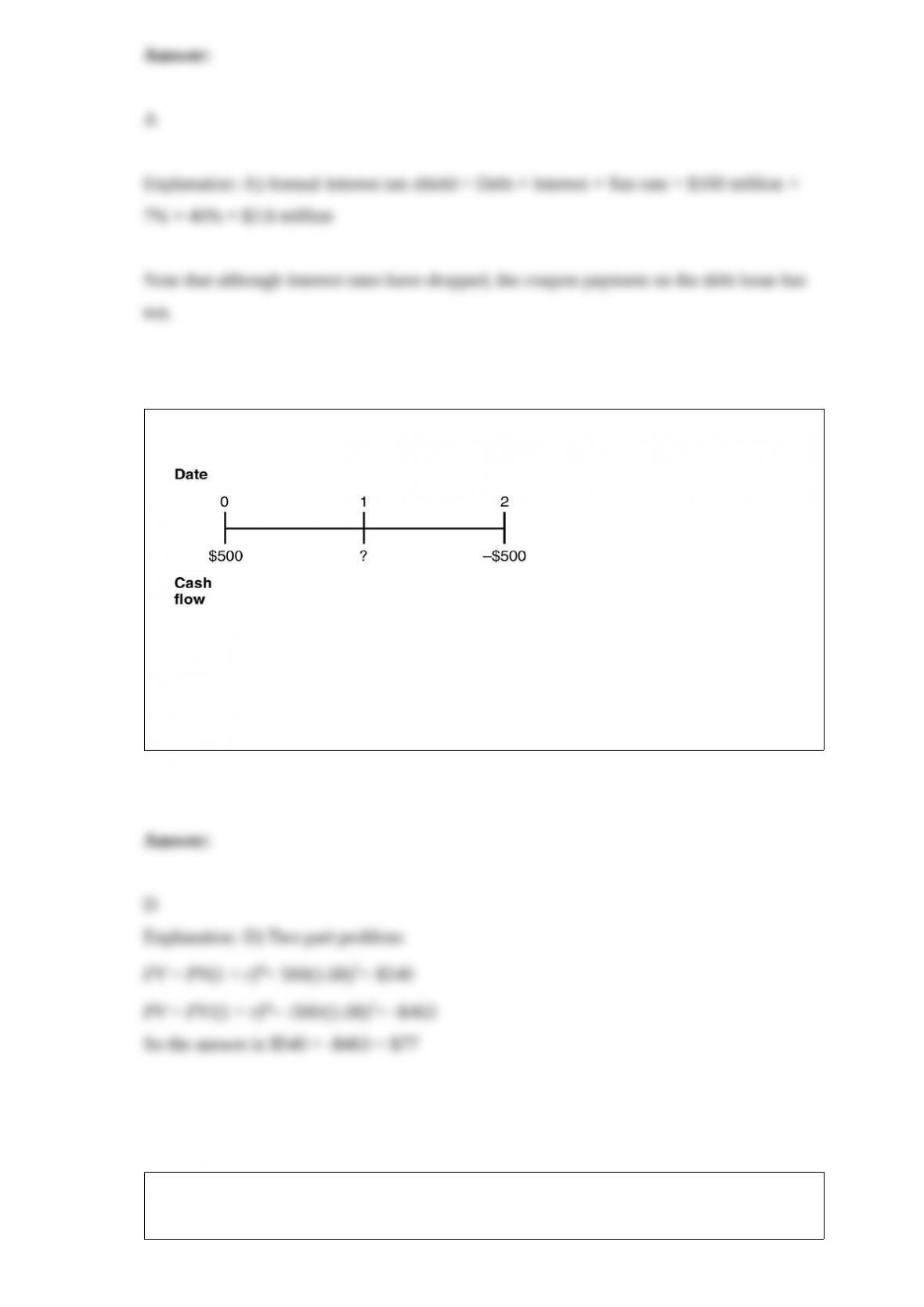
Consider the following timeline:
If the current market rate of interest is 8%, then the value as of year 1 is closest to:
A) $0
B) $1003
C) $540
D) $77
Which of the following statements is FALSE?
A) To estimate a firm’s enterprise value, we compute the present value of the free cash

flows (FCF) that the firm has available to pay equity holders.
B) The NPV of any individual project represents its contribution to the firm’s enterprise
value.
C) When using the total payout model, we discount total dividends and share
repurchases, and use the growth rate in earnings when forecasting the growth of the
firm’s payout.
D) In the total payout model, we first value the firm’s equity, rather than just a single
share.
Assume that the S&P 500 currently has a dividend yield of 3% and that on average, the
dividends of S&P 500 firms have increased by about 5% per year. If the risk-free
interest rate is 4%, then your estimate for the future market risk premium is:
A) 7%
B) 8%
C) 6%
D) 4%
Wyatt Oil has assets with a market value of $600 million, $70 million of which are
cash. It has debt of $250 million, and 20 million shares outstanding. Assume perfect
capital markets.
If Wyatt Oil distributes the $70 million as a share repurchase, then its stock price after

the share repurchase will be closest to:
A) $11.00
B) $12.50
C) $14.00
D) $17.50
Which of the following statements is FALSE?
A) Creditors often place restrictions on the actions that the firm can take. Such
restrictions are referred to as debt covenants.
B) Covenants are often designed to prevent management from exploiting debt holders,
so they may help to reduce agency costs.
C) Agency costs are smallest for long-term debt.
D) Covenants may limit the firm’s ability to pay large dividends or the types of
investments that the firm can make.
MJ LTD is expected to grow at various rates over the next five years. The company just
paid a $1.00 dividend. The company expects to grow at 20% for the next two years
(effecting D1 and D2), then the company expects to grow at 10% for three additional
years (D3, D4, D5) after which the company expects to grow at a constant rate of 5%
per year indefinitely. If the required rate of return on MJ’s common stock is 12%, then
what is a share of MJ’s stock worth?
Consider the following income statement for Kroger Inc. (all figures in $ Millions):
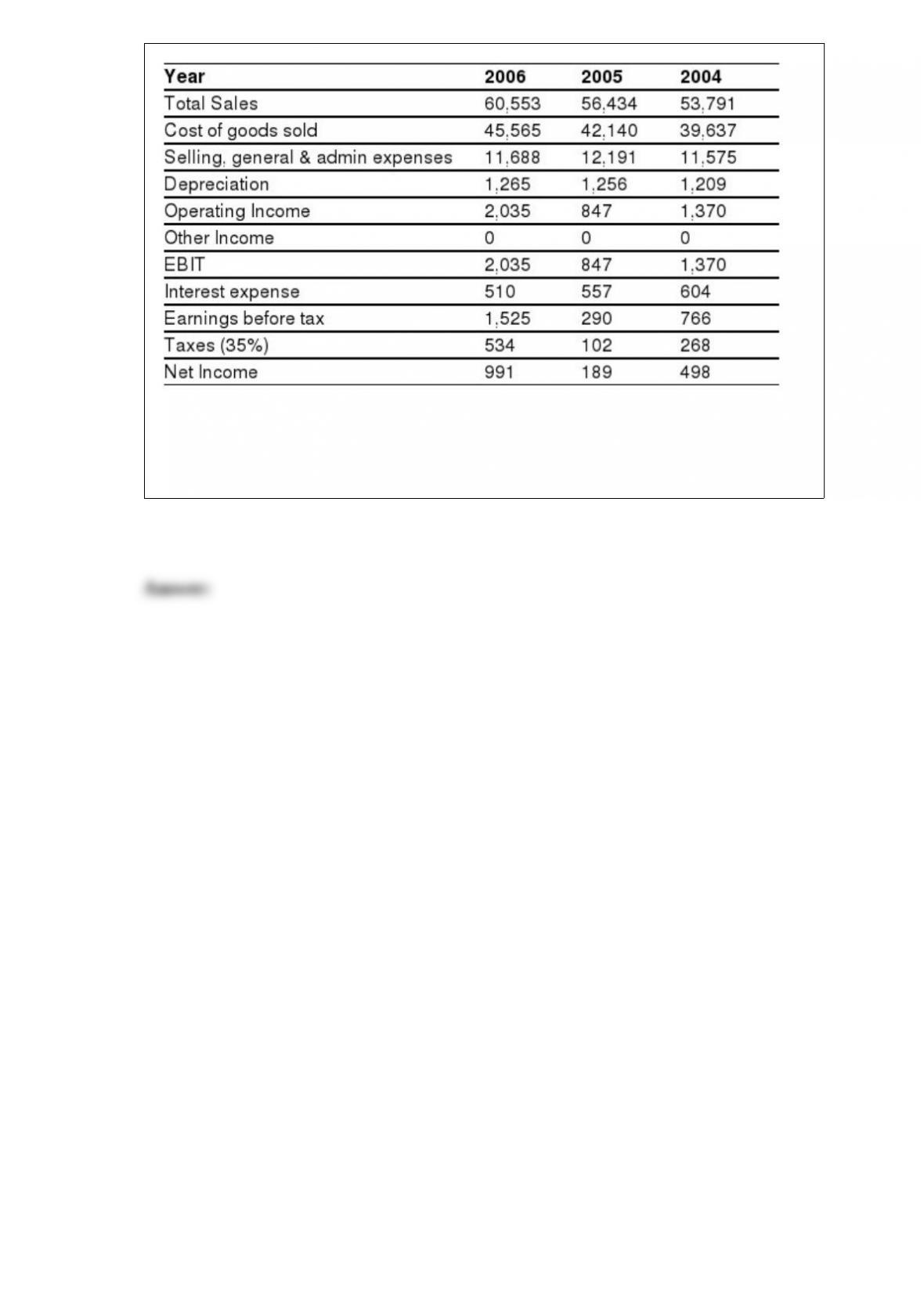
Calculate the interest tax shield, the total amount available to payout to all the investors,
and the income that would be available to equity holders if Kroger was not levered all
for the year 2004.
Suppose that a young couple has just had their first baby and they wish to insure that
enough money will be available to pay for their child’s college education. They decide
to make deposits into an educational savings account on each of their daughter’s
birthdays, starting with her first birthday. Assume that the educational savings account
will return a constant 7%. The parents deposit $2000 on their daughter’s first birthday
and plan to increase the size of their deposits by 5% each year. Draw a timeline that
details the amount that would be available for the daughter’s college expenses on her
18th birthday.
Explain why the expected return of a corporate bind does not equal its yield to
maturity?
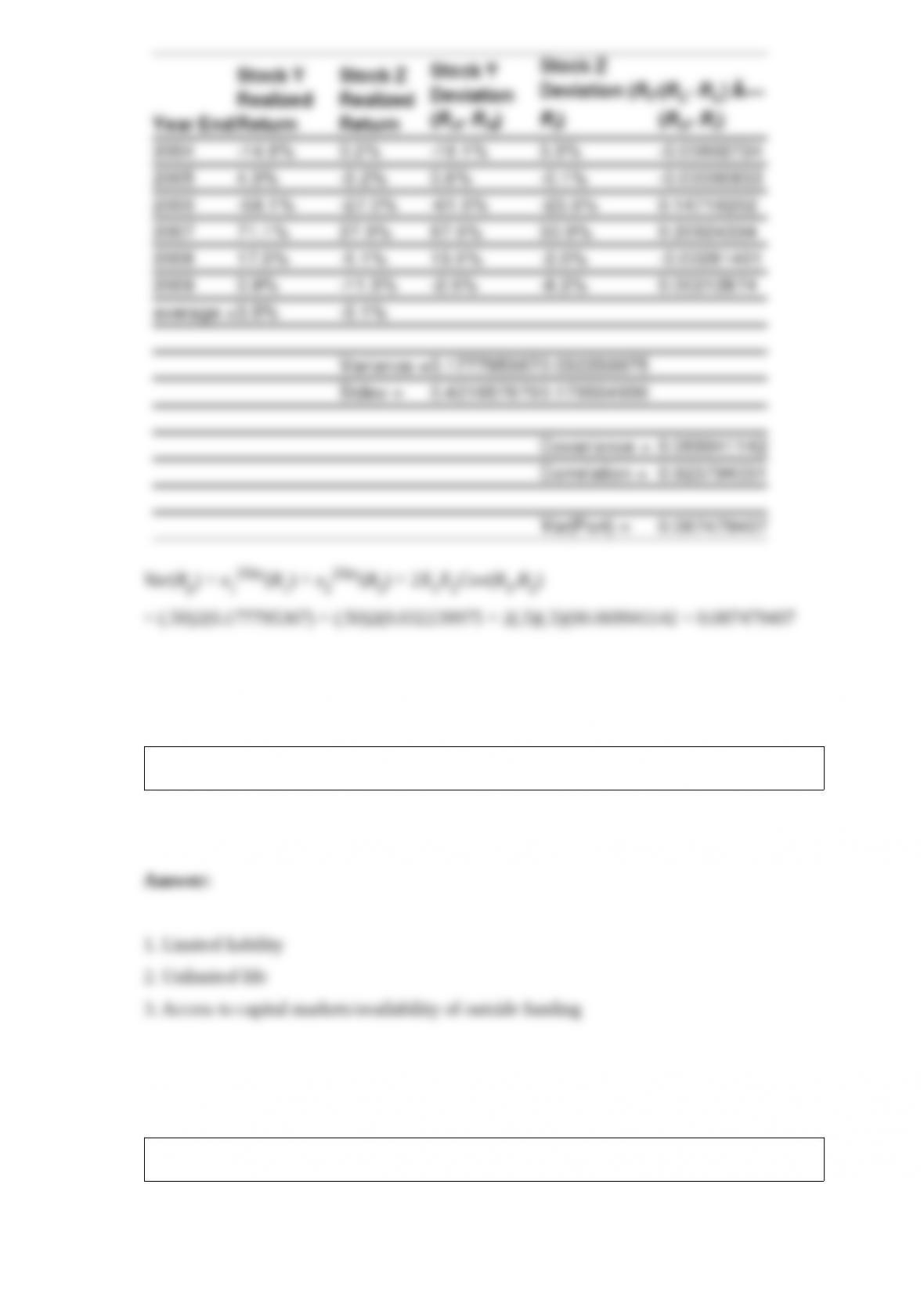
Consider the following returns:
Calculate the variance on a portfolio that is made up of equal investments in Stock Y
and Stock Z stock .
2Var(R1) + x2
2Var(R2) + 2X1X2Cov(R1,R2)
Explain the benefits of incorporation.
Explain why the market portfolio proxy may not be efficient.
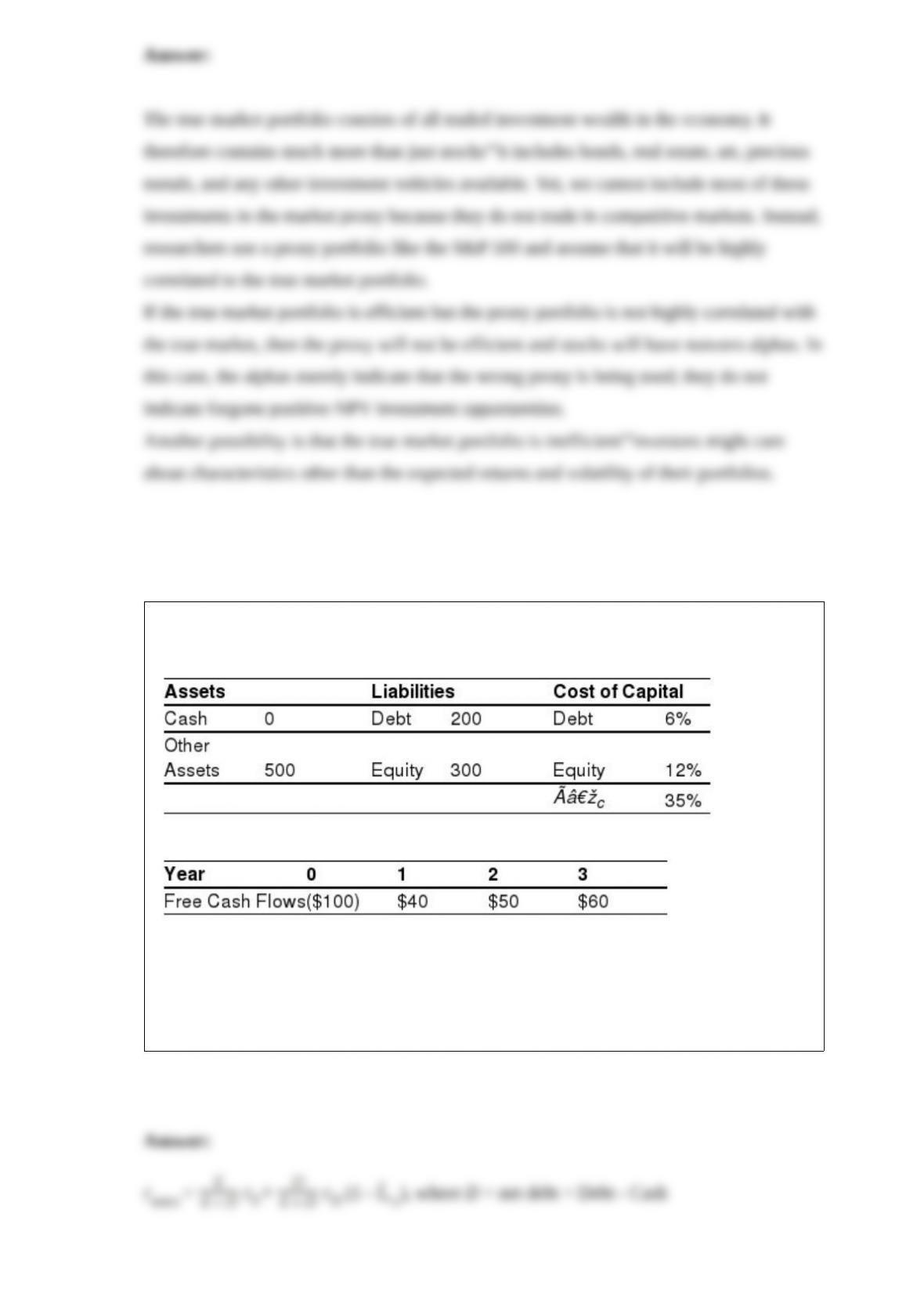
Omicron Industries’ Market Value Balance Sheet ($ Millions)
and Cost of Capital
Omicron Industries New Project Free Cash Flows
Assume that this new project is of average risk for Omicron and that the firm wants to
hold constant its debt to equity ratio.
Calculate the debt capacity of Omicron’s new project for years 0, 1, and 2.

Consider two firms: firm Without has no debt, and firm With has debt of $10,000 on
which it pays interest of 5% per year. Both companies have identical projects that
generate free cash flows of $1000 or $2000 each year. Suppose that there are no taxes,
and after paying any interest on debt, both companies use all remaining cash free cash
flows to pay dividends each year.Suppose you own 10% of the equity of Without. What
is another portfolio you could hold that would provide you with the same exact cash
flows?
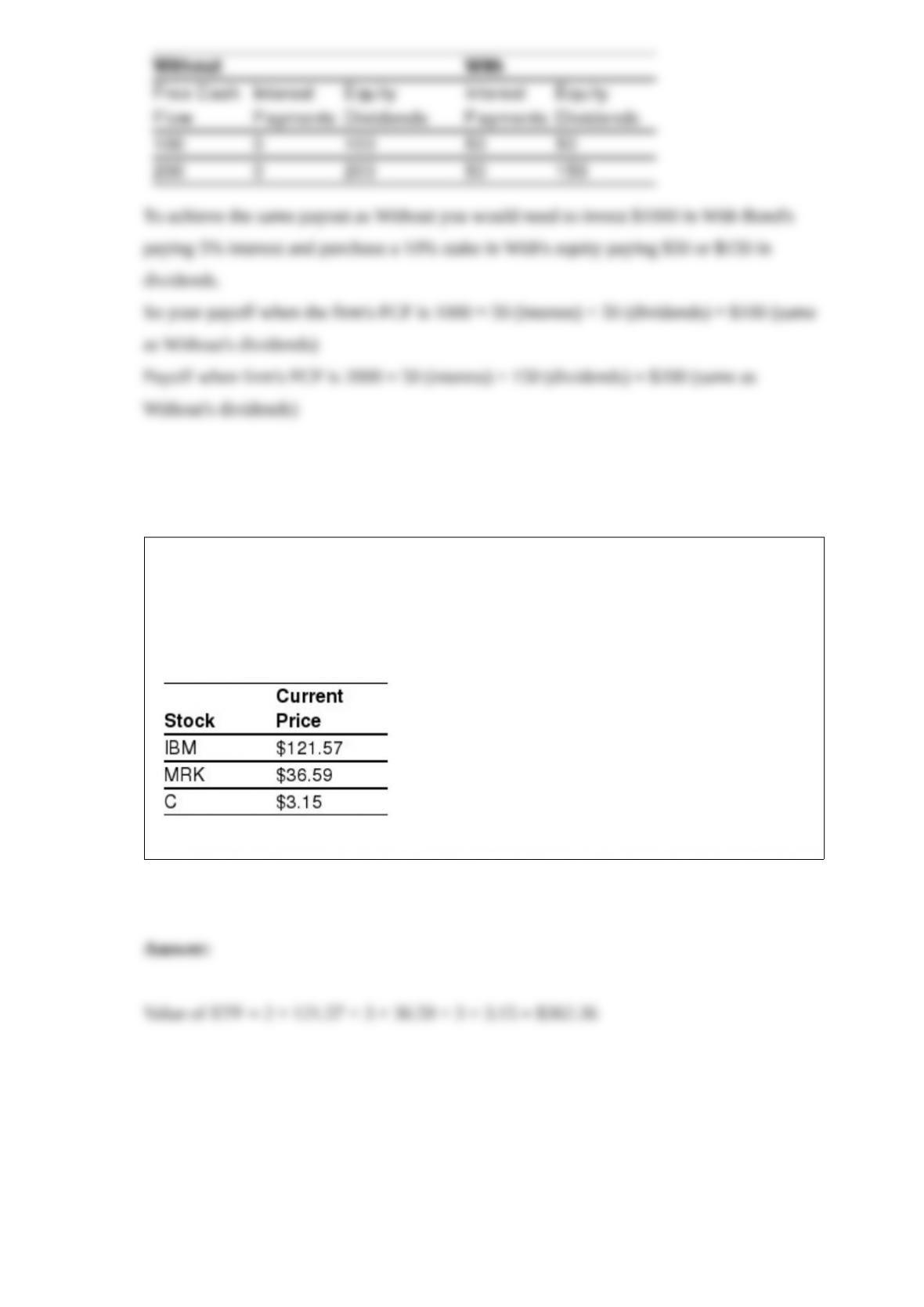
An exchange traded fund (ETF) is a security that represents a portfolio of individual
stocks. Consider an ETF for which each share represents a portfolio of two shares of
International Business Machines (IBM), three shares of Merck (MRK), and three shares
of Citigroup Inc. (C). Suppose the current market price of each individual stock are
shown below:
The price per share of the ETF in a normal market is: