
You want to create a $65,000 portfolio comprised of two stocks plus a risk-free security.
Stock A has an expected return of 14.2 percent and Stock B has an expected return of
17.8 percent. You want to own $20,000 of Stock B. The risk-free rate is 4.8 percent and
the expected return on the market is 13.1 percent. If you want the portfolio to have an
expected return equal to that of the market, how much should you invest in the risk-free
security?
A. $11,921
B. $13,509
C. $15,266
D. $17,315
E. $18,775
Answer:
The average net income of a project divided by the project’s average book value is
referred to as the project’s:
A. required return.
B. market rate of return.
C. internal rate of return.
D. average accounting return.
E. discounted rate of return.
Answer:

Kelly just completed compiling a listing of her firm’s accounts receivable with each
invoice segregated according to the length of time the invoice has been outstanding.
What is the name given to this listing?
A. Aging schedule
B. Collection report
C. Credit evaluation report
D. Invoice schedule
E. Terms of credit
Answer:
The operating cycle is equal to which one of the following?
A. Inventory period plus the accounts payable period
B. Accounts receivable period plus the cash cycle
C. Inventory period minus the accounts payable period plus the accounts receivable
period

D. Accounts receivable period plus the inventory period
E. Inventory period plus the cash cycle
Answer:
Boone Brothers remodels homes and replaces windows. Ace Builders constructs new
homes. If Boone Brothers considers expanding into new home construction, it should
evaluate the expansion project using which one of the following as the required return
for the project?
A. Boone Brothers’ cost of capital
B. Ace Builders’ cost of capital
C. Average of Boone Brothers’ and Ace Builders’ cost of capital
D. Lower of Boone Brothers’ or Ace Builders’ cost of capital
E. Higher of Boone Brothers’ or Ace Builders’ cost of capital
Answer:

Zero coupon bonds:
A. are valued using simple interest.
B. are issued only by the U.S. Treasury.
C. create a tax deduction for the issuer only at maturity.
D. are issued at a premium.
E. create annual taxable income to individual bondholders.
Answer:
The 7.5 percent preferred stock of Home Town Brewers is selling for $45 a share. What
is the firm’s cost of preferred stock if the tax rate is 35 percent and the par value per
share is $100?
A. 7.50 percent
B. 15.92 percent
C. 16.17 percent
D. 16.52 percent
E. 16.67 percent
Answer:

A project has the following cash flows. What is the payback period?
A. 2.38 years
B. 2.49 years
C. 2.60 years
D. 3.01 years
E. 3.33 years
Answer:
Generally speaking, which of the following situations will occur if a seasonal company
adopts a compromise financial policy?
I. periods where short-term financing is required
II less long-term debt than if the firm followed a restrictive financial policy
III. periods of excess funds which can be invested in short-term marketable securities
IV. lower investment in fixed assets than if the firm adopted a flexible financial policy

A. I only
B. II only
C. I and III only
D. II and IV only
E. I, III, and IV only
Answer:
Which one of the following statements concerning disbursement float is correct?
A. Disbursement float is the period of time between a firm making a bank deposit and
the funds from that deposit being available to the firm.
B. Disbursement float decreases when a check is delayed in the mail due to an extended
holiday weekend.
C. Disbursement float causes the available balance to exceed the ledger balance.
D. Disbursement float is being totally eliminated by the Check Clearing Act for the 21st
Century.
E. Disbursement float exists when the available balance is less than the book balance.
Answer:

Mike’s Fish Market is implementing a project that will initially increase accounts
payable by $4,600, increase inventory by $4,800, and decrease accounts receivable by
$800. All net working capital will be recouped when the project terminates. What is the
cash flow related to the net working capital for the last year of the project?
A. -$2,000
B. -$400
C. -$600
D. $200
E. $2,000
Answer:
How much money does Suzie need to have in her retirement savings account today if
she wishes to withdraw $25,000 a year for 30 years? She expects to earn an average rate
of return of 13 percent.
A. $176,800.16
B. $180,419.81
C. $181,533.33
D. $185,160.98
E. $187,391.34

Answer:
What is the effective annual rate of 6.5 percent compounded quarterly?
A. 6.02 percent
B. 6.29 percent
C. 6.54 percent
D. 6.66 percent
E. 6.83 percent
Answer:
Which one of the following terms refers to the basic factors that are reviewed when
evaluating the creditworthiness of a potential customer?
A. Terms of sale
B. Cash concentration
C. Five Cs of credit

D. Collection policy
E. Credit score
Answer:
Which one of the following must be significantly eliminated if interest rate parity is to
exist?
A. Absolute purchasing power parity
B. Short-run exposure to exchange rate risk
C. Covered interest arbitrage opportunities
D. Relative purchasing power parity
E. Translation exposure
Answer:
Here are some important figures from the budget of Wexter Enterprises for the second
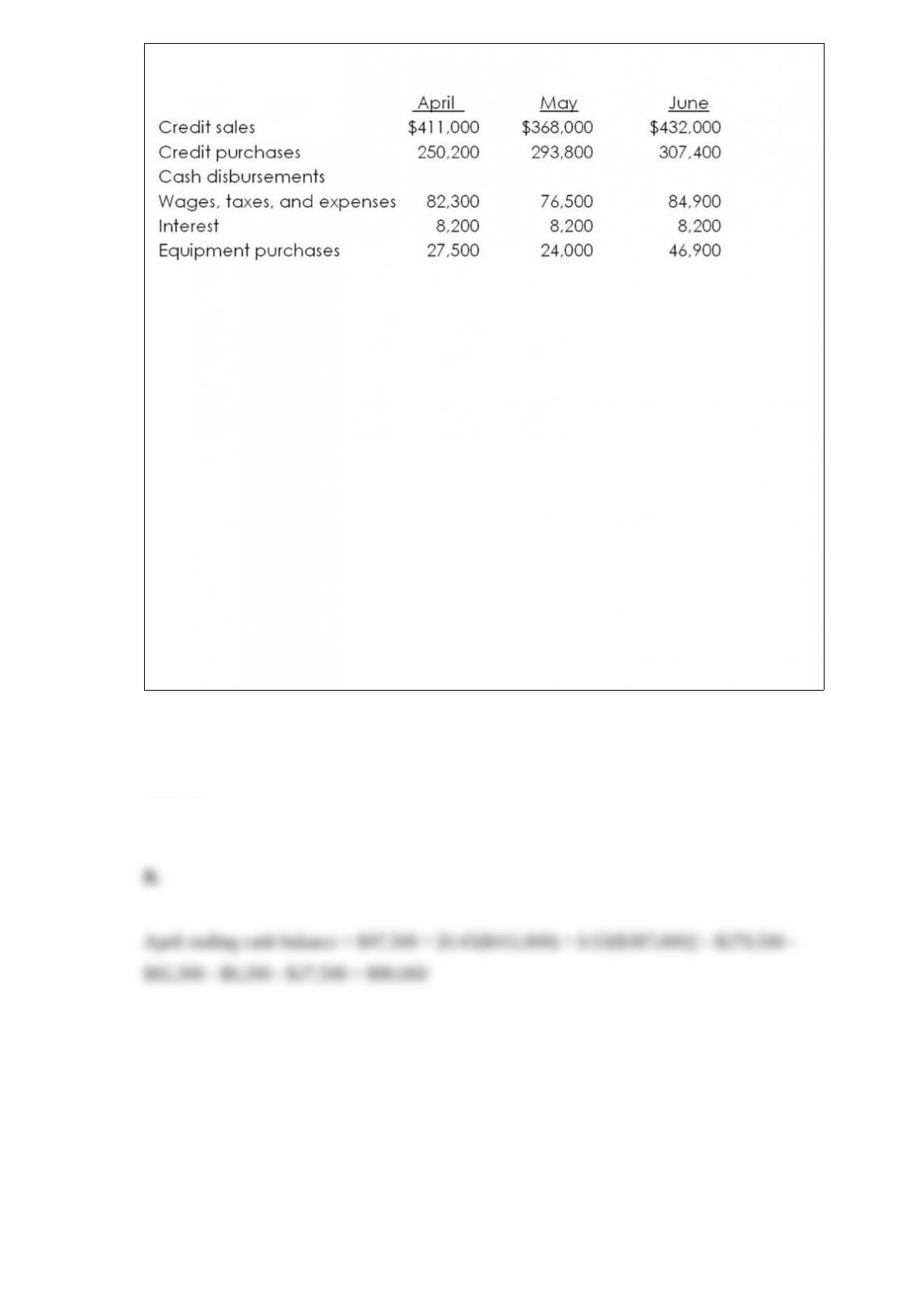
quarter of 2013:
The company predicts that 2 percent of its credit sales will never be collected, 45
percent of its sales will be collected in the month of sale, and the remaining 53 percent
will be collected in the following month. Credit purchases will be paid in the month
following the purchase.
In March 2013, credit sales were $387,000 and credit purchases were $279,500. What is
the ending cash balance for April if the beginning cash balance was $97,500?
A. $87,410
B. $90,060
C. $92,800
D. $94,440
E. $97,230
Answer: