
1) since 1980 the number of banks in the united states has been increasing dramatically
due to deregulation of the industry.
2) federally insured mortgages are called conventional mortgages.
3) accrued interest owed to the bond seller increases as the next coupon payment date
approaches.
4) a u.s. corporation has a yen-denominated loan it must repay in 6 months. a long
position in yen futures could help offset the corporation’s foreign exchange risk.
5) 360/h times the difference between the face value and the current value divided by
the face value gives you the discount yield on an instrument.
6) the process of creating a secondary market for securities or contracts is termed
brokerage.
7) the investment company act of 1940 and the securities acts of 1933 and 1934 are
examples of investor protection regulations.

8) everything else equal, the interest rate required on a callable bond will be less than
the interest rate on a convertible bond.
9) a 65-year-old person has saved $1,250,000 and wishes to receive 10 annual annuity
payments, beginning in one year. if the annuity rate is 5.75%, he can expect to receive
$167,829 per year.
10) a shelf registration allows firms the opportunity to avoid the normal
______________ day waiting period by allowing preregistration of securities for up to
______________ years.
a.20-; 2
b.10-; 1
c.15-; 3
d.20-; 1
e.30-; 2
11) in 2010, the largest u.s. savings institution was
a.ing bank
b.washington mutual
c.navy federal
d.hudson city bancorp
e.hsbc financial
12) figure 12-1
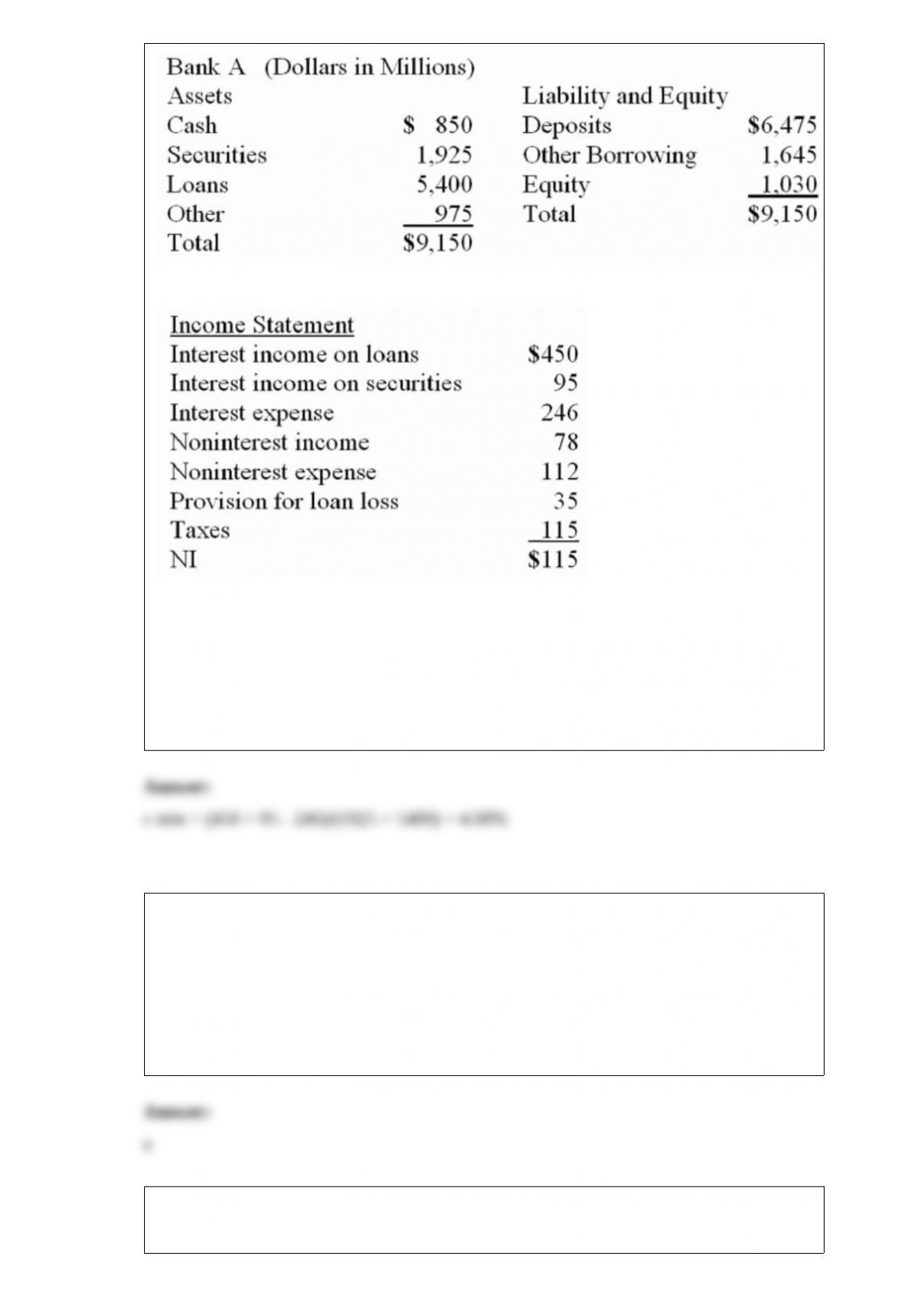
if the average net interest margin for this type of bank is 4.65%, then, ceteris paribus,
this particular bank is performing
a.the same as average because this bank has a nim of 4.65%
b.better than average because this bank has a nim of 6.55%
c.poorer than average because this bank has a nim of 4.08%
d.better than average because this bank has a nim of 5.23%
e.one can’t determine with the information given
13) about ___________ of retirement plan investments are in so-called institutional
funds, which are funds that manage retirement plans for an institution’s employees.
a.40%
b.50%
c.60%
d.70%
e.80%
14) a 9-year maturity aaa-rated corporate bond has a 6% coupon rate. the bond’s
promised yield is currently 5.75% and the bond sells for its fpv. the bond pays interest
semiannually and has an annual duration of 7.1023 years.
a) what is the bond’s convexity?
b) if promised yields decrease to 5.45%, what is the bond’s predicted new price,
including convexity?
c) based on your result in b), would you prefer to have a bond with more or less
convexity? explain.
15) fernando bank has interest expense of $150 million, earning assets of $1,400
million and a nim of 5.00%. the bank also has interest-bearing liabilities of $1,100
million. fernando bank’s spread is
a.1.10%
b.1.65%
c.1.94%
d.2.08%
e.2.16%
16) as a business lender, you would prefer that the borrower have stable or growing
cash flows resulting from which part of the statement of cash flows?

a.financing cash flows
b.cash flows from investment
c.operating cash flows
d.dividends
e.common stock
17) which of the following would normally be expected to result in an increase in the
supply of funds, all else equal?
i. the perceived riskiness of all investments decreases.
ii. expected inflation increases.
iii. current income and wealth levels increase.
iv. near term spending needs of households increase as energy costs rise.
a.i and iii only
b.ii and iii only
c.ii, iii, and iv only
d.i and iv only
e.i, ii, iii, and iv
18) social security began running a deficit for the first time in what year?
a.1990
b.1995
c.2000
d.2005
e.2010
19) figure 22-1
a bank has the following balance sheet:
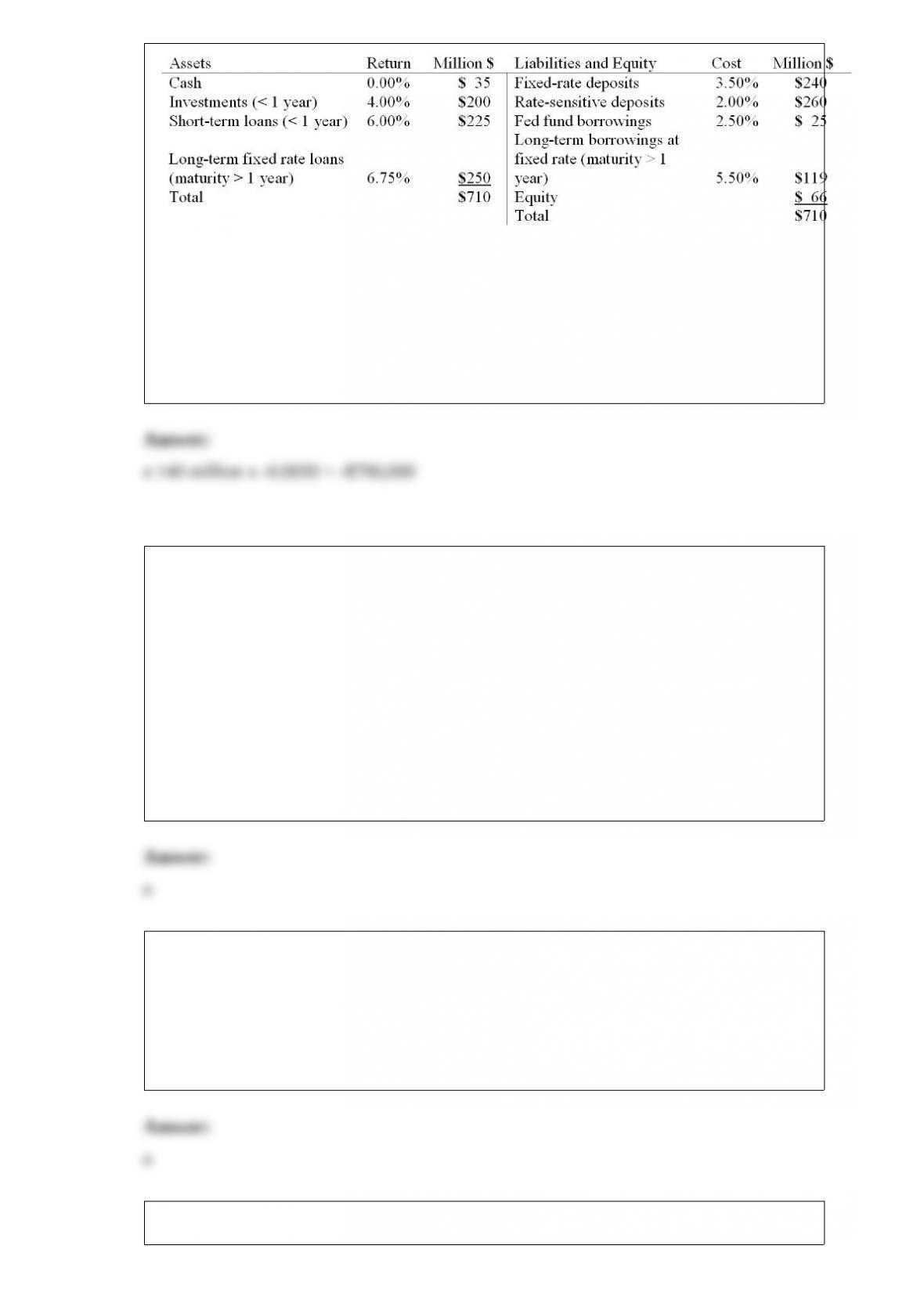
if the spread effect is zero and all interest rates decline 50 basis points, the bank’s nii
will change by ________________ over the year.
a.$0
b.$400,000
c.-$400,000
d.$700,000
e.-$700,000
20) as compared to fixed-rate mortgages, arms result in which of the following for the
lender?
i. higher interest rate risk
ii. lower default risk
iii. greater prepayment penalty fees
a.i, ii, and iii
b.i and ii only
c.ii and iii only
d.i and iii only
e.none of the above
21) hybrid mutual funds normally invest significant amounts in
a.common stock
b.commercial paper
c.long-term bonds
d.treasury bills
e.both a and c
22) which of the following is/are true about a roth ira?

i. contributions are tax deductible.
ii. withdrawals after retirement are not taxed.
iii. you must begin withdrawals at age 70 .
iv. employers match contributions.
v. they are only available to individuals earning less than $50,000, or households
earning less than $90,000.
a.i, ii, and iv
b.ii, iv, and v
c.i, iii, and iv
d.ii only
e.v only
23) premiums received before the coverage period are termed
a.unearned premiums
b.lagged premiums
c.loss adjustment expenses
d.loss reserves
e.policyholder’s surplus
24) if a borrower makes a 20% down payment on a conventional mortgage they will be
required to obtain
a.fha insurance
b.va insurance
c.private mortgage insurance
d.gnma payment guarantees
e.none of the above
25) credit unions are
i. mutual associations
ii. not open to the general public
iii. for profit institutions
a.i only
b.ii only
c.i and ii only
d.i, ii, and iii

e.ii and iii only
26) in what major ways do stocks differ from bonds?
27) why do changes in reserve requirements have less predictable effects on the money
supply in comparison to changes in open market operations?
28) why are most loan sales on an assignment basis rather than a participation basis?
29) why are p&c insurers dependent on investment yields? is this an argument for
changing how this industry operates and/or how we regulate the industry? explain.
30) why won’t a loan officer usually approve a loan solely on the basis of collateral?
31) what are soft dollar fees or commissions? how can these lead to conflicts of interest
for investment bankers?
32) a corporate treasurer is looking to invest about $4 million for 60 days. commercial
paper rates are a 3.65% discount and cd rates are 3.66%. comparing the bond equivalent
yields over a 365-day year, which is the best alternative? what is the opportunity cost of
leaving the funds idle? (watch your rounding)
33) a municipal bond holder buys a 5% coupon annual payment muni bond at a price of
$4,900. the bond has a $5,000 face value. in one year she sells the bond for $4,975. the
appropriate capital gains tax rate is 15% and her ordinary income tax rate is 28%. what
is her after-tax rate of return?
34) can the actual real rate of interest be negative? when? can the expected real rate be
negative?