
The Friedman rule suggests that
a. the optimal nominal interest rate in an economy should be negative.
b. the optimal nominal interest rate in an economy should be positive.
c. the optimal nominal inflation rate in an economy should be positive.
d. the optimal nominal inflation rate in an economy should be negative.
Answer:
If the Fed follows the Taylor rule and actual inflation is below the inflation target set by
the Fed,
a. the Fed should reduce the nominal federal funds rate.
b. the Fed should reduce the supply of money.
c. the Fed should charge a higher tax rate.
d. the Fed should spend lesser money.
Answer:
A bank is said to have when its average costs decline as its volume of sales increases.
a. economies of scope.
b. economies of scale.
c. cost diminution.
d. decreasing returns to scale.
Answer:
Suppose the money demand function is MD = P × [(0.25 × Y) − (100 × i)], where Y is
expressed in billions of dollars and i is expressed in percentage points.
a. Suppose that initially P = 2, Y = 5,000, and i = 5. If income rises to 6,000, what is
the new equilibrium nominal interest rate?
b. Suppose that initially P = 3, Y = 4,000, and i = 7. If the price level falls to 2, what
is the new equilibrium nominal interest rate?
Answer:
The group that determines the peaks and troughs of business cycles is a part of the
a. Department of Commerce.
b. Bureau of Labor Statistics.
c. National Bureau of Economic Research.
d. Center for International Business Cycle Research.
Answer:
Which of the following serves as the lender of last resort for credit unions?
a. The Federal Deposit Insurance Corporation
b. The Federal Reserve
c. National Credit Union Administration’s Credit Liquidity Facility
d. The National Credit Union Share Insurance Fund

Answer:
Realized real interest rates in the United States were the highest in the
a. 1960s.
b. 1970s.
c. 1980s.
d. 1990s.
Answer:
In the U.S., the output gap is equal to
a. 1 time the unemployment gap.
b. 2 times the unemployment gap.
c. 1 time the unemployment gap.
d. 2 times the unemployment gap.
Answer:

A rise in the incomes of foreign consumers, everything else remaining unchanged,
causes net exports to
a. decline.
b. not change.
c. rise.
d. rise at first, then decline later.
Answer:
The chairman of the Federal Reserve Board, under whose leadership the inflation rate
reduced from about 10 percent to about 4 percent in the 1980s was
a. Arthur Burns.
b. G. William Miller.
c. Paul Volcker.
d. Alan Greenspan.
Answer:

Higher the rate of inflation
a. slower will be the rate at which money will lose value.
b. lower will be the will to spend money.
c. lower will be the will to hold money.
d. lower will be the will to invest money.
Answer:
The law that allowed banks to engage in investment banking was the
a. Gramm-Leach-Bliley Act.
b. Glass-Steagall Act.
c. McFadden Act.
d. Garn-St. Germain Act.
Answer:
The Gramm-Leach-Bliley Act created the financial holding company (FHC) structure in
order to
a. allow banks to engage in additional non-banking activities.

b. allow banks to merge with other banks.
c. prevent banks from dealing in securities and insurance products.
d. prevent bank holding companies from branching across state lines.
Answer:
Which of the following is true of the Glass-Steagall Act?
a. The act provides authority to the Federal Reserve to regulate bank holding companies
and prevent them from branching out.
b. The act enables banks to engage in more non-banking activities by operating
subsidiaries.
c. The act prohibits banks to own subsidiary firms that sold products other than banking
services.
d. The act encourages banks to meet the credit needs of their communities.
Answer:
Everything else remaining unchanged, an increase in the supply of security A and a
decrease in the demand for security B will cause the price of security A to____ and the
price of security B to______ .

a. fall; fall
b. fall; rise
c. rise; fall
d. rise; rise
Answer:
Suppose that a risk-neutral investor has a choice between buying a one-year bond
paying 4 percent today, a two- year bond paying 5 percent today, a three-year bond
paying 3 percent today, or a four-year bond paying 5.8 percent today. The investor
would buy
a. a one-year bond today.
b. a two-year bond today.
c. a three-year bond today.
d. a four-year bond today.
Answer:
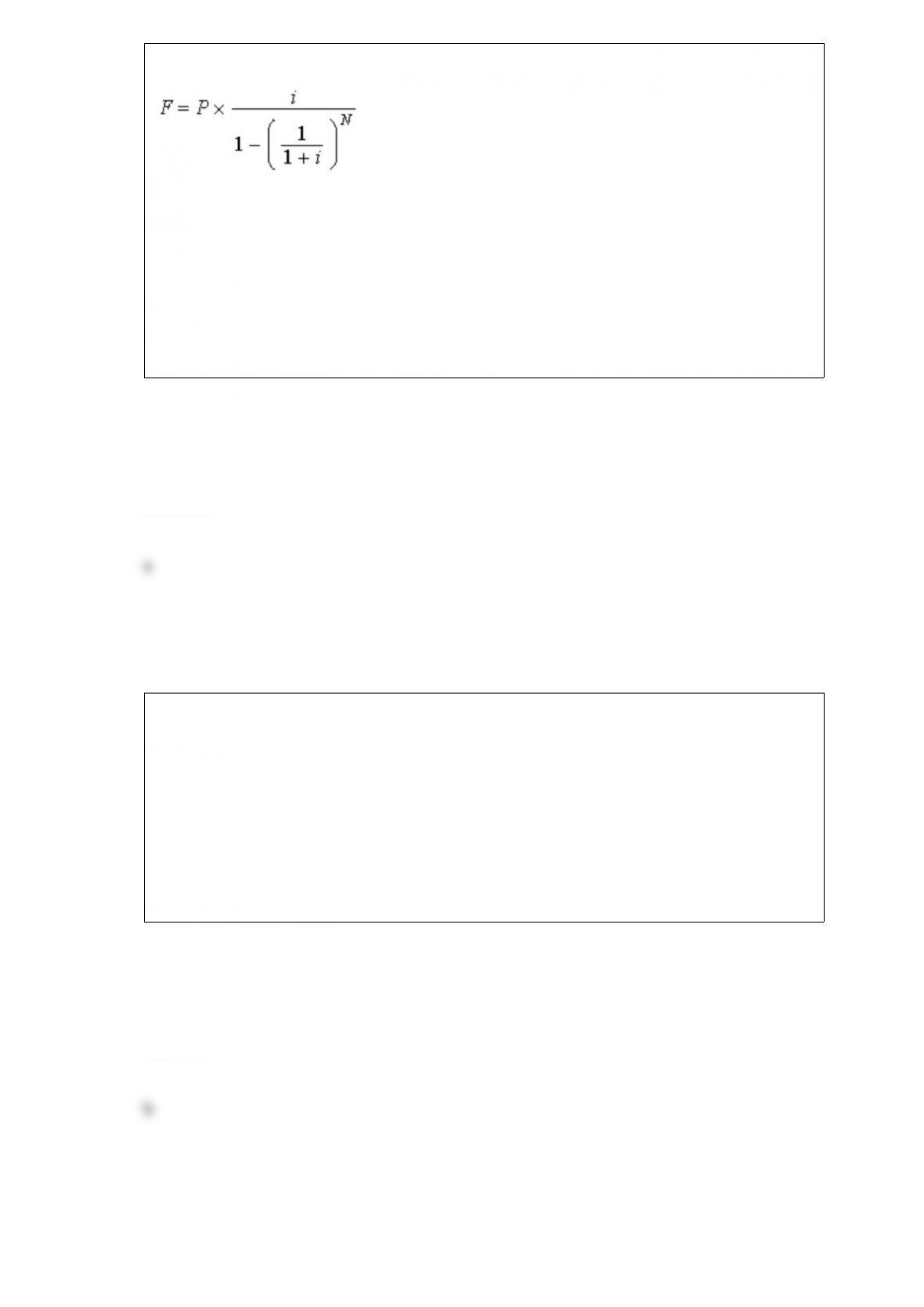
Suppose you take out a car loan of $10,000 for 3 years at an annual interest rate of 8
percent, with payments to be made monthly. What will be the approximate monthly
payments? The relevant formula is:
a. $313.36.
b. $323.36.
c. $853.45.
d. $3,880.34.
Answer:
The last depression in the United States occurred in
a. the 1900s.
b. the 1930s.
c. the 1960s.
d. the 1990s.
Answer:

When the Federal Reserve makes a loan to a bank at the discount window,
a. the Fed requires that the loan be repaid the next day.
b. the interest rate charged by the Fed is equal to the federal funds rate.
c. the loan is backed by collateral.
d. the Fed requires the bank to buy additional deposit insurance.
Answer:
Consider the following four debt securities, which are identical in every characteristic
except as noted: W: A corporate bond rated AAA
X: A corporate bond rated BBB
Y: A corporate bond rated AAA with a shorter time to maturity than bonds W and X
Z: A corporate bond rated AAA with the same time to maturity as bond Y that trades in
a more liquid market than bonds W, X, or Y
Which of the following is the most likely order of the interest rates (yields to maturity)
of the bonds from highest to lowest?
a. X, W, Y, Z
b. W, X, Z, Y
c. X, Y, Z, W
d. X, Z, W, Y
Answer:

Macroeconomic models from the 1950s and 1960s that consist of hundreds of equations
that describe the economy in great detail are called
a. real business-cycle models.
b. large, structural macroeconomic models.
c. VARs.
d. structural VARs.
Answer:
International investors believe that when a country gets into financial trouble, the IMF
will rescue the country, thus reducing the investors’ risk. As a result, investors take
greater risks than they would otherwise. This is an example of
a. a risk premium.
b. a lender of last resort.
c. adverse selection.
d. moral hazard.
Answer:

According to Keynesians, the main source of the business cycle is
a. changes in the amount of money in the economy.
b. waves of optimism and pessimism.
c. changes in the prices of oil and other resources.
d. changes in productivity.
Answer:
Discounting is the process of dividing a future value by the to obtain the value.
a. discount factor; past
b. discount factor; present
c. rate of discount; past
d. rate of discount; present
Answer:
Which of the following was an outcome of the announcement made by the U.S.
government in October 2001 that it will stop selling 30-year bonds?

a. There was a sharp fall in the price of the securities and an increase in the yield to
maturity.
b. There was a sharp rise in the price of the securities and a decline in the yield to
maturity.
c. There was a sharp rise in the price of the securities and an increase in the yield to
maturity.
d. There was a sharp fall in the price of the securities and a decline in the yield to
maturity.
Answer:
In which of the following ways can a bank increase its reserves?
a. Give out more loans
b. Sell securities
c. Reduce interest rate on time deposits
d. Increase service charges for safety vault facility
Answer:
Of the nine directors of each Federal Reserve Bank, are elected by member banks.

a. zero
b. three
c. six
d. nine
Answer:
An RBC researcher who picks a few key parameters based on long-run historical
averages of the data is probably
a. calibrating a model.
b. using econometric analysis.
c. replicating a model.
d. solving a model analytically.
Answer:
Everything else remaining unchanged, an increase in the supply of security A and an
increase in the demand for security B causes the price of security A to_____ and the
price of security B to_____ .

a. fall; fall
b. fall; rise
c. rise; fall
d. rise; rise
Answer:
What does a yield curve show?
a. The yield to maturity on the vertical axis and the time to maturity on the horizontal
axis
b. The time to maturity on the vertical axis and the yield to maturity on the horizontal
axis
c. The yield to maturity on the vertical axis and the maturity date on the horizontal axis
d. The maturity date on the vertical axis and the yield to maturity on the horizontal axis
Answer:
Why are policymakers willing to use rules for monetary policy as general guides, but
unlikely to follow such rules blindly?
Answer:
Explain how an economist could use the slope of the yield curve to analyze the
probability that a recession will occur.
Explain why the spread may matter.
Answer:
Is there evidence that the Federal Reserve has built itself into an inefficient
bureaucracy?
Answer:
In the two-period model, suppose a household’s income in the first period is $60,000,
income in the second period is
$100,000, and the real interest rate is 50 percent. Draw a diagram showing the budget
constraint. Now, suppose the household’s income in the second period increased to
$120,000. Draw the new budget constraint. For the budget constraints you have drawn,
be sure to show the values of the intercepts on each axis. Show your work.
Answer:
Explain how a sudden change in productivity could lead to a change in economic
output. Give an example.
Answer:
In the fourth quarter of 2004, economic statistics showed the following:

Real GDP $10,994.3 billion
Unemployment rate 5.4%
Inflation rate 2.2%
The conceptual variables corresponding to these data are:
Potential output $11,144.6 billion
Natural rate of unemployment 5.2%
Ideal inflation rate 1.0%
a. Calculate the output gap in percentage. Show your work.
b. Calculate the unemployment gap in percentage. Show your work. c. Calculate the
inflation gap in percentage. Show your work.
d. Calculate the output loss and the inflation loss. Show your work.
e. Calculate the totalloss in the fourth quarter of 2004 if the weigh on the
inflation loss equals
f. Calculatethe totalloss inthe fourth quarter of 2004 if the weight on the inflation loss
equals
Answer:
Gary Goldwater has $5,000 in cash. He deposits $1,000 in his checking account, buys
$500 of traveler’s checks, puts
$1,500 in his money-market mutual fund, and buys a $2,000 CD. How does this
transaction affect M1 and M2?
Answer:
What are the nontraditional policies suggested by Ben Bernanke for a central bank
caught in a liquidity trap?
Answer:
Put the following securities in order according to their after-tax interest rates, from
lowest to highest. The federal tax rate on interest income is 30 percent. Show your
work.
A: A corporate bond that pays an interest rate of 6 percent. B: A corporate bond that
pays an interest rate of 7 percent.
C: A local government bond identical that pays an interest rate of 5 percent.
Answer:
What causes the formation of an expectations trap and how can the Fed prevent one
from forming?
Answer:
How does a central bank establish credibility?
Answer:
Consider the bond market to be in equilibrium according to our complete theory of the
term structure of interest rates. You observe the following interest rates available today
on bonds with differing times to maturity. (You may ignore transactions costs.)
Time to maturity Yield to maturity
1 year 5.0%
2 years 7.0%
3 years 7.5%
The term premium for the two-year bond is the extra yield to maturity paid on a
two-year bond compared with buying two separate one-year bonds (one today and
another after one year). You believe that the term premium on the two-year bond is 5
percent.
The term premium for the three-year bond is the extra yield to maturity paid on a
three-year bond compared with buying three separate one-year bonds (one today,
another after one year, and another after two years). You believe that the term premium
on the three-year bond is 0 percent.
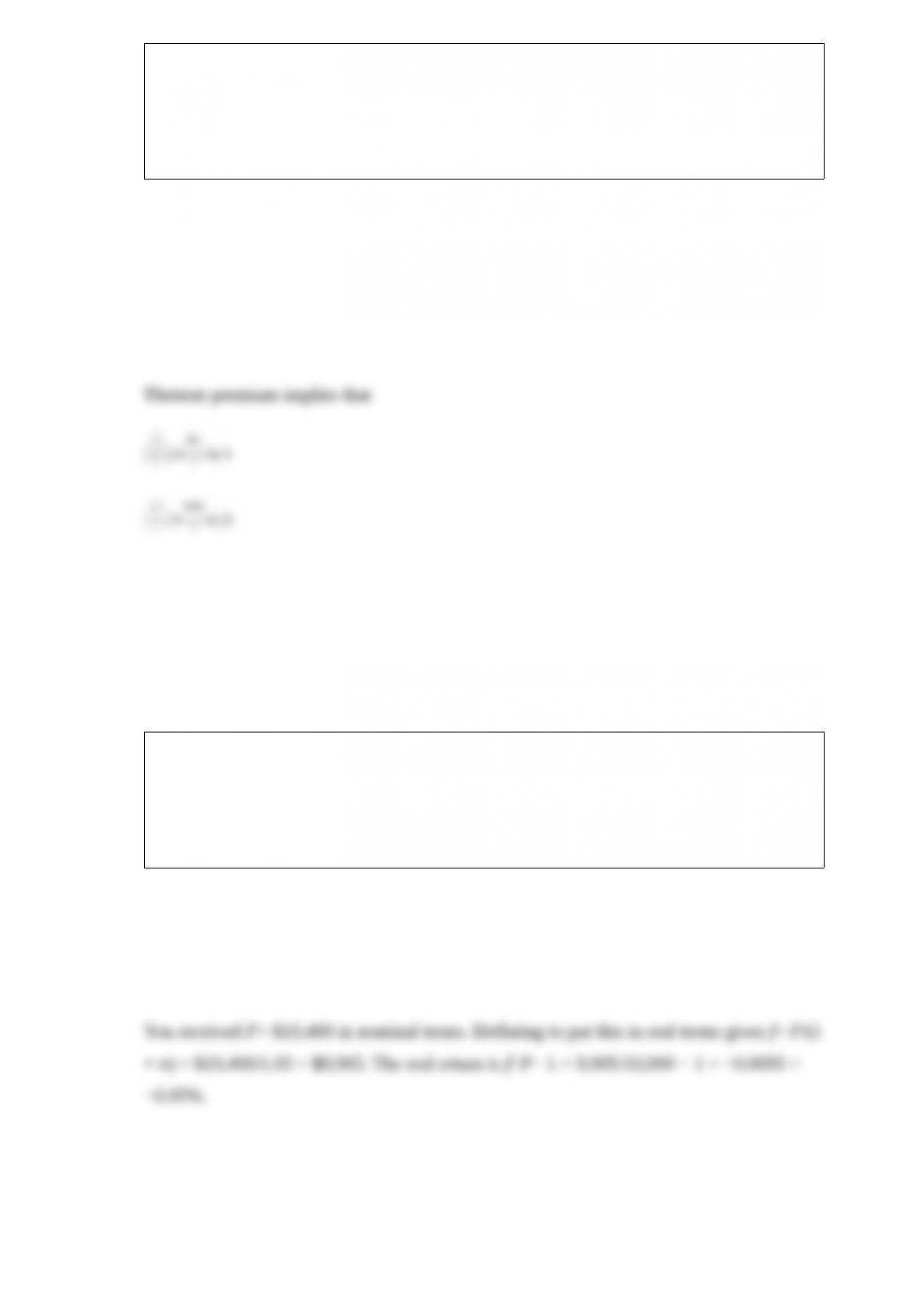
Given your beliefs about the term premiums on two-year and three-year bonds,
calculate the interest rates on one- year bonds that you expect to prevail one year from
now and two years from now. In other words, what do you expect to be the yield to
maturity on a one-year bond one year from now and what do you expect to be the yield
to maturity on a one-year bond two years from now? Explain and show all your work.
Answer:
One year ago, you bought a bond for $10,000. You received interest of $400 at the end
of the year, as well as your
$10,000 principal. If the inflation rate over the last year was 5 percent, calculate your
real return. Show your work.
Answer:

In a dynamic model, what three key assumptions are needed to make the prices of
goods and services endogenous?
Answer:
An economy has fifty households, all of which have incomes of $25,000 each in period
2. The twenty-five poor households have incomes of $10,000 each in period 1, while
the twenty-five rich households have incomes of $20,000 each in period 1. Assume that
the price of the good is $1 in both periods. Suppose that each household decides that its
consumption in period 1 will equal 50 percent of the present value of its income from
both periods.
Calculate the present value of income for poor households as a function of the interest
rate.
a. Calculate the amount that poor households will spend on consumption, as a function
of the interest rate. Calculate the amount that poor households will save as a function of
the real interest rate.Show your work.
Calculate the present value of income for rich households as a function of the interest
rate.
b. Calculate the amount that rich households will spend on consumption, as a function
of the interest rate. Calculate the amount that rich households will save as a function of
the real interest rate.Show your work.
c. Given the equations you calculated for savings for each type of household and
assuming that the households borrow from each other, find the equilibrium value of the
interest rate. Show your work.
Answer: