
1) According to the moderate view of capital structure theory, the cost of common
equity is constant regardless of the debt financing level.
2) If a project’s IRR is equal to its required return, then the project’s NPV is equal to
zero and its PI is equal to one.
3) If a project’s profitability index is less than one then the project should be rejected.
4) A project’s IRR is analogous to the concept of the yield to maturity for bonds.
5) When economies of scale exist, the percent of sales method will overestimate the
assets required and therefore overestimate the amount of discretionary financing
needed.
6) Dividends per share divided by earnings per share equal the dividend payout ratio.
7) As a rule, any cash flows that are not affected by the accept/reject criterion should
not be included in capital-budgeting analysis.

8) The use of a call provision in addition to a sinking fund can effectively create a
maturity date for preferred stock.
9) Since stockholders are able to reduce their exposure to risk by efficiently
diversifying their holdings of securities, there is no reason for individual firms to seek
diversification of their holdings of assets.
10) ABC Corp 5% preferred stock with a par value of $100 and a market price of $125
will pay an annual dividend this year of $12 per share.
11) Given the constant growth dividend valuation model, the expected percentage
growth in value of a stock is equal to the capital gains yield for that stock.
12) The common stock of a constant-growth firm is valued in the same manner as its
preferred stock.
13) Share repurchases are not part of the stock valuation process because by definition
the cash flow from a share repurchase ends the investment as the stock is no longer
owned by the shareholder.
14) Seasonality is introduced into financial ratios by averaging monthly account
balances, and thus it is recommended that ending account balances be used.

15) The same underlying formula is used for computing both the future value and
present value.
16) The Sarbanes-Oxley Act, or SOX
A) holds corporate advisors strictly accountable in a legal sense for any instances of
misconduct
B) pretexts the interests of shareholders by providing greater protection against
accounting fraud and financial misconduct.
C) reduces the cost of financial reporting by standardizing reporting requirements
D) accomplishes both A and B
17) LTM, Inc. has an issue of preferred stock whose par value is $1,000. The preferred
stock pays a 4.5% dividend. If investors require a 5.5% rate of return for these shares,
what price should the preferred stock sell for?
A) $611.11
B) $508.33
C) $409.09
D) $818.18
18) A project would be acceptable if
A) the payback is greater than the discounted equivalent annual annuity
B) the equivalent annual annuity is greater than or equal to the firm’s discount rate
C) the profitability index is greater than the net present value
D) the net present value is positive
19) Dividends generally
A) are paid as a fixed percentage of earnings
B) fluctuate more than earnings
C) are guaranteed by the SEC

D) are more stable than earnings
20) Table 4-2
Drummond Company
Balance Sheet
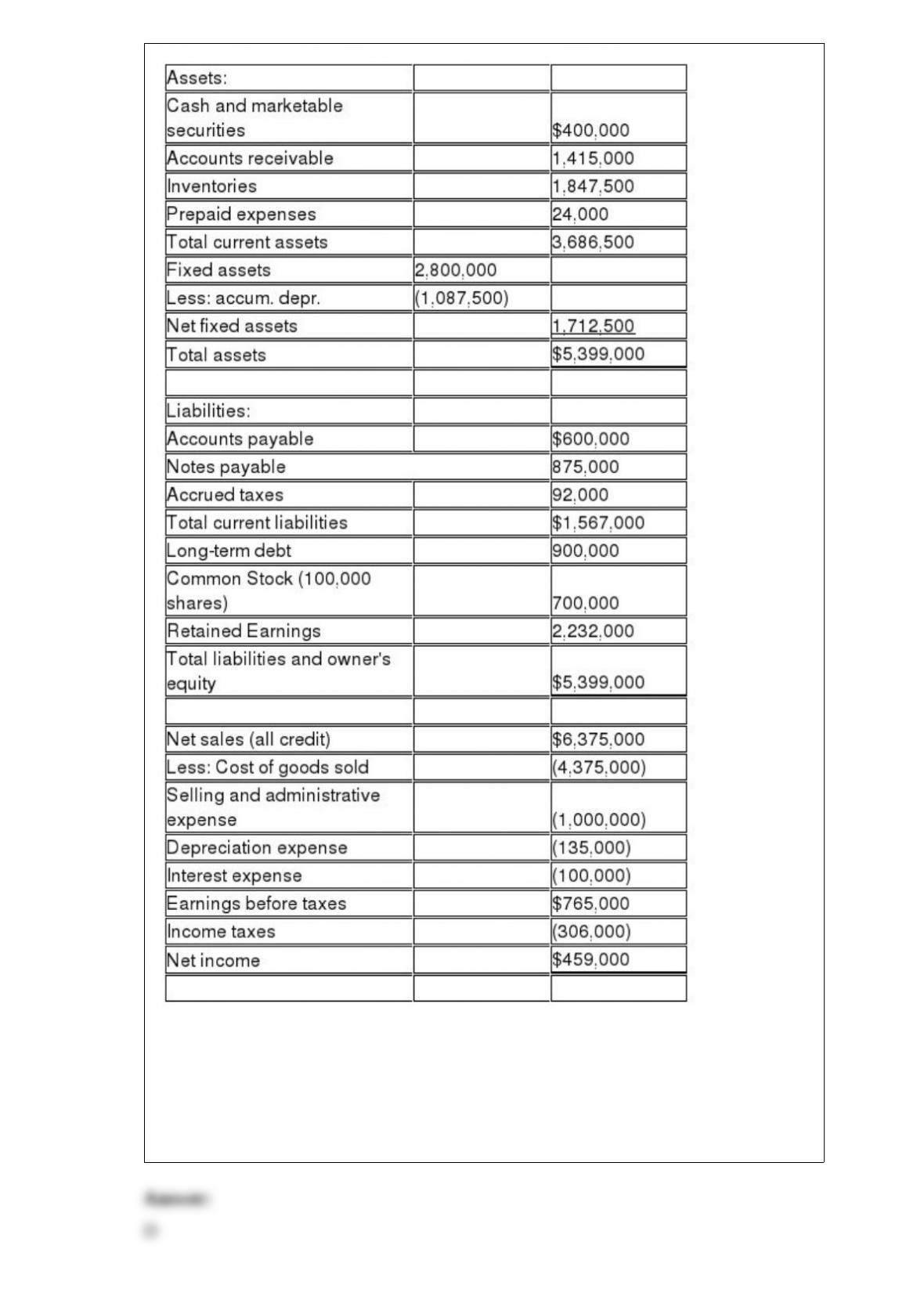
Based on the information in Table 4-2, the return on equity is
A) 19.33%
B) 18.47%
C) 16.66%
D) 15.65%

21) Assume that a firm had such serious financial problems that it was about to be
liquidated after a bankruptcy. All of the firm’s assets are about to be sold in order to pay
the following claims against the firm: bondholders, preferred stockholders, common
stockholders, and federal income taxes. Of the claims mentioned, what priority would
common stockholders have?
A) first
B) second
C) third
D) fourth
22) If the NPV (Net Present Value) of a project with multiple sign reversals is positive,
then the project’s required rate of return ________ its calculated IRR (Internal Rate of
Return).
A) must be less than
B) must be greater than
C) could be greater or less than
D) cannot be determined without actual cash flows
23) The payment of dividends may indirectly result in closer monitoring of
management’s investment activities, thus increasing shareholder value by
A) reducing agency costs
B) increasing information asymmetry
C) increasing a company’s amount of free cash flow
D) reducing auditing fees
24) Which of the following statements concerning junk bonds is MOST correct?
A) A rational investor will always prefer a AAA-rated bond to a junk bond
B) Junk bonds have higher interest rates than AAA-rated bonds because of the higher
risk
C) Junk bonds may also be called low-yielding securities
D) Junk bonds are priced higher than AAA-rated bonds because junk bonds are more
risky

25) Financial leverage could mean financing some of a firm’s assets with
A) preferred stock
B) retained earnings
C) private equity capital
D) sales revenues
26) You are considering an investment in a U.S. Treasury bond but you are not sure
what rate of interest it should pay. Assume that the real risk-free rate of interest is 1.0%;
inflation is expected to be 1.5%; the maturity risk premium is 2.5%; and, the default
risk premium for AAA-rated corporate bonds is 3.5%. What rate of interest should the
U.S. Treasury bond pay?
A) 8.5%
B) 6.0%
C) 5.0%
D) 2.5%
27) Capital budgeting is concerned with
A) whether a company’s assets should be financed with debt or equity
B) managing a firms cash budgeting procedures
C) what long-term investments a firm should undertake
D) planning sales of a corporation’s equity capital
28) Which form of organization is free of initial legal requirements?
A) sole proprietorship
B) general partnership
C) corporation
D) both A and B
29) Tempo Corp. will issue preferred stock to finance a new artillery line. The firm’s
existing preferred stock pays a dividend of $4.00 per share and is selling for $40 per
share. Investment bankers have advised Tempo that flotation costs on the new preferred
issue would be 5% of the selling price. Tempo’s marginal tax rate is 30%. What is the
relevant cost of new preferred stock?
A) 7.00%
B) 7.37%
C) 10.00%
D) 10.53%
E) 15.00%
30) The PMI, Inc. processes an estimated 200,000 checks per year from its customers.
Total revenue collected by check is $40,000,000. The average float time until the funds
are credited to PMI’s checking account is 6 days. For an extra cost of $ .06/check, PMI’s
bank will install a lock-box system that will reduce float time from 6 days to 2.5 days.
If PMI earns 3.5% on its checking account, how much per check will PMI make if it
uses the lock-box system?
A) $.005
B) $.006
C) $.007
D) $.008
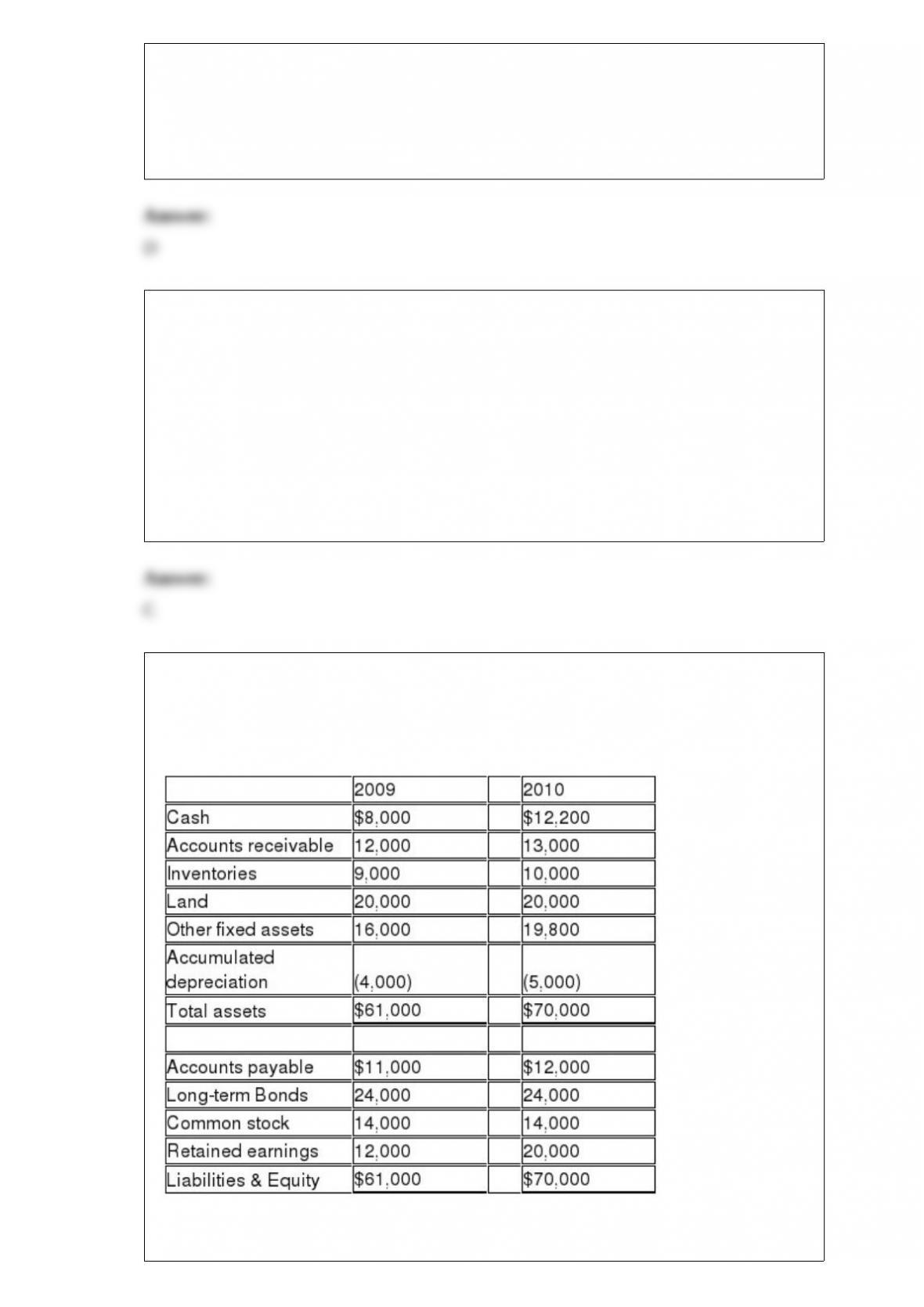
31) Table 4-5
Yen Inc.
Balance Sheet
Yen Inc.
Income Statement
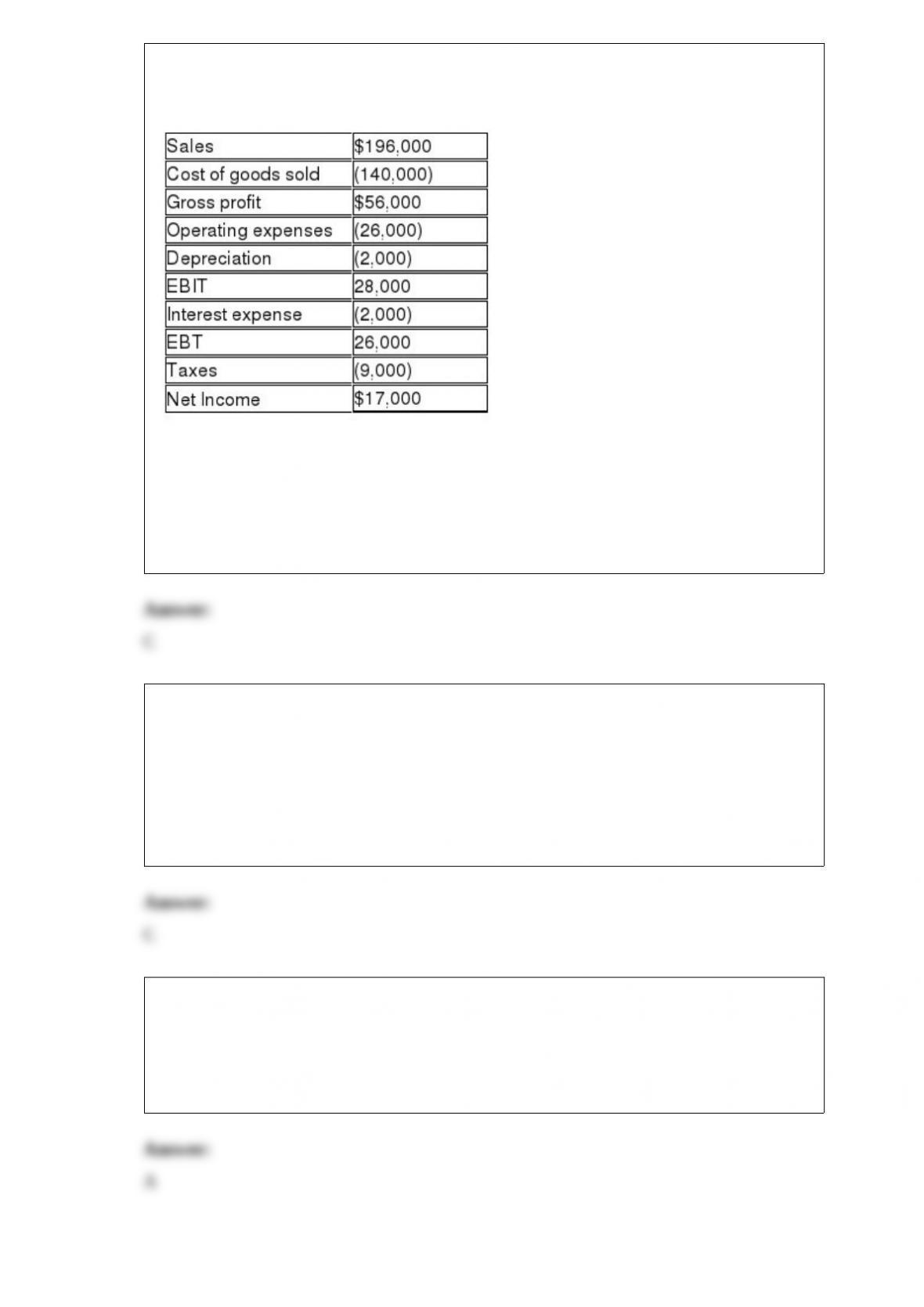
For the year ended December 31, 2010
Based on the information contained in Tables 4-5, what was the total amount of Yen’s
common stock dividend for 2010?
A) $17,000
B) $12,800
C) $9,000
D) $8,000
32) If you want to have $3,575 in 29 months, how much money must you put in a
savings account today? Assume that the savings account pays 12% and it is
compounded monthly (round to nearest $1).
A) $3,147
B) $3,008
C) $2,679
D) $2,438
33) Financial leverage has to do with
A) the usage of fixed cost financial securities to finance a portion of a firm’s assets
B) using common stock to finance a portion of a firm’s assets
C) the incurrence of fixed operating costs in the firm’s income stream
D) a high gross profit margin

34) Capital market instruments include
A) negotiable certificates of deposit
B) corporate equities
C) commercial paper
D) Treasury bills
35) Which of the following represents the correct ordering of returns over the period
1926 to 2011 (from lowest to highest return)?
A) Treasury bills, long-term corporate bonds, common stocks, small firm common
stocks
B) small firm common stocks, common stocks, long-term corporate bonds, Treasury
bills
C) Treasury bills, common stocks, long-term corporate bonds, small firm common
stocks
D) long-term corporate bonds, Treasury bills, common stocks, small firm common
stocks
36) A wide bid/ask spread could indicate which of the following?
A) the presence of arbitrageurs
B) large volume transactions are taking place
C) frequent trading of a currency
D) an inefficient market
37) Which of the following factors would most likely be present if a company increases
its dividend payout ratio significantly?
A) a high debt/equity ratio (i.e., use of a large amount of financial leverage)
B) a quick ratio that is significantly below the industry average
C) current shareholders cannot participate in a new offering and desire to maintain
ownership control
D) the variability of expected future earnings decreases
38) Which of the following actions would decrease a firm’s liquidity?
A) selling stock and reducing accounts payable

B) selling machinery and using proceeds to retire bonds
C) reducing accounts receivable and buying bonds
D) selling bonds and holding proceeds in the cash account
39) Wildings, Inc. common stock has a beta of 1.2. If the expected risk free return is 4%
and the expected market risk premium is 9%, what is the expected return on Wildings’
stock?
A) 10.0%
B) 12.0%
C) 13.8%
D) 14.8%
40) Which of the following statements is true?
A) The value of a bond is inversely related to changes in investors’ present required rate
of return
B) If interest rates decrease, the value of a bond will decrease
C) If interest rates increase, the value of a bond will increase
D) If interest rates remain constant, the value of premium bonds will increase over time
41) Dew Drop In, Inc. announces is quarterly dividend will increase from $3.80 to
$4.00. After the announcement, the price of Dew Drop In, Inc.’s stock drops. The most
likely explanation is that
A) the stock market is a perfect market
B) investors are irrational
C) investors were expecting a larger increase
D) Dew Drop In, Inc.’s debt ratio decreased
42) Assume that Montana Mining, Inc. borrows $5,000,000 for 120 days. The total
interest paid is $150,000. What is the APY, or Effective Annual Rate of interest that
Billings pays?
A) 3.00%
B) 9.00%
C) 9.27%

D) 9.77%
43) Net working capital is equal to
A) total assets minus total liabilities
B) current assets minus total liabilities
C) total operating capital minus net income
D) current assets minus current liabilities
44) MovieTone, Inc. is a producer and distributor of specialty DVDs. It sells directly to
large retail firms on terms of net 60 and has average monthly sales of $350,000. It has
recently decided to pledge all of its accounts receivable to its bank. The bank advances
up to 80 percent of the face value of these receivables at a rate of 4 percent over the
prime rate, while charging 2.5 percent on all receivables pledged for processing to
cover billing and collection services. Prior to this arrangement MovieTone was
spending $50,000 a year on its credit department. The prime rate is 6 percent.
a.What is the average level of accounts receivable?
b.What is the effective cost of using this short-term credit for one year?
45) A large corporation has annual sales revenues of $6 billion. The corporation
currently earns 2.25% on its money market account. If the corporation can reduce its
float by three days by making its billing and collection functions more efficient, the
company’s operating profits will increase by approximately
A) $3,069,863
B) $2,196,500
C) $1,350,000
D) $1,109,589

46) QRW Corp. needs to replace an old lathe with a new, more efficient model. The old
lathe was purchased for $50,000 nine years ago and has a current book value of $5,000.
(The old machine is being depreciated on a straight-line basis over a ten-year useful
life.) The new lathe costs $100,000. It will cost the company $10,000 to get the new
lathe to the factory and get it installed. The old machine will be sold as scrap metal for
$2,000. The new machine is also being depreciated on a straight-line basis over ten
years. Sales are expected to increase by $8,000 per year while operating expenses are
expected to decrease by $12,000 per year. QRW’s marginal tax rate is 40%. Additional
working capital of $3,000 is required to maintain the new machine and higher sales
level. The initial outlay for the new machine is
A) $113,000
B) $112,200
C) $111,000
D) $109,800
47) In the context of managing working capital, the hedging principle refers to which of
the following?
A) speculation regarding the direction of short-term interest rates
B) the usage of interest rate swaps
C) matching the maturity of the source of financing to the cash flow generating
characteristics of the asset being financed
D) protecting the firm against the risk of rising interest rates
48) If market interest rates rise
A) short-term bonds will decline in value more than long-term bonds
B) short-term bonds will rise in value more than long-term bonds
C) long-term bonds will decline in value more than short-term bonds
D) long-term bonds will rise in value more than short-term bonds
49) Your company is considering the replacement of an old delivery van with a new one
that is more efficient. The old van cost $40,000 when it was purchased 5 years ago. The
old van is being depreciated using the simplified straight-line method over a useful life
of 8 years. The old van could be sold today for $7,000. The new van has an invoice
price of $80,000, and it will cost $6,000 to modify the van to carry the company’s
products. Cost savings from use of the new van are expected to be $28,000 per year for
5 years, at which time the van will be sold for its estimated salvage value of $18,000.
The new van will be depreciated using the simplified straight-line method over its

5-year useful life. The company’s tax rate is 35%. Working capital is expected to
increase by $5,000 at the inception of the project, but this amount will be recaptured at
the end of year five. What is the initial outlay required to fund this replacement project?
A) $81,200
B) $78,600
C) $74,500
D) $73,580
50) Which of the following are short-term, unsecured promissory notes sold by large
businesses?
A) negotiable certificates of deposit
B) repurchase agreements
C) money market mutual funds
D) commercial paper
51) Howton Mining expects to have credit sales of $8,000,000 this year. First National
Bank is offering Howton Mining a lock-box system for $1,200 per month. Howton
Mining estimates that the new lock-box system will reduce float by 4.5 days. What rate
of return must Howton Mining earn on its marketable securities to make it worthwhile
for the company to institute this lock-box system? Use a 365-day year.
52) Outpost has 2 million shares of common stock outstanding; net income is $300,000;
the P/E ratio is 9; and management is considering an 18% stock dividend. What will be
the expected effect on the price of the common stock? If an investor owns 300 shares in
the company, how does this change his total value? Explain.
53) Given the anticipated rate of inflation (i) of 2.13% and the real rate of interest (R)
of 3.1%, find the nominal rate of interest (r).
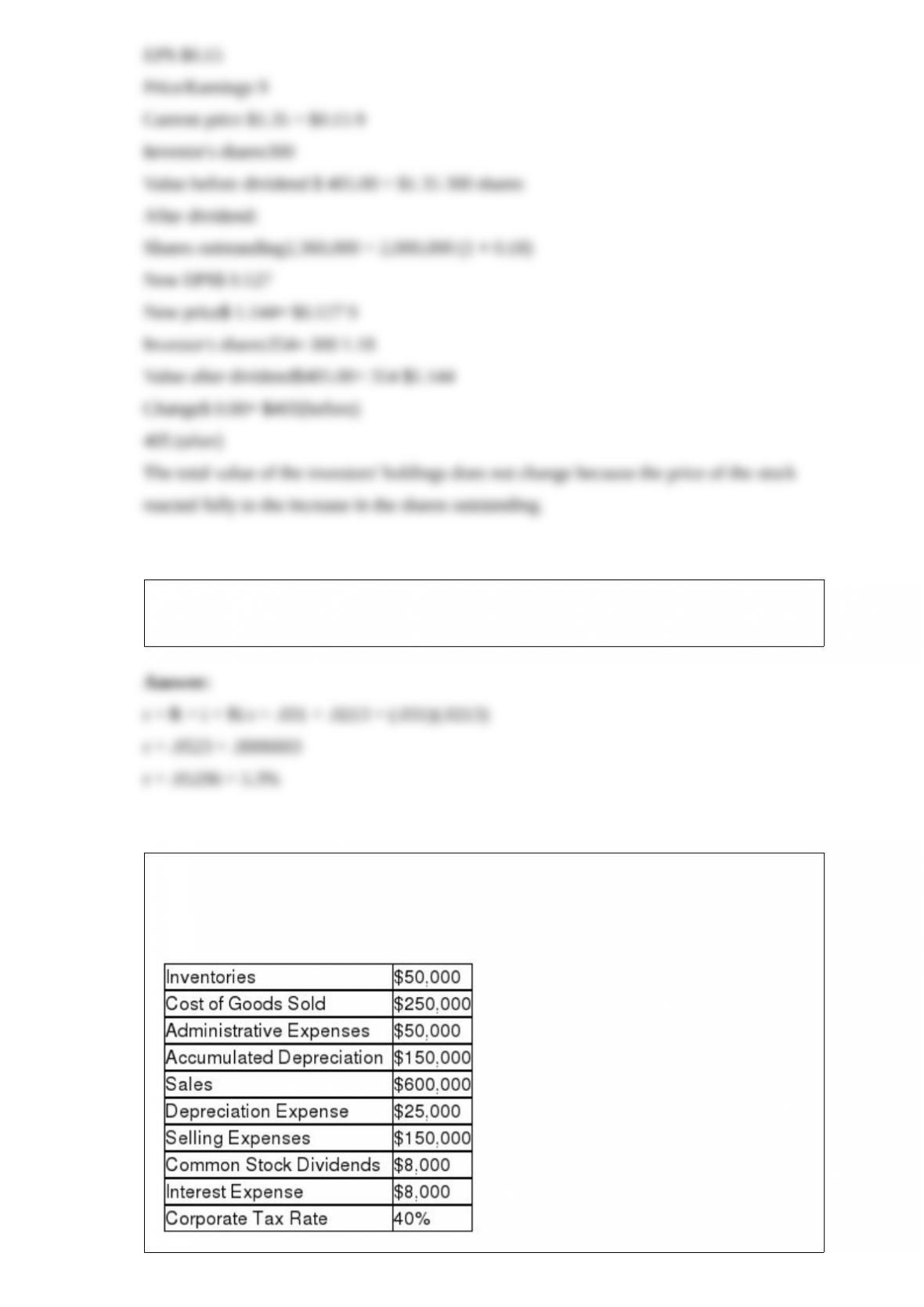
54) Prepare an income statement using the information given below. Make sure to
identify gross profit, operating income, and net income.
55) The Western Boot Company will produce 94,000 pairs of boots next year. Variable
costs are 35 percent of sales, while fixed costs total $223,000. At what price must each
pair of boots be sold for Western to obtain an EBIT of $1,391,500?
56) Table 4-6
Financial Data for Springfield Power Co. as of December 31, 2010:
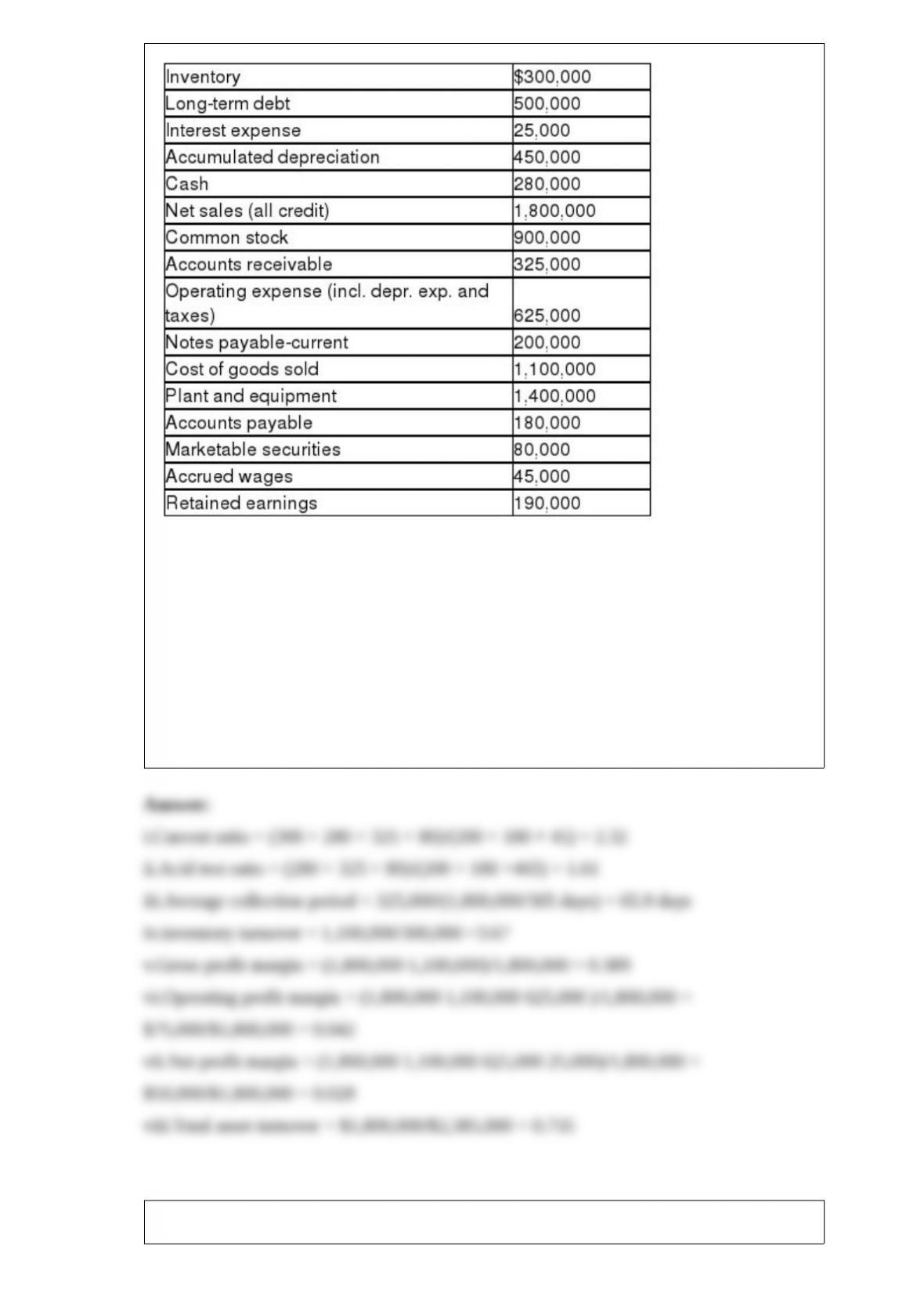
From the information presented in Table 4-6, calculate the following ratios for the
Springfield Power Co.
i.current ratio
ii.acid test ratio
iii.average collection period
iv.inventory turnover
v.gross profit margin
vi.operating profit margin
vii.net profit margin
viii.total asset turnover
57) Beverly Corp. had total sales of $1,200,000 in 2010 (80 percent of its sales are
credit). The company’s gross profit margin is 25 percent, its ending inventory is
$150,000, and its accounts receivable balance is $90,000. What additional amount of
cash could the firm have generated if it had increased its inventory turnover ratio to 9.0
and reduced its average collection period to 28.21875 days?
58) Table 3-3
Marlett Company
Financial Information
Based on the information in Table 3-3, prepare a statement of cash flows for 2010.
Assume that there were no changes in any other asset or liability accounts, and that the
ending cash balance for 2009 was $100.
59) Betty borrows $60,000 at 12 percent compounded annually. The loan is to be repaid
in five equal annual end-of-year installments. How much must each loan payment be?
60) Sunshine Candy Company’s capital structure for the past year of operation is shown
below.
First mortgage bonds at 12%$2,000,000
Debentures at 15% 1,500,000
Common stock (1,000,000 shares)5,000,000
Retained earnings500,000
TOTAL$9,000,000
The federal tax rate is 50 percent. Sunshine Candy Company, home-based in Orlando,
wants to raise an additional $1,000,000 to open new facilities in Tampa and Miami. The
firm can accomplish this via two alternatives: (1) It can sell a new issue of 20-year
debentures with 16 percent interest; or (2) 20,000 new shares of common stock can be
sold to the public to net the candy company $50 per share. A recent study, performed by

an outside consulting organization, projected Sunshine Candy Company’s long-term
EBIT level at approximately $6,800,000. Find the indifference level of EBIT (with
regard to earnings per share) between the suggested financing plans.