
1) What is the difference between a prospectus and a red herring prospectus?
A.The red herring prospectus is a preliminary version distributed to potential equity
investors
B.The red herring prospectus is a corrected version of the prospectus
C.The red herring prospectus is only for issuing long-term bonds
D.The red herring prospectus is the report filed with the SEC but not necessarily
distributed to equity investors
2) Which of the following makes this a true statement? In this slightly more realistic
world with corporate taxes, managers can
A.minimize the firm’s value by taking on as much debt as possible
B.maximize the firm’s value by taking on as much debt as possible
C.maximize the firm’s value by taking on as much equity as possible
D.maximize the firm’s value by financing only with debt
3) Dominant Portfolios Determine which one of these three portfolios dominates
another. Name the dominated portfolio and the portfolio that dominates it. Portfolio
Blue has an expected return of 14 percent and risk of 19 percent. The expected return
and risk of portfolio Yellow are 15 percent and 18 percent, and for the Purple portfolio
are 16 percent and 21 percent.
A.Portfolio Blue dominates Portfolio Yellow
B.Portfolio Yellow dominates Portfolio Blue
C.Portfolio Purple dominates Portfolio Blue
D.Portfolio Purple dominates Portfolio Yellow
4) Which of the following statements is correct?
A.The bottom line on the statement of cash flows equals the change in the retained
earnings on the balance sheet
B.The reason the statement of cash flows is important is because cash is what pays the
firm’s obligations, not accounting profit
C.If a firm has accounting profit, its cash account will always increase
D.All of these statements are correct

5) Which of the following is incorrect with respect to leverage buyouts (LBOs)?
A.They originated in the 1960s and were originally known as bootstrap transactions
which reflected the general consensus that the firm was, more or less, paying for its
own acquisition
B.The typical LBO uses a ratio of 70% debt to 30% equity but levels of debt can reach
much higher
C.LBOs are an extreme example of releveraging because debt is used to buy out the
majority of the equityholders to gain control of the firm
D.None of these statements is incorrect
6) The additional funds needed by the firm can be calculated by assuming which of the
following?
A.The firm’s additional sales will grow proportionately as assets are purchased
B.The firm’s additional capital needed will grow proportionately with projected changes
in sales
C.The firm’s balance sheet will grow proportionately with projected changes in sales
D.The firm’s additional sales will grow proportionately as capital is brought on to the
balance sheet
7) All of the following are cash flows from financing except a(n) _________.
A.Increase in accounts payable
B.Issuing stock
C.Stock repurchases
D.Paying dividends
8) A capital budgeting method that converts a project’s cash flows using a more
consistent reinvestment rate prior to applying the IRR decision rule is referred to as
______________.
A.IRR
B.EAR
C.NPV
D.MIRR
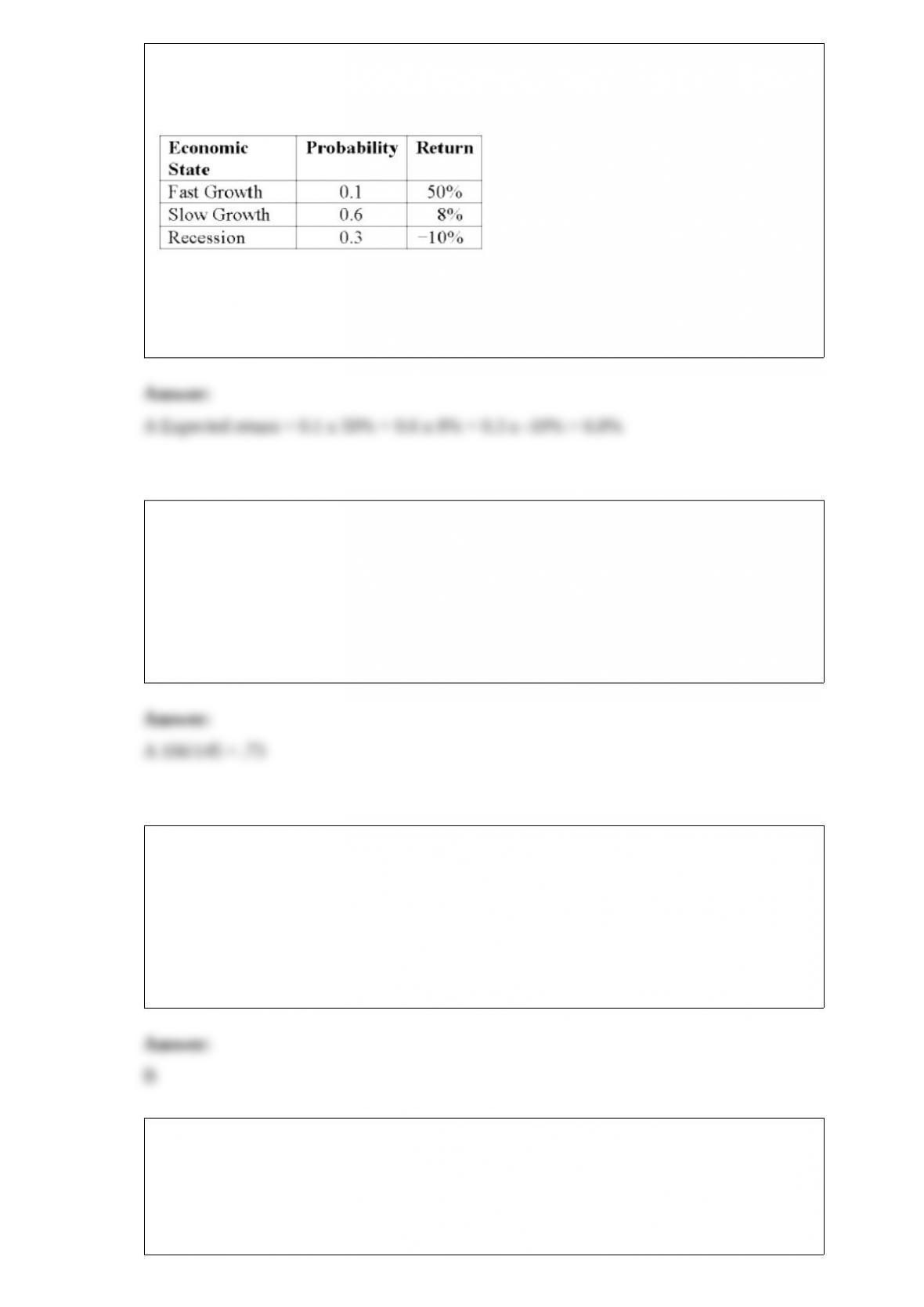
9) Expected Return Compute the expected return given these three economic states,
their likelihoods, and the potential returns:
A.6.8%
B.12.8%
C.16.0%
D.22.7%
10) Abracadabra Inc. has total assets of $106,000 and a debt ratio of 40%. If last year’s
sales were $145,000 and sales are expected to grow 10% in the future, what is
Abracadabra’s capital intensity ratio?
A.0.73
B.1.37
C.0.44
D.2.27
11) In 2000, the S&P500 Index earned 11% while the T-bill yield was 4.4%. Given this
information, which of the following statements is correct with respect to the market risk
premium?
A.The market risk premium must have been negative
B.The market risk premium must have been positive
C.The market risk premium must have been zero
D.Unable to answer without more information
12) US Bancorp holds a press conference to announce a positive news event that was
unexpected to the market. As soon as the announcement is made, the stock price
increases $8 per share but then over the next hour the price falls resulting in a net
increase of only $4. Given this information which of the following statements is
correct?

A.This is an example of a market overreaction
B.This is an example of a market underreaction
C.This is an example of a semi-strong efficient market
D.None of these statements are correct
13) The Standard & Poor’s 500 Index includes
A.all of the stock listed on the New York Stock Exchange
B.30 of the largest (market capitalization) and most active companies in the U.S.
economy
C.500 firms that are the largest in their respective economic sectors
D.500 firms that are the largest as ranked by Fortune Magazine
14) Risk Premiums You own $5,000 of Software Corp’s stock that has a beta of 3.75.
You also own $10,000 of Home Improvement Corp (beta = 1.5) and $15,000 of
Publishing Corp (beta = 0.35). Assume that the market return will be 13 percent and the
risk-free rate is 4.5 percent. What is the risk premium of the portfolio?
A.11.05%
B.16.50%
C.17.00%
D.24.70%
15) Rates over One Year Determine the interest rate earned on a $500 deposit when
$650 is paid back in one year.
A.0.77%
B.1.30%
C.30.0%
D.77.0%

16) KADS, Inc. has spent $400,000 on research to develop a new computer game. The
firm is planning to spend $250,000 on a machine to produce the new game. Shipping
and installation costs of the machine will be capitalized and depreciated; they total
$50,000. The machine has an expected life of 3 years, a $75,000 estimated resale value,
and falls under the MACRS 7-Year class life. Revenue from the new game is expected
to be $600,000 per year, with costs of $250,000 per year. The firm has a tax rate of 35
percent, an opportunity cost of capital of 15 percent, and it expects net working capital
to increase by $100,000 at the beginning of the project. What will the year 0 free cash
flow for this project be?
A.-$400,000
B.-$350,000
C.-$250,000
D.-$300,000
17) All of the following are different techniques that can be used to help firms reduce
collection float except ___________.
A.Use drafts
B.Use wire transfers
C.Use concentration banking
D.Use a lockbox system
18) All of the following are examples of the costs of financial distress except
__________________.
A.Excellent employees find employment elsewhere
B.Suppliers are reluctant to sell on credit to the firm
C.Bondholders decide to exercise their call option
D.Customers may be leery of buying from the firm
19) Consider the risk-return relationship in T-bills during each decade since 1950 .
Given this data, which of the following statements is correct?
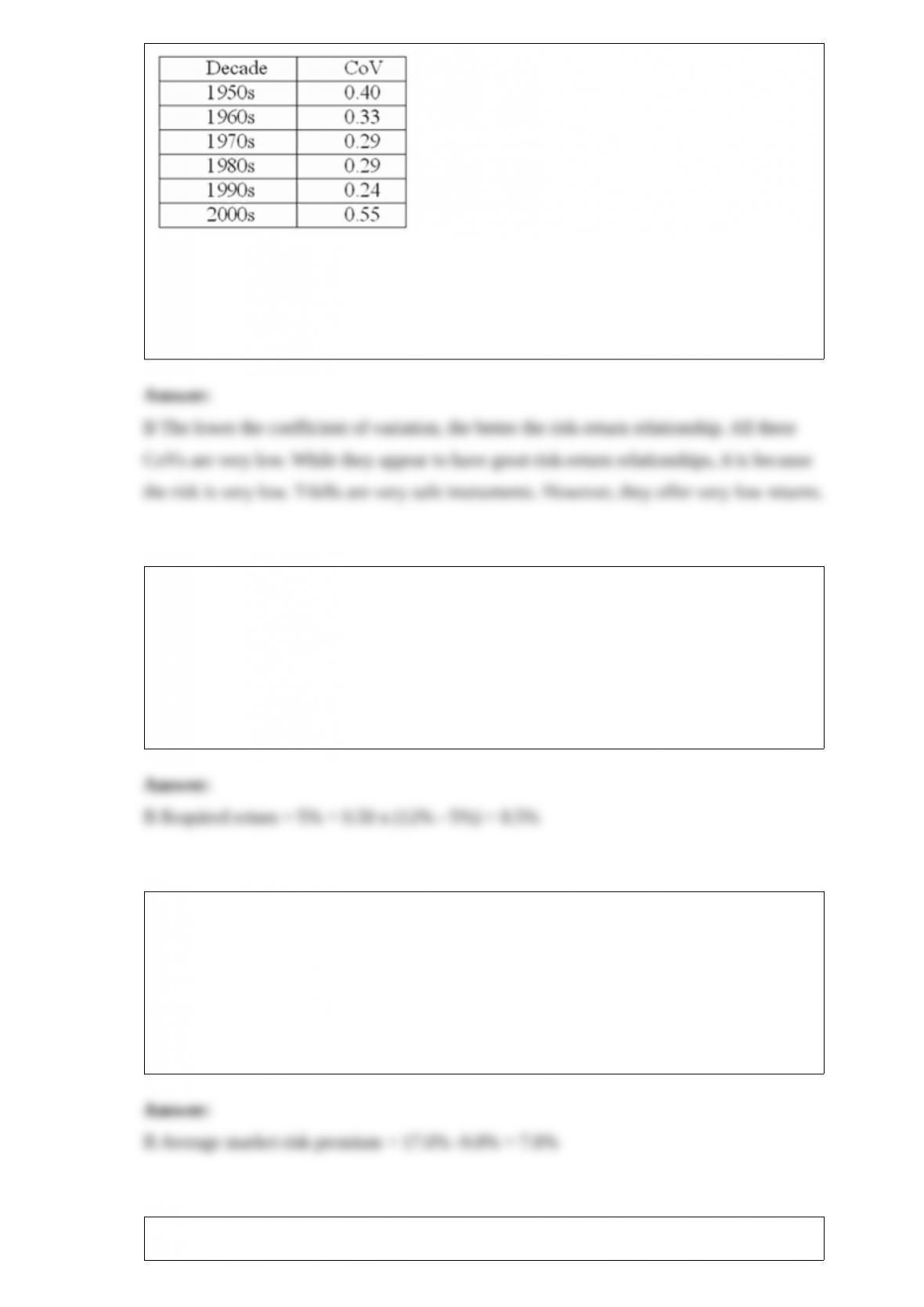
A.The best risk-return relationship was during the 1950s
B.The best risk-return relationship was during the 1990s
C.Since T-bills are backed by the full faith of the U.S. government, computing the
risk-return relationship for them is invalid
D.None of these statements are correct
20) CAPM Required Return A company has a beta of 0.50. If the market return is
expected to be 12 percent and the risk-free rate is 5 percent, what is the company’s
required return?
A.6.0%
B.8.5%
C.11.0%
D.13.5%
21) The average annual return on the S&P 500 Index from 1986 to 1995 was 17.6
percent. The average annual T-bill yield during the same period was 9.8 percent. What
was the market risk premium during these ten years?
A.8.2%
B.7.8%
C.8.8%
D.9.8%
22) A metaphor used to illustrate how an individual pursuing his own interests also

tends to promote the good of the community.
A.agency theory
B.angel investor
C.invisible hand
D.perks/perquisites
23) Interest Payments Determine the interest payment for the following three bonds: 4
percent coupon corporate bond (paid semi-annually), 4.75 percent coupon Treasury
note, and a corporate zero coupon bond maturing in 15 years. (Assume a $1,000 par
value.)
A.$4.00, $4.75, $0, respectively
B.$20.00, $23.75, $0, respectively
C.$20.00, $23.75, $150, respectively
D.$40.00, $47.50, $0, respectively
24) Which of the following is a true statement regarding Proposition I?
A.Vu in a world with taxes is going to be more than Vu in a world without taxes
B.Vu in a world with taxes is going to be less than Vu in a world without taxes
C.Vu in a world with taxes is going to be equal to Vu in a world without taxes
D.Vu in a world with taxes cannot be compared to Vu in a world without taxes
25) Which of the following managers would NOT use finance?
A.Operational managers
B.Marketing managers
C.Human resource managers
D.All of these would use finance
26) Which of these is defined as the currency exchange rate between two foreign
currencies, each of which are not the currency of the domestic country?
A.exchange rates
B.spot rates
C.indirect rates
D.cross rates
27) This is the condition in which a firm is near bankruptcy.
A.passive capital structure
B.active capital structure
C.financial distress
D.call position
28) A firm reported a profit margin of 8.5%, total asset turnover of 0.85 times,
debt-to-equity ratio of 0.90 times, net income of $550,000, and dividends paid to
common stockholders of $100,000. The firm has no preferred stock outstanding. What
is the firm’s internal growth rate?
A.3.61%
B.6.29%
C.5.91%
D.11.04%
29) Your company doesn’t face any taxes and has $300 million in assets, currently
financed entirely with equity. Equity is worth $10 per share, and book value of equity is
equal to market value of equity. Also, let’s assume that the firm’s expected values for
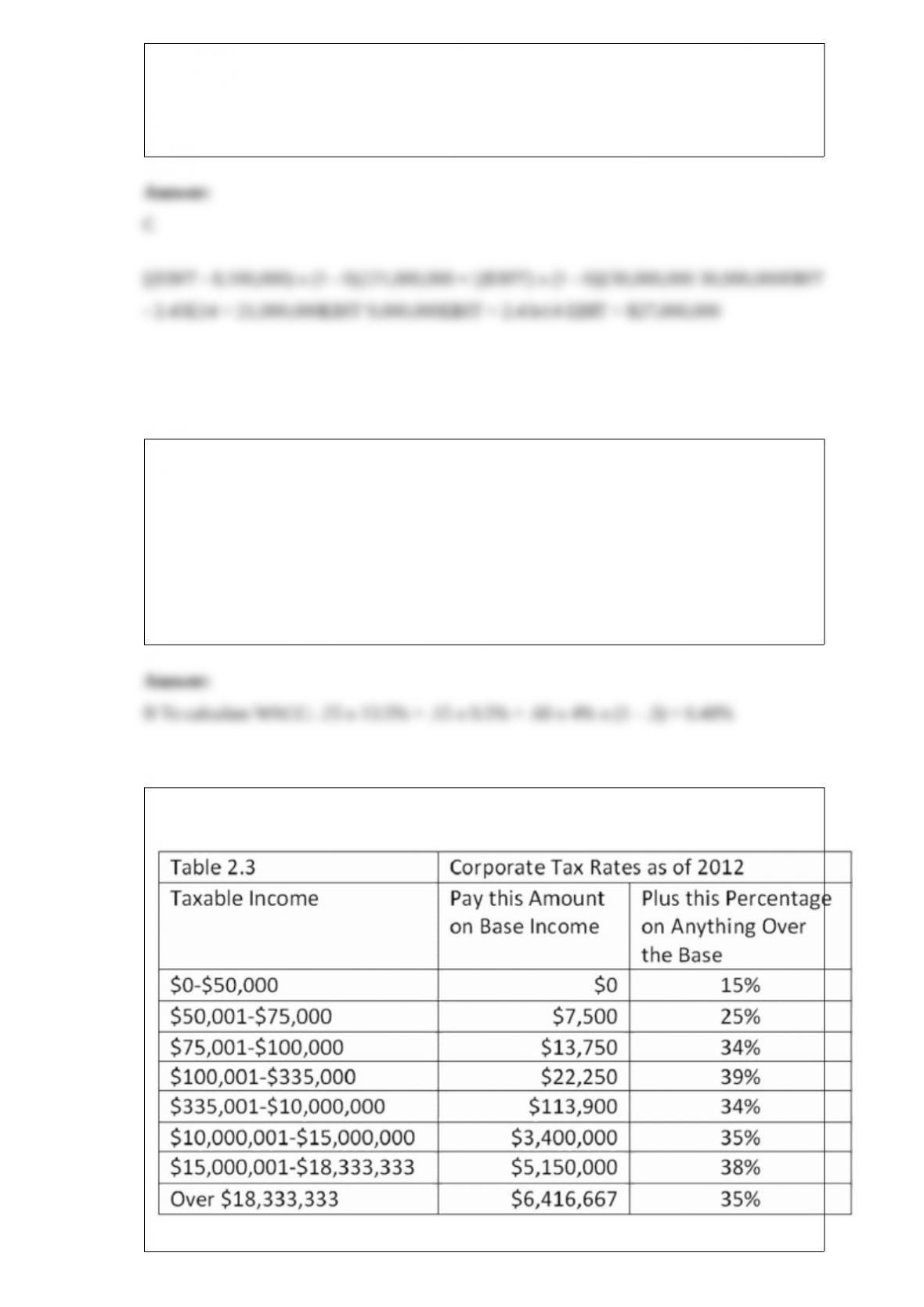
EBIT depend upon which state of the economy occurs this year, with the possible
values of EBIT and their associated probabilities as shown below:
The firm is considering switching to a 30-percent debt capital structure, and has
determined that they would have to pay a 9 percent yield on perpetual debt in either
event. What will be the break-even EBIT?
A.$19,000,000
B.$21,200,000
C.$27,000,000
D.$30,000,000
30) Suppose that TW, Inc. has a capital structure of 25 percent equity, 15 percent
preferred stock, and 60 percent debt. If the before-tax component costs of equity,
preferred stock and debt are 13.5 percent, 9.5 percent and 4 percent, respectively, what
is TW’s WACC if the firm faces an average tax rate of 30%?
A.6.19%
B.6.48%
C.7.2%
D.9.0%
31)
Corporate Taxes The Carolina Corporation had a 2010 taxable income of $3,000,000
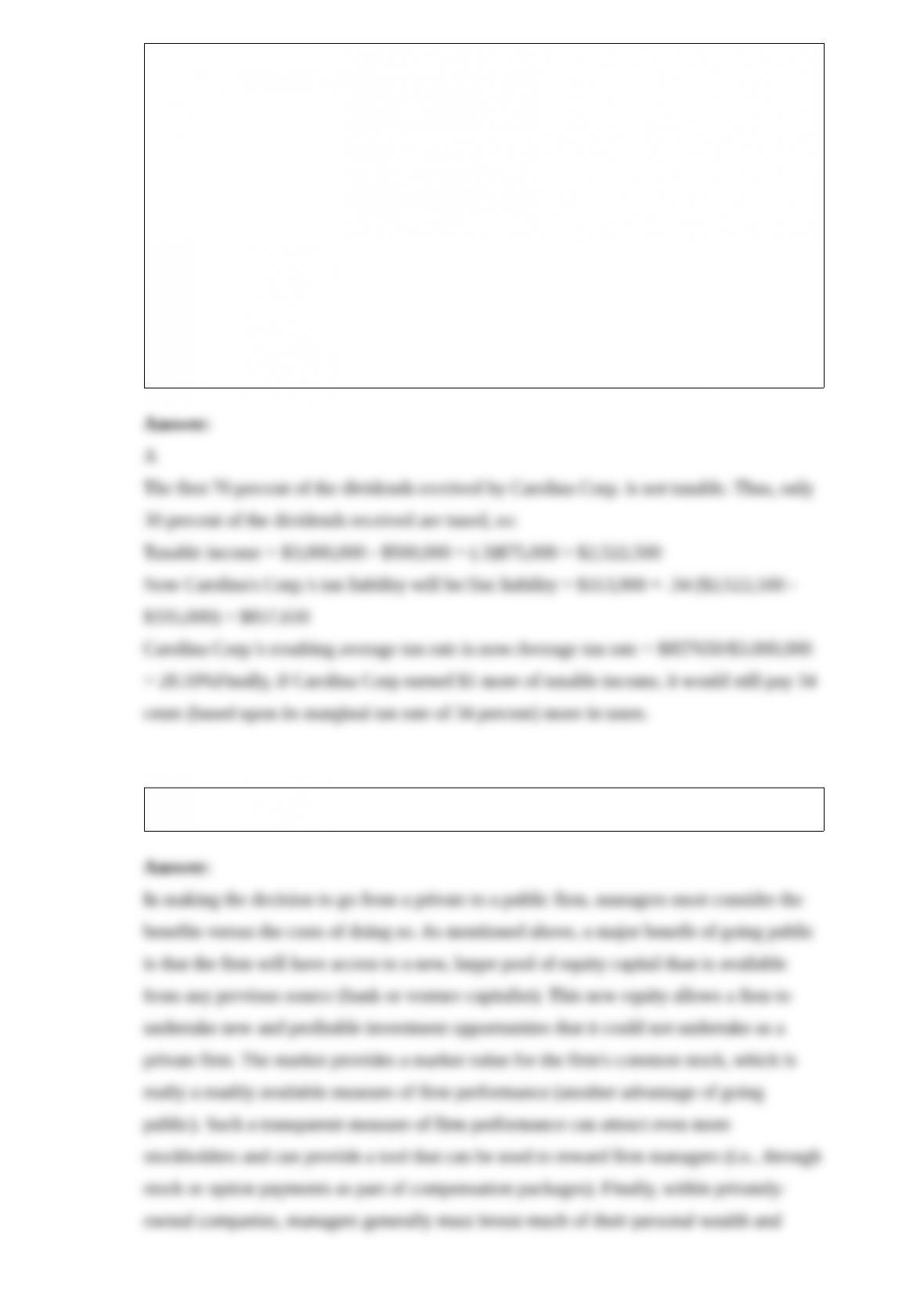
from operations after all operating costs but before
(1) interest charges of $500,000,
(2) dividends received of $75,000,
(3) dividends paid of $1,000,000, and
(4) income taxes.
Using the tax schedule in Table 2.3, what is Carolina’s income tax liability?
What are Carolina’s average and marginal tax rates on taxable income from operations?
A.$857,650, 28.59%, 34%, respectively
B.$875,500, 29.18%, 34%, respectively
C.$875,500, 34.00%, 34%, respectively
D.$1,020,000, 34.00%, 34%, respectively
32) As a new or small firm considers going public, what must the owners consider?
33) Why might a firm announce a reverse stock split?
34) What is meant when it is said that the U.S. dollar is weakening? How would it
impact your vacation abroad and foreign visitors to the United States?
35) What is the source of firm-specific risk? What is the source of market risk?
36) Carrying costs are associated with having current assets and fall into two general
categories. List those two categories.
37) Loan Payments You wish to buy a $20,000 car. The dealer offers you a 3-year loan
with an 8 percent APR. What are the monthly payments? How would the payment
differ if you paid interest only? What would the consequences of such a decision be?
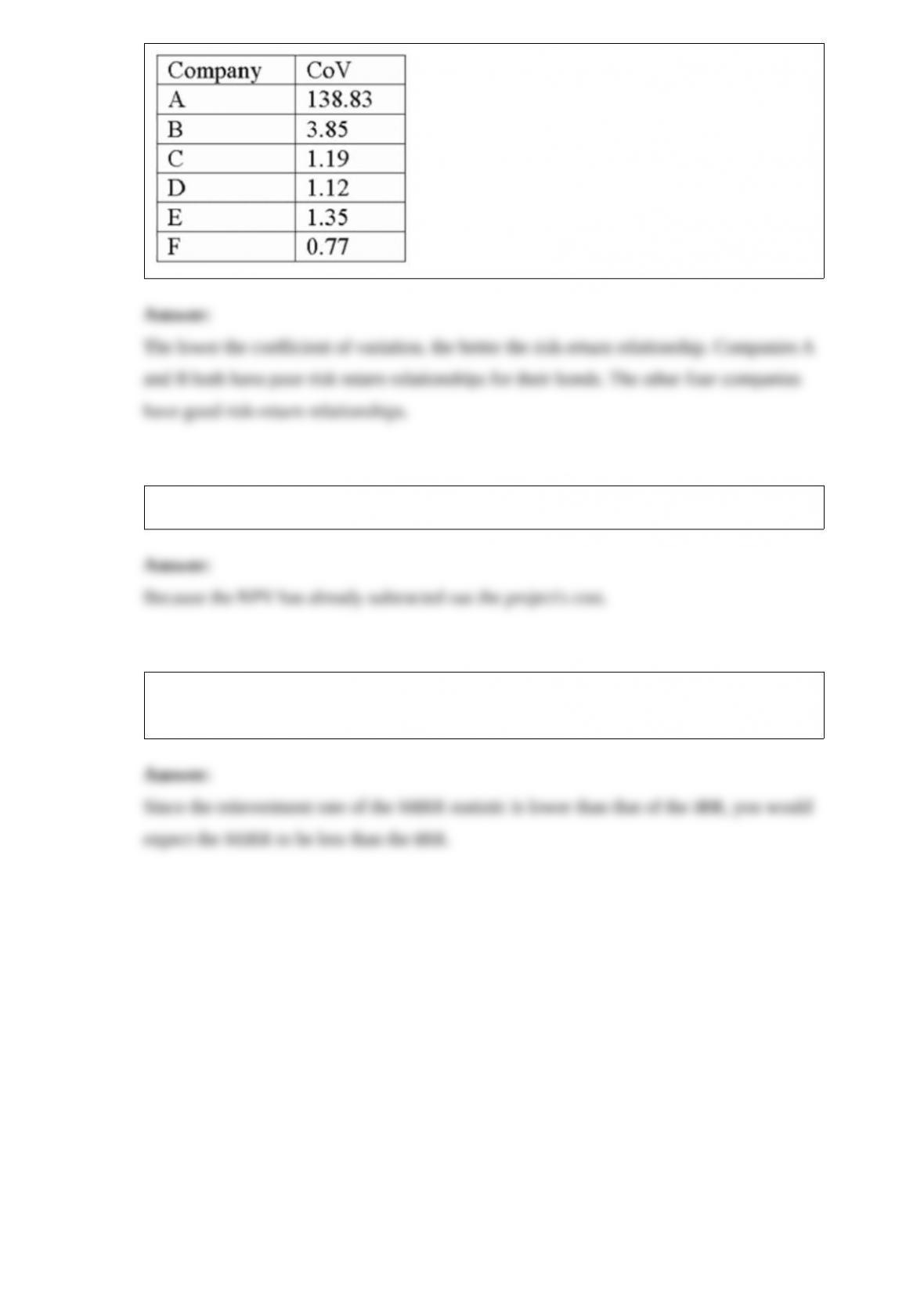
38) Risk versus Return in Bonds Assess the risk-return relationship of the following
bonds:
39) Why is a project’s cost not an appropriate benchmark for its NPV?
40) For a project with normal cash flows, what would you expect the relationship to be
between the MIRR and the IRR?