
1) Corporations have two costs of common equity, one for retained earnings and one if
the company issues new common stock.
2) A stock dividend differs from a stock split because in a stock split, the par value of
the company’s stock is reduced, while the par value remains the same after a stock
dividend is paid.
3) A corporation’s cost of common equity may be estimated using either a dividend
valuation model or the capital asset pricing model.
4) In general, the required rate of return is a function of (1) the time value of money, (2)
the risk of an asset, and ( the investor’s attitude toward risk.
5) The residual dividend theory suggests that dividends should be paid to stockholders
first and then what is left can be reinvested by the firm.
6) Financial ratios are used by managers inside the company and by lenders,
credit-rating agencies, and investors outside of the company.
7) Depreciation is a non-cash deduction so it may be ignored in the calculation of a
project’s incremental after-tax cash flows.

8) Because the NPV and PI methods both yield the same accept/reject decision, a
company attempting to rank capital budgeting projects for funding consideration can
use either method and get the same results.
9) Sensitivity analysis involves changing one variable at a time.
10) The difference between the asked price and the bid price is known as the spread.
11) An example of an annuity is the interest received from bonds.
12) A stock repurchase plan can be viewed as both a financing decision and an
investment decision.
13) Purchasing power parity suggests that interest rates in different countries will adjust
so that each currency will have the same purchasing power.
14) Other things the same, the use of debt financing reduces the firm’s total tax bill
resulting in a higher total market value.

15) Calculating the modified internal rate of return on an Excel spreadsheet involves the
use of the IRR function multiple times, once using the financing rate, and once using
the reinvestment rate.
16) The root cause of agency problems is conflicts of interest.
17) Both the profitability index (PI) and net present value (NPV) are based on the
present value of all future free cash flows, but the PI is a relative measure while the
NPV is an absolute measure of a project’s desirability.
18) The goal of the firm’s financial managers should be the maximization of the total
value of the firm’s stock.
19) Raindrip Corp. can purchase a new machine for $1,875,000 that will provide an
annual net cash flow of $650,000 per year for five years. The machine will be sold for
$120,000 after taxes at the end of year five. What is the net present value of the
machine if the required rate of return is 13.5%.
A) $558,378
B) $513,859
C) $473,498
D) $447,292
20) Consider two mutually exclusive projects X and Y with identical initial outlays of
$600,000 and useful lives of 5 years. Project X is expected to produce an after-tax cash
flow of $180,000 each year. Project Y is expected to generate a single after-tax net cash
flow of $1,015,000 in year 5 . The discount rate is 14 percent.

a.Calculate the net present value for each project.
b.Calculate the IRR for each project.
c.What decision should you make regarding these projects?
21) Spontaneous sources of financing include
A) marketable securities
B) wages payable
C) accounts receivable
D) common stock
22) You observe Thundering Herd Common Stock selling for $40.00 per share. The
next dividend is expected to be $4.00, and is expected to grow at a 5% annual rate
forever. If your required rate of return is 12%, should you purchase the stock?
A) yes, because the present value of the expected future cash flows is greater than $40
B) no, because the present value of the expected future cash flows is less than $40
C) yes, because the present value of the expected future cash flows is less than $40
D) no, because the present value of the expected future cash flows is greater than $40
23) Which of the following transactions will decrease a corporation’s retained earnings?
A) The corporation declares and pays a $2 per share cash dividend.
B) The company completes a 2 for 1 stock split.
C) The company pays a 20% stock dividend.
D) Both A and C.
24) Stock A has the following returns for various states of the economy:
State of
the EconomyProbabilityStock A’s Return

Recession9%-72%
Below Average16%-15%
Average51%16%
Above Average14%35%
Boom10%85%
Stock A’s expected return is
A) 9.9%
B) 12.7%
C) 13.8%
D) 16.5%
25) Smith Corporation has earned a return on capital invested of 10% for the past two
years, but an investment analyst reviewing the company has stated the company is not
creating shareholder value. This may be due to the fact that
A) the risk free rate of interest is 3%
B) the corporation’s inventory turnover is high
C) investors’ required rate of return is 8%
D) investors’ required rate of return is 12%
26) Which of the following statements concerning junk bonds is MOST correct?
A) A rational investor will always prefer a AAA-rated bond to a junk bond
B) Junk bonds have higher interest rates than AAA-rated bonds because of the higher
risk
C) Junk bonds may also be called low-yielding securities
D) Junk bonds are priced higher than AAA-rated bonds because junk bonds are more
risky
27) Exchange rate risk
A) arises from the fact that the spot exchange rate on a future date is a random variable
B) applies only to certain types of international businesses
C) has been phased out due to recent international legislation
D) has been reduced by the adoption of floating exchange rates

28) Salamander Insurance Company tries to settle claims as quickly as possible. In
certain cases, agents can present payments to claimants which are cleared through the
banking system like a check, but must be passed through the Insurance Company for
approved prior to payment. This is an example of a
A) zero balance account
B) payable-through draft
C) insurance float voucher
D) post-dated check
29) Which of the following statements is FALSE?
A) Brokers purchase securities for their own account
B) Most corporate bond trading takes place over the counter
C) Broker-dealers stand ready to buy and sell specific securities at selected prices
D) none of the above
30) You won the lottery and can receive either (1) $60,000 today, or (2) $10,000 one
year from today plus $25,000 two years from today plus $35,000 three years from
today. You plan to use the money to pay for your child’s college education in 15 years.
You should
A) take the $60,000 today because of the time value of money regardless of current
interest rates
B) take option two because you get $70,000 rather than $60,000 regardless of current
interest rates
C) take the $60,000 today only if the current interest rate is at least 16.67%
D) take the $60,000 today if you can earn 6.81% per year or more on your investments
31) Consider the after-tax cash flows for Project S and Project L:
Project SProject L
Year 1$30000
Year 20$3000
Project SProject L
Year 1$30000
Year 20$3000
A rational person would prefer ________
A) Project S because the money can be reinvested sooner
B) Project L because they can avoid taxes by receiving cash flows later
C) information about profits instead of cash flows

D) neither investment over the other
32) AFB Corp. Declared a $1.00 dividend on January 5th, with an ex-dividend date of
January 19th, a record date of January 21st, and a payment date of March 15th. Doug
purchased AFB stock on January 6th.
A) Doug will not receive the dividend because he purchased the stock after the
declaration date.
B) Doug will not receive the dividend because he purchased the stock prior to the
record date.
C) Doug will receive the dividend if he still sells his stock on January 20th because he
owned the stock on the ex-dividend date.
D) Doug will receive the dividend if he still owns the stock on January 21st, even if he
sells the stock before the payment date.
33) Which of the following is NOT a valid theory that attempts to explain the shape of
the term structure of interest rates?
A) the unbiased expectations theory
B) the liquidity preference theory
C) the market segmentation theory
D) the Fisher Effect theory
34) In general, which of the following rankings, from highest to lowest cost, is most
accurate?
A) cost of new common stock, cost of preferred stock, cost of debt, cost of retained
earnings
B) cost of debt, cost of preferred stock, cost of new common stock, cost of retained
earnings
C) cost of new common stock, cost of retained earnings, cost of preferred stock, cost of
debt
D) cost of preferred stock, cost of new common stock, cost of retained earnings, cost of
debt
35) A one-sign-reversal project should be accepted if it
A) generates an internal rate of return that is higher than the profitability index
B) produces an internal rate of return that is greater than the firm’s discount rate
C) results in an internal rate of return that is above a project’s equivalent annual annuity
D) results in a modified internal rate of return that is higher than the internal rate of
return
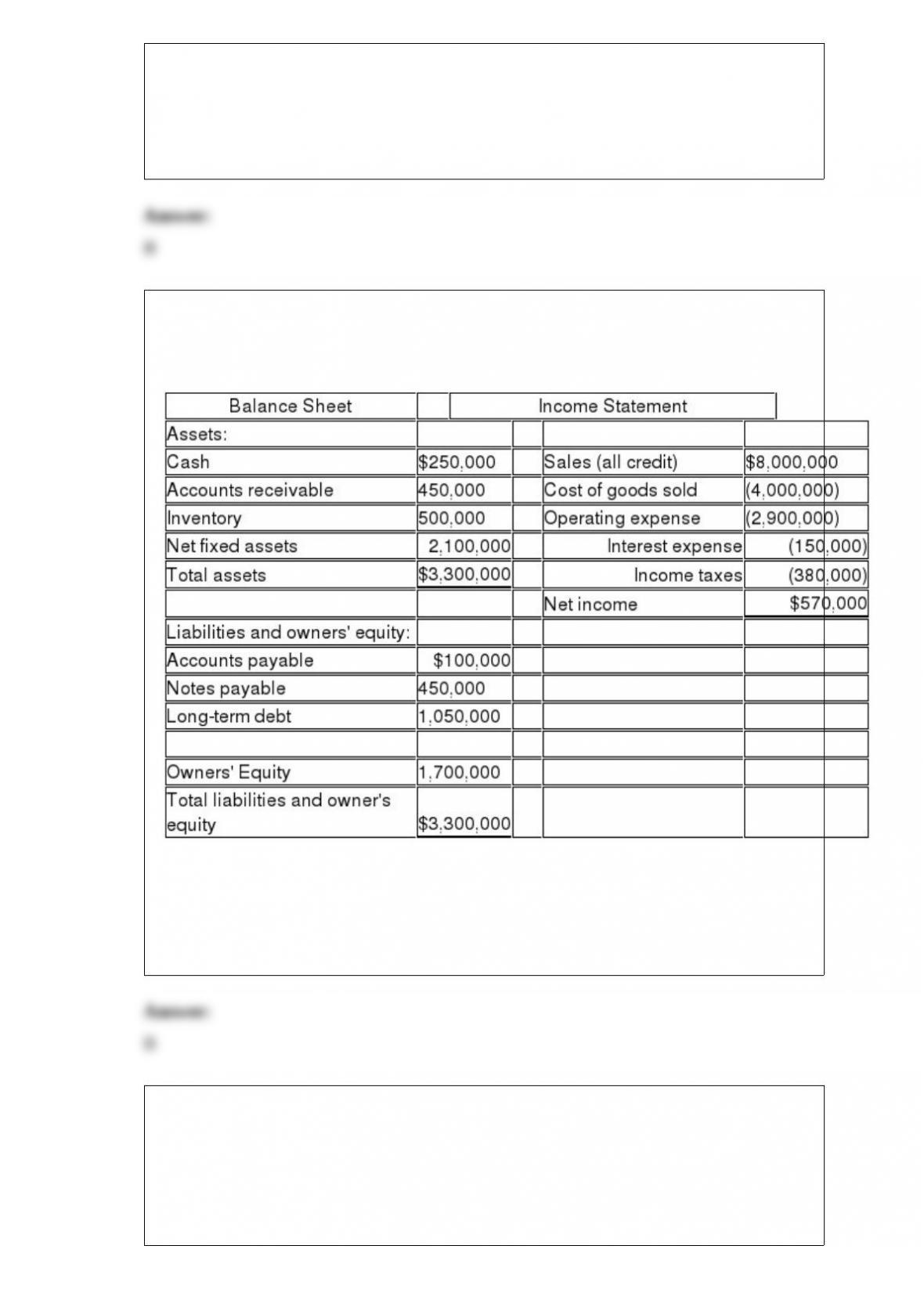
36) Table 4-3
Emery Corporation
The total asset turnover is
A) 2.10 times
B) 2.42 times
C) 2.87 times
D) 3.25 times
37) Assume that a firm has a steady record of paying stable dividends for years. Market
analysts had expected management to increase the dividend by 7.5% in the latest
quarter. However, management announced a 15% increase in the current year’s
dividend. The market value of the stock rose 20% on the day of the announcement.
Which of the following would best explain the stock market’s reaction to the
announcement?
A) expectations theory
B) dividend irrelevance theory
C) residual dividend theory
D) agency theory
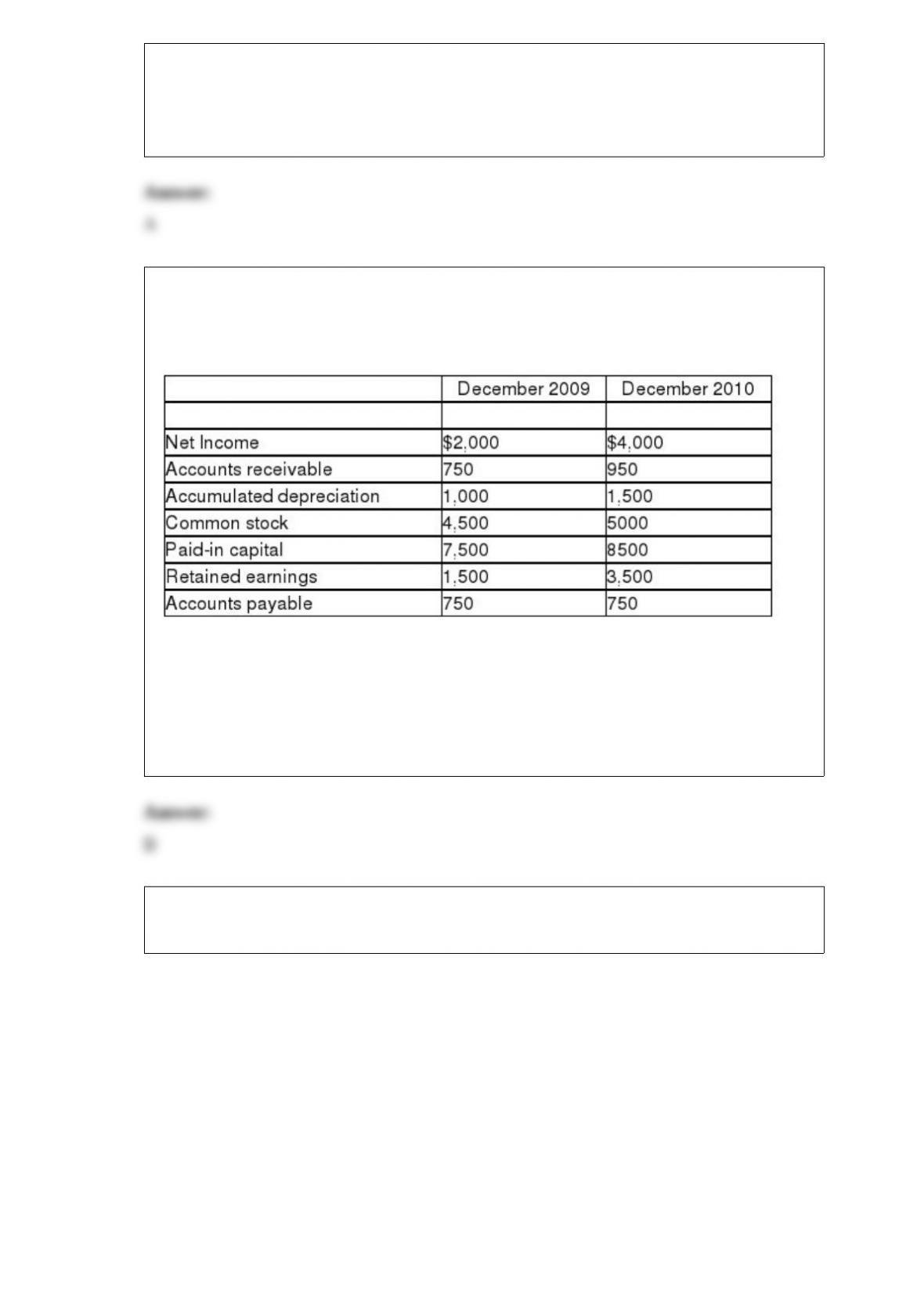
38) Table 3-1
Jones Company
Financial Information
Assuming that no assets were disposed of during 2010, the amount of depreciation
expense was
A) $375
B) $500
C) $2,500
D) $3,500
39) Table 3-2
Enigma has the following financial information:

No changes were made in interest payable or taxes payable.
What is Enigma’s cash flow from operations?
A) $85,000
B) $100,000
C) $105,000
D) $75,000
40) All of the following conclusions on the importance of a dividend policy are TRUE
EXCEPT
A) as a firm’s investment opportunities increase, the dividend payout ratio should
decrease
B) the firm’s expected earning power and the riskiness of these earnings are more
important to the investor than the dividend policy
C) dividends may influence stock price by the investor’s desire to minimize and/or defer
taxes and from the role of dividends in minimizing agency costs
D) in order to avoid surprising investors, management should anticipate financing needs
for the short-term, but not for the long term
41) Which of the following statements about International Financial Reporting
Standards (IFRS) is NOT TRUE?
A) IFRS sets out broad and general principles that accountants should follow when
preparing financial statements
B) IFRS leaves LESS room for discretion than GAAP does
C) IFRS offers simplicity but also possibly more leeway for accounting malpractice
than does GAAP
D) In 2008, the Securities and Exchange Commission (SEC) announced its plan to
convert U.S. companies from GAAP to IFRS

42) AFB, Inc. stock is currently selling for $20 per share. The company completed a
5-for-1 stock split two days earlier. Two years ago, the company had a 2-for-1 stock
split. If the stock splits had not happened, the price of AFB, Inc. stock would, other
things being equal, be
A) $140.00 per share.
B) $200.00 per share.
C) $100.00 per share.
D) $2.00 per share.
43) Which of the following is TRUE?
A) The forward rate is the same as the spot rate that will prevail in the future
B) The future spot rate is equal to the forward rate less the current spot rate
C) The actual spot rate that will prevail in the future is not known today
D) The future spot rate is the current spot rate increased by the inflation rate
44) A U.S.-based multinational corporation (MNC) currently has an investment
portfolio that includes Japanese securities valued at 10,000,000 yen. The company also
owes its Japanese suppliers 12,000,000 yen. Which of the following statements is
MOST correct?
A) The MNC is not exposed to exchange rate risk because it holds both assets and
liabilities denominated in yen
B) The MNC will be exposed to exchange rate losses if the yen declines in value
relative to the dollar
C) The MNC will be exposed to exchange rate losses if the yen increases in value
relative to the dollar
D) The MNC can avoid exchange rate risk by paying its Japanese liabilities with dollars
45) You charged $1,000 on your credit card for Christmas presents. Your credit card
company charges you 26% annual interest, compounded monthly. If you make the
minimum payments of $25 per month, how long will it take ( to the nearest month) to
pay off your balance?
A) 94 months
B) 79 months
C) 54 months
D) 40 months