
1) A stock has a beta of 1.25. The risk free rate is 5% and the return on the market is
6%. The estimated return for the stock is 14%. According to the CAPM you should
a. Sell because it is overvalued.
b. Sell because it is undervalued.
c. Buy because it overvalued.
d. Buy because it is undervalued.
e. Short because it is undervalued.
2) Some studies have attempted to determine whether it is possible to predict future
returns for a stock based on publicly available quarterly earnings reports. The results of
these studies indicate
a.Stock prices adjust to reflect quarterly earnings reports.
b.Stock prices do not adjust to reflect quarterly earnings reports.
c.Support for the semistrong EMH.
d.Stock prices adjust if earnings reports are released in January.
e.Stock prices do not adjust if earnings reports are released in January.
3) The Sortino measure differs from the Sharpe ratio in that
a. It measures the portfolio’s average return in excess of a user-selected minimum
acceptable return threshold.
b. It measures the downside risk in a portfolio.
c. Higher values of the Sortino measure are not desirable, while higher values in the
Sharpe ratio are desirable.
d. Both a and b.
e. All of the above.
4) A 1994 study by Burmeister, Roll, and Ross defined all of the following risk factors
except
a. Confidence risk
b. Market risk
c. Inflation risk
d. Market-timing risk
e. Business cycle risk
5) Consider a 10%, 15 year bond that pays interest annually quarterly, and its current
price is $1060. What is the promised yield to maturity?
a. 10.23%
b. 18.45%
c. 2.31%
d. 17.77%
e. 9.26%
6) Which type of bond market is the largest sector in both Japan and the United States?
a. Corporate
b. High Yield/Emerging Market
c. Securitized/Collaterallized
d. Sovereign
e. Quasi & Foreign Governments
7) Exhibit 17.1
USE THE INFORMATION BELOW FOR THE FOLLOWING PROBLEM(S)
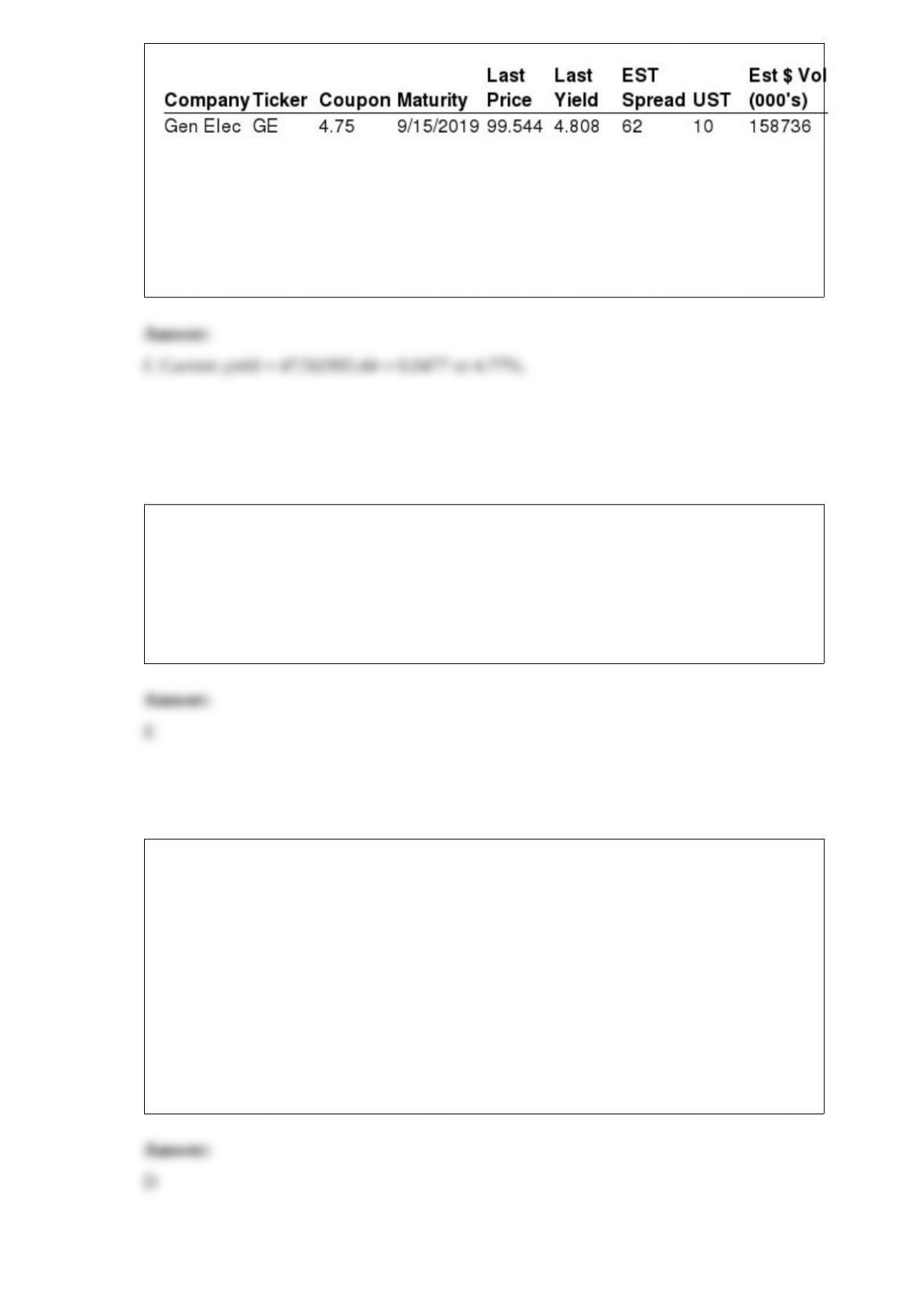
What is the current yield for this bond?
a. 4.18%
b. 5.88%
c. 4.77%
d. 8.125%
e. 4.063%
8) What might cause an industry’s sales to decline?
a. Changes in consumer tastes
b. Product obsolescence
c. Growth of substitute products
d. Sluggish economic growth
e. All of the above
9) Convexity is a desirable feature of bonds because.
a. As interest rates decline, the price of a low convexity bond decreases at a decreasing
rate.
b. As interest rates decline, the price of a high convexity bond decreases at an
increasing rate.
c. As interest rates decline, the price of a low convexity bond increases at a decreasing
rate.
d. As interest rates decline, the price of a high convexity bond increases at an increasing
rate.
e. As interest rates decline, the price of a high convexity bond decreases at a decreasing
rate.
10) Exhibit 19.11
USE THE INFORMATION BELOW FOR THE FOLLOWING PROBLEM(S)
Consider two bonds, both pay semiannual interest. Bond X has a coupon of 7% per
year, maturity of 20 years, yield to maturity of 8% per year, and a face value of $1000.
Bond Y has a coupon of 7% per year, maturity of 20 years, yield to maturity of 8.5%
per year, and a face value of $1000.
Calculate the value of swap out of Bond X into Bond Y.
a. 0.38%
b. 0.81%
c. 1.94%
d. 3.76%
e. 4.12%
11) Exhibit 6.3
USE THE INFORMATION BELOW FOR THE FOLLOWING PROBLEM(S)
Rit= return for stock i during period t
Rmt= return for the aggregate market during period t
Refer to Exhibit 6.3. What is the abnormal rate of return for Hemlick when you
consider its systematic risk measure (beta)?
a.0.1%
b.0.3%
c.0.5%
d.1.5%
e.3.0%