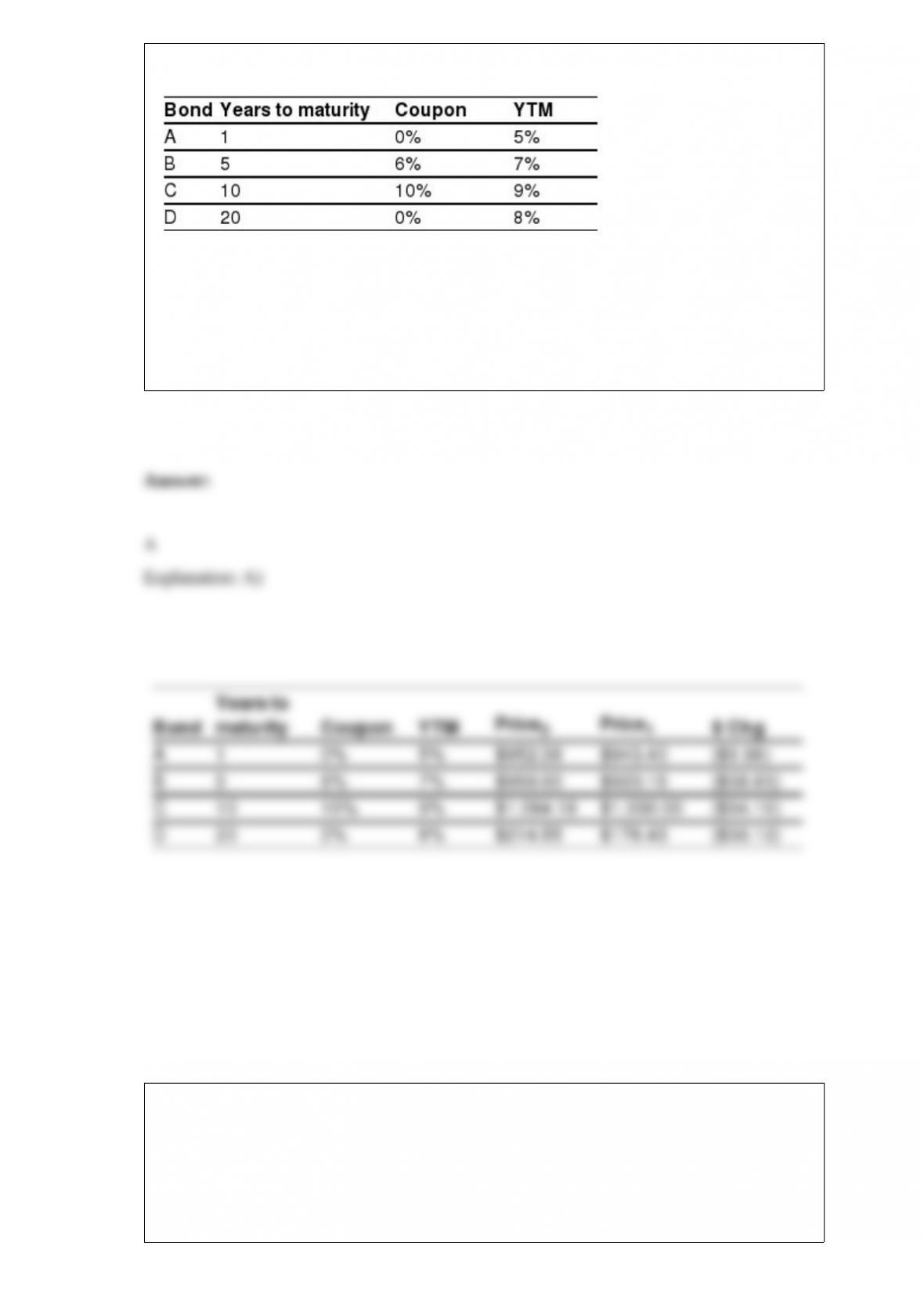
Consider the following four bonds that pay annual coupons:
The amount that the price of bond “D” will change if its yield to maturity increases
from 8% to 9% is closest to:
A) -$36
B) -$39
C) $36
D) $9
By evaluating cost and benefits using competitive market prices, we can determine
whether a decision will make the firm and its investors wealthier. This central concept
is called:
A) the Law of One Price.
B) the Present Value.
C) the Valuation Principle.
D) the Internal Rate of Return.
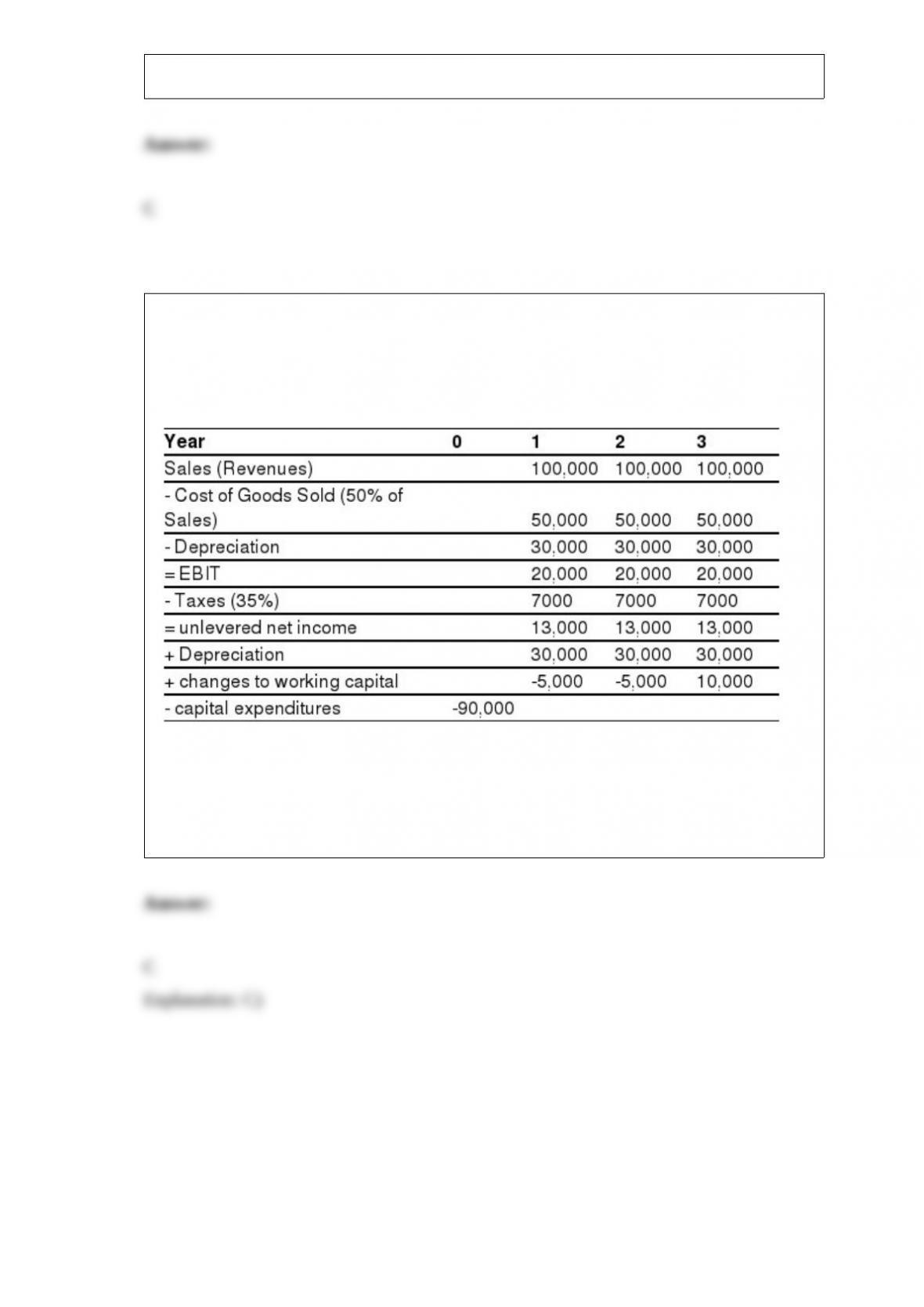
Epiphany Industries is considering a new capital budgeting project that will last for
three years. Epiphany plans on using a cost of capital of 12% to evaluate this project.
Based on extensive research, it has prepared the following incremental cash flow
projects:
The free cash flow for the first year of Epiphany’s project is closest to:
A) $43,000
B) $25,000
C) $38,000
D) $45,000
Flagstaff Enterprises expected to have free cash flow in the coming year of $8 million,
and this free cash flow is expected to grow at a rate of 3% per year thereafter. Flagstaff
has an equity cost of capital of 13%, a debt cost of capital of 7%, and it is in the 35%
corporate tax bracket.
If Flagstaff maintains a debt to equity ratio of 1, then Flagstaff’s pre-tax WACC is
closest to:
A) 11.0%
B) 10.5%
C) 10.0%
D) 9.0%

Which of the following statements is FALSE?
A) Many practitioners prefer to use average industry betas rather than individual stock
betas.
B) When estimating beta by using past returns it is best to use the longest time horizon
of returns available.
C) The CAPM predicts that a security’s expected return depends on its beta with regard
to the market portfolio of all risky investments available to investors.
D) If we use too short a time horizon when estimating beta, our estimate of beta will be
unreliable.
Which of the following statements is FALSE?
A) When using the incremental IRR rule, you must keep track of which project is the
incremental project and ensure that the incremental cash flows are initially positive and
then become negative.
B) Picking one project over another simply because it has a larger IRR can lead to
mistakes.
C) Problems arise using the IRR method when the mutually exclusive investments have
differences in scale.
D) When the risks of two projects are different, only the NPV rule will give a reliable
answer.
Consider the following zero-coupon yields on default free securities:
The forward rate for year 3 (the forward rate quoted today for an investment that begins
in two years and matures in three years) is closest to:
A) 4.5%
B) 5.0%
C) 5.2%
D) 4.6%
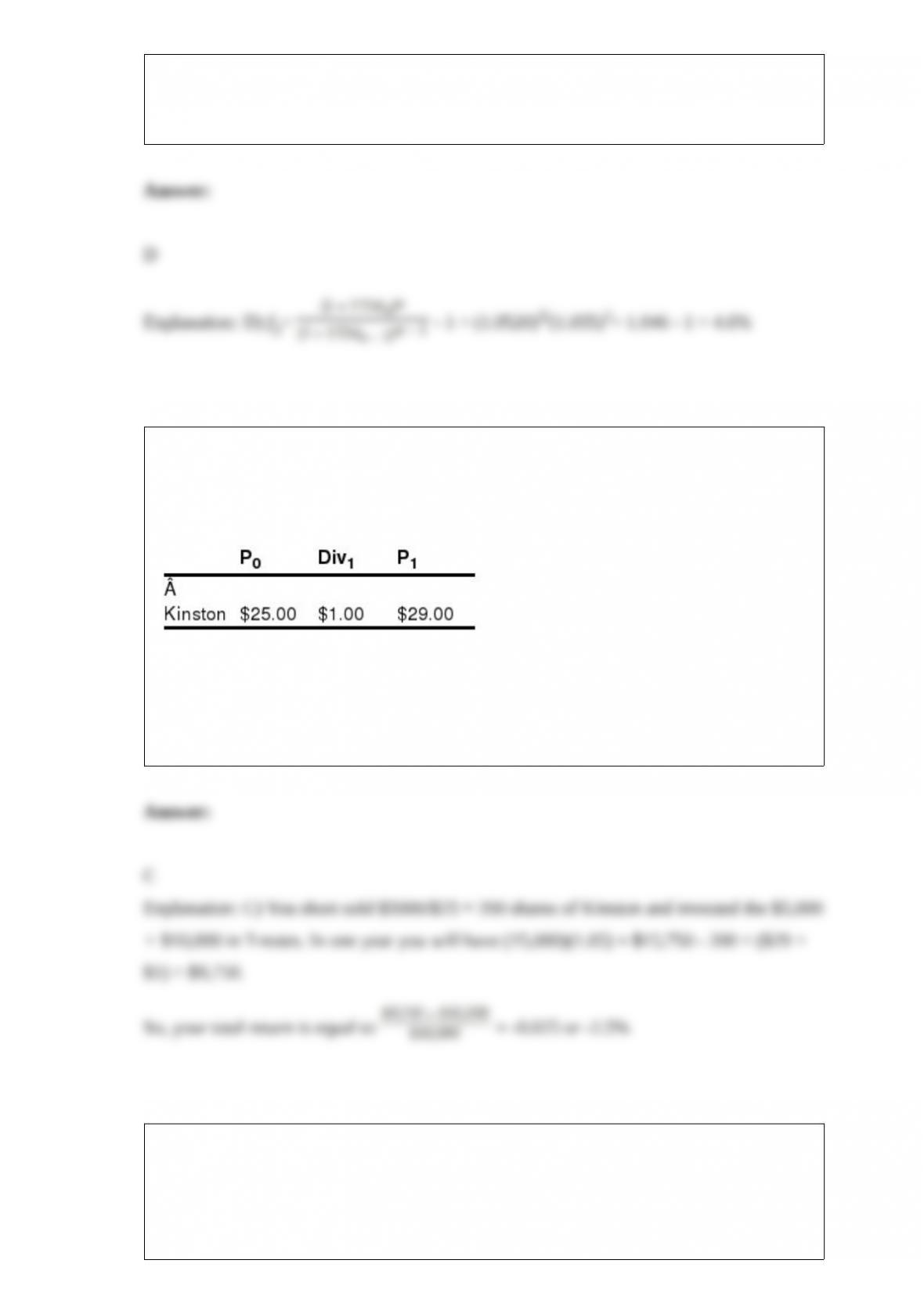
Suppose you have $10,000 in cash to invest. You decide to sell short $5,000 worth of
Kinston stock and invest the proceeds from your short sale, plus your $10,000 into
one-year U.S. treasury bills earning 5%. At the end of the year, you decide to liquidate
your portfolio. Kinston Industries has the following realized returns:
The return on your portfolio is closest to:
A) -0.5%
B) 13.5%
C) -2.5%
D) 14.5%
Wyatt Oil has assets with a market value of $600 million, $70 million of which are
cash. It has debt of $250 million, and 20 million shares outstanding. Assume perfect
capital markets.
If Wyatt Oil distributes the $70 million as a share repurchase, then the number of shares

outstanding after the repurchase will be closest to:
A) 16.0 million
B) 16.5 million
C) 17.5 million
D) 18.0 million
Wyatt oil is considering drilling a new oil well that is initially expected to produce oil at
a rate of 10 million barrels per year. Wyatt has a long-term contract that allows them to
sell the oil at a profit of $2.50 per barrel. The cost of drilling the rig is $175,000,000. If
the rate of oil production from the rig declines by 3% over the year and the discount
rate is 9% per year (EAR), then using continuous compounding, the NPV of this new
oil well is closest to:
A) -$333,333,000
B) $28,128,000
C) $33,333,000
D) $39,340,000

You own 100 shares of a “C” corporation. The corporation earns $5.00 per share before
taxes. Once the corporation has paid any corporate taxes that are due, it will distribute
the rest of its earnings to its shareholders in the form of a dividend. If the corporate tax
rate is 40% and your personal tax rate on (both dividend and non-dividend) income is
30%, then how much money is left for you after all taxes have been paid?
A) $210
B) $300
C) $350
D) $500
Which of the following statements is FALSE?
A) The more cash the firm uses to repurchase shares, the less it has available to pay
dividends.
B) Free cash flow measures the cash generated by the firm after payments to debt or
equity holders are considered.
C) We estimate a firm’s current enterprise value by computing the present value of the
firm’s free cash flow.
D) We can interpret the enterprise value as the net cost of acquiring the firm’s equity,
taking its cash and paying off all debts.
Nielson Motors (NM) is a newly public firm with 25 million shares outstanding. You
are doing a valuation analysis of Nielson and you estimate its free cash flow in the
coming year to be $40 million. You expect the firm’s free cash flows to grow by 4% per
year in subsequent years. Because the firm has only been listed on the stock exchange
for a short time, you do not have an accurate assessment of Nielson’s equity beta.
However, you do have the following data for another firm in the same industry:

Nielson has a much lower debt-equity ratio of .5, which is expected to remain stable,
and Nielson’s debt is risk free. Nielson’s corporate tax rate is 40%, the risk-free rate is
5%, and the expected return on the market portfolio is 10%.
Nielson’s equity cost of capital is closest to:
A) 11.3%
B) 12.2%
C) 14.0%
D) 14.4%
The firm’s unlevered (asset) cost of capital is:
A) the weighted average of the equity cost of capital and the debt cost of capital.
B) the weighted average of the levered cost of capital and the equity cost of capital.
C) the debt cost of capital minus the equity cost of capital.
D) the unlevered beta minus the cost of capital.

Wyatt Oil has assets with a market value of $600 million, $70 million of which are
cash. It has debt of $250 million, and 20 million shares outstanding. Assume perfect
capital markets.
If Wyatt Oil distributes the $70 million as a share repurchase, then its debt-to-equity
ratio after the share repurchase will be closest to:
A) 0.9
B) 1.0
C) 1.1
D) 1.4
Which of the following formulas is INCORRECT?
A) P0= + + … +
B) P0=
C) rE=
D) P0=

JR Industries has a $20 million loan due at the end of the year and under its current
business strategy its assets will have a market value of only $15 million when the loan
comes due. JR is considering a new much riskier business strategy. While this new
riskier strategy can be implemented using JR’s existing assets without any additional
investment, the new strategy has only a 40% probability of succeeding. If the new
strategy is a success, the market value of JR’s assets will be $30, but if the strategy fails
the assets will be worth only $5 million.
What is the overall expected payoff under JR’s new riskier business strategy?
A) $4 million
B) $11 million
C) $20 million
D) $15 million
Which of the following statements is FALSE?
A) The actual cash flow that the investor will get to keep will be reduced by the amount
of any tax payments.
B) The equivalent after-tax interest rate is r(1 – Ï„).
C) The right discount rate for a cash flow is the rate of return available in the market on
other investments of comparable risk and term.
D) To compensate for the risk that they will receive less if the firm defaults, investors
demand a lower interest rate than the rate on U.S. Treasuries.
If a bond is currently trading at its face (par) value, then it must be the case that:

A) the bond’s yield to maturity is less than its coupon rate.
B) the bond’s yield to maturity is equal to its coupon rate.
C) the bond’s yield to maturity is greater than its coupon rate.
D) the bond is a zero-coupon bond.
Equity in a firm with no debt is called:
A) levered equity.
B) unlevered equity.
C) riskless equity.
D) risky equity.