
The term “financial distress costs” includes which of the following?
I. Direct bankruptcy costs
II. Indirect bankruptcy costs
III. Direct costs related to being financially distressed, but not bankrupt
IV. Indirect costs related to being financially distressed, but not bankrupt
A. I only
B. III only
C. I and II only
D. III and IV only
E. I, II, III, and IV
F. None of the above.
Answer:
You plan to pay $50 for a share of preferred stock that pays a $2.40 dividend per year
forever. What annual rate of return will you realize?
A. 0.48%
B. 2.40%
C. 4.80%

D. 5.10%
E. 20.83%
F. None of the above.
Answer:
Which of the following securities has a purely fixed claim against a firm’s cash flows?
A. bonds
B. options
C. common stock
D. None of the above.
Answer:

According to the pecking order theory of capital structure, why do firms avoid issuing
equity?
A. Because fees associated with issuing new equity are so high
B. Because they want to avoid dilution of earnings per share
C. Because they don’t want to commit to paying dividends on the new equity
D. Because equity issuance signals that managers believe their stock is overvalued,
which causes the price of the stock to fall
Answer:
Steve has estimated the cash inflows and outflows for his sporting goods store for next
year. The report that he has prepared summarizing these cash flows is called a:
A. pro forma income statement.
B. sales projection.
C. cash budget.
D. receivables analysis.
E. credit analysis.
F. None of the above.
Answer:

The Limited collects 25 percent of sales in the month of sale, 60 percent of sales in the
month following the month of sale, and 15 percent of sales in the second month
following the month of sale. During the month of April, the firm will collect:
A. 60 percent of February sales.
B. 15 percent of April sales.
C. 60 percent of March sales.
D. 15 percent of March sales.
E. 25 percent of February sales.
Answer:
According to the pecking order theory proposed by Stewart Myers of MIT, which of the
following are correct?
I. For financing needs, firms prefer to first tap internal sources such as retained profits
and excess cash.
II. There is an inverse relationship between a firm’s profit level and its debt level.

III. Firms prefer to issue new equity rather than source external debt.
IV. A firm’s capital structure is dictated by its need for external financing.
A. I and III only
B. II and IV only
C. I, III, and IV only
D. I, II, and IV only
E. I, II, III, and IV
F. None of the above.
Answer:
Which of the following is/are helpful for evaluating the effect of leverage on a
company’s risk and potential returns?
I. Estimated pro forma coverage ratios
II. The recognition that financing decisions do not affect firm or shareholder value
III. A range of earnings chart and proximity of expected EBIT to the breakeven value
IV. A conservative debt policy that obviates the need to evaluate risk
A. I only
B. III only

C. I and III only
D. II and III only
E. IV only
F. None of the above.
Answer:
Zack owns a bond that will pay him $35 each year in interest plus a $1,000 principal
payment at maturity. The $1,000 principal payment is called the:
A. coupon.
B. par value.
C. discount.
D. yield.
E. call premium.
F. None of the above.
Answer:

Please refer to the financial data for Link, Inc. above. Assume a 365-day year for your
calculations. Link’s days’ sales in cash at the end of 2014 is:
A. 24.3
B. 28.8
C. 219.6
D. 249.7
E. None of the above.
Answer:
A company is considering two alternative methods of producing a new product. The
relevant data concerning the alternatives are presented below.
At the end of the useful life of whatever equipment is chosen the product will be
discontinued. The company’s tax rate is 50 percent and its cost of capital is 10 percent.
a. Calculate the net present value of each alternative.
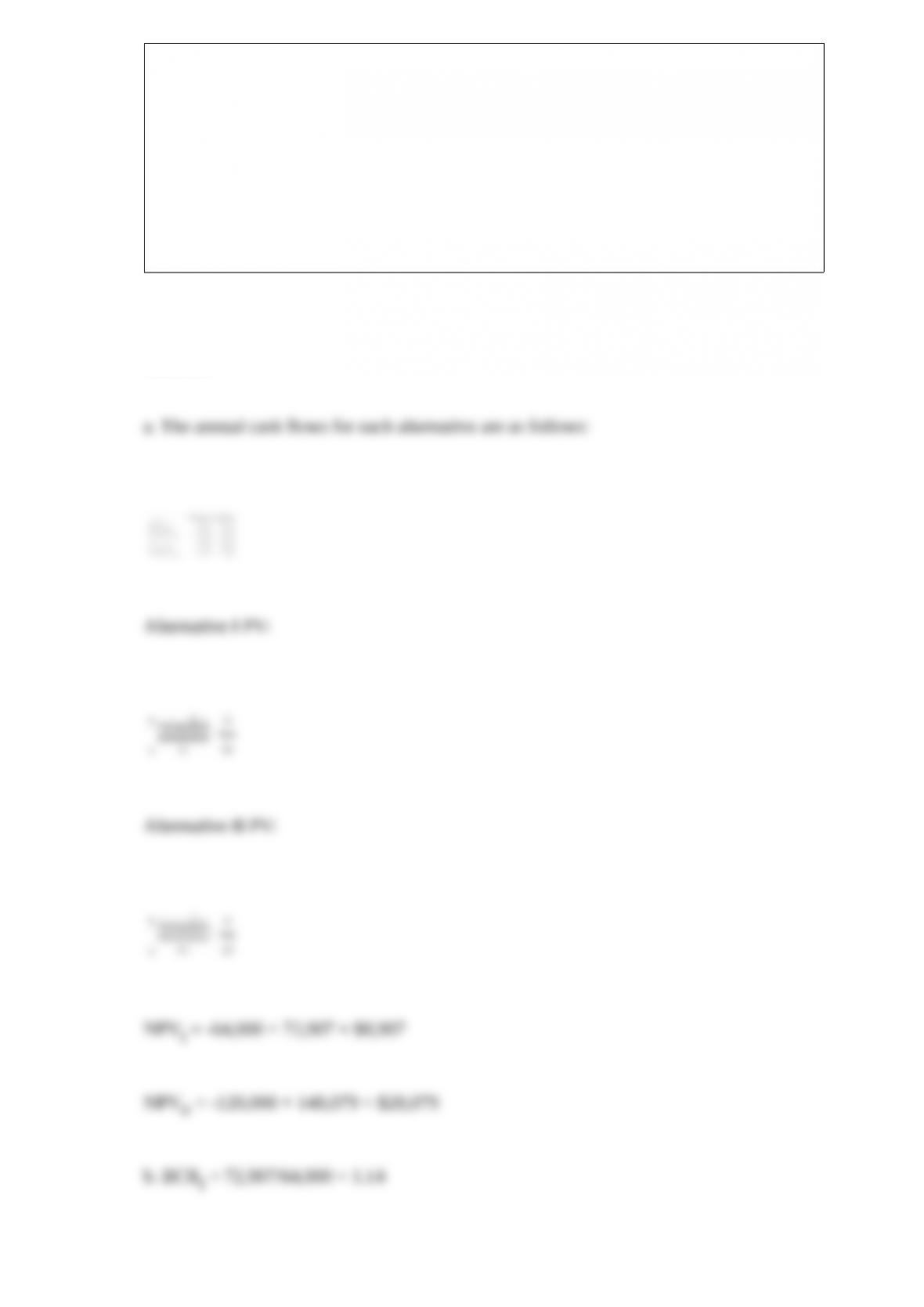
b. Calculate the benefit-cost ratio for each alternative.
c. Calculate the internal rate of return for each alternative.
d. If the company is not under capital rationing, which alternative should be chosen?
Why?
Answer:

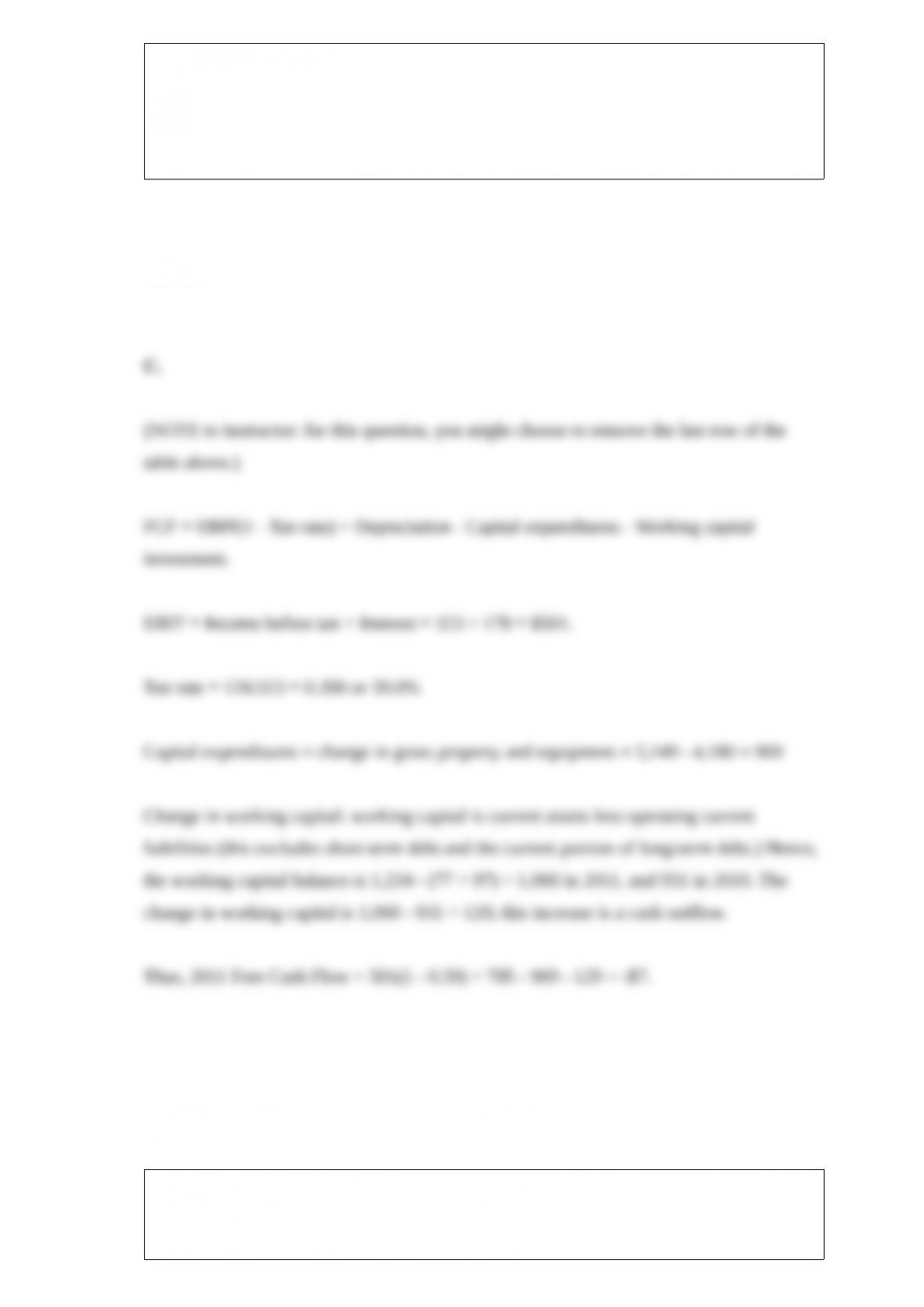
In March of 2011, Macklemore Corp. considered an acquisition of Blue Scholar
Learning, Inc. (BSL), a privately held educational software firm. As a first step in
deciding what price to bid for BSL, Macklemore’s CFO, Ryan Lewis, has prepared a
five-year financial projection for the company assuming the acquisition takes place.
Use BSL’s actual financial data for 2010 and its projections for 2011 as shown above.
What is BSL’s projected free cash flow (in $ millions) for 2011?
A. -$938
B. -$792
C. -$7
D. $122
E. $1,091
F. None of the above.
Answer:
Giant Corp. is considering a project that requires a $1,500 initial cost for a new machine
that will be depreciated straight line to a salvage value of 0 on a 5-year schedule. The
project will require a one-time increase in the level of net working capital of $300. The

project will generate an additional $1,600 in revenues and $700 in operating expenses
each year. The project will end at the end of year 2, at which time the machinery is
expected to be sold for $800. Giant’s tax rate is 50%. In a discounted cash flow analysis
of this project, what would be the projected Year 0 free cash flow?
A. -$1,200
B. -$1,500
C. -$1,800
D. -$2,100
Answer:
What type of financial instrument is depicted in the position diagram shown below?
A. Forward sale
B. Forward purchase
C. Call option
D. Put option
Answer: