1) due to fewer regulations domestic banks are able to offer a narrower spread than
eurobanks.
2) domestic currency devaluation always improves the balance of trade in the short run.
3) capital budgeting refers to the evaluation of prospective investment alternatives and
the commitment of funds to preferred projects.
4) if a currency has appreciated more than the price differential between two countries
as implied by ppp, then a currency is overvalued.
5) portfolio diversification explains the two-way flow of capital between countries.
6) if the nominal exchange rate in dollars per pound rises by 5%, the u.s. inflation is
2%, and the u.k. inflation is 0%, what is the percent change in the real exchange rate?
a.7%
b.5%
c.3%
d.2%
7) the uncovered interest rate parity (uirp) indicates that the interest rate differential is
(approximately) equal to___________.
a.expected premium
b.risk premium
c.forward premium
d.exchange rate premium
8) suppose an exchange rate between korean won and u.s. dollar is 1,000 korean won
per dollar. a hotel vacation package in korea with a price of 500,000 korean won will
cost:
a.$50
b.$500
c.$1,000
d.$500,000,000
9) when the demand is ________, an increase in price will increase the total revenue.
a.elastic
b.inelastic
c.contracted
d.expanded
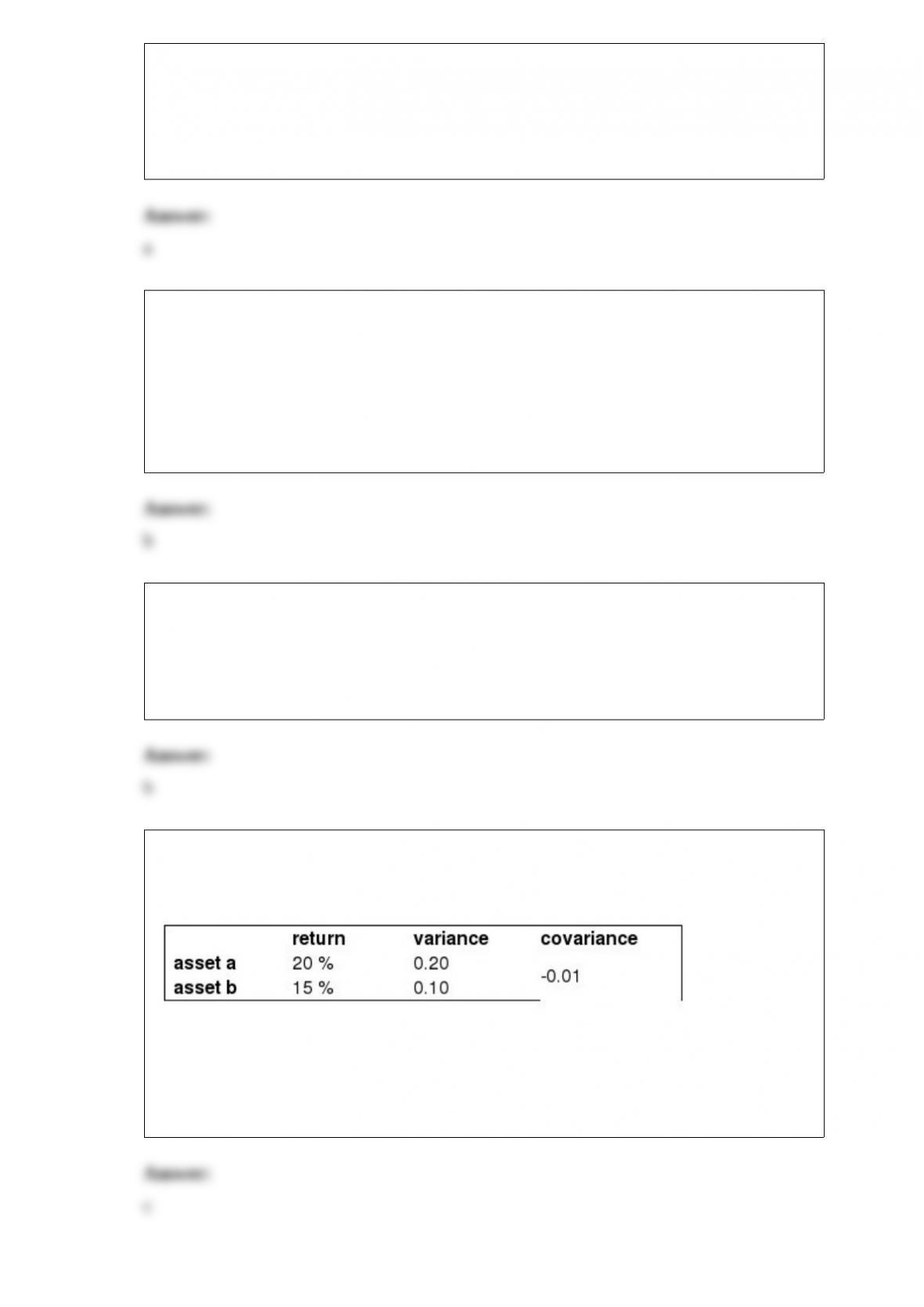
10) assume that you are considering a portfolio of two assets, a and b, with 40%
invested in asset a and invested 60% in asset b. assume also that the assets have the
following statistics:
the portfolio expected return is ________ and the variance of the portfolio is _______.
a.return = 20%
b.return = 18%
c.return = 17%
d.return = 16%
11) the following statement is supported by what concept? allowing the devaluation of
currency will improve balance of trade if we allow domestic spending by households,
businesses, and government or total gdp to adjust appropriately.
a.absorption theory
b.elasticities theory
c.j-curve effect
d.disequilibrium approach
12) profit-seeking arbitrage activity ensures:
a.covered interest rate parity
b.decreased competition
c.higher interest rates on loans
d.increased banking regulation
13) which of the following countries has the highest daily trading volume of foreign
exchange market?
a.the u.s
b.the u.k
c.japan
d.hong kong
14) if the price of british pounds in terms of u.s. dollars is $1.80 per pound, then the
price of u.s. dollars in terms of british pounds is:
a.1.80£ per dollar
b.0.555£ per dollar
c.0.90£ per dollar
d.3.60£ per dollar
15) the following example supports which extension to the monetary approach to
exchange rates: suppose the money supply increases. the initial change of the spot price
exceeds that of its long-run value.
a.general equilibrium approach
b.trade balance approach
c.overshooting approach
d.currency substitution approach
16) the following curves represent an equilibrium in which markets? match the curves
with the type of equilibrium.
i.money market equilibrium
ii.balance of payments equilibrium
iii.goods market equilibrium
a.is, bp, lm
b.lm, bp, is
c.bp, is, lm
d.lm, is, bp
17) under the flexible exchange rate, an increase in the foreign price level leads to a
domestic currency __________.
a.appreciation
b.depreciation
c.devaluation
d.overshooting
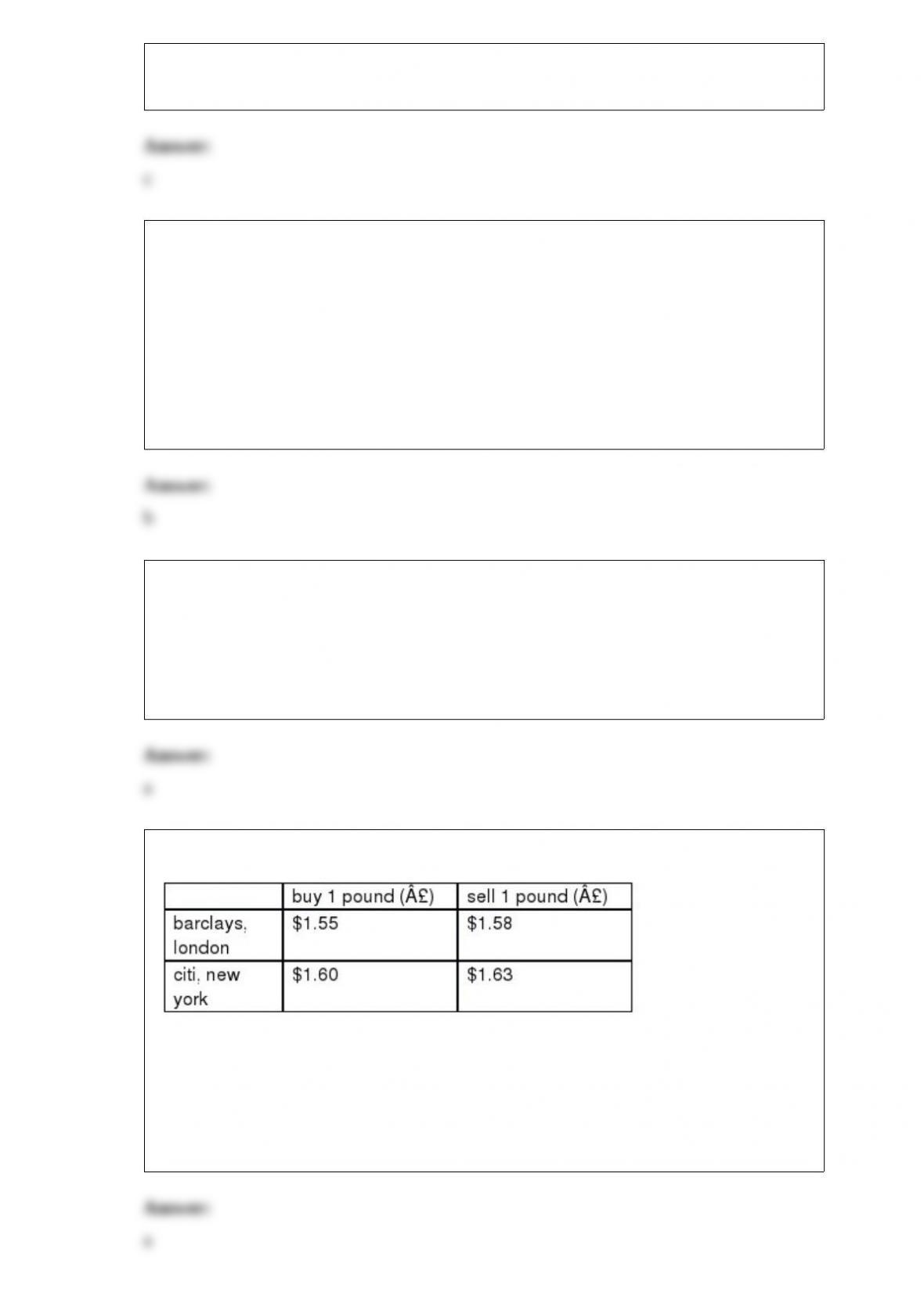
18) suppose that the spot exchange rates for british pound quoted in two locations are:
suppose that you have £1 million, you can make arbitrage profit by selling pounds for
dollars in _________ and selling dollars for pounds in _______.
a.new york; london
b.new york; new york
c.london; new york
d.london; london
19) suppose that the u.s. fed increases the money supply by 10%. then under maer:
a.the exchange rate (dollar/foreign currency) rises by 10%
b.the exchange rate (dollar/foreign currency) falls by 10%
c.foreign inflation rises by 10%
d.foreign inflation falls by 10%
20) the foreign exchange _______ is the difference between the forward exchange rate
and the expected future spot exchange rate.
a.risk premium
b.exposure
c.strike price
d.leverage point
21) a u.s. importer has to pay skr1 million to a swedish firm in 60 days. the current spot
rate is $0.5 per swedish krona, and the 60-day forward rate is $0.65. bob forecasts that
the spot rate in 60 days will be $0.45. jane forecasts that the spot rate will be $0.85 in
60 days. the actual spot rate in 60 days turns out to be $0.68. whose advice, between
bob and jane, will save the companys money?
a.bob
b.jane
c.both bob and jane
d.neither ben nor jane
22) an american tourist is planning to visit mexico. the exchange rate at which the
tourist can buy pesos in a retail bank is the ________.
a.bid price
b.ask price
c.flat rate
d.cross rate
23) which of the following were not present in the 1997 asian financial crisis?
a.weak financial markets
b.external shocks

c.overvalued currencies
d.current account surpluses