
1) a bank that has made floating rate loans funded by longer maturity deposits is at risk
from falling interest rates.
2) although an investor can write checks on a cash management account held with a
broker, regulations prevent the use of atms or debit cards on these accounts.
3) of all the depository institutions, as a percentage of assets, credit unions rely the most
on deposit sources of funds.
4) if the united states has inflation of 3% and europe has inflation of 5%, the value of
the euro should increase, ceteris paribus.
5) a keogh plan is designed for self-employed individuals.
6) the buyer of an american-style bond call option has the right, but not the obligation,
to sell the bond at a set price until the option expires.
7) the national credit union administration is the primary regulator of federally
chartered credit unions.

8) premiums on standard annual renewable term life will generally increase as the
policyholder ages.
9) c&i loans are loans to businesses used to finance capital needs, equipment purchases,
and plant expansions.
10) federal reserve interest rate decisions can be vetoed by the u.s. president or the
congress.
11) in the t-bill secondary market the ask yield will normally be less than the bid yield.
12) because of the government backing, investors in gnma pass-throughs are guaranteed
to earn at least the t-bill rate on their investments.
13) the cash flow from the interest a bank receives on a long-term loan that is normally
reinvested is called the runoff from the loan.
14) a $2 million jumbo cd is paying a quoted 3.55% interest rate on 180-day maturity
cds. how much money will you have at maturity if you invest in the cd?
a.$2,000,000
b.$2,035,014
c.$2,035,500
d.$2,071,000

e.$2,088,400
15) which of the following statements about euro bonds is/are true?
i. the issuer chooses the currency of denomination.
ii. spreads on firm commitment offers are lower for euro bonds than for u.s. bonds.
iii. euro bonds typically have denomination of $5,000 and $10,000.
iv. euro bonds are bearer bonds.
a.i and ii only
b.i, iii, and iv only
c.ii, iii, and iv only
d.ii and iii only
e.i, ii, iii, and iv are true
16) in the t-bill auction process, the competitive bidder is guaranteed a
______________ and a noncompetitive bidder is guaranteed a _______________.
a.minimum price; maximum price
b.maximum price; minimum price
c.maximum price; given quantity
d.minimum price; maximum quantity
e.none of the above
17) rank the following in asset size from largest to smallest in 2010 .
i. mutual funds
ii. insurance companies
iii. commercial banks
a.i, ii, iii
b.i, iii, ii
c.ii, iii, i
d.iii, ii, i
e.iii, i, ii

18) the term disintermediation refers to
a.the policy of not closing insolvent institutions in hopes that they can eventually turn
around their performance
b.the withdrawal of deposits from depository institutions that are reinvested in other
types of intermediaries
c.the policy of regulating the minimum rate of return institutions can pay on deposits
d.chartering restrictions that limit the ability of new banks to enter into a local market
e.the policy of not allowing banks to grow by creating a de novo branch outside their
traditional market area
19) a retirement account specifically designed for self-employed persons is a
a.roth ira
b.traditional ira
c.keogh
d.penny benny
e.public pension plan
20) which one of the following has the highest concentration of mortgage-related assets
on the balance sheet?
a.savings institutions
b.commercial banks
c.credit unions
d.finance companies
e.pension funds
21) repurchase agreements (repos) are used extensively to finance security holdings. in
2007, many investment banks and other financial institutions were unable to roll over
their maturing repurchase agreements during the subprime mortgage crisis. this inability
to get new repo financing is an example of
a.credit risk
b.liquidity risk
c.sovereign risk
d.technological risk
e.operational risk

22) an ilc is a type of
a.finance company
b.thrift institution
c.credit card bank
d.nonbank bank
e.foreign-owned loan corporation
23) you buy a stock for $30 per share and sell it for $33 after holding it for slightly over
a year and collecting a $0.75 per share dividend. your ordinary income tax rate is 28%
and your capital gains tax rate is 20%. your after-tax rate of return is
___________________.
a.8.00%
b.10.25%
c.12.50%
d.9.80%
e.8.75%
24) finance companies enjoy several advantages over banks. these include all but which
one of the following?
a.finance companies can offer various types of products and services without regulatory
interference
b.many finance companies have considerable knowledge and expertise about specific
industries and products
c.finance companies can accept riskier customers than banks
d.finance companies generally have lower overhead than banks
e.finance companies have lower funds costs than banks
25) recent regulation such as the riegle-neal act of 1994 has removed some of the
federal banking laws that formerly constrained profitable opportunities for commercial
banks. the riegle-neal act removes the major restrictions on banks’ ability to
_________________.
a.diversify geographically
b.diversify their product line
c.engage in securities underwriting
d.engage in insurance underwriting
e.engage in loan brokerage

26) if an underwriter overestimates the demand for a firm’s securities in a firm
commitment offering, the underwriter can
a.sell the shares back to the issuing firm at a discount
b.lower the bid price to the issuing firm
c.increase the fees charged to the issuing firm
d.cancel the issue and refund the fees paid by the issuing firm
e.none of the above
27) of the following, the most recent derivative security innovations are
a.foreign currency futures
b.interest rate futures
c.stock index futures
d.stock options
e.credit derivatives
28) which of the following indices are value-weighted?
i. nyse composite
ii. s&p500
iii. nasdaq composite
iv. dow jones industrial average
a.i, ii, iii, and iv
b.i only
c.ii only
d.ii, iii, and iv only
e.i, ii, and iii only
29) figure 23-1
after conducting a rate sensitive analysis, a bank finds itself with the following amounts
of rate- sensitive assets and liabilities (rsas and rsl) and fixed-rate assets and liabilities
(fras and frls), the rate of return and cost rates on the accounts are also given:
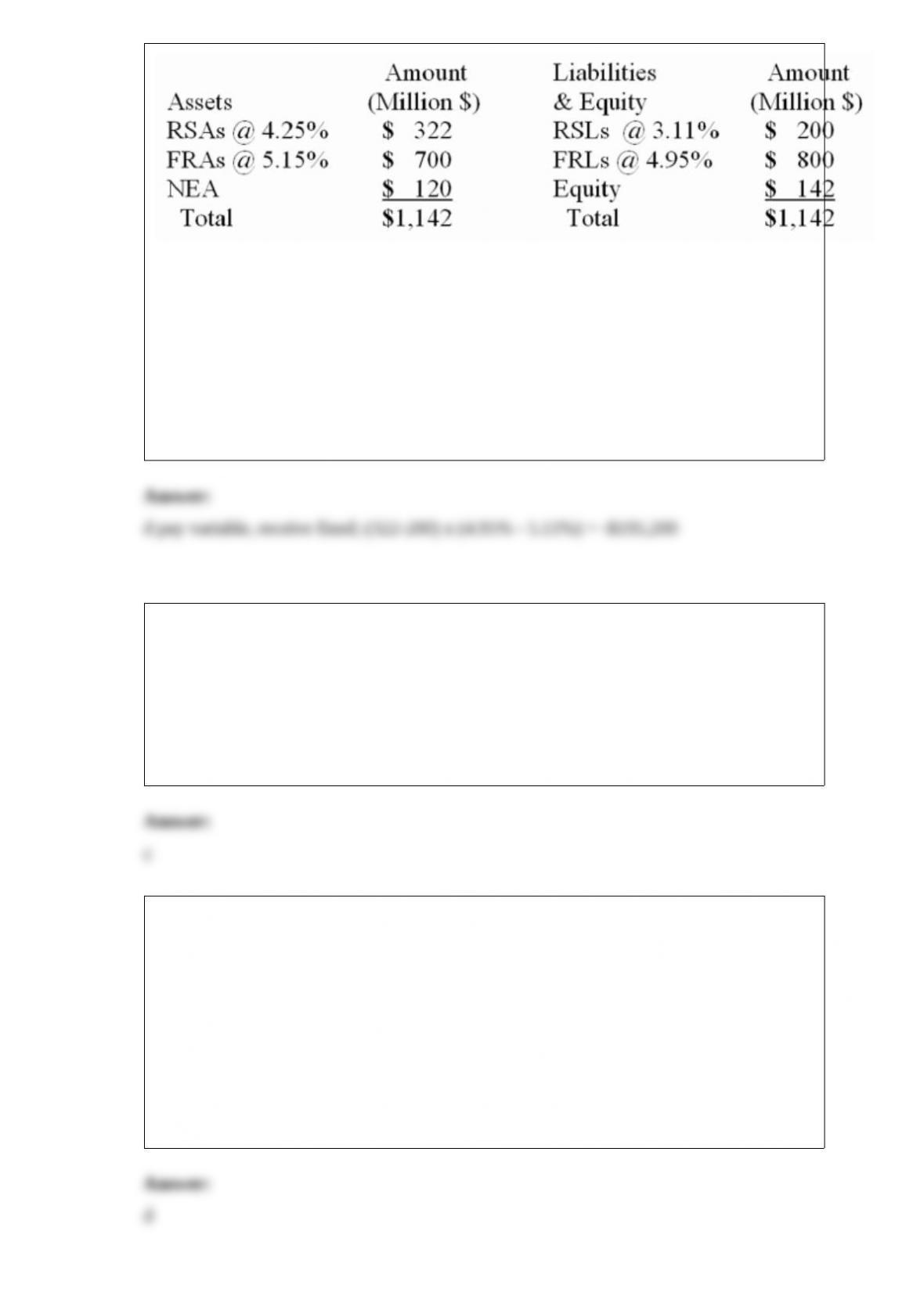
suppose the institution wishes to fully hedge the interest rate risk with a swap. a swap is
available with whatever notional principle is needed that pays fixed at 4.95% and pays
variable at libor. libor is currently 5.11%. by how much would profits change right now
if the bank engages in the swap?
a.$202,600
b.-$202,600
c.$300,000
d.-$195,200
e.$195,200
30) investment firms that pool money from individuals and/or institutions and invest
equity funds in startup firms are called
a.top-tier bankers
b.section 20 affiliates
c.venture capital firms
d.ecns
e.discount brokerage houses
31) which of the following statements, if any, is(are) true?
i. mutual funds never have runs.
ii. funds invested with insurers are as safe as deposits at a bank.
iii. pension funds generally have less liquidity risk than banks.
a.all three are true
b.only i is true
c.only ii and iii are true
d.only iii is true
e.none are true

32) under erisa, pension fund managers are required to invest fund assets as wisely as if
they were investing their own money. this requirement is called the
a.owl rule
b.vesting requirement
c.403(b) requirement
d.prudent person rule
e.funding rule
33) a bank has interest income to total assets ratio of 5.45% and has noninterest income
of $45 million and total assets of $700 million. what is the bank’s asset utilization ratio?
a.5.45%
b.6.43%
c.9.67%
d.15.02%
e.11.88%
34) should regulators of fis be concerned about the increased trading activity of fis?
35) an fi’s position in fx markets generally reflects four trading activities. what are they,
and which cause the fi to bear fx risk?

36) why are mutual funds popular with individual investors?
37) explain how a drop in the value of the dollar could affect the u.s. import and export
sectors.
38) you have 5 years until you need to take your money out of your investments to
make a planned expenditure. right now bonds are promising an 8% return. you buy a
5-year duration bond. after you buy the bond, interest rates fall to 6% and stay there for
the full five years. you reinvest the coupons and earn 6%. will your realized return be
more or less than the originally promised 8%? explain.
39) why is it important to regulate the mutual fund industry?

40) how have recent changes in discount window credit programs affected the use of
this tool for monetary policy?
41) explain how an fi’s capital protects against credit risk and interest rate risk.
42) in dollars, how many subprime mortgages were originated in relation to the total
mortgage market in 2006? how has the subprime crisis affected the profitability of
finance companies? are all finance companies equally affected? explain.