
The primary goal of financial management is most associated with increasing the:
A. dollar amount of each sale.
B. traffic flow within the firm’s stores.
C. the fixed costs while lowering the variable costs.
D. firm’s liquidity.
E. market value of the firm.
Cash flow from assets is defined as:
A. the cash flow to shareholders minus the cash flow to creditors.
B. operating cash flow plus the cash flow to creditors plus the cash flow to
shareholders.
C. operating cash flow minus the change in net working capital minus net capital
spending.
D. operating cash flow plus net capital spending plus the change in net working capital.
E. cash flow to shareholders minus net capital spending plus the change in net working
capital.
You want to create a $50,000 portfolio that consists of three stocks and has an expected
return of 12.6 percent. Currently, you own $14,200 of Stock A and $21,700 of Stock B.
The expected return for Stock A is 16.2 percent, and for Stock B it is 10.4 percent. What
is the expected rate of return for Stock C?
A. 13.67 percent
B. 14.14 percent
C. 13.38 percent
D. 12.36 percent
E. 12.11 percent

Bruno’s stock should return 14 percent in a boom, 11 percent in a normal economy, and
4 percent in a recession. The probabilities of a boom, normal economy, and recession
are 8 percent, 90 percent, and 2 percent, respectively. What is the variance of the returns
on this stock?
A. .011387
B. .000169
C. .001506
D. .001538
E. .011561
Design Interiors has a cost of equity of 14.9 percent and a pretax cost of debt of 8.6
percent. The firm’s target weighted average cost of capital is 11 percent and its tax rate
is 34 percent. What is the firm’s target debt-equity ratio?
A. 1.37
B. .87
C. .98
D. 1.02
E. .73
The net present value of an investment represents the difference between the
investment’s:
A. cash inflows and outflows.
B. cost and its net profit.
C. cost and its market value.
D. cash flows and its profits.
E. assets and liabilities.

If Treasury bills are currently paying 2.84 percent and the inflation rate is 1.63 percent,
what is the approximate real rate of interest? The exact real rate?
A. 1.21 percent; 1.19 percent
B. 1.21 percent; 1.20 percent
C. 1.20 percent; 1.21 percent
D. 1.19 percent; 1.20 percent
E. 1.19 percent; 1.21 percent
Industrial Services is analyzing a proposed investment that would initially require
$489,000 of new equipment. This equipment would be depreciated on a straight-line
basis to a zero balance over the four-year life of the project. The estimated salvage
value is $135,000. The project requires $32,000 initially for net working capital, all of
which will be recouped at the end of the project. The projected operating cash flow is
$174,900 a year. What is the internal rate of return on this project if the relevant tax rate
is 35 percent?
A. 16.54 percent
B. 17.01 percent
C. 21.15 percent
D. 18.67 percent
E. 19.02 percent
Based on the recognition principle, revenue is recorded on the financial statements
when the:
I. payment is collected for the sale of a good or service.
II. earnings process is virtually complete.
III. value of a sale can be reliably determined.
IV. product is physically delivered to the buyer.
A. I and II only
B. I and IV only
C. II and III only
D. II and IV only
E. I and III only

AJ’s Market generally holds $50,000 in cash in case an unexpected investment
opportunity arises. This is an example of the ____ motive for holding cash.
A. precautionary
B. opportunistic
C. speculative
D. reserve
E. transaction
Which one of the following is an ordinary annuity, but not a perpetuity?
A. $75 paid at the beginning of each monthly period for 50 years
B. $15 paid at the end of each monthly period for an infinite period of time
C. $40 paid quarterly for 5 years, starting today
D. $50 paid every year for ten years, starting today
E. $25 paid weekly for 1 year, starting one week from today
Which one of the following has the highest effective annual rate?
A. 6 percent compounded annually
B. 6 percent compounded semiannually
C. 6 percent compounded quarterly
D. 6 percent compounded daily
E. 6 percent compounded every 2 years
Use the following tax table to answer this question:
BT Trucking has taxable income of $617,429. How much does it owe in taxes?

A. $96,025.86
B. $240,797.31
C. $118,542.79
D. $209,925.86
E. $201,354.82
The accounts receivable period is the time that elapses between the _____ and the ____.
A. purchase of inventory; payment to the supplier
B. purchase of inventory; collection of the receivable
C. sale of inventory; payment to supplier
D. sale of inventory; collection of the receivable
E. sale of inventory; billing to customer
What term is used to describe an account that a bond trustee manages for the sole
purpose of redeeming bonds early?
A. Registered account
B. Bearer account
C. Call account
D. Sinking fund
E. Premium fund
The Green Shoe option is most apt to be exercised when an IPO is ______ and _____.
A. underpriced; oversubscribed
B. underpriced; undersubscribed
C. correctly priced; neither over nor undersubscribed
D. overpriced; oversubscribed
E. overpriced; undersubscribed

You just returned from a trip to Germany and have 356euros in your pocket. How many
dollars will you receive when you exchange this money if the U.S. dollar equivalent of
the euro is 1.2452?
A. $402.08
B. $443.29
C. $411.40
D. $397.18
E. $462.05
The Green Pickle has estimated quarterly sales for next year, starting with Quarter I, of
$18,600, $21,300, $24,500, and $19,600.The accounts receivable period is 18 days.
What is the expected accounts receivable balance at the end of the third quarter?
Assume each month has 30 days.
A. $4,333
B. $4,900
C. $4,500
D. $4,667
E. $4,600
Sixty years ago, your grandparents opened two savings accounts and deposited $250 in
each account. The first account was with City Bank at 3.6 percent, compounded
annually. The second account was with Country Bank at 3.65 percent, compounded
annually. Which one of the following statements is true concerning these accounts? (Do
not round intermediate calculations.)
A. The City Bank account is currently worth $2,076.42.
B. The City Bank account has paid $48.19 more in interest than the Country Bank
account.
C. The Country Bank account is currently worth $2,170.32.
D. The Country Bank account has paid $72.24 more in interest than the City Bank
account.
E. The Country Bank account has paid $61.30 more in interest than the City Bank
account.
A local magazine is offering a $2,500 grand prize to one lucky winner. The prize will be
paid in four annual payments of $625 each, starting one year after the drawing. How
much would this prize be worth to you if you can earn 9 percent on your money?
A. $1,848.18
B. $1,934.24
C. $2,024.82
D. $2,450.14
E. $2,545.54
The present value of a lump sum future amount:
A. increases as the interest rate decreases.
B. decreases as the time period decreases.
C. is inversely related to the future value.
D. is directly related to the interest rate.
E. is directly related to the time period.
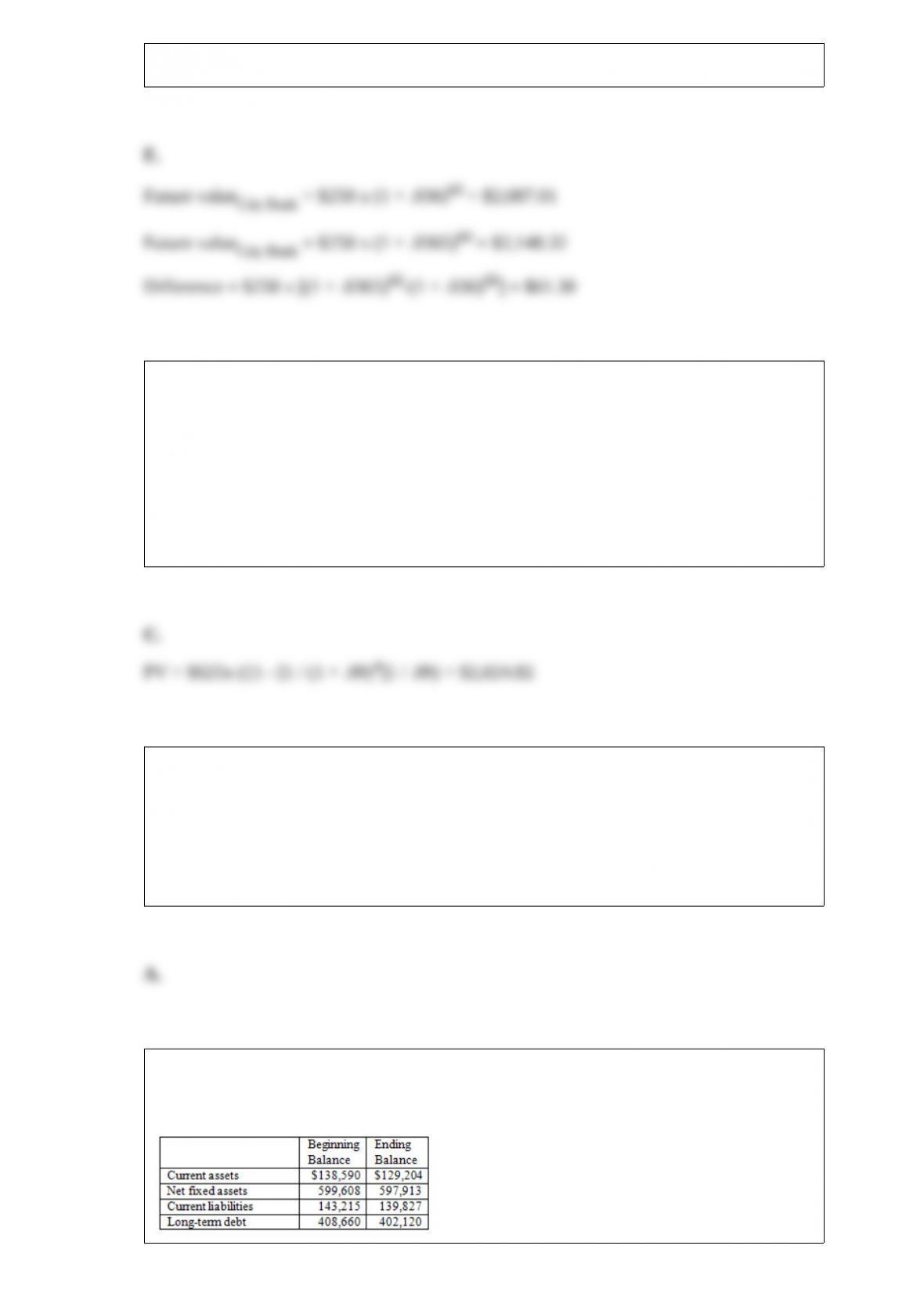
The Plaza Cafe has an operating cash flow of $83,770, depreciation expense of
$43,514, and taxes paid of $21,590. A partial listing of its balance sheet accounts is as
follows:

What is the amount of the cash flow from assets?
A. $26,359
B. $47,949
C. $61,487
D. $43,909
E. $35,953
A particular set of golf clubs in the U.S. costs $879. According to absolute purchasing
power parity, what should the identical set of clubs cost in the UK if the spot rate is
£.6421 = $1?
A. £1,368.95
B. £1,428.08
C. £533.80
D. £547.50
E. £564.41
Kessler Cleaners has accounts receivable of $28,943, total assets of $387,600, cost of
goods sold of $317,400, and a capital intensity ratio of .97. What is the accounts
receivable turnover rate?
A. 12.63
B. 13.81
C. 12.42
D. 14.61
E. 10.97
A bond has a par value of $1,000, a current yield of 6.25 percent, and semiannual
interest payments. The bond quote is 100.8. What is the amount of each coupon

payment?
A. $63.00
B. $31.50
C. $37.50
D. $62.50
E. $31.25
One advantage of the corporate form of organization is the:
A. taxation of the corporate profits.
B. unlimited liability for its shareholders.
C. double taxation of profits.
D. ability to raise larger sums of equity capital than other organizational forms.
E. ease of formation compared to other organizational forms.
Nu-Tek is expanding rapidly. As a result, the company expects to pay annual dividends
of $.62, .80, and $1.05 per share over the next three years, respectively. After that, the
dividend is projected to increase by 4 percent annually. What is the current value of this
stock if the required return is 16 percent?
A. $7.63
B. $9.67
C. $10.46
D. $6.58
E. $8.49
Portfolio diversification eliminates:

A. all investment risk.
B. the portfolio risk premium.
C. market risk.
D. unsystematic risk.
E. the reward for bearing risk.
Northern Companies has three separate divisions. Each year, the company determines
the amount it can afford to spend in total for capital expenditures and then allocates
one-third of that amount to each division. This allocation process is called:
A. soft rationing.
B. hard rationing.
C. opportunity cost allocation.
D. divisional separation.
E. strategic planning.
Candy Supplies purchases are equal to 68 percent of the following quarter’s sales.
Assume each month has 30 days, the accounts receivable period is 30 days, and the
accounts payable period is 45 days. The estimated quarterly sales for next year, starting
with Quarter 1, are $38,900, $40,600, $58,900, and $69,200, respectively. How much
will the firm pay its suppliers in the third quarter?
A. $41,379
B. $46,811
C. $44,514
D. $40,947
E. $43,554
Wilberton’s has total assets of $537,800, net fixed assets of $412,400, long-term debt of
$323,900, and total debt of $388,700. If inventory is $173,900, what is the current
ratio?
A. 2.01
B. .52
C. .84
D. 1.18
E. 1.94
You are making an investment of $110,000 and require a rate of return of14.6 percent.
You expect to receive $48,000 in the first year, $52,500 in the second year, and $55,000
in the third year. There will be a cash outflow of $900 in the fourth year to close out the
investment. What is the net present value of this investment?
A. $7,881.55
B. $4,305.56
C. $1,879.63
D. $633.33
E. $8,534.25
TMS just paid an annual dividend of $2.84 per share on its stock. The dividends are
expected to grow at a constant rate of 1.85 percent per year. If investors require a rate of
return of 10.4 percent, what will be the stock price be in Year 11?
A. $41.71
B. $40.64
C. $35.75
D. $41.39
E. $42.57
Which statement is true?
A. All else equal, an ordinary annuity is more valuable than an annuity due.

B. All else equal, a decrease in the number of payments increases the future value of an
annuity due.
C. An annuity with payments at the beginning of each period is called an ordinary
annuity.
D. All else equal, an increase in the discount rate decreases the present value and
increases the future value of an annuity.
E. All else equal, an increase in the number of annuity payments decreases the present
value and increases the future value of an annuity.