
Over the last four years, a stock has had an arithmetic average return of 8.8 percent.
Three of those four years produced returns of 16.3 percent, 10.2 percent, and -14.1
percent, respectively. What is the geometric average return for this four-year period?
A. 7.83 percent
B. 8.39 percent
C. 8.67 percent
D. 9.40 percent
E. 9.97 percent
Answer:
Many of the smaller sell orders sent to the floor of the NYSE are:
A. handled by the floor traders.
B. purchased by the commission brokers.
C. electronically transmitted to the DMMs.
D. executed on an ECN.
E. executed in the primary market.
Answer:

Sam wants to invest $5,000 for 5 years. Which one of the following rates will provide
him with the largest future value?
A. 5 percent simple interest
B. 5 percent interest, compounded annually
C. 6 percent interest, compounded annually
D. 7 percent simple interest
E. 7 percent interest, compounded annually
Answer:
Stevenson’s Bakery is an all-equity firm that has projected perpetual earnings before
interest and taxes of $138,000 a year. The cost of equity is 13.7 percent and the tax rate
is 32 percent. The firm can borrow money at 6.75 percent. Currently, the firm is
considering converting to a debt-equity ratio of 0.45. What is the firm’s levered value?
A. $527,613
B. $689,919
C. $752,987
D. $829,507

E. $903,682
Answer:
Which one of the following is contained in the corporate bylaws?
A. Procedures for electing corporate directors
B. State of incorporation
C. Number of authorized shares
D. Intended life of the corporation
E. Business purpose of the corporation
Answer:
The NYSE:
A. presently conducts all of its trading through SuperDOT.

B. is a dealer market.
C. is in the business of attracting order flow.
D. is solely a primary market.
E. is based on a multiple market maker system.
Answer:
Which of the following will increase the present value of an annuity, all else held
constant?
I. Increase in the number of payments
II. Increase in the interest rate
III. Decrease in the interest rate
IV. Decrease in the payment amount
A. I and II only
B. I and III only
C. II and IV only
D. I, II, and IV only
E. I, III, and IV only
Answer:

Anne plans to save $40 a week for the next five years. She expects to earn 3 percent for
the first two years and 5 percent for the last three years. How much will her savings be
worth at the end of the five years?
A. $10,215.60
B. $10,684.29
C. $10,983.58
D. $11,014.88
E. $11,708.15
Answer:
Today, you are borrowing money from your local bank. The loan is to be repaid in one
lump sum payment of $15,000 one year from now. How much money are you
borrowing today if the APR is 10.6 percent?
A. $11,899.48

B. $12,550.00
C. $13,562.39
D. $13,762.14
E. $14,037.97
Answer:
Heidi owns 400 shares of Boyd Enterprises stock, which is valued at $17 a share. Boyd
Enterprises just declared a 10 percent stock dividend. How many shares will Heidi own
and what will the price per share be after the dividend?
A. 360; $15.45
B. 360; $18.70
C. 440; $15.45
D. 440; $17.00
E. 440; $18.70
Answer:

Which of the following will decrease the future value of a lump sum investment made
today assuming that all interest is reinvested? Assume the interest rate is a positive
value.
I. Increase in the interest rate
II. Decrease in the lump sum amount
III. Increase in the investment time period
IV. Decrease in the investment time period
A. I and III only
B. I and IV only
C. I, II, and III only
D. II and III only
E. II and IV only
Answer:
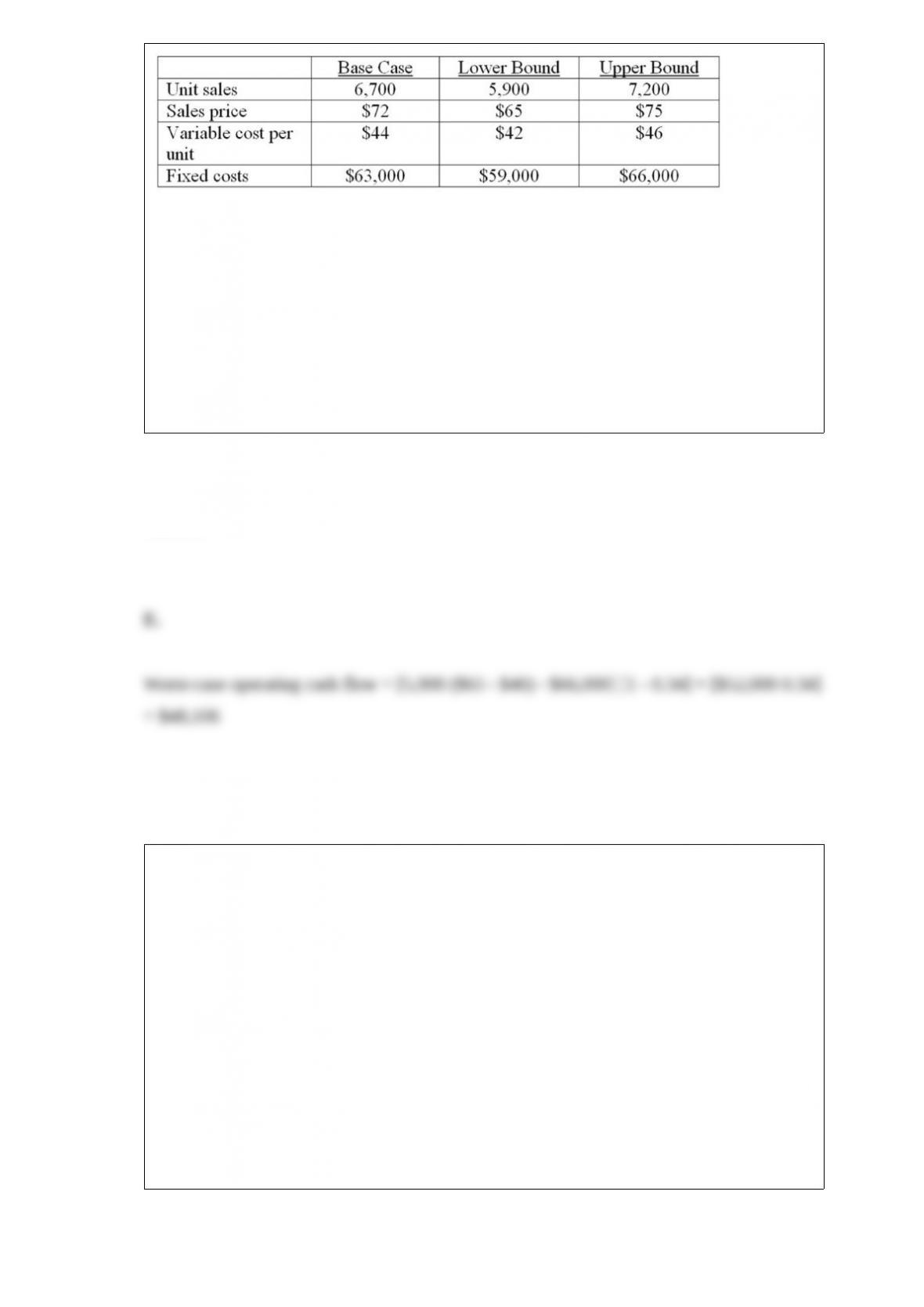
You are analyzing a project and have developed the following estimates. The
depreciation is $52,000 a year and the tax rate is 34 percent. What is the worst-case
operating cash flow?
A. -$32,509
B. -$19,288
C. -$4,225
D. $27,556
E. $48,106
Answer:
Horseshoe Stables is losing significant market share and thus its managers have decided
to decrease the firm’s annual dividend. The last annual dividend was $0.90 a share but
all future dividends will be decreased by 10 percent annually. What is a share of this
stock worth today at a required return of 15 percent?
A. $3.06
B. $3.24
C. $3.41
D. $3.59
E. $3.95

Answer:
Which one of the following is a drawback of cash dividends?
A. Firms may have to forgo positive net present value projects.
B. Stock prices tend to increase as annual dividend amounts increase.
C. Cash dividends support stock prices.
D. Dividends are felt to be directly related to agency costs.
E. Dividend-paying firms tend to attract a wider field of investors than do
non-dividend-paying firms.
Answer:
Kurt wants to have $25,000 in an investment account four years from now. The account
will pay 0.2 percent interest per month. If he saves money every month, starting one
month from now, how much will he have to save each month to reach his goal?
A. $496.75
B. $497.03
C. $497.75

D. $501.03
E. $502.14
Answer:
The Good Life Store has sales of $79,600. The cost of goods sold is $48,200 and the
other costs are $18,700. Depreciation is $8,300 and the tax rate is 34 percent. What is
the net income?
A. $2,904
B. $8,382
C. $11,204
D. $14,660
E. $16,682
Answer:

The balance sheet of a firm shows beginning net fixed assets of $348,200 and ending
net fixed assets of $371,920. The depreciation expense for the year is $46,080 and the
interest expense is $11,460. What is the amount of the net capital spending?
A. -$22,360
B. -$4,780
C. $23,720
D. $58,340
E. $69,800
Answer:
The Color Box uses a combination of common stock, preferred stock, and debt
financing. The company wants preferred stock to represent 8 percent of the total
financing. It also wants to structure the firm in a manner that will produce a weighted
average cost of capital of 10.25 percent. The aftertax cost of debt is 5.1 percent, the cost
of preferred is 9.3 percent, and the cost of common stock is 15.6 percent. What
percentage of the firm’s capital funding should be debt financing?
A. 46.12 percent
B. 52.03 percent
C. 54.15 percent
D. 58.78 percent
E. 63.21 percent
Answer:
The accounts receivable turnover rate for Big Men’s Wear has gone from an average of
10.8 times to 10.2 times per year. How has this change affected the firm’s accounts
receivable period?
A. Decrease of 1.98 days
B. Increase of 1.98 days
C. Decrease of 2.28 days
D. Increase of 2.28 days
E. Increase of 2.97 days
Answer:
You are considering an equipment purchase costing $187,000. This equipment will be
depreciated straight-line to zero over its three-year life. What is the average accounting
return if this equipment produces the following net income?

A. 12.29 percent
B. 14.38 percent
C. 15.67 percent
D. 16.51 percent
E. 21.00 percent
Answer:
The Universal Network has sales of $496,500, cost of goods sold of $264,900, and
inventory of $87,100. What is the inventory turnover rate?
A. 1.33
B. 3.04
C. 5.70
D. 7.14
E. 8.47
Answer:

You are assigned the task of computing the expected return on a portfolio containing
several individual stocks. Which one of the following statements is correct concerning
this task?
A. The expected rate of return on the portfolio must be positive.
B. The arithmetic average of the betas for each security held in the portfolio must equal
1.0.
C. The portfolio beta must be 1.0.
D. The summation of the return deviation from the portfolio expected return for each
economic state must equal zero.
E. The standard deviation of the portfolio must equal 1.0.
Answer:
A firm earns $0.18 in profit for every $1 of equity in the firm. The company borrows
$0.60 for every $1 of equity. What is the firm’s return on assets?
A. 8.85 percent
B. 11.25 percent
C. 25.15 percent
D. 26.07 percent
E. 28.33 percent

Answer:
Which one of the following activities is a source of cash?
A. Decreasing long-term debt
B. Increasing inventory
C. Repurchasing shares of stock
D. Increasing fixed assets
E. Decreasing accounts receivable
Answer:
Which one of the following most likely represents the greatest political risk for a
U.S.-based firm?
A. A product assembly plant located in a foreign country
B. A foreign sales office
C. Accounting office that handles all payroll functions and is located in a foreign

country
D. Natural ore mine in a foreign country
E. Subassembly plant in a foreign country that uses U.S.-made components
Answer: