
Which of the following statements regarding Net Present Value (NPV) is incorrect?
A) The NPV represents the value of the project in terms of cash today.
B) Good projects will have a positive NPV.
C) The NPV of a project is the difference between the present value of its benefits and
the present value of its costs.
D) When faced with a set of alternatives, choose the one with the lowest NPV in order
to minimize the preset value of costs.
Use the following information to answer the question(s) below.
Galt Industries is expected to generate free cash flows of $24 million per year. Galt has
permanent debt of $80 million, a corporate tax rate of 40%, and an unlevered cost of
capital of 12% and its cost of debt capital is 6%.
The value of Galt’s equity using the APV method is closest to:
A) $150 million
B) $180 million
C) $230 million
D) $240 million
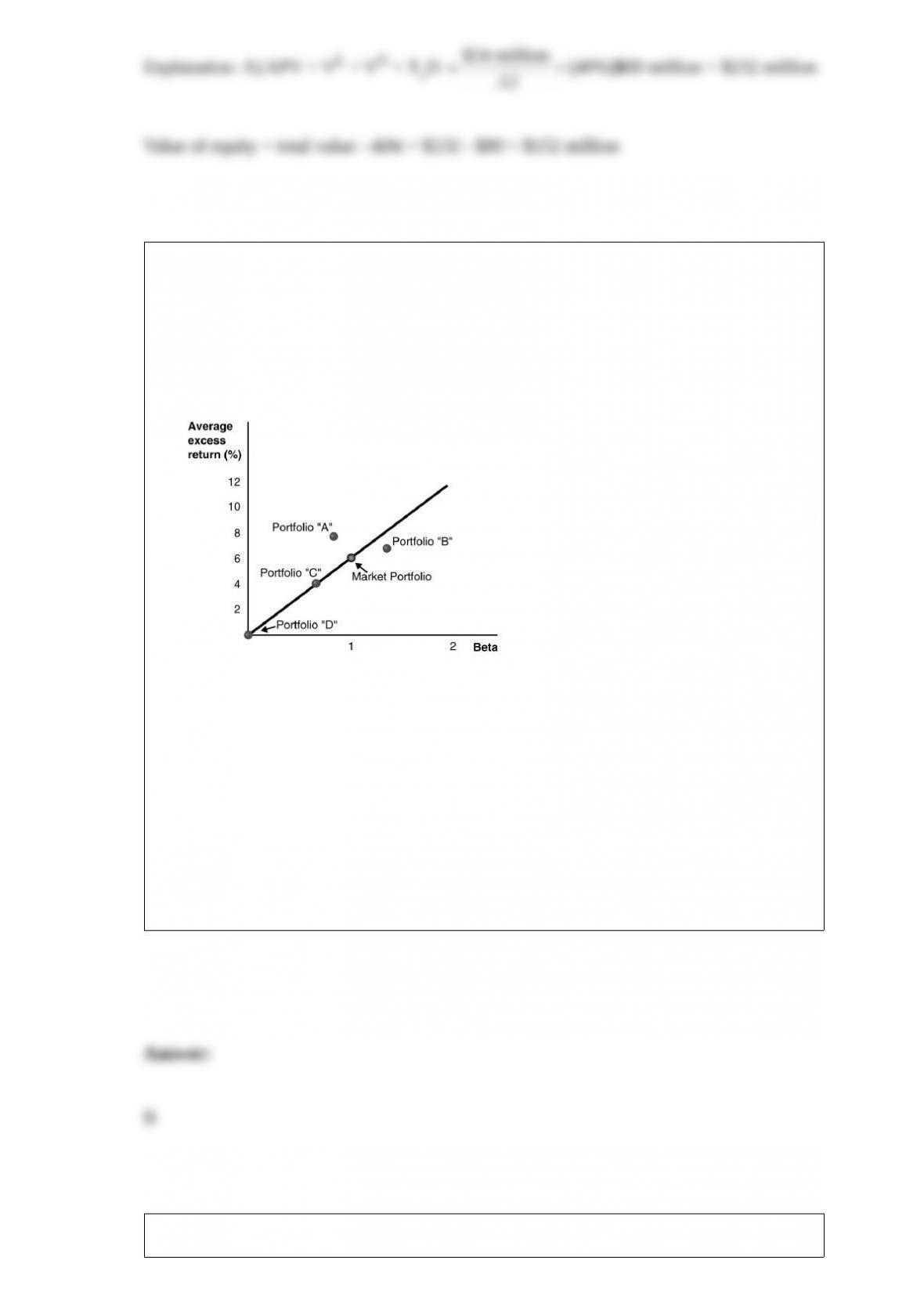
Use the figure for the question(s) below.
Consider the following graph of the security market line:
Portfolio “B”
A) is less risky than the market portfolio.
B) is overpriced.
C) has a positive alpha.
D) falls above the SML.
Consider the following timeline detailing a stream of cash flows:

If the current market rate of interest is 10%, then the present value of this stream of
cash flows is closest to:
A) $674
B) $600
C) $460
D) $287
Consider the following two projects:
Assume that projects Alpha and Beta are mutually exclusive. The correct investment
decision and the best rational for that decision is to
A) invest in project Beta since NPVBeta > 0.

B) invest in project Alpha since NPVBeta < NPVAlpha.
C) invest in project Beta since IRRB > IRRA.
D) invest in project Beta since NPVBeta > NPVAlpha > 0.

Which of the following statements is false?
A) It is not actually necessary to identify the efficient portfolio itself. All that is required
is to identify a collection of portfolios from which the efficient portfolio can be
constructed.
B) Although we might not be able to identify the efficient portfolio itself, we know
some characteristics of the efficient portfolio.
C) An efficient portfolio can be constructed from other diversified portfolios.
D) An efficient portfolio need not be well diversified.
The price today of a 4 year default free security with a face value of $1000 and an
annual coupon rate of 5.25% is closest to:
A) $1000
B) $1003
C) $1008
D) $987

Use the information for the question(s) below.
The current spot exchange rate, S, is $1.8862/. Suppose that the yield curve in both
countries is flat. The risk-free rate on dollars, r$, is 5.35% and the risk-free interest rat
on pounds, r, is 4.80%.
Using the covered interest parity condition, the calculated three-year forward rate F3 is
closest to:
A) $1.8568/
B) $1.9161/
C) $1.8961/
D) $1.8764/
Mortgages that do not meet certain credit criteria and have a high probability of default
are know as ________ mortgages.
A) prepayment

B) pooled
C) under-water
D) subprime
A loan agreement requires that the firm pay interest on the loan and pay back the
principal in one lump sum at the end of the loan is called
A) a short-term mortgage loan.
B) a single, end-of-period-payment loan.
C) a bridge loan.
D) a line of credit.
Which of the following cash flows are relevant incremental cash flows for a project that
you are currently considering investing in?
A) The tax savings brought about by the project’s depreciation expense
B) The cost of a marketing survey you conducted to determine demand for the proposed
project
C) Interest payments on debt used to finance the project
D) Research and Development expenditures you have made
Use the information for the question(s) below.
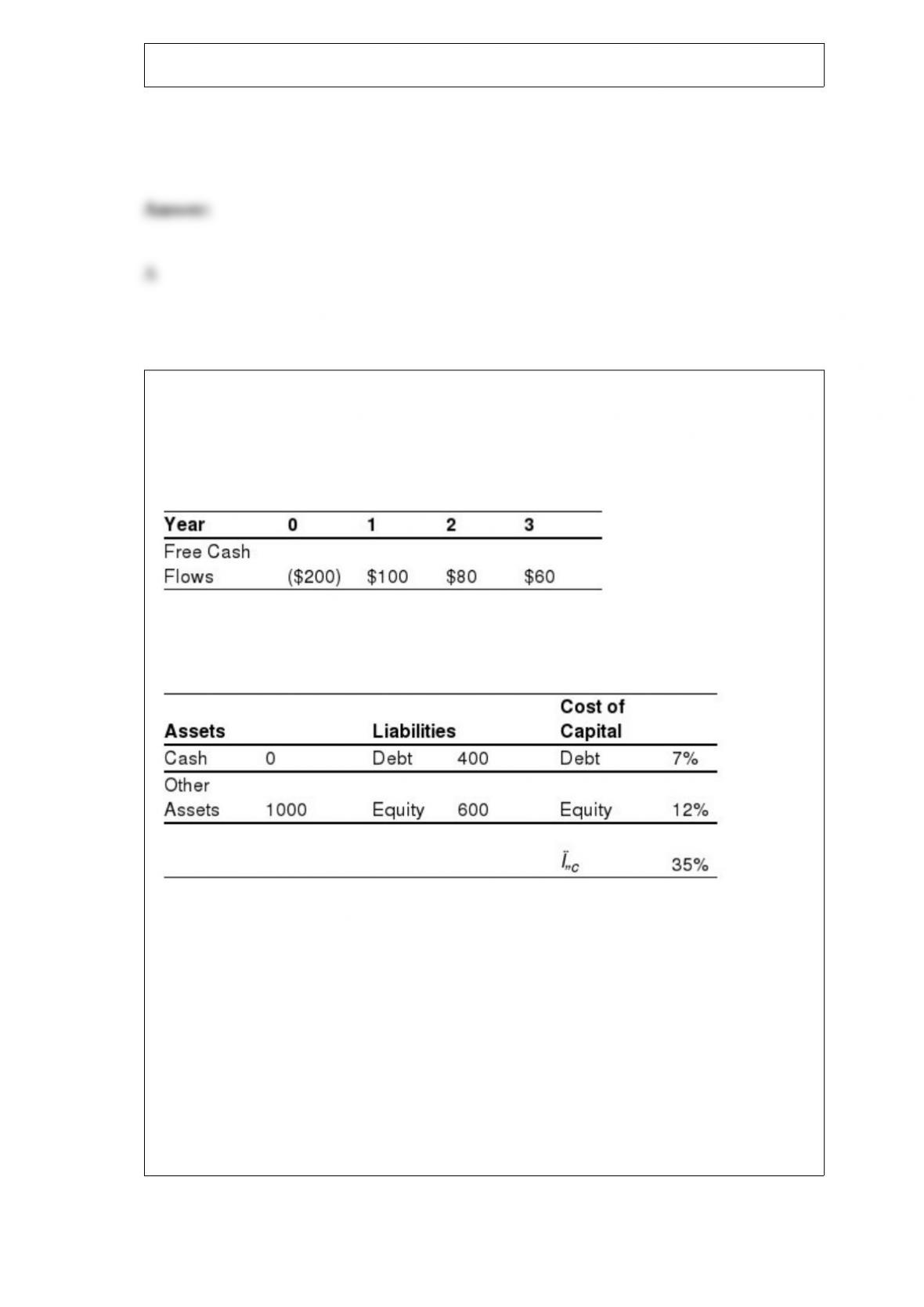
Aardvark Industries is considering a project that will generate the following free cash
flows:
You are also provided with the following market value balance sheet and information
regarding Aardvark’s cost of capital:
Suppose that to fund this new project, Aardvark borrows $120 with the principal to be
paid in three equal installments at the end each year. The levered value of Aardvark’s
new project is closest to:
A) $210.15
B) $207.35
C) $207.00
D) $210.50

An exploration of the effect on NPV of changing multiple project parameters is called
A) scenario analysis.
B) IRR analysis.
C) accounting break-even analysis.
D) sensitivity analysis.

Which of the following statements is false?
A) The Cadbury Commission stiffened the criminal penalties for providing false
information to shareholders.
B) The Exchange Acts of 1933 and 1934, among other things, established the Securities
and Exchange Commission (SEC) and prohibited trading on private information gained
as an insider of a firm.
C) Many of the problems at Enron, WorldCom, and elsewhere were kept hidden from
boards and shareholders until it was too late. In the wake of these scandals, many
people felt that the accounting statements of these companies, while often remaining
true to the letter of GAAP, did not present an accurate picture of the financial health of
a company.
D) While one study found that those firms that separated the position of CEO and
chairman performed better, another found no relation between the independence of key
board committees and firm performance in the post-Cadbury era.
Which of the following statements is false?
A) Many countries regulate or limit capital inflows or outflows, and many do not allow
their currencies to be freely converted into dollars, thereby creating capital market
segmentation.
B) The existence of internationally integrated capital markets makes many decisions in
international corporate finance more complicated but potentially more lucrative for a
firm that is well positioned to exploit the market segmentation.
C) Political, legal, social, and cultural characteristics that differ across countries may
require compensation in the form of a country risk premium.
D) Swaps allow firms to mitigate their exchange rate risk exposure between assets and
liabilities, while still making investments and raising funds in the most attractive
locales.

Which of the following statements is false?
A) If firms smooth dividends, the firm’s dividend choice will contain information
regarding management’s expectations of future earnings.
B) Because of the increasing popularity of repurchases, firms cut dividends much more
frequently than they increase them.
C) Announcing a share repurchase today does not necessarily represent a long-term
commitment to repurchase shares.
D) While cutting the dividend is costly for managers in terms of their reputation and the
reaction of investors, it is by no means as costly as failing to make debt payments.
Which of the following statements is false?
A) The tangent portfolio is efficient and that, once we include the risk-free investment,
all efficient portfolios are combinations of the risk-free investment and the tangent
portfolio.
B) The optimal portfolio of risky investments depends on how conservative or
aggressive the investor is.

C) By combining the efficient portfolio with the risk-free investment, an investor will
earn the highest possible expected return for any level of volatility her or she is willing
to bear.
D) The efficient portfolio is the tangent portfolio, the portfolio with the highest Sharpe
ratio in the economy.
If Ford Motor Company bought The Goodyear Tire & Rubber Company, this would be
an example of a ________ merger.
A) conglomerate
B) vertical
C) horizontal
D) diagonal
Use the following information to answer the question(s) below.
Rearden Metal imports ore from South America. Rearden Metal is worried that the
South American mines may enter into a long-term contract with the Chinese to sell all
of their ore output to China, hence cutting off Rearden Metal’s supply. In the event of
such a contract with the Chinese, Rearden Metal will face much higher costs for its raw
materials causing its operating profits to decline substantially and its marginal tax rate

to fall from its current level of 35% down to 10%. An insurance firm has agreed to
write a trade insurance policy that will pay Rearden Metal $2,500,000 in the event of
the South American supply of ore being cut off. The chance of the South American
supply being cut off is estimated to be 20%, with a beta of -2.0. The risk-free rate of
interest is 4% and the return on the market is estimated to be 12%.
Rearden’s NPV for purchasing this policy is closest to:
A) $32,500
B) $56,750
C) $142,000
D) $156,250
Consider the following tax rates:

*The current tax rates are set to expire in 2008 unless Congress extends them. The tax
rates shown are for financial assets held for one year. For assets held less than one year,
capital gains are taxed at the ordinary income tax rate (currently 35% for the highest
bracket); the same is true for dividends if the assets are held for less than 61 days.
In 2006, Luther Incorporated paid a special dividend of $5 per share for the 100 million
shares outstanding. If Luther has instead retained that cash permanently and invested it
into treasury bills earning 6%, then the present value of the additional taxes paid by
Luther would be closest to:
A) $35 million
B) $290 million
C) $175 million
D) $585 million
Which of the following statements is false?
A) When a holder of an option enforces the agreement and buys or sells a share of stock
at the agreed-upon price, he is exercisingthe option.

B) There are two kinds of options. European options allow their holders to exercise the
option on any date up to and including a final date called the expiration date.
C) Because an option is a contract between two parties, for every owner of a financial
option, there is also an option writer, the person who takes the other side of the contract.
D) The price at which the holder buys or sells the share of stock when the option is
exercised is called the strike priceor exercise price.
A 4 year default free security with a face value of $1000 and an annual coupon rate of
5.25% will trade
A) at a premium.
B) at par.
C) at a discount.
D) There is insufficient information provided to answer this question.

Which of the following statements is false?
A) Controlling shareholders pay for their control rights because the firm effectively
faces a higher cost of equity for outside capital.
B) Most countries follow what is called the stakeholder model, giving explicit
consideration to other stakeholdersin particular, rank-and-file employees.
C) In a pyramid structure, a family first creates a company in which it owns more than
50% of the shares and therefore has a controlling interest.
D) A conflict of interest arises because the family has an incentive to try to move profits
(and hence dividends) down the pyramidthat is, toward companies in which it has few
cash flow rights and away firms in which it has more cash flow rights.
Floyd Ferris invested $3,000 into an account five years ago. Today his account has
grown to have a balance of $3,927.50. Given that his account offered monthly
compounding of interest, the APR on this account is was closest to:
A) 5.00%
B) 5.25%
C) 5.40%
D) 5.54%

You are considering adding a microbrewery on to one of your firm’s existing
restaurants. This will entail an investment of $40,000 in new equipment. This
equipment will be depreciated straight line over five years. If your firm’s marginal
corporate tax rate is 35%, then what is the value of the microbrewery’s depreciation tax
shield in the first year of operation?
A) $2,800
B) $14,000
C) $5,200
D) $26,000
You are a risk manager for Security First Trust Savings and Loan (SFTSL). SFTSL’s
balance sheet is as follows (in millions of dollars):

The duration of the auto loans is three years and the duration of the mortgages is eight
years. Both cash reserves and checking and savings have zero duration. The CDs have a
duration of two years and the long-term financing has a ten year duration.
If interest rates are currently 5%, but fall to 4%, your estimate of the approximate
change in SFTSL equity is closest to:
A) 8% decrease
B) 12% decrease
C) 8% increase
D) 14% increase

Your firm is considering building a new office complex. Your firm already owns land
suitable for the new complex. The current book value of the land is $100,000, however
a commercial real estate again has informed you that an outside buyer is interested in
purchasing this land and would be willing to pay $650,000 for it. When calculating the
NPV of your new office complex, ignoring taxes, the appropriate incremental cash flow
for the use of this land is:
A) $650,000
B) $0
C) $100,000
D) $750,000
Use the information for the question(s) below.
The Aardvark Corporation is considering launching a new product and is trying to
determine an appropriate discount rate for evaluating this new product. Aardvark has
identified the following information for three single division firms that offer products
similar to the one Aardvark is interested in launching:
The unlevered cost of capital for Armadillo Industries is closest to:
A) 10.3%
B) 10.1%
C) 9.5%
D) 9.9%
Use the equation for the question(s) below.
Consider the following regression model:
Rs – rf = as + (RF1 – rf) + (RF2 – rf) + e
The term is a(n)

A) measure of the expected percent change in the excess return of a security for a 1%
change in the excess return of the second factor portfolio.
B) error term that has an expectation of zero and is uncorrelated with either factor.
C) constant term.
D) measure of the expected percent change in the excess return of a security for a 1%
change in the excess return of the first factor portfolio.
Cash is a
A) Long-term Asset.
B) Current Asset.
C) Current Liability.
D) Long-term Liability.