Assume you own a portfolio of diverse securities which are each correctly priced.
Given this, the reward-to-risk ratio:
A. for the portfolio must equal 1.0.
B. for the portfolio must be less than the market risk premium.
C. for each security must equal zero.
D. of each security is equal to the risk-free rate.
E. of each security must equal the slope of the security market line.
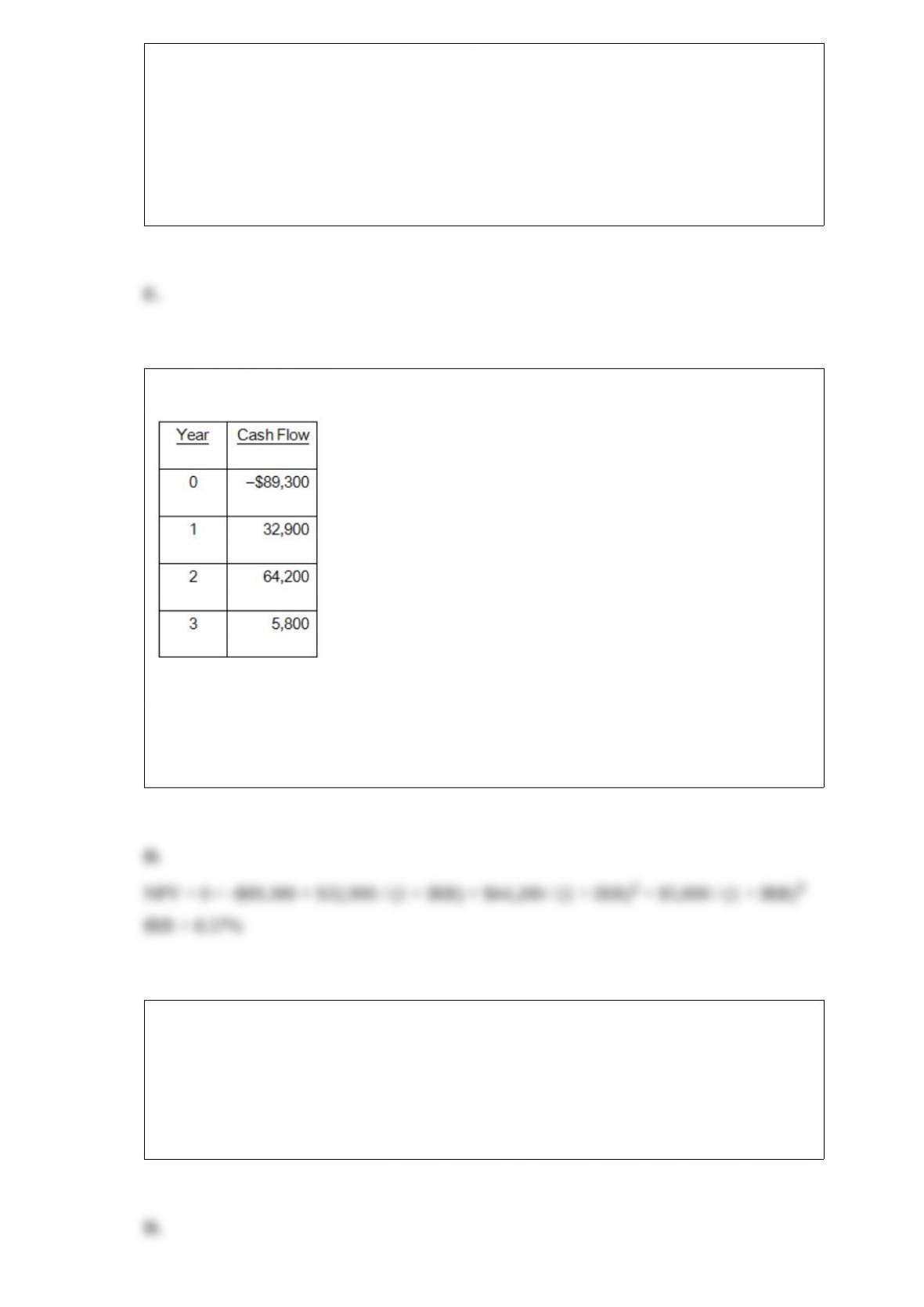
A project has the following cash flows. What is the internal rate of return?
A. 11.21 percent
B. 10.47 percent
C. 10.72 percent
D. 8.57 percent
E. 9.19 percent
The net working capital invested in a project is generally:
A. a sunk cost.
B. an opportunity cost.
C. recouped in the first year of the project.
D. recouped at the end of the project.
E. depreciated to a zero balance over the life of the project.

Which one of the following represents the amount of compensation an investor should
expect to receive for accepting the unsystematic risk associated with an individual
security?
A. Security beta multiplied by the market rate of return
B. Market risk premium
C. Security beta multiplied by the market risk premium
D. Risk-free rate of return
E. Zero
Which type of financing is generally used by new car dealers to finance their
inventories?
A. Blanket inventory lien arrangement
B. Trust receipt loans
C. Committed line of credit
D. Trade credit financing
E. Field warehousing financing
Today, you are buying a $1,000 face value bond at an invoice price of $987. The bond
has a coupon rate of 6 percent and pays interest semiannually. There are two months
until the next coupon date. What is the clean price of this bond?
A. $947
B. $957
C. $967
D. $977
E. $987
The potential conflict of interest between a firm’s owners and its managers is referred to
as which type of conflict?
A. Organizational

B. Structural
C. Formative
D. Agency
E. Territorial
Which one of the following is the maximum growth rate that a firm can achieve without
any additional external financing?
A. DuPont rate
B. External growth rate
C. Sustainable growth rate
D. Internal growth rate
E. Cash flow rate
Which one of the following is the minimum required rate of return on a new investment
that makes that investment attractive?
A. Risk-free rate
B. Market risk premium
C. Expected return minus the risk-free rate
D. Market rate of return
E. Cost of capital
Which one of the following is true if the managers of a firm accept only projects that
have a profitability index greater than 1.5?
A. The firm should increase in value each time it accepts a new project.
B. The firm is most likely steadily losing value.
C. The price of the firm’s stock should remain constant.
D. The net present value of each new project is zero.
E. The internal rate of return on each new project is zero.

Which one of the following indicates that a project should be rejected? Assume the cash
flows are normal, i.e., the initial cash flow is negative.
A. Average accounting return that exceeds the requirement
B. Payback period that is shorter than the requirement period
C. Positive net present value
D. Profitability index less than 1.0
E. Internal rate of return that exceeds the required return
A bond has a yield to maturity of 9.38 percent, a coupon of 7.5 percent paid
semiannually, a $1,000 face value, and a maturity date 21 years from today. What is the
current yield?
A. 7.91 percent
B. 8.47 percent
C. 9.05 percent
D. 9.38 percent
E. 9.46 percent
Jamie is employed as a currency trader in the Japanese yen market. Her job falls into
which one of the following areas of finance?
A. International finance
B. Financial institutions
C. Corporate finance
D. Capital management
E. Personal finance

Piedmont Hotels is an all-equity firm with 48,000 shares of stock outstanding. The
stock has a beta of 1.19 and a standard deviation of 14.8 percent. The market risk
premium is 7.8 percent and the risk-free rate of return is 4.1 percent. The company is
considering a project that it considers riskier than its current operations so has assigned
an adjustment of 1.35 percent to the project’s discount rate. What should the firm set as
the required rate of return for the project?
A. 9.85 percent
B. 10.92 percent
C. 15.39 percent
D. 14.73 percent
E. 17.33 percent
Which of these occurs when interest rate parity exists between Countries A and B?
A. Country A investors are indifferent between risk-free investments in Countries A and
B.
B. Forward exchange rates for Countries A and B must be equal for all time periods.
C. Risk-free interest rates in Countries A and B must be equal.
D. Spot and forward exchange rates between the currencies of the two countries must
be equal.
E. Significant covered interest arbitrage opportunities between currencies of Countries
A and B must exist.
It takes K’s Boutique an average of 53 days to sell its inventory and an average of 16.8
days to collect its accounts receivable. The firm has sales of $942,300 and costs of
goods sold of $692,800. What is the accounts receivable turnover rate? Assume a
365-day year.
A. 23.69
B. 11.41
C. 21.73
D. 24.23
E. 19.55

The transaction motive refers to the need to hold cash:
A. as a safety margin.
B. for unforeseen investment opportunities.
C. for daily operations.
D. as a financial reserve.
E. for emergency situations.
The rate of return on which one of the following has a risk premium of 0%?
A. Long-term government bonds
B. Long-term corporate bonds
C. Intermediate-term government bonds
D. U.S. Treasury bills
E. Large-company stocks
Vegan Delite stock is valued at $68.60 a share. The company pays a constant annual
dividend of $2.40 per share. What is the total return on this stock?
A. 3.62 percent
B. 4.00 percent
C. 3.50 percent
D. 3.39 percent
E. 3.82 percent
JLT is a mature manufacturing firm. The company just paid an annual dividend of
$3.62, but management expects to reduce future payouts by 3.5 percent per year,
indefinitely. What is this stock worth today at a required return of 12.5 percent?
A. $21.42
B. $21.83
C. $20.24

D. $23.56
E. $20.02
Which one of the following individuals is most apt to purchase a municipal bond?
A. Minimum-wage employee
B. Retired individual with minimal current income
C. Recent college graduate
D. Tax-exempt organization
E. Highly compensated business owner
Which of the following are important factors to consider when seeking a venture
capitalist?
I. Exit strategy
II. Management style
III. Personal contacts
IV. Financial strength
A. I and III only
B. II and IV only
C. III and IV only
D. II, III, and IV only
E. I, II, III, and IV
Kurt will receive $1,200 a month for five years from an insurance settlement. The first
payment was received today. If he invests the full amount of each payment at a
guaranteed 6.15 percent rate, how much will he have saved at the end of the five years?
A. $76,003.18
B. $88,219.97
C. $91,388.71
D. $84,478.33
E. $95,115.16
Stock A has a beta of 1.09 while Stock B has a beta of .76 and an expected return of 8.2
percent. What is the expected return on Stock A if the risk-free rate is 4.6 percent and
both stocks have equal reward-to-risk premiums?
A. 11.12 percent
B. 8.07 percent
C. 9.76 percent
D. 10.89 percent
E. 11.73 percent
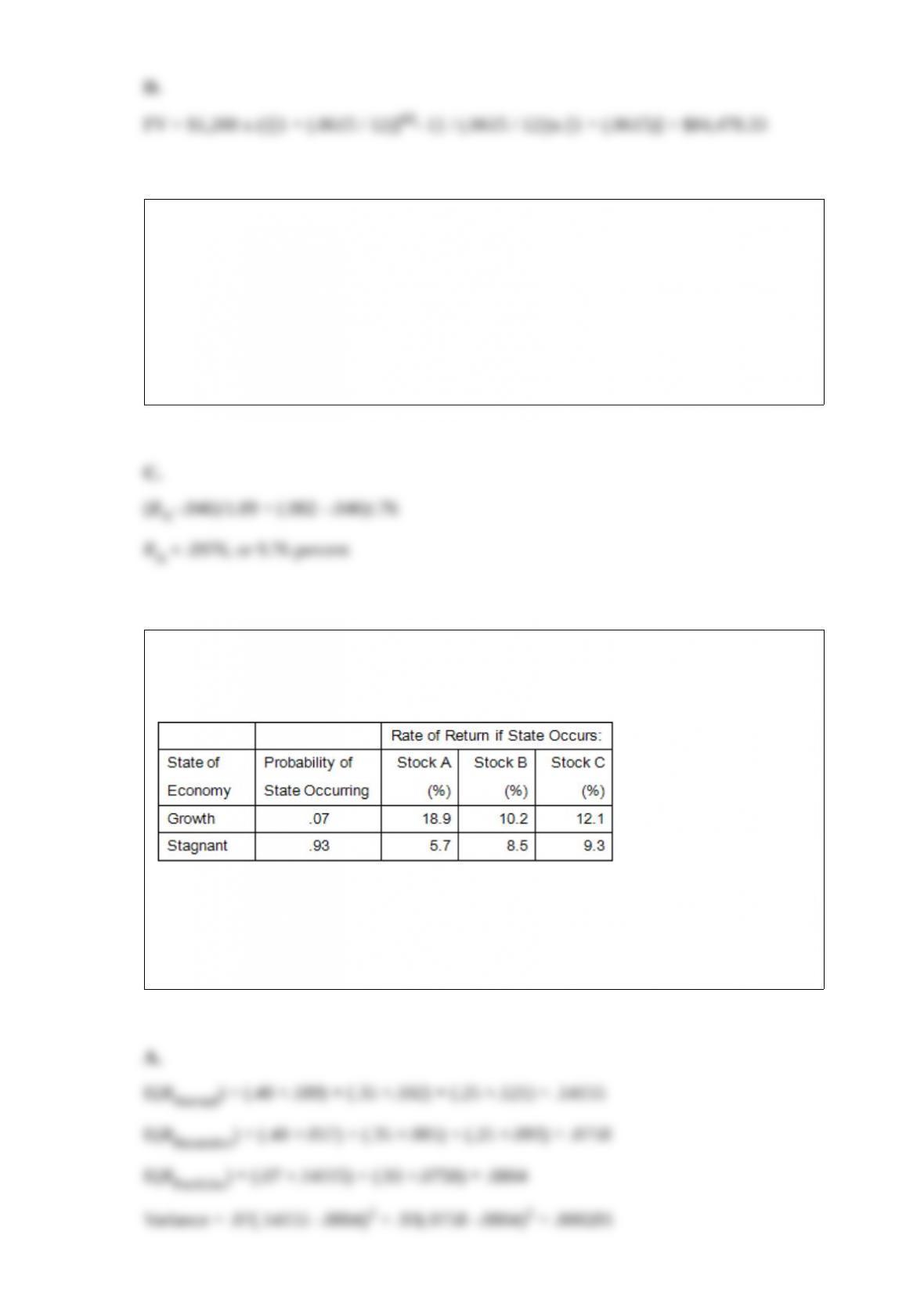
Given the following information, what is the standard deviation of the returns on a
portfolio that is invested 40 percent in Stock A, 35 percent in Stock B, and the
remainder in Stock C?
A. 1.68 percent
B. 6.72 percent
C. 3.16 percent
D. 2.43 percent
E. 16.57 percent

Three years ago, Stock Tek purchased some five-year MACRS property for $82,600.
Today, it is selling this property for $31,500. How much tax will the company owe on
this sale if the tax rate is 34 percent? The MACRS allowance percentages are as
follows, commencing with Year 1: 20.00, 32.00, 19.20, 11.52, 11.52, and 5.76 percent.
A. -$2,451.81
B. -$5,857.08
C. $0
D. $5,857.08
E. $2,621.81
The market where euros, pesos, dollars, and pounds are traded is referred to as the:
A. ADR market.
B. LIBOR market.
C. gilt market.
D. euromarket.
E. foreign exchange market.
You have $5,000 you want to invest for the next 45 years. You are offered an
investment plan that will pay you 6 percent per year for the next 15 years and 10
percent per year for the last 30 years. How much will you have at the end of the 45
years?
A. $201,516.38
B. $219,062.14
C. $209,092.54
D. $203,096.74
E. $221,408.97

An all-equity firm has a return on assets of 13.3 percent. The firm is considering
converting to a debt-equity ratio of .48. The pretax cost of debt is 8.6 percent. Ignoring
taxes, what will the cost of equity be if the firm switches to the levered capital
structure?
A. 16.01 percent
B. 15.28 percent
C. 16.60 percent
D. 17.03 percent
E. 15.56 percent
Which one of the following statements correctly applies to a sole proprietorship?
A. The business entity has an unlimited life.
B. The ownership can easily be transferred to another individual.
C. The owner enjoys limited liability for the firm’s debts.
D. Debt financing is easy to arrange in the firm’s name.
E. Obtaining additional equity is dependent on the owner’s personal finances.
The yield to maturity on a discount bond is:
A. equal to both the coupon rate and the current yield.
B. equal to the current yield but greater than the coupon rate.
C. greater than both the current yield and the coupon rate.
D. less than the current yield but greater than the coupon rate.
E. less than both the current yield and the coupon rate.
Which one of these has the least potential to increase the net present value of a
proposed investment? Assume the project has a positive net present value in at least one
set of circumstances.
A. Ability to wait until the economy improves before making the investment

B. Ability to immediately shut down a project should the project become unprofitable
C. Option to increase production beyond that initially projected
D. Option to place the investment on hold until a more favorable discount rate becomes
available
E. Option to discontinue a project at the end of its intended life