1) Mahler, Inc., applies manufacturing overhead at the rate of $40 per machine hour.
Budgeted machine hours for the current period were anticipated to be 120,000;
however, a lengthy strike resulted in actual machine hours being worked of only
90,000. Budgeted and actual manufacturing overhead figures for the year were
$4,800,000 and $4,180,000, respectively. On the basis of this information, the
company’s year-end overhead was:
A.overapplied by $580,000
B.underapplied by $580,000
C.overapplied by $1,200,000
D.underapplied by $1,200,000
E.underapplied by $900,000
2) Custom Plastics plans to purchase $4.5 million of equipment in the not-too-distant
future. The equipment will be depreciated by the optional straight-line method over the
MACRS life of 5 years. Custom is subject to a 30% income tax rate.
The company’s accountant is about to perform a net-present-value analysis, assuming a
10% after-tax hurdle rate.
Required:
A. Determine the discounted cash flows that would be reflected in the analysis in year 0
and year 1 .
B. Determine the discounted cash flow that would be reflected in the analysis in year 6,
assuming that Custom sells the equipment for $450,000,
3) The following questions explore the relationships between total and marginal
functions in the economic profit-maximizing (EPM) model:
A. The total revenue function rises over the range of operating activity portrayed in the
text. Why does the marginal revenue function decrease?
B. What is the behavior of the marginal cost curve?
C. In the EPM model, where is the profit-maximizing volume level? Explain.
4) Nguyen plans to sell 40,000 units of product no. 75 in June, and each of these units
requires five square feet of raw material. Pertinent data follow.
If the company purchases 201,000 square feet of raw material during the month, the
estimated raw-material inventory on June 30 would be:
A.11,000 square feet
B.13,000 square feet
C.23,000 square feet
D.25,000 square feet
E.None of the other answers are correct
5) If the amount of effort and attention to products varies substantially throughout a
company’s various manufacturing operations, the company might consider the use of:
A.a plant wide overhead rate
B.departmental overhead rates
C.actual overhead rates instead of predetermined overhead rates
D.direct labor hours to determine the overhead rate
E.machine hours to determine the overhead rate
6) Metro Corporation uses a predetermined overhead rate of $20 per machine hour. In
deriving this figure, the company’s accountant used:
A.a denominator of budgeted machine hours for the current accounting period
B.a denominator of actual machine hours for the current accounting period
C.a denominator of actual machine hours for the previous accounting period
D.a numerator of budgeted machine hours for the current accounting period
E.a numerator of actual machine hours for the current accounting period
7)
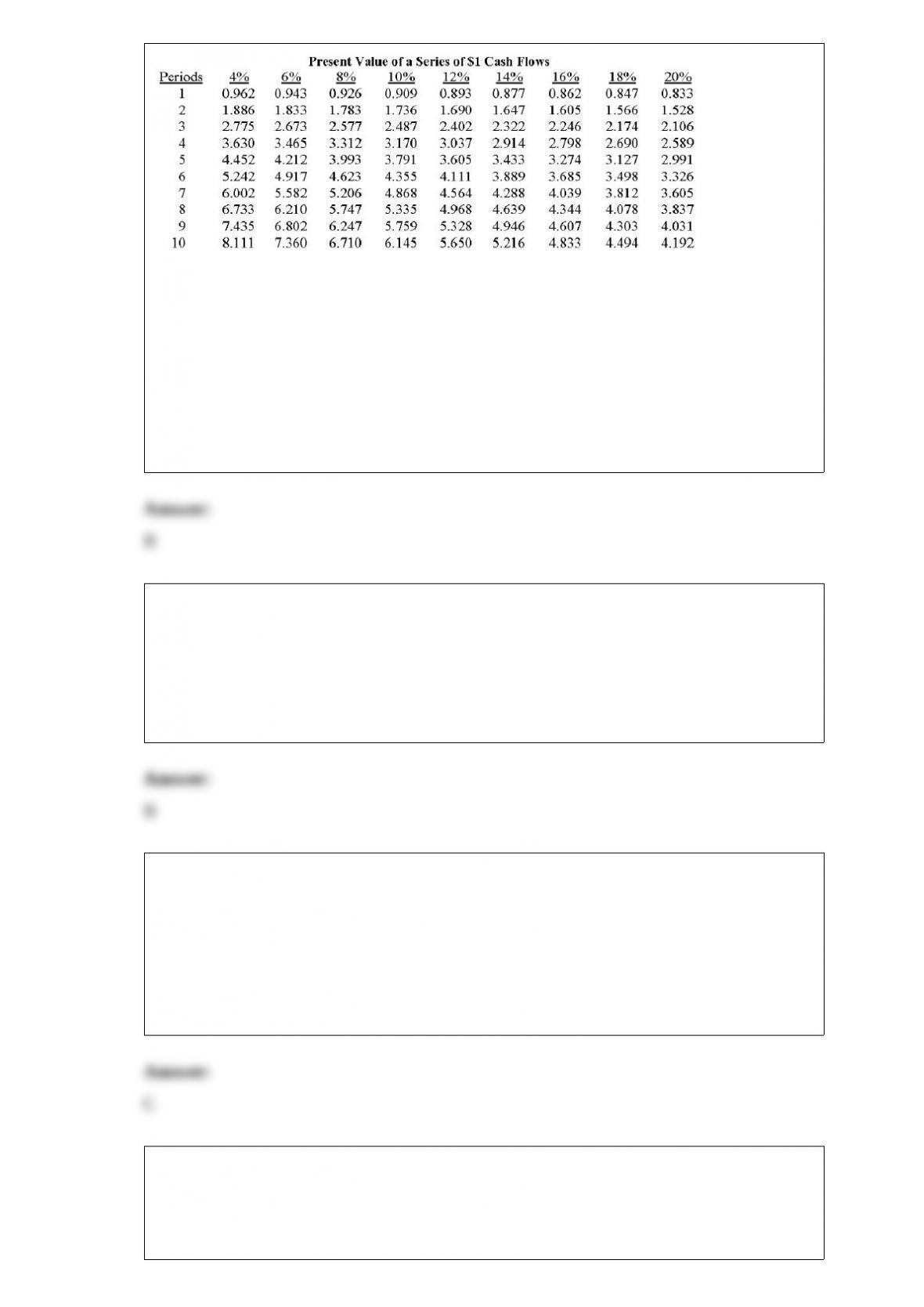
A machine costs $25,000; it is expected to generate annual cash revenues of $8,000 and
annual cash expenses of $2,000 for five years. The required rate of return is 12%. The
net present value of the machine is:
A.$(3,840)
B.$(3,370)
C.$0
D.$21,630
E.$28,840
8) The internal-rate-of-return method assumes that project funds are reinvested at the:
A.hurdle rate
B.rate of return earned on the project
C.cost of debt capital
D.cost of equity capital
E.rate of earnings growth (REG)
9) Which of the following expressions can be used to calculate break-even sales
revenue with the contribution-margin ratio (CMR)?
A.CMR fixed costs
B.CMR fixed costs
C.Fixed costs CMR
D.(Fixed costs + variable costs) CMR
E.(Sales revenue – variable costs) CMR
10) Product costs are:
A.expensed when incurred
B.inventoried
C.treated in the same manner as period costs
D.treated in the same manner as advertising costs
E.subtracted from cost of goods sold
11)
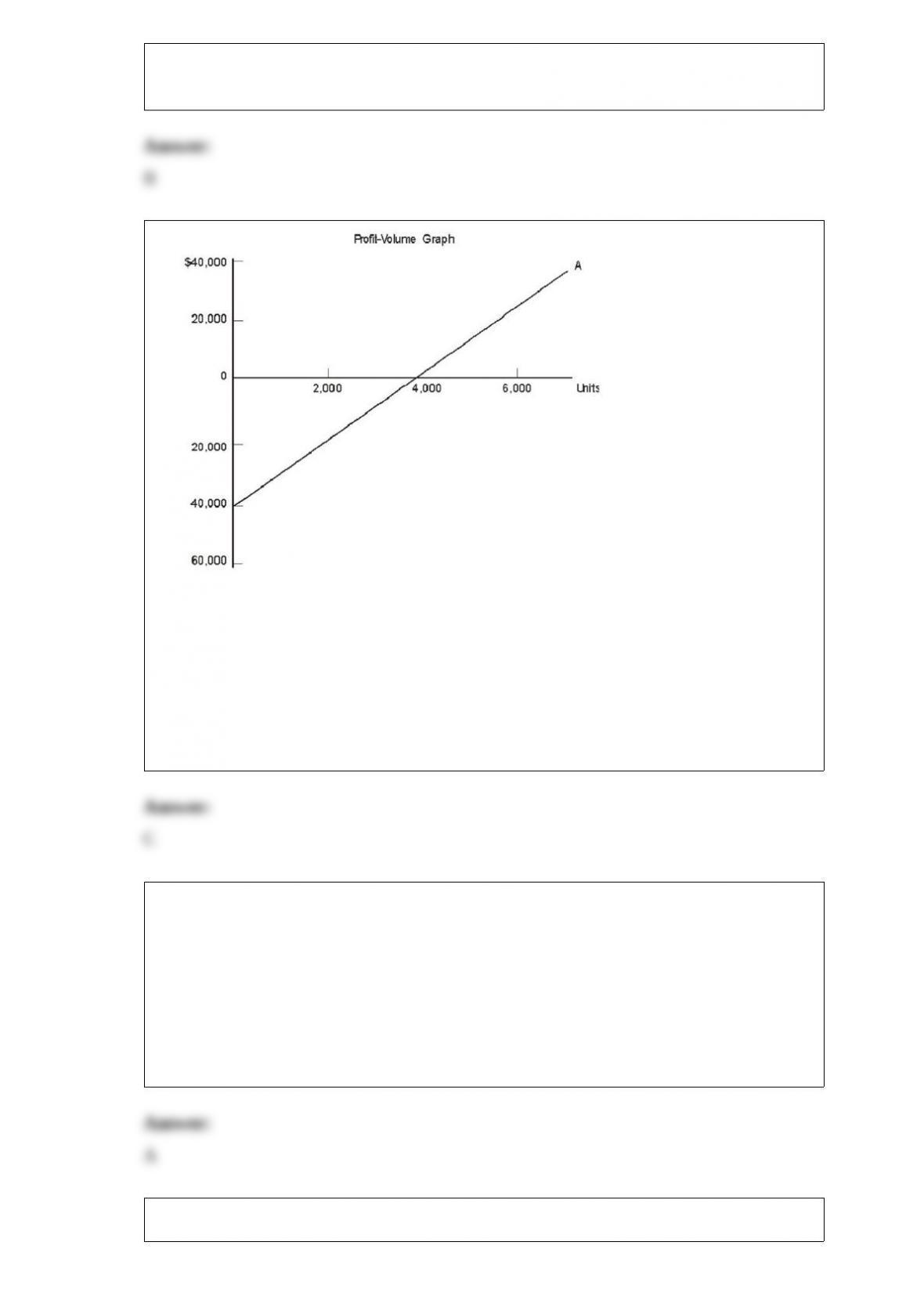
Refer to the figure above. The triangular area between the horizontal axis and Line A, to
the right of 4,000, represents:
A.fixed cost
B.variable cost
C.profit
D.loss
E.sales revenue
12) Glass Industries reported the following data for the year just ended: sales revenue,
$1,750,000; cost of goods sold, $980,000; cost of goods manufactured, $560,000; and
selling and administrative expenses, $170,000. Glass’ gross margin would be:
A.$940,000
B.$1,190,000
C.$1,020,000
D.$380,000
E.$770,000
13) Taylor Enterprises purchased 56,000 pounds (cost = $420,000) of direct material to
be used in the manufacture of the company’s sole product. According the production
specifications, each completed unit requires five pounds of direct material at a standard
cost of $7.80 per pound. Direct materials consumed by the end of the period totaled
53,500 pounds in the manufacture of 10,900 finished units.
An examination of Taylor’s payroll records revealed that the company worked 22,000
labor hours (cost = $319,000) during the period, and specifications called for each
completed unit requiring two hours of labor at a standard cost of $14.80 per hour.
Assume that the company computes variances at the earliest point in time.
Taylor’s direct-material price variance was:
A.$16,050F
B.$16,050U
C.$16,800F
D.$16,800U
E.none of the other answers are correct
14) When a company is analyzing a capital project by a discounted-cash-flow approach
and income taxes are being considered, depreciation:
A.should be ignored
B.should be considered because it results in a tax savings
C.should be considered because it is a fixed cost
D.should be considered because it is a cash inflow
E.should be considered because, like other expenses, it is a cash outlay related to
operations
15) A firm that decides to emphasize those goods with the highest contribution margin
per unit may have made an incorrect decision when the company:
A.is highly automated
B.has excess capacity
C.has capacity constraints in the form of limited resources
D.has a high fixed-cost structure
E.has a high level of sunk costs
16) The biggest challenge in making a decentralized organization function effectively
is:
A.earning maximum profits through fair practices
B.minimizing losses
C.taking advantage of the specialized knowledge and skills of highly talented managers
D.obtaining goal congruence among division managers
E.developing an adequate budgetary control system
17) Griswold, Inc., which uses a process-costing system, transfers completed
production from Department no. 1 to Department no. 2 for further work. Which of the
following best describes the account that would be debited to record this transfer?
A.Cost of Goods Transferred
B.Finished-Goods Inventory: Department no. 1
C.Finished-Goods Inventory: Department no. 2
D.Work-in-Process Inventory: Department no. 1
E.Work-in-Process Inventory: Department no. 2
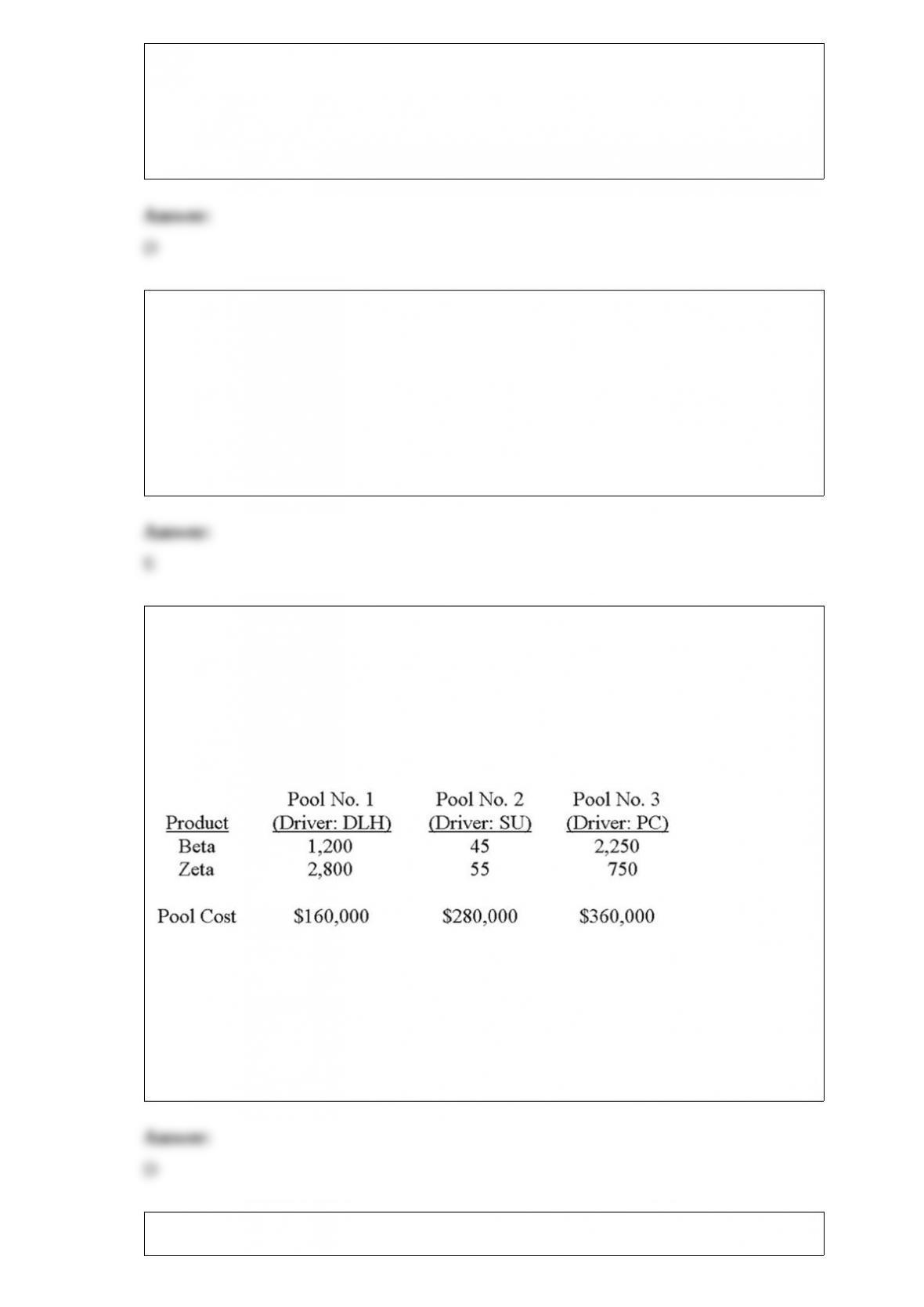
18) St. James, Inc., currently uses traditional costing procedures, applying $800,000 of
overhead to products Beta and Zeta on the basis of direct labor hours. The company is
considering a shift to activity-based costing and the creation of individual cost pools
that will use direct labor hours (DLH), production setups (SU), and number of parts
components (PC) as cost drivers. Data on the cost pools and respective driver volumes
follow.
The overhead cost allocated to Zeta by using traditional costing procedures would be:
A.$240,000
B.$356,000
C.$444,000
D.$560,000
E.None of the other answers is correct
19) Telfair & Company had 3,000 units in finished-goods inventory on December 31 .
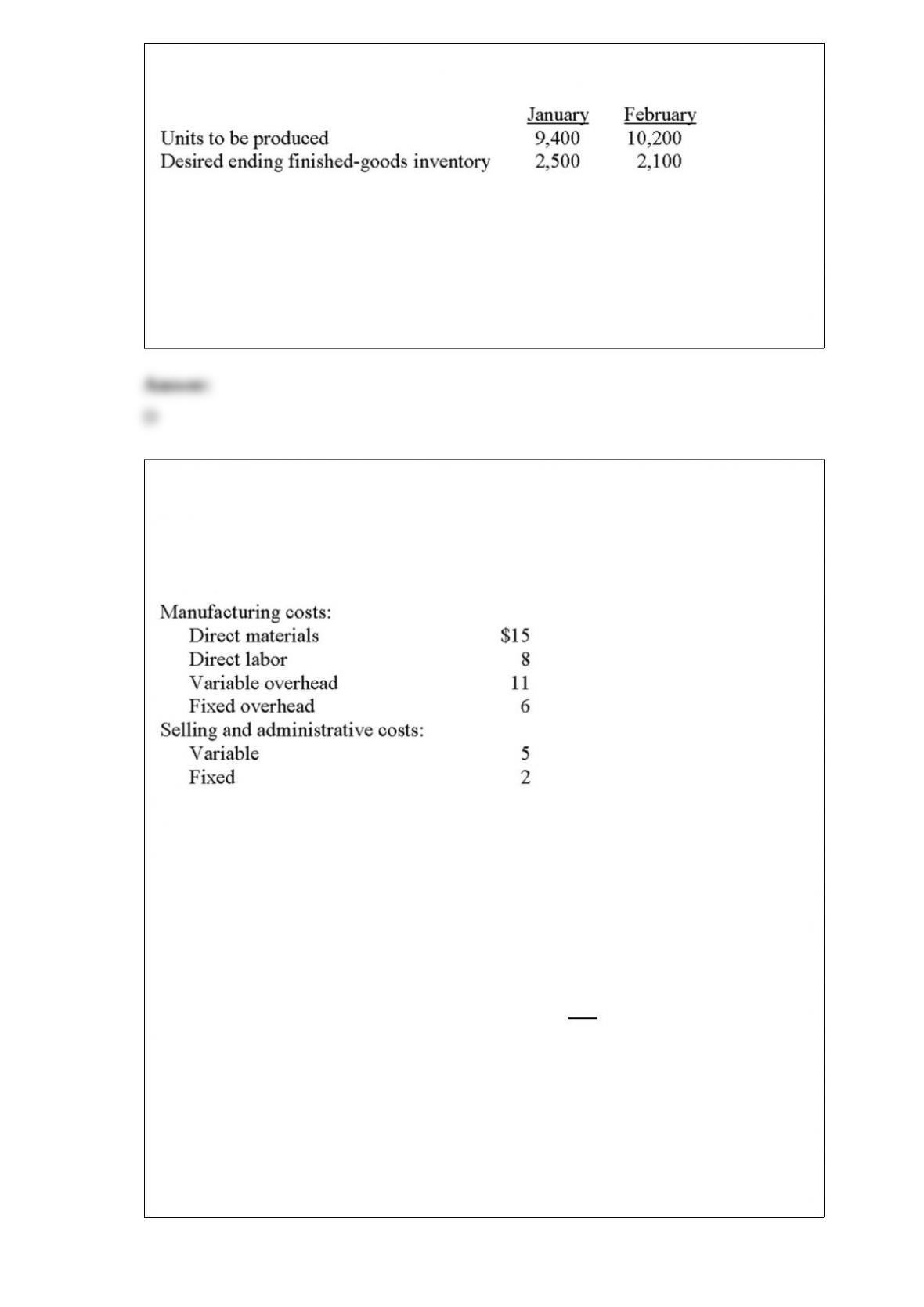
The following data are available for the upcoming year:
The number of units the company expects to sell in January is:
A.6,900
B.8,900
C.9,400
D.9,900
E.11,900
20) Giraldo Systems began business on January 1 of the current year, producing a
single product that is popular with home builders. Demand was very strong, allowing
the company to sell its entire manufacturing output of 80,000 units. The following unit
costs were incurred:
Giraldo anticipates an increase in productive output to 100,000 units and sales of
95,000 units in the next accounting period. The company uses appropriate drivers to
determine cost behavior and estimates.
Required:
A. Assuming that present cost behavior patterns continue, compute the total expected
costs in the upcoming accounting period.
B. Ben Levy is about to prepare a graph that shows the unit cost behavior for variable
selling and administrative cost. If the graph’s horizontal axis is volume and the vertical
axis is dollars, briefly describe what Levy’s graph should look like.
C. Determine whether the following costs are variable or fixed in terms of behavior:
1> Yearly lease payments for a state-of-the-art cutting machine.
2> A fee paid to a consultant who provided advice about quality issues. The fee was
based on the number of consulting hours provided.
3> Cost of an awards dinner for ‘star” salespeople.
21) Managerial accountants:
A.often work on cross-functional teams
B.are located throughout an organization
C.are found primarily at lower levels of the organizational hierarchy
D.are found primarily at higher levels of the organizational hierarchy
E.often work on cross-functional teams and are located throughout an organization
22) Generally speaking, companies prefer doing business with customers who:
A.order small quantities rather than large quantities
B.often change their orders
C.require special packaging or handling
D.request normal delivery times
E.need specialized engineering design changes
23) Management of Children Are Precious (CAP), an operator of day-care facilities,
wants the company’s profit to be subdivided by center. The firm’s accountant has
provided the following data:
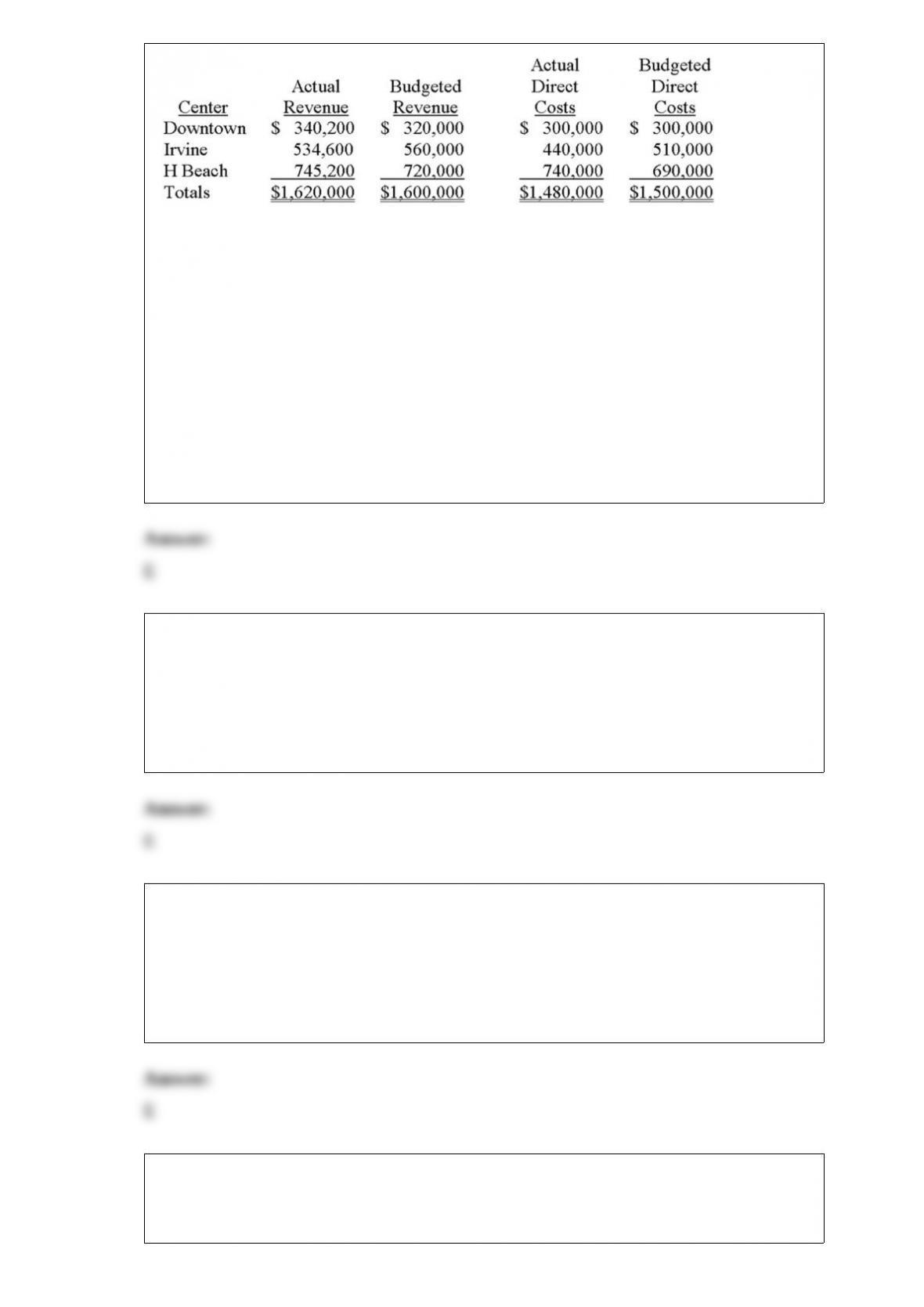
CAP’s advertising, which is handled by the home office, is not reflected in the
preceding figures and amounted to $60,000.
Assume that management used the allocation base that is most influenced by
advertising effort and consistent with sound managerial accounting practices. How
much advertising would be allocated to the Irvine center?
A.$17,838
B.$19,800
C.$20,000
D.$20,400
E.$21,000
24) Standard costs:
A.allow a manager to assess the efficiency of operations
B.allow a company to practice management by exception
C.provide management with a basis for performance evaluations
D.if set correctly, can provide a motivational tool for employees
E.all of the other answers are correct
25) The chief managerial and financial accountant of an organization is the:
A.chief executive officer (CEO)
B.treasurer
C.vice-president of accounting
D.internal auditor
E.chief financial officer (CFO)
26) The curve that shows the change in total revenue that accompanies a change in
quantity sold is called the:
A.marginal revenue curve
B.average cost curve
C.profit curve
D.demand curve
E.revenue curve
27) Section 404 of the Sarbanes-Oxley Act, Management Assessment of Internal
Controls, includes all of the following except:
A.A statement of management’s responsibility for establishing the internal control
structure
B.A waiver of auditor responsibility for assessing management’s report on internal
controls
C.An assessment of the effectiveness of internal controls by management
D.An assessment of the effectiveness of procedures for financial reporting by
management
E.A requirement that management include in its annual report an internal control report
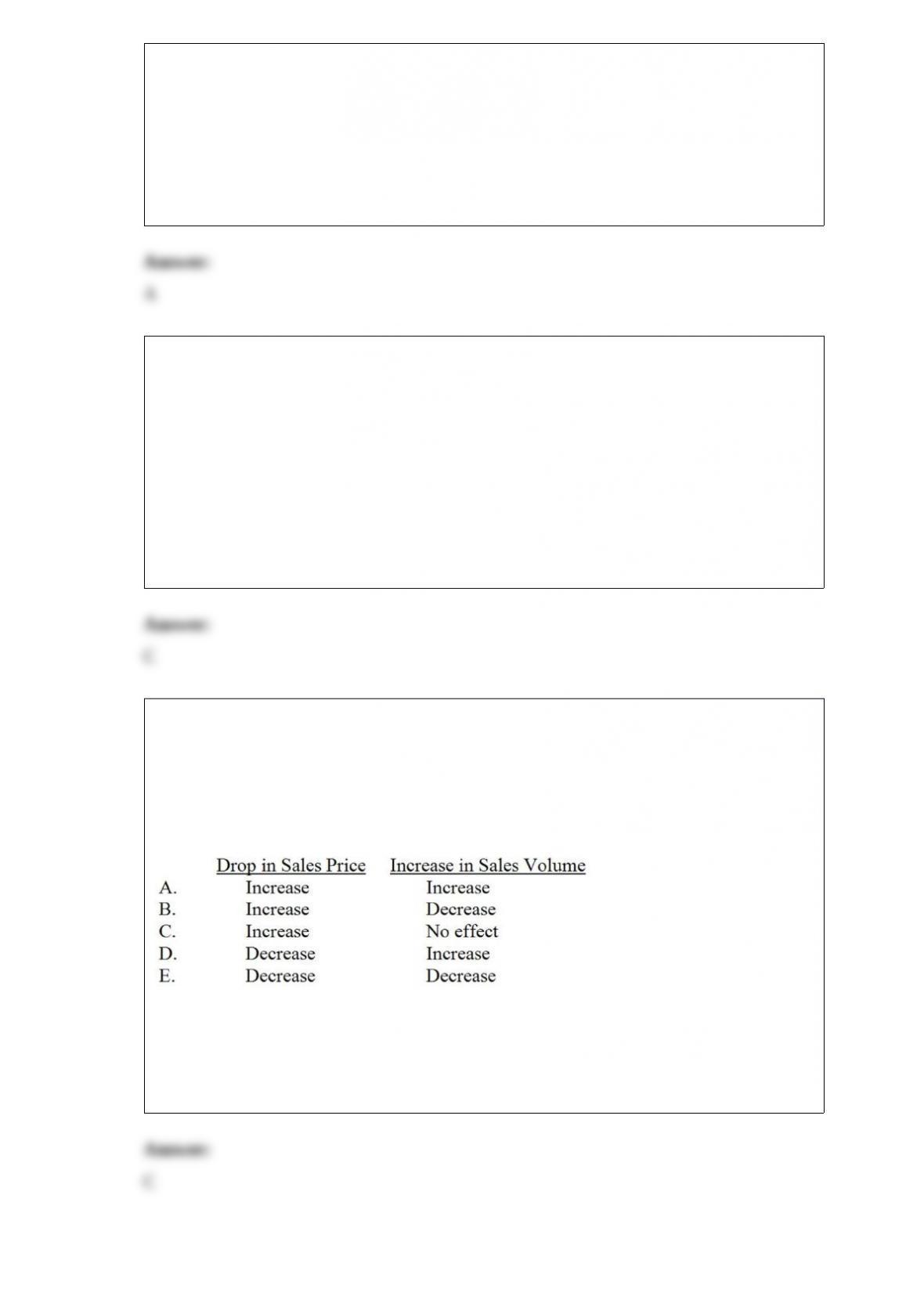
28) Hot’lanta, Inc., which uses the high-low method to analyze cost behavior, has
determined that machine hours best explain the company’s utilities cost. The company’s
relevant range of activity varies from a low of 600 machine hours to a high of 1,100
machine hours, with the following data being available for the first six months of the
year:
The fixed utilities cost per month is:
A.$3,764
B.$4,400
C.$4,760
D.$5,100
E.None of the other answers is correct
29) Which of the following terms describes a pricing strategy in which a new product’s
initial price is set relatively low in order to gain a large market share?
A.Penetration pricing
B.Price skimming
C.Customer pricing
D.Designed pricing
E.Market-share pricing
30) Gajewski began operations on January 1 of the current year. The company uses a
process-costing system, and conversion cost is incurred evenly throughout
manufacturing. By January 31, the firm had completed 56,000 units. Which of the
following statements is true about the ending work-in-process inventory if equivalent
units for conversion cost totaled 59,000 units?
A.There is no ending work-in-process inventory
B.The ending work-in-process inventory totaled 3,000 physical units
C.The ending work-in-process inventory of 10,000 physical units was 30% complete
D.The ending work-in-process inventory of 20,000 physical units was 85% complete
E.More than one of the other answers is true
31) Cleason sells a single product at $14 per unit. The firm’s most recent income
statement revealed unit sales of 80,000, variable costs of $800,000, and fixed costs of
$560,000. Management believes that a $3 drop in selling price will boost unit sales
volume by 20%. Which of the following correctly depicts how these two changes will
affect the company’s break-even point?
A.Choice A
B.Choice B
C.Choice C
D.Choice D
E.Choice E
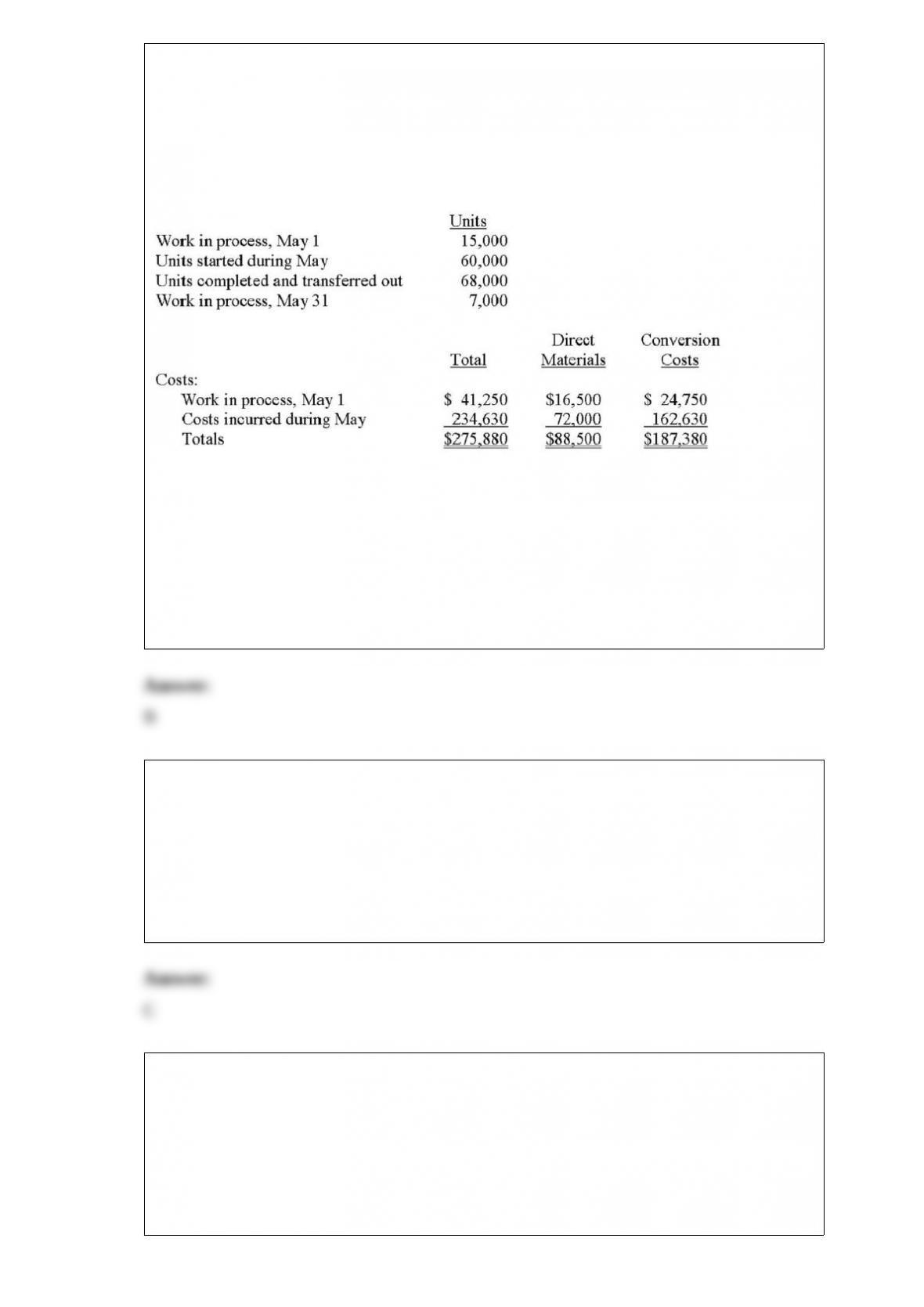
32) Southern Lake Chemical manufactures a product called Zubek. Direct materials are
added at the beginning of the process, and conversion activity occurs uniformly
throughout production. The beginning work-in-process inventory is 60% complete with
respect to conversion; the ending work-in-process inventory is 20% complete. The
following data pertain to May:
Using the weighted-average method of process costing, the total costs remaining in
work in process on May 31 are:
A.$0
B.$12,040
C.$17,480
D.$25,640
E.None of the answers is correct
33) A company observed a decrease in the cost per unit. All other things being equal,
which of the following is most likely true?
A.The company is studying a variable cost, and total volume has increased
B.The company is studying a variable cost, and total volume has decreased
C.The company is studying a fixed cost, and total volume has increased
D.The company is studying a fixed cost, and total volume has decreased
E.The company is studying a fixed cost, and total volume has remained constant
34) A variable cost that has a definitive physical relationship to the activity measure is
called a (n):
A.discretionary cost
B.engineered cost
C.managed cost
D.programmed cost
E.committed cost