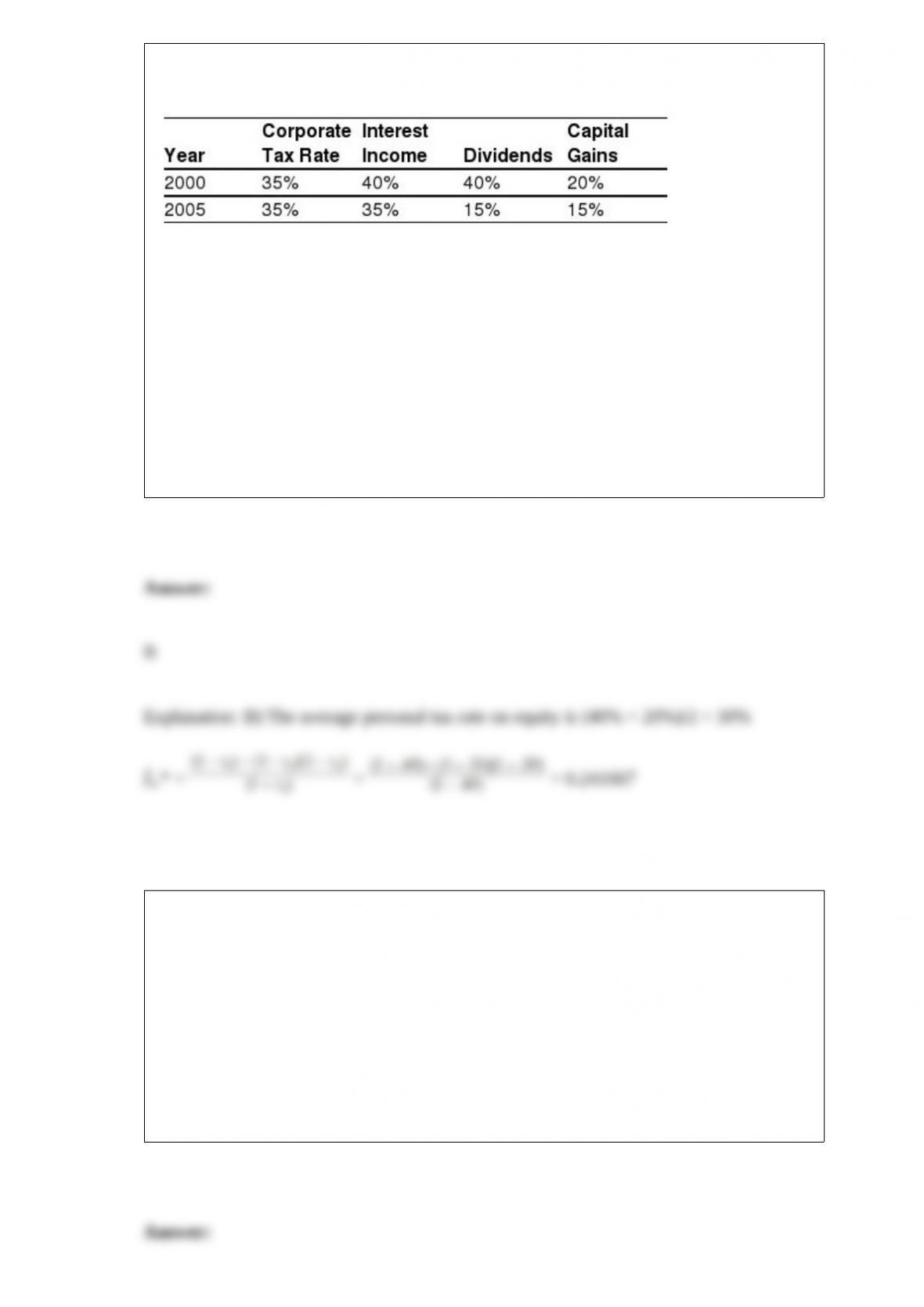
Consider the following top federal tax rates in the United States:
Personal Tax Rates
In 2000, assuming an average dividend payout ratio of 50%, the effective tax advantage
for debt (t*) was closest to:
A) 40%
B) 24%
C) 30%
D) 18%
You expect that Bean Enterprises will have earnings per share of $2 for the coming
year. Bean plans to retain all of its earnings for the next three years. For the subsequent
two years, the firm plans on retaining 50% of its earnings. It will then retain only 25%
of its earnings from that point forward. Retained earnings will be invested in projects
with an expected return of 20% per year. If Bean’s equity cost of capital is 12%, then
the price of a share of Bean’s stock is closest to:
A) $17.00
B) $10.75
C) $27.75
D) $43.50
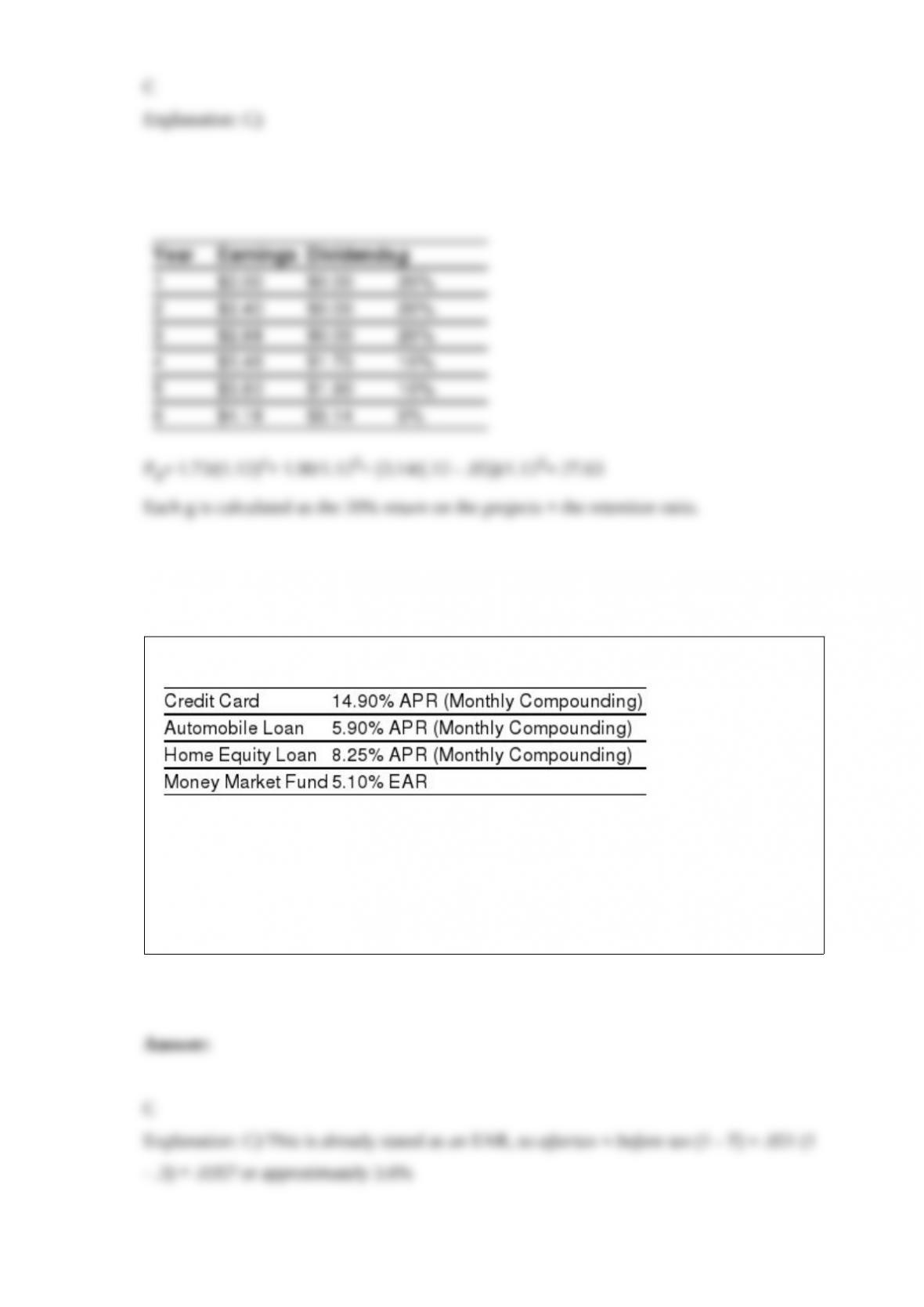
Suppose you have the following Loans/Investments
If your income tax rate is 30%, then the after-tax return you receive on your money
market fund is closest to:
A) 3.7%
B) 5.1%
C) 3.6%
D) 4.2%

The statement of financial performance is also known as the:
A) balance sheet.
B) income statement.
C) statement of cash flows.
D) statement of stockholder’s equity.
You are considering purchasing a new automobile that will cost you $28,000. The
dealer offers you 4.9% APR financing for 60 months (with payments made at the end of
the month). Assuming you finance the entire $28,000 and finance through the dealer,
your monthly payments will be closest to:
A) $1,454
B) $527
C) $467
D) $457
Assume that the economy has three types of people. 20% are fad followers, 75% are
passive investors, and 5% are informed traders. The portfolio consisting of all informed
traders has a beta of 1.4 and an expected return of 16%. The market has an expected
return of 10% and the risk-free rate is 4%.The alpha for the fad follower’s portfolio is

closest to:
A) -0.9%
B) 0.0%
C) 3.6%
D) 6.0%
Which of the following statements is FALSE?
A) The risk premium of any marketable security can be written as the sum of the risk
premium of each factor multiplied by the sensitivity of the stock with that factor.
B) The factor betas measure the sensitivity of the stock to a particular factor.
C) If we use more than one portfolio as factors, then together these factors will capture
systematic risk, but each factor captures different components of the systematic risk.
D) When we use more than one portfolio to capture risk, the model is known as a single
factor model.

Which of the following types of risk doesn’t belong?
A) Idiosyncratic risk
B) Undiversifiable risk
C) Market risk
D) Systematic risk
Assume that Rose Corporation’s (RC) EBIT is not expected to grow in the future and
that all earnings are paid out as dividends. RC is currently an all equity firm. It expects
to generate earnings before interest and taxes (EBIT) of $6 million over the next year.
Currently RC has 5 million shares outstanding and its stock is trading for a price of
$12.00 per share. RC is considering borrowing $12 million at a rate of 6% and using the
proceeds to repurchase shares at the current price of $12.00.
Prior to any borrowing and share repurchase, RC’s EPS is closest to:
A) $0.60
B) $1.00
C) $1.20
D) $0.50
What type of company trades on an organized stock exchange?
A) A limited liability company
B) A private company
C) An “S” corporation
D) A public company

Which of the following statements is FALSE?
A) On Nasdaq, stocks can and do have multiple market makers who compete with each
other. Each market maker must post bid and ask prices in the Nasdaq network where
they can be viewed by all participants.
B) Bid prices exceed ask prices.
C) Because customers always buy at the ask and sell at the bid, the bid-ask spread is a
transaction cost investors have to pay in order to trade.
D) On the floor of the NYSE, market makers (known on the NYSE as specialists)
match buyers and sellers.
Suppose that you currently have $250,000 invested in a portfolio with an expected
return of 12% and a volatility of 10%. The efficient (tangent) portfolio has an expected
return of 17% and a volatility of 12%. The risk-free rate of interest is 5%.
The Sharpe ratio for your portfolio is closest to:
A) 1.2
B) 0.6
C) 1.0
D) 0.7

You are considering investing in a security that will pay you $80 in interest at the end of
each of the next 10 years. If this security is currently selling for $588.81, then the IRR
for investing in this security is closest to:
A) 6.0%
B) 7.0%
C) 6.5%
D) 5.0%
Luther is a successful logistical services firm that currently has $5 billion in cash.
Luther has decided to use this cash to repurchase shares from its investors, and has
already announced the stock repurchase plan. Currently Luther is an all equity firm with
1.25 billion shares outstanding. Luther’s shares are currently trading at $20 per share.
After the repurchase how many shares will Luther have outstanding?
A) 0.75 billion
B) 1.0 billion
C) 1.1 billion
D) 1.2 billion

The owner of the Krusty Krab is considering selling his restaurant and retiring. An
investor has offered to buy the Krusty Krab for $350,000 whenever the owner is ready
for retirement. The owner is considering the following three alternatives:
1. Sell the restaurant now and retire.
2. Hire someone to manage the restaurant for the next year and retire. This will require
the owner to spend $50,000 now, but will generate $100,000 in profit next year. In one
year the owner will sell the restaurant.
3. Scale back the restaurant’s hours and ease into retirement over the next year. This will
require the owner to spend $40,000 on expenses now, but will generate $75,000 in
profit at the end of the year. In one year the owner will sell the restaurant.
If the discount rate is 15%, the alternative with the lowest NPV is:
A) #1 with an NPV of approximately $350,000
B) #2 with an NPV of approximately $341,300
C) #3 with an NPV of approximately $329,570
D) #2 with an NPV of approximately $400,000
E) None of the above
Galt Industries is expected to generate free cash flows of $24 million per year. Galt has
permanent debt of $80 million, a corporate tax rate of 40%, and an unlevered cost of
capital of 12% and its cost of debt capital is 6%.The value of Galt’s equity using the
APV method is closest to:
A) $150 million
B) $180 million
C) $230 million

D) $240 million
Suppose you invest $20,000 by purchasing 200 shares of Abbott Labs (ABT) at $50 per
share, 200 shares of Lowes (LOW) at $30 per share, and 100 shares of Ball Corporation
(BLL) at $40 per share.
The weight on Lowes in your portfolio is:
A) 40%
B) 20%
C) 50%
D) 30%
Consider the following Price and Dividend data for J. P. Morgan Chase:
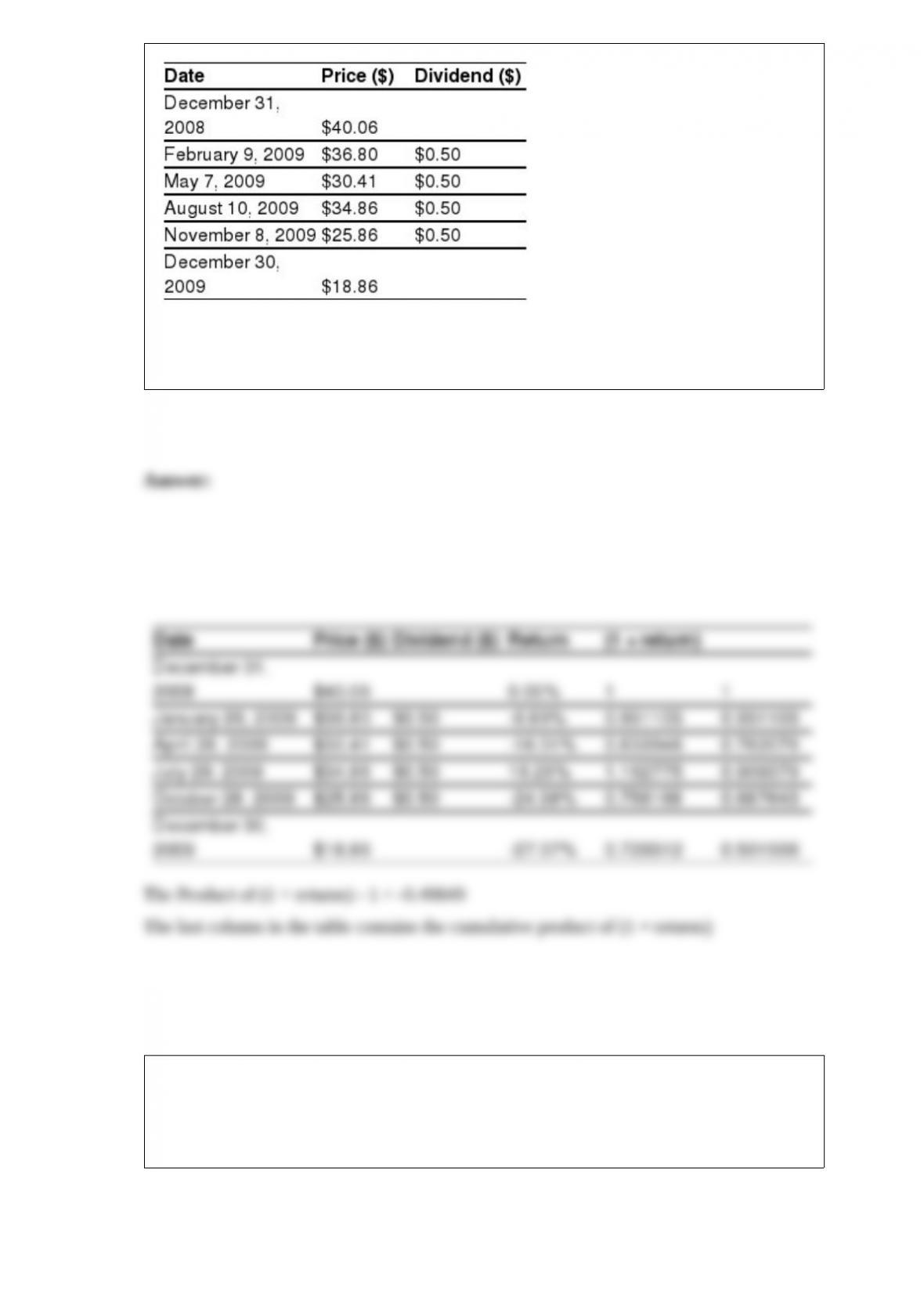
Assume that you purchased J. P. Morgan Chase stock at the closing price on December
31, 2008 and sold it at the closing price on December 30, 2009. Calculate your realized
annual return is for the year 2005.
Sisyphean Bolder Movers Incorporated has no debt, a total equity capitalization of $50
billion, and a beta of 2.0. Included in Sisyphean’s assets are $12 billion in cash and
risk-free securities. Calculate Sisyphean’s enterprise value and unlevered cost of equity
considering the fact that Sisyphean’s cash is risk-free.
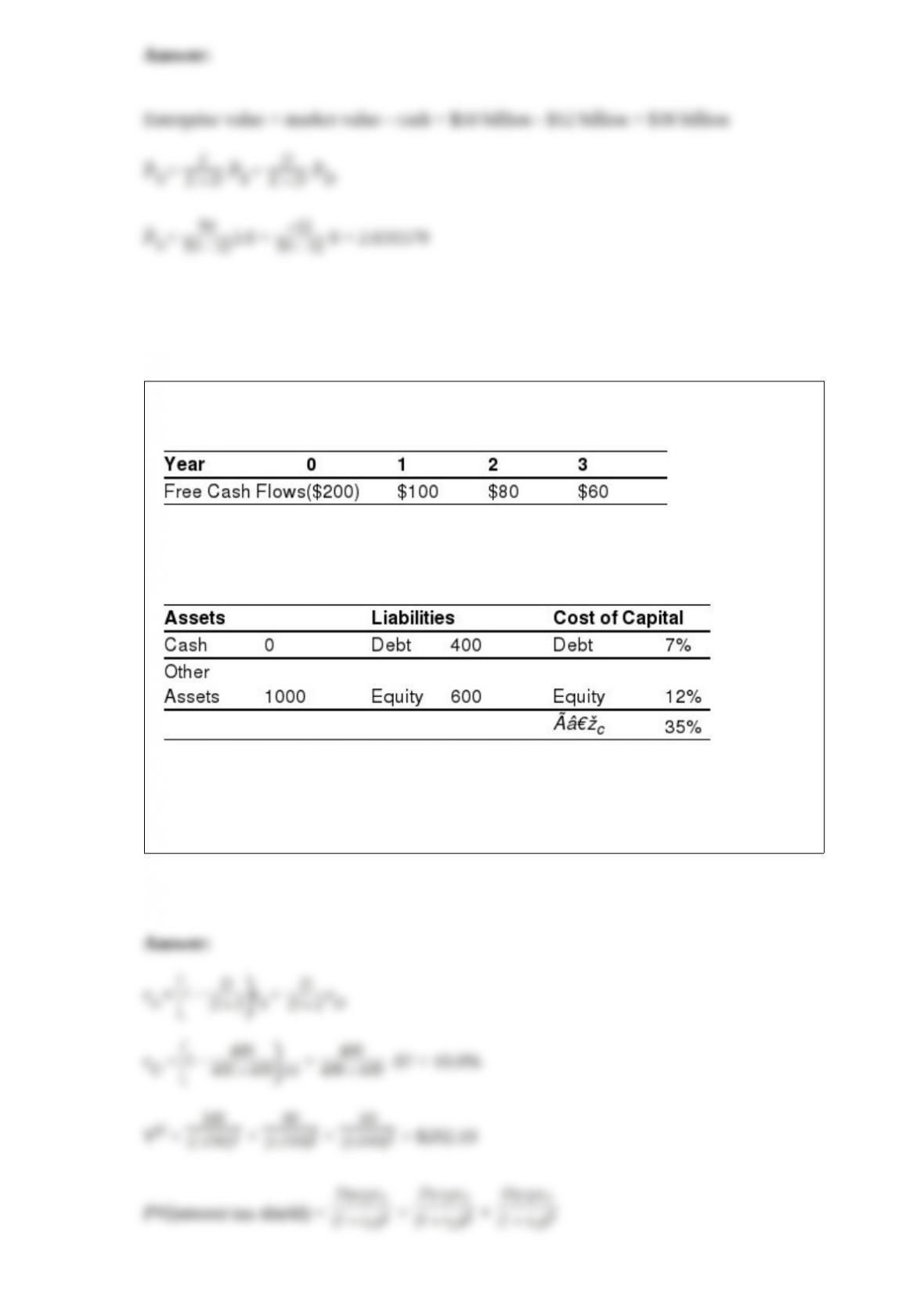
Aardvark Industries is considering a project that will generate the following free cash
flows:
You are also provided with the following market value balance sheet and information
regarding Aardvark’s cost of capital:
Suppose that to fund this new project, Aardvark borrows $150 with the principal to be
paid in three equal installments at the end each year. Calculate the The levered value of
Aardvark’s new project.

Omicron Technologies has $50 million in excess cash and no debt. The firm expects to
generate additional free cash flows of $40 million per year in subsequent years and will
pay out these future free cash flows as regular dividends. omicrons unlevered cost of
capital is 10% and there are 10 million shares outstanding. Omicron’s board is meeting
to decide whether to pay out its $50 million in excess cash as a special dividend or to
use it to repurchase shares of the firm’s stock.
Assume that you own 4000 shares of Omicron stock and that Omicron uses the entire
$50 million to repurchase shares. Suppose you are unhappy with Omicron’s decision
and would have preferred that Omicron used the excess cash to pay a special dividend.
Detail exactly how you could create a homemade dividend that will provide you with
the same combination of cash and stock that you would have received if Omicron paid
the special dividend.

Luther Corporation
Consolidated Balance Sheet
December 31, 2009 and 2008 (in $ millions)
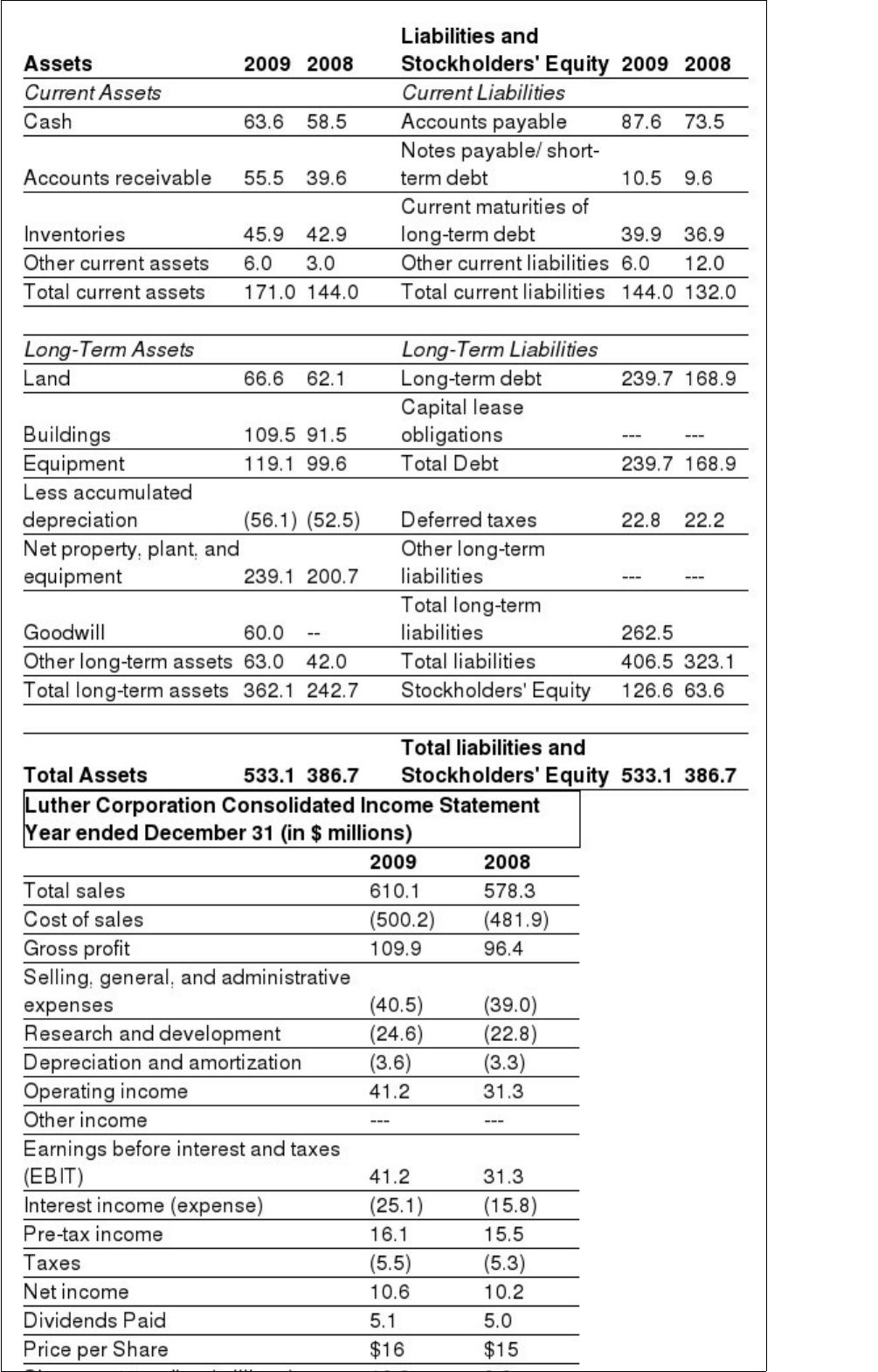
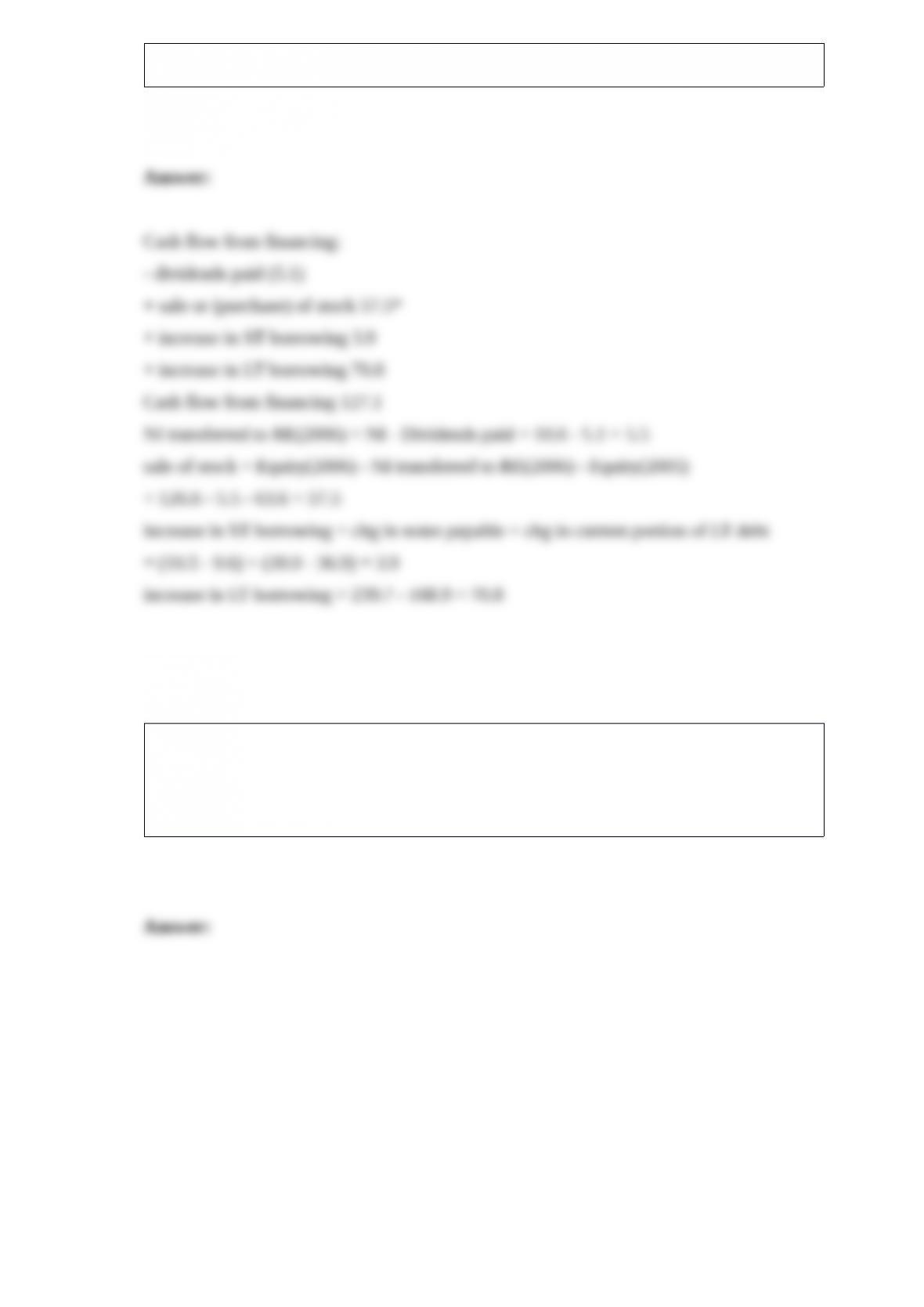
For the year ending December 31, 2009 Luther’s cash flow from financing activities is:
Two separate firms are considering investing in this project. Firm unlevered plans to
fund the entire $80,000 investment using equity, while firm levered plans to borrow
$45,000 at the risk-free rate and use equity to finance the remainder of the initial
investment. Calculate the expected returns for both the levered and unlevered firm.
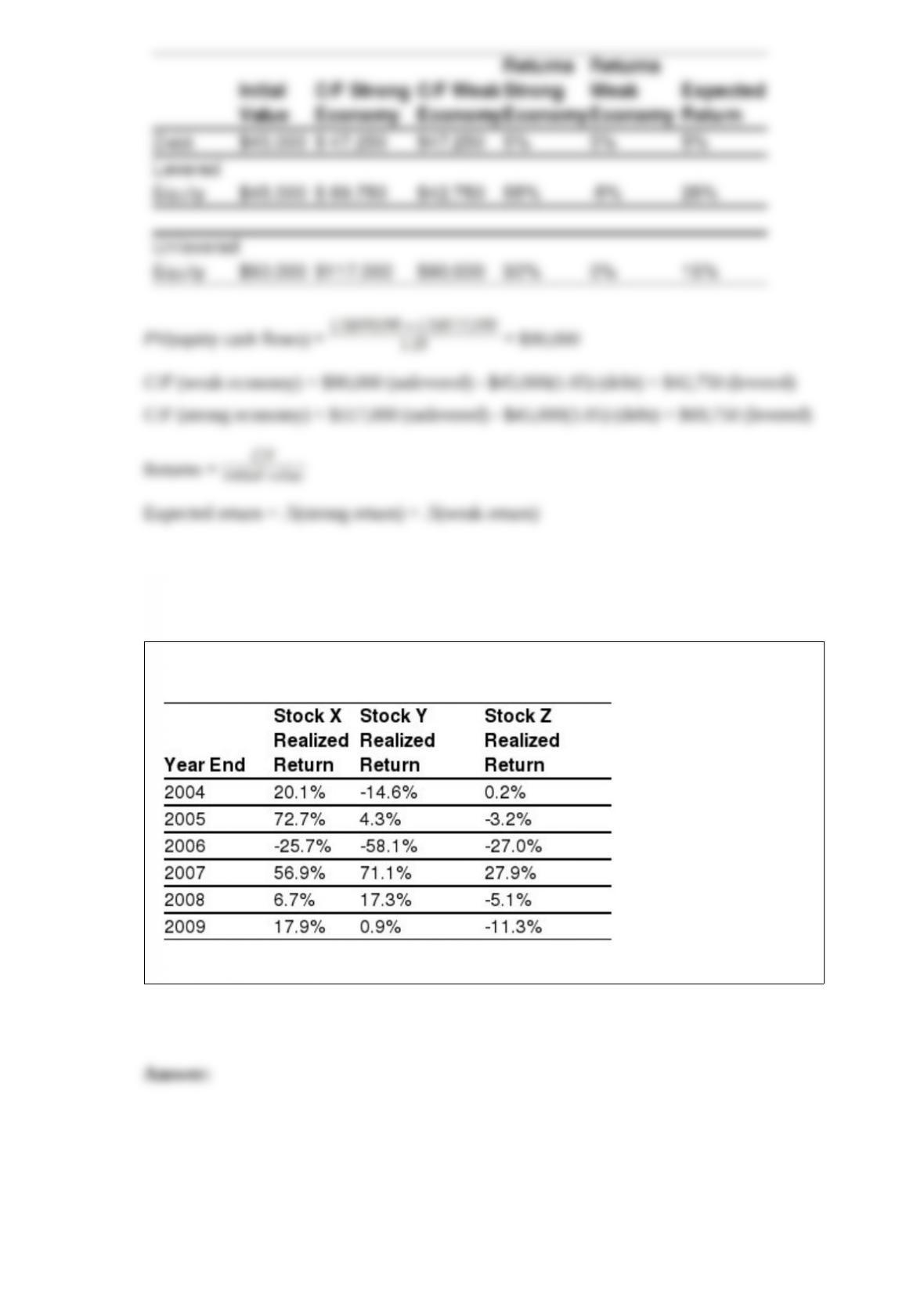
Consider the following returns:
Calculate the covariance between Stock Y’s and Stock Z’s returns .