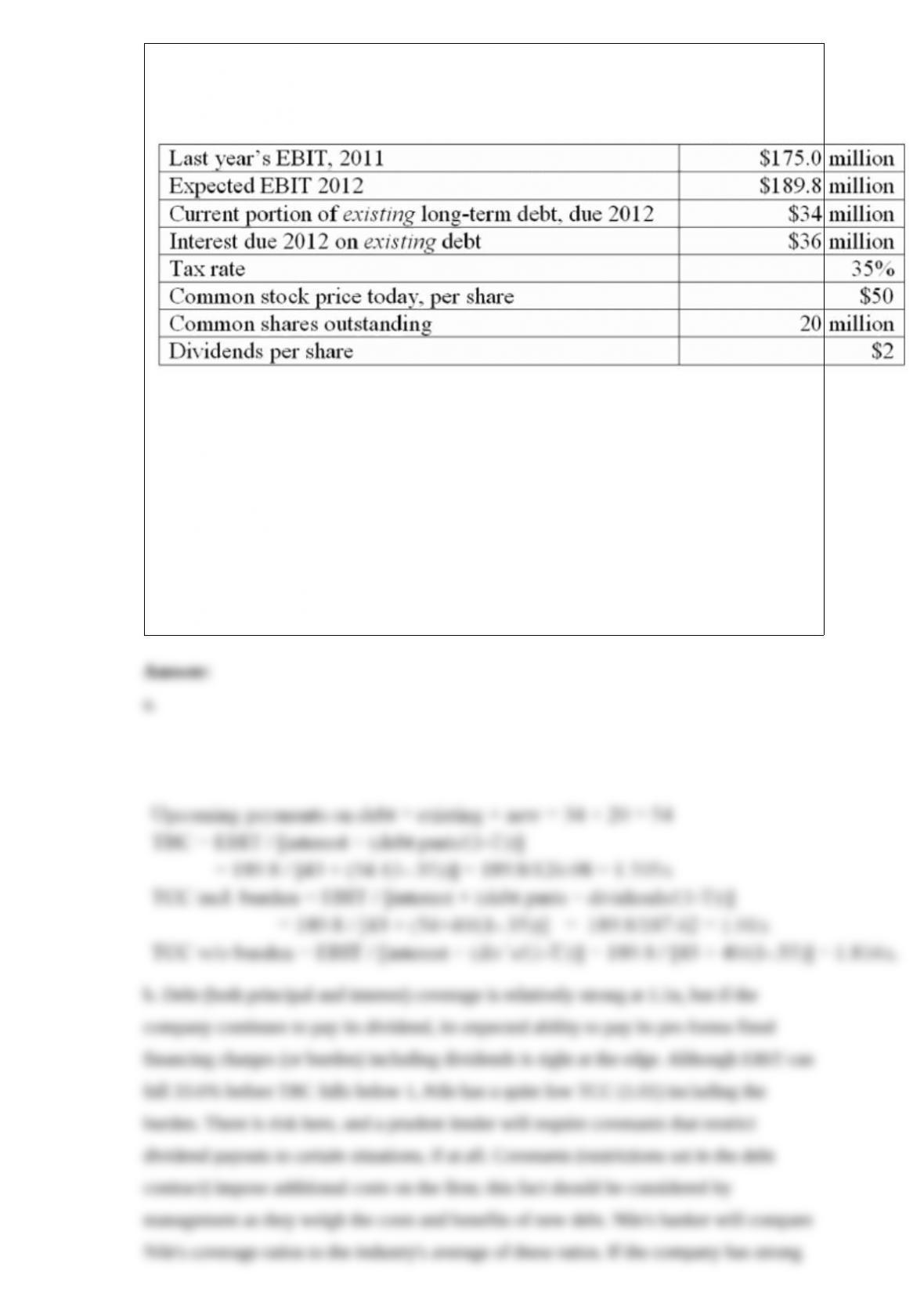
1) As CFO of Nile Holdings, a carpet wholesaler, you have the following information as
of December 2011:
Nile has an attractive investment opportunity, and to finance it, must decide whether to
issue $100 million in new debt or new equity.
Assume Nile raises $100 million of new debt at the end of 2011, at an interest rate of
7%.
a. Assuming Nile must make a $20 million payment on the new debt next year,
calculate the firm’s times burden covered ratio and times common covered (including
debt payments) ratio.
b. As Nile’s banker, would you be comfortable loaning the company this new debt?
Briefly explain why, or for what reasons you’d be comfortable or uncomfortable.
2) Which one of the following is a use of cash?
A.increase in notes payable
B.increase in inventory
C.increase in long-term debt
D.decrease in accounts receivable
E.increase in common stock
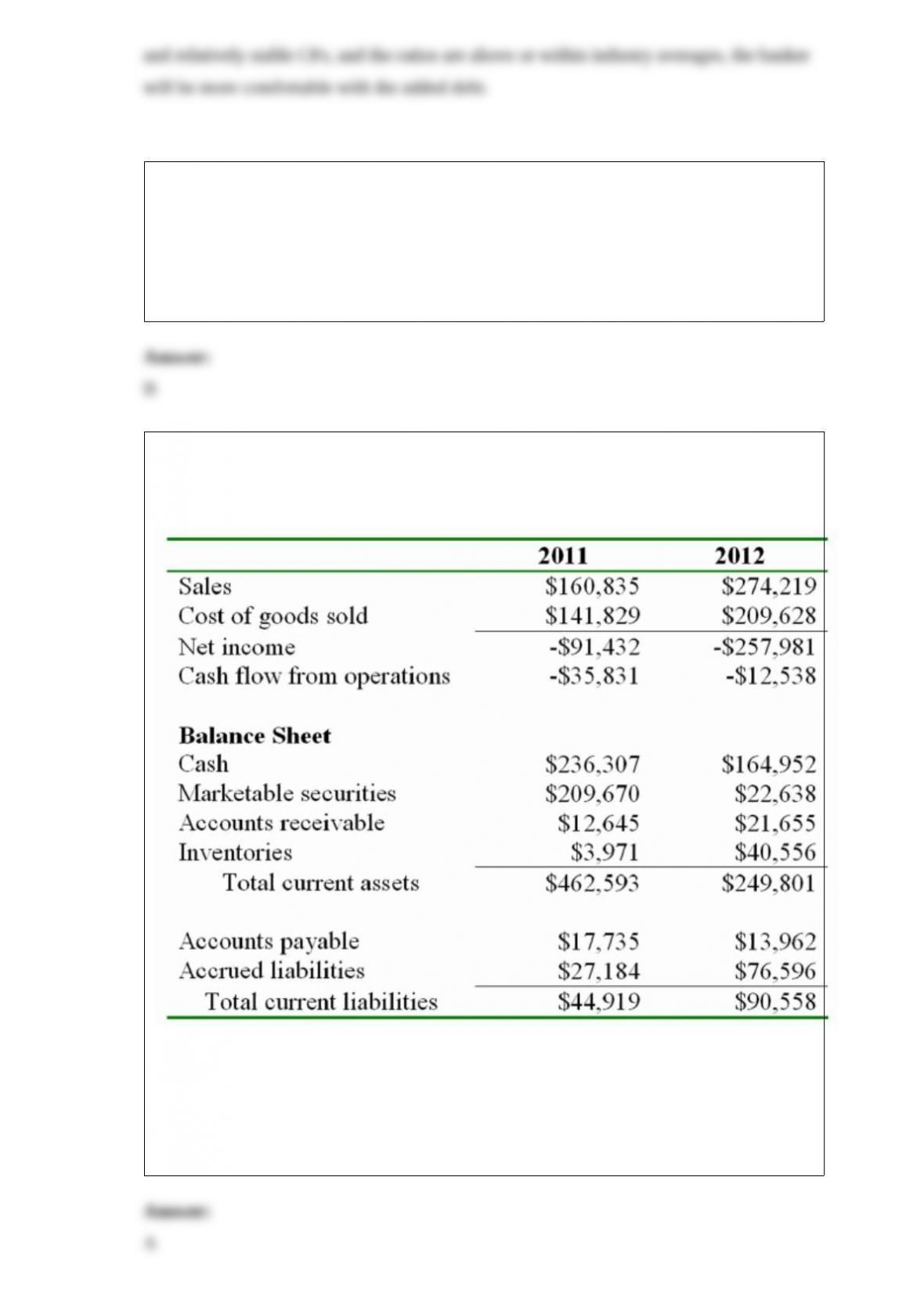
3) Selected financial data for Link, Inc. follows: ($ in thousands)
The profit margin for 2012 is:
A.-94%
B.-57%
C.13%
D.31%
E.None of the above
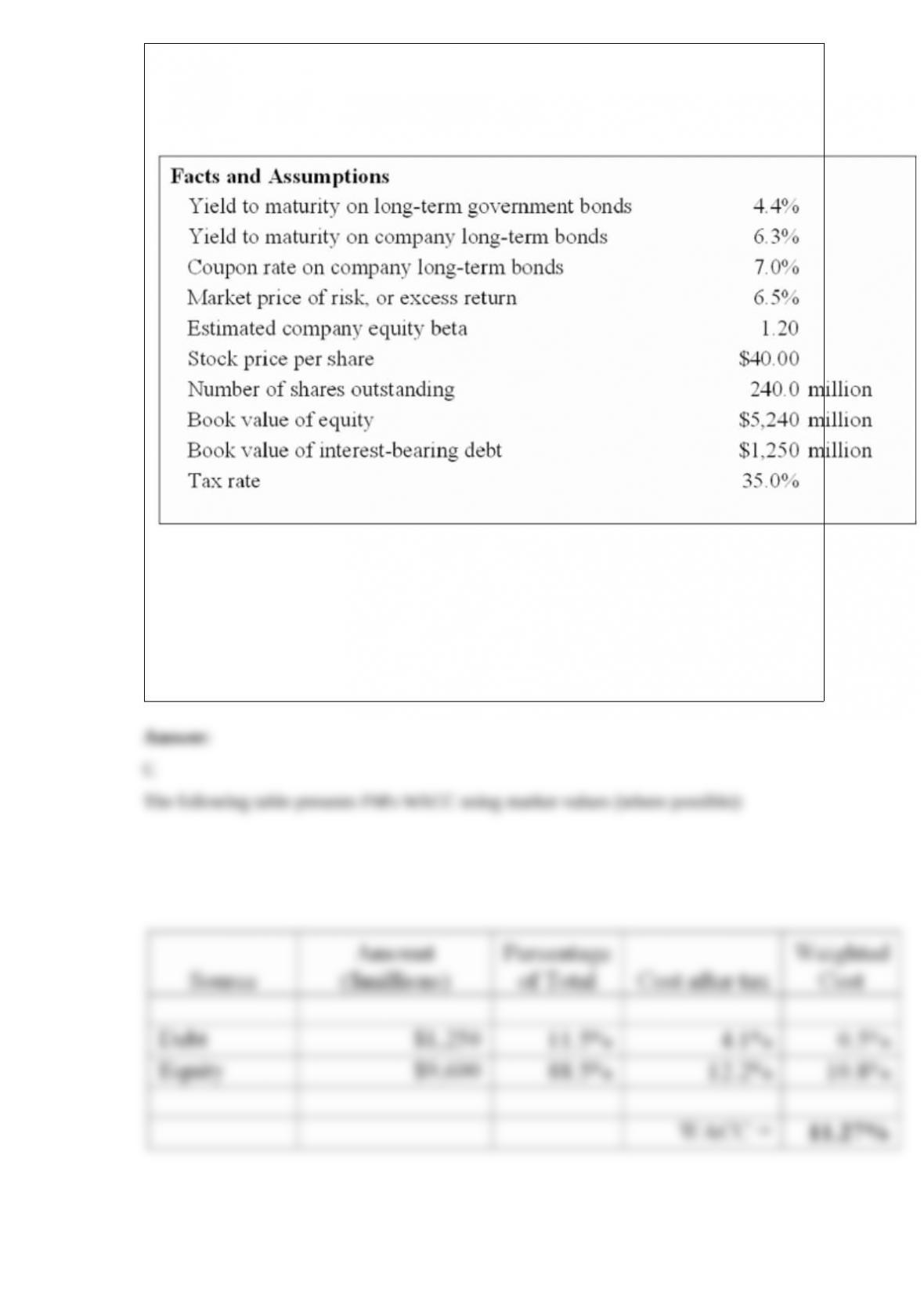
4) Key facts and assumptions concerning FM Foods, Inc. at December 31, 2011, appear
below.
Estimate FM’s weighted-average cost of capital.
A.6.46%
B.6.58%
C.11.27%
D.11.32%
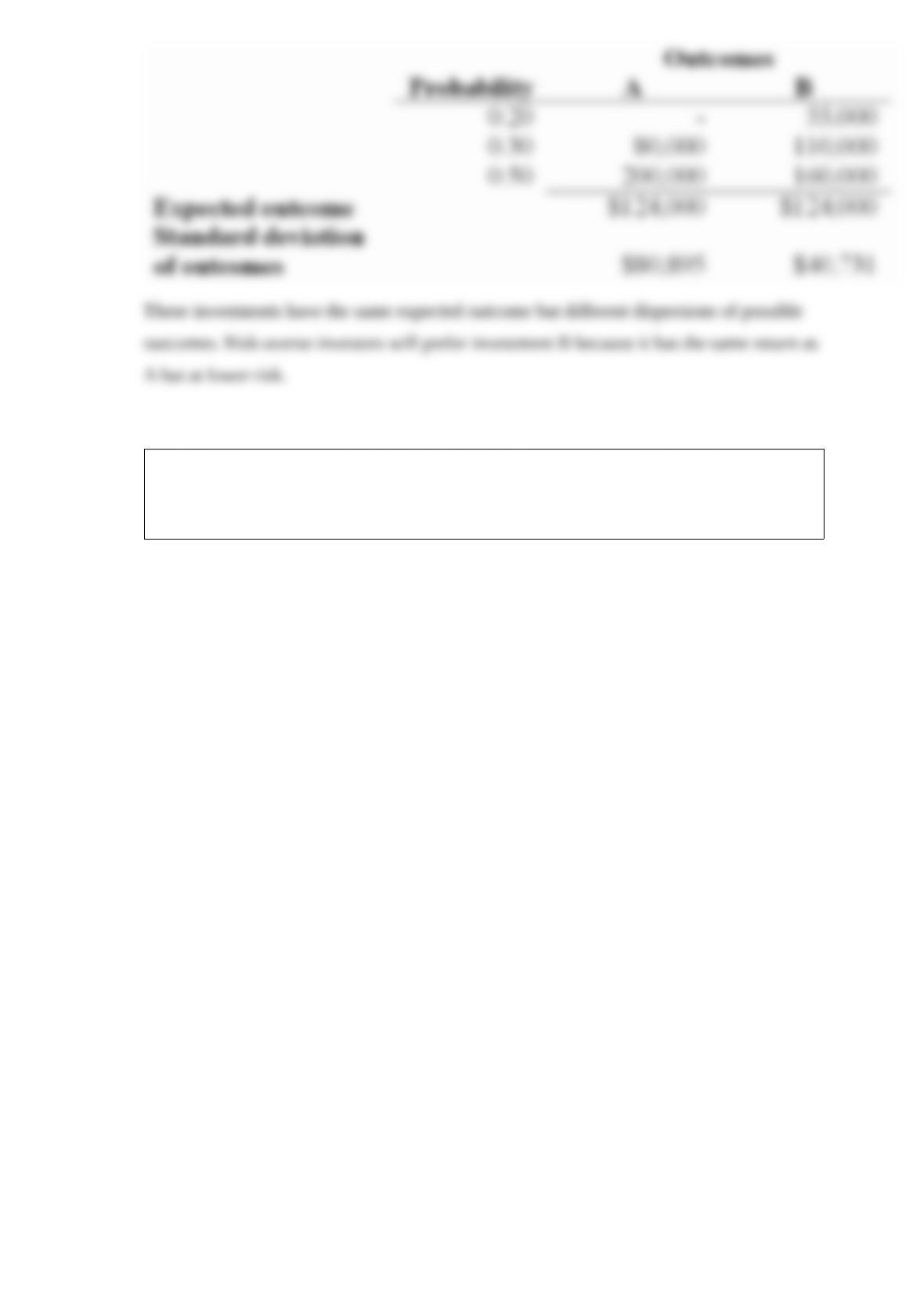
E.11.52%
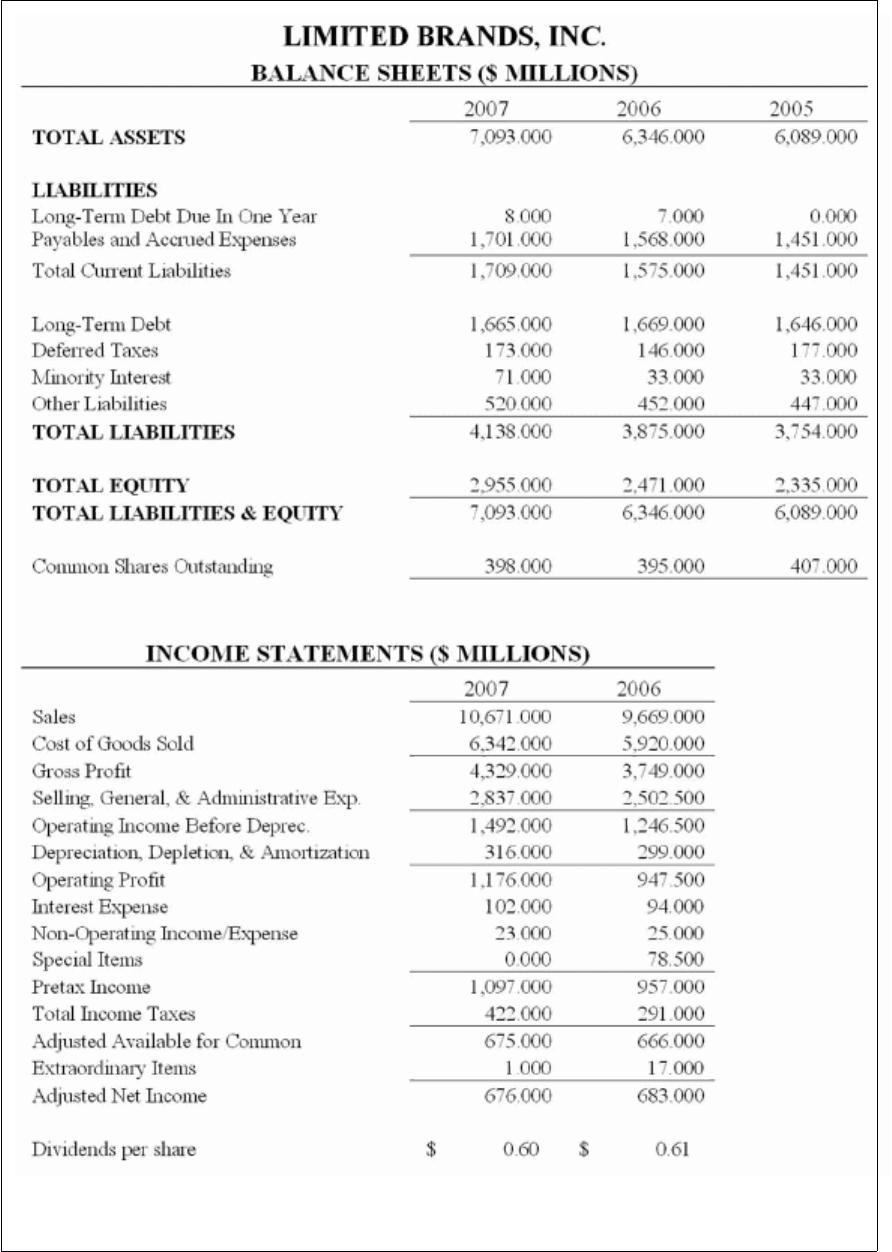
F.None of the above

5) The Limited collects 25 percent of sales in the month of sale, 60 percent of sales in
the month following the month of sale, and 15 percent of sales in the second month
following the month of sale. During the month of April, the firm will collect:
A.60 percent of February sales
B.15 percent of April sales
C.60 percent of March sales
D.15 percent of March sales
E.25 percent of February sales
6) Blue Diamond Equipment has 80,000 bonds outstanding that are selling at par.
Bonds with similar characteristics are yielding 6.75 percent. The company also has
750,000 shares of 7 percent preferred stock and 2.5 million shares of common stock
outstanding. The preferred stock sells for $53 a share. The common stock has a beta of
1.34 and sells for $42 a share. The U.S. Treasury bill is yielding 2.8 percent and the
return on the market is 11.2 percent. The corporate tax rate is 38 percent. What is the
firm’s weighted average cost of capital?
A.10.39 percent
B.10.64 percent
C.11.18 percent
D.11.30 percent
E.11.56 percent
F.None of the above
7) The dividend growth model can be used to compute the cost of equity for a firm in
which of the following situations?
I. Firms that have a 100 percent retention ratio
II. Firms that pay an unchanging dividend
III. Firms that pay a constantly increasing dividend
IV. Firms that pay an erratically growing dividend
A.I and II only
B.I and IV only
C.II and III only
D.I, II, and III only
E.I, III, and IV only
F.None of the above
8) Which one of the following statements is true?
A.Equity securities offer fixed claims on future cash payouts
B.Unlike bondholders, for their returns, shareholders rely entirely on price appreciation
C.In theory, common shareholders exercise very little control over company decisions
D.Historically, common shareholders have earned a risk premium as compensation for
risk borne in excess of government bonds
E.Preferred shareholders are the first investors to be repaid in bankruptcy liquidation
F.None of the above
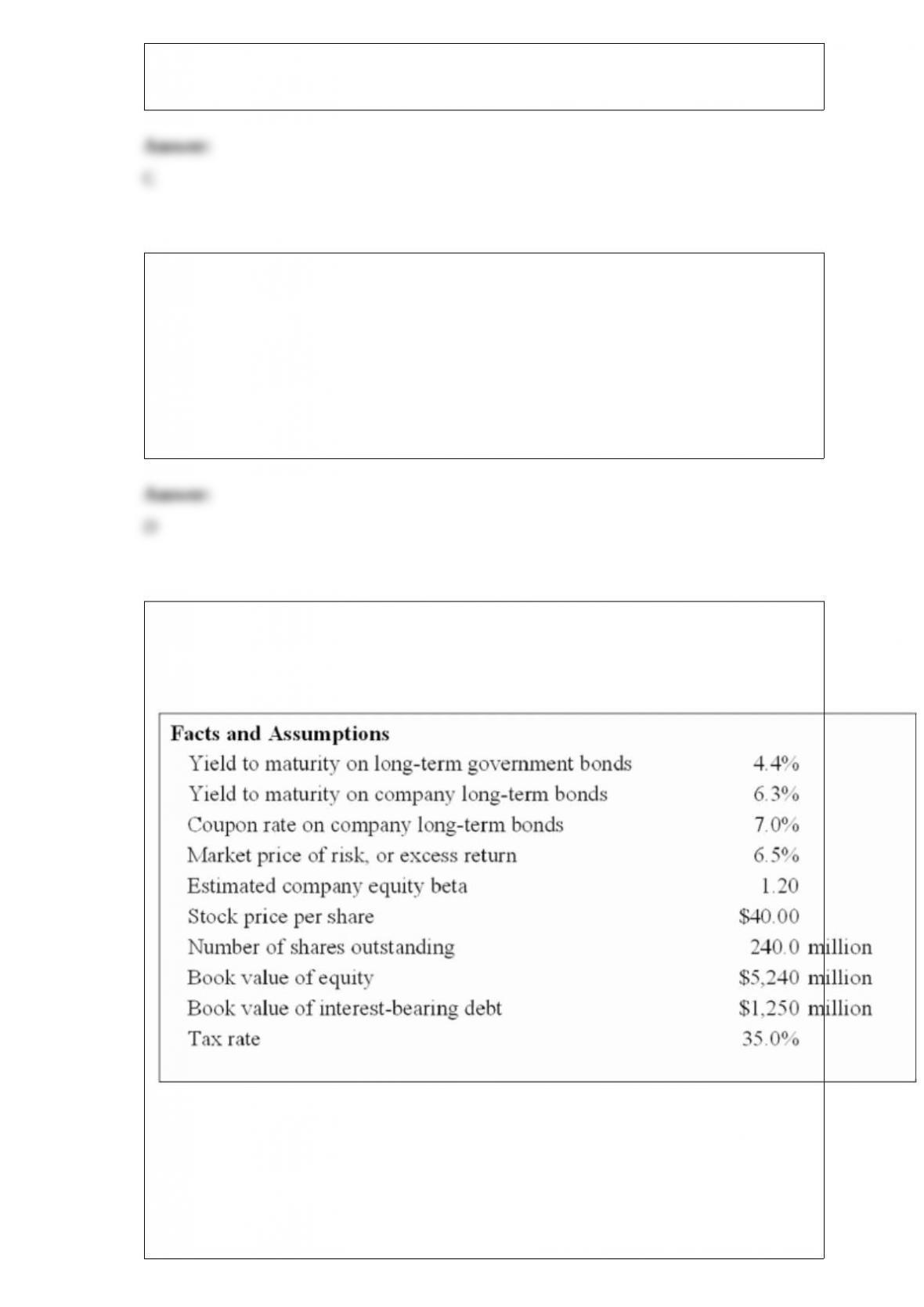
9) Key facts and assumptions concerning FM Foods, Inc. at December 31, 2011, appear
below.
Estimate the appropriate weight of equity to be used when calculating FM’s weighted
average cost of capital.
A.11.5%
B.19.3%
C.80.7%
D.88.5%
E.100.0%

F.None of the above
10) Zack owns a bond that will pay him $35 each year in interest plus a $1,000
principal payment at maturity. The $1,000 principal payment is called the:
A.coupon.
B.par value
C.discount
D.yield
E.call premium
F.None of the above
11) The term “financial distress costs” includes which of the following?
I. Direct bankruptcy costs
II. Indirect bankruptcy costs
III. Direct costs related to being financially distressed, but not bankrupt
IV. Indirect costs related to being financially distressed, but not bankrupt
A.I only
B.III only
C.I and II only
D.III and IV only
E.I, II, III, and IV
F.None of the above
12) Which of the following statements concerning the cash flow production cycle is
true?
A.The profits reported in a given time period equal the cash flows generated
B.A company’s operations and finances are independent of each other
C.Financial statements have nothing to do with reality
D.The movement of cash to inventory, to accounts receivable, and back to cash is

known as the firm’s working capital cycle
E.A profitable company will always have sufficient cash to meet its obligations
13) The interest tax shield has no value when a firm has:
I. no taxable income.
II. debt-equity ratio of 1.
III. zero debt.
IV. no leverage.
A.I and III only
B.II and IV only
C.I, III, and IV only
D.II, III, and IV only
E.I, II, and IV only
F.None of the above
14) Ginormous Oil entered into an agreement to purchase all of the outstanding shares
of Slick Company for $60 per share. The number of outstanding shares at the time of
the announcement was 82 million. The book value of liabilities on the balance sheet of
Slick Co. was $1.46 billion. Immediately prior to the Ginormous Oil bid, the shares of
Slick Co. traded at $33 per share. What value did Ginormous Oil place on the control of
Slick Co.?
A.$2.21 billion
B.$2.71 billion
C.$4.17 billion
D.$6.38 billion
E.None of the above
15) The book value of a firm is:
A.equivalent to the firm’s market value provided that the firm has some fixed assets
B.based on historical cost
C.generally greater than the market value when fixed assets are included
D.more of a financial than an accounting valuation
E.adjusted to the market value whenever the market value exceeds the stated book
value
16) You bought a yen-denominated corporate bond at the beginning of the year for
100,000. The bond paid 3 percent annual interest and was trading for 110,000 at
year-end. The exchange rate was $1 = 100 at the beginning of the year and $1 = 122 at
year-end. What holding period return, measured in yen, did you earn on the bond?
A.-18.03%
B.-7.38%
C.-5.03%
D.3.0%
E.0%
F.None of the above
17) The sustainable growth rate:
A.assumes there is no external financing of any kind
B.assumes no additional long-term debt is available
C.assumes the debt-equity ratio is constant
D.assumes the debt-equity ratio is 1.0
E.assumes all income is retained by the firm
F.None of the above

18) Which of the following statements are correct?
I. Liquidation value of a firm is equal to the present worth of expected future cash flows
from operating activities.
II. When an acquiring firm purchases a target firm’s equity, the acquirer must assume
the target’s liabilities.
III. The market value of a public company reflects the worth of the business to minority
investors.
IV. The fair market value of a business is usually the lower of its liquidation value and
its going-concern value.
A.I and III only
B.II and IV only
C.II and III only
D.I, II, and III only
E.II, III, and IV only
F.None of the above
19) Figure 9.1
In March of 2011, Macklemore Corp. considered an acquisition of Blue Scholar
Learning, Inc. (BSL), a privately-held educational software firm. As a first step in
deciding what price to bid for BSL, Macklemore’s CFO, Ryan Lewis, has prepared a
five-year financial projection for the company assuming the acquisition takes place.
Use this projection and BSL’s 2010 actual financial figures to answer the questions
below.
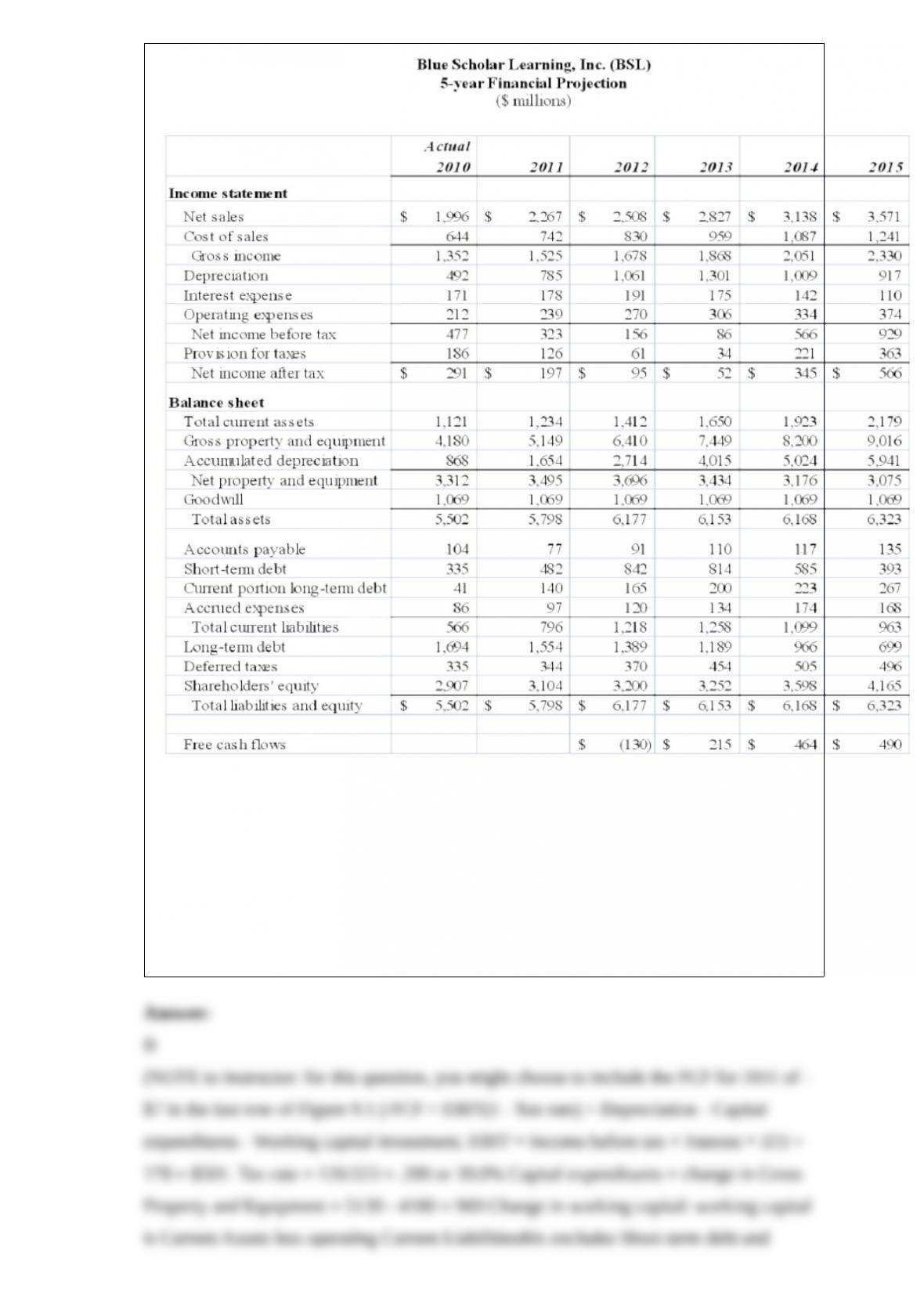
Estimate the present value of BSL’s free cash flow (in $ millions) for the years 2011 –
2015. Macklemore’s WACC is 8.0 percent. BSL’s WACC is 11.5 percent, and the
average of the two companies’ WACCs, weighted by sales, is 8.2 percent.
A.- $1.29
B.$628.24
C.$720.58
D.$726.68
E.$743.94
F.None of the above

20) Breakers Bay Inc. has succeeded in increasing the amount of goods it sells while
holding the amount of inventory on hand at a constant level. Assume that both the cost
per unit and the selling price per unit also remained constant. All else held constant,
how will this accomplishment be reflected in the firm’s financial ratios?
A.decrease in the fixed asset turnover rate
B.decrease in the financial leverage ratio
C.increase in the inventory turnover rate
D.increase in the day’s sales in inventory
E.no change in the total asset turnover rate
21) Which of the following statements are correct?
I. Using the same risk-adjusted discount rate to discount all future cash flows adjusts for
the fact that the more distant cash flows are often more risky than cash flows occurring
sooner.
II. If you can borrow all of the money you need for a project at 5%, the cost of capital
for this project is 5%.
III. The best way to obtain the cost of debt capital for a firm is to use the coupon rates
on its bonds.
IV. The cost of capital, or WACC, is not the correct discount rate to use for all projects
undertaken by a firm.
A.I and III only
B.II and IV only
C.I and II only
D.I and IV only
E.I, II, and III only
F.None of the above
22) The retention ratio is:
A.equal to net income divided by the change in total equity
B.the percentage of net income available to the firm to fund future growth
C.equal to one minus the asset turnover ratio
D.the change in retained earnings divided by the dividends paid
E.the dollar increase in net income divided by the dollar increase in sales
F.None of the above
23) An investment costing $100,000 promises an after-tax cash flow of $36,000 per
year for 6 years.
a. Find the investment’s accounting rate of return and its payback period.
b. Find the investment’s net present value at a 15 percent discount rate.
c. Find the investment’s benefit-cost ratio (profitability index) at a 15 percent discount
rate.
d. Find the investment’s internal rate of return.
e. Assuming the required rate of return on the investment is 15 percent, which of the
above figures of merit indicate the investment is attractive? Which indicate it is
unattractive?
24) According to the pecking-order theory proposed by Stewart Myers of MIT, which of
the following are correct?
I. For financing needs, firms prefer to first tap internal sources such as retained profits
and excess cash.

II. There is an inverse relationship between a firm’s profit level and its debt level.
III. Firms prefer to issue new equity rather than source external debt.
IV. A firm’s capital structure is dictated by its need for external financing.
A.I and III only
B.II and IV only
C.I, III, and IV only
D.I, II, and IV only
E.I, II, III, and IV
F.None of the above
25) Ian is going to receive $20,000 six years from now. Sunny is going to receive
$20,000 nine years from now. Which one of the following statements is correct if both
Ian and Sunny apply a 7 percent discount rate to these amounts?
A.The present values of Ian and Sunny’s monies are equal
B.In future dollars, Sunny’s money is worth more than Ian’s money
C.In today’s dollars, Ian’s money is worth more than Sunny’s
D.Twenty years from now, the value of Ian’s money will be equal to the value of
Sunny’s money
E.Sunny’s money is worth more than Ian’s money given the 7 percent discount rate
F.None of the above
26) Himmel Corp. wants to raise $100 million in a new stock issue. Its investment
banker indicates that the sale of new stock will require 12 percent underpricing and a 7
percent spread. (Hint: The underpricing is 12 percent of the current stock price, and the
spread is 7 percent of the issue price.)
a. Assuming Himmel’s stock price does not change from its current price of $50 per
share, how many shares must the company sell and at what price to the public?
b. How much money will the investment banking syndicates earn on the sale?
c. Is the 12 percent underpricing a cash flow? Is it a cost? If so, to whom?
27) Figure 9.1
In March of 2011, Macklemore Corp. considered an acquisition of Blue Scholar
Learning, Inc. (BSL), a privately-held educational software firm. As a first step in
deciding what price to bid for BSL, Macklemore’s CFO, Ryan Lewis, has prepared a
five-year financial projection for the company assuming the acquisition takes place.
Use this projection and BSL’s 2010 actual financial figures to answer the questions
below.
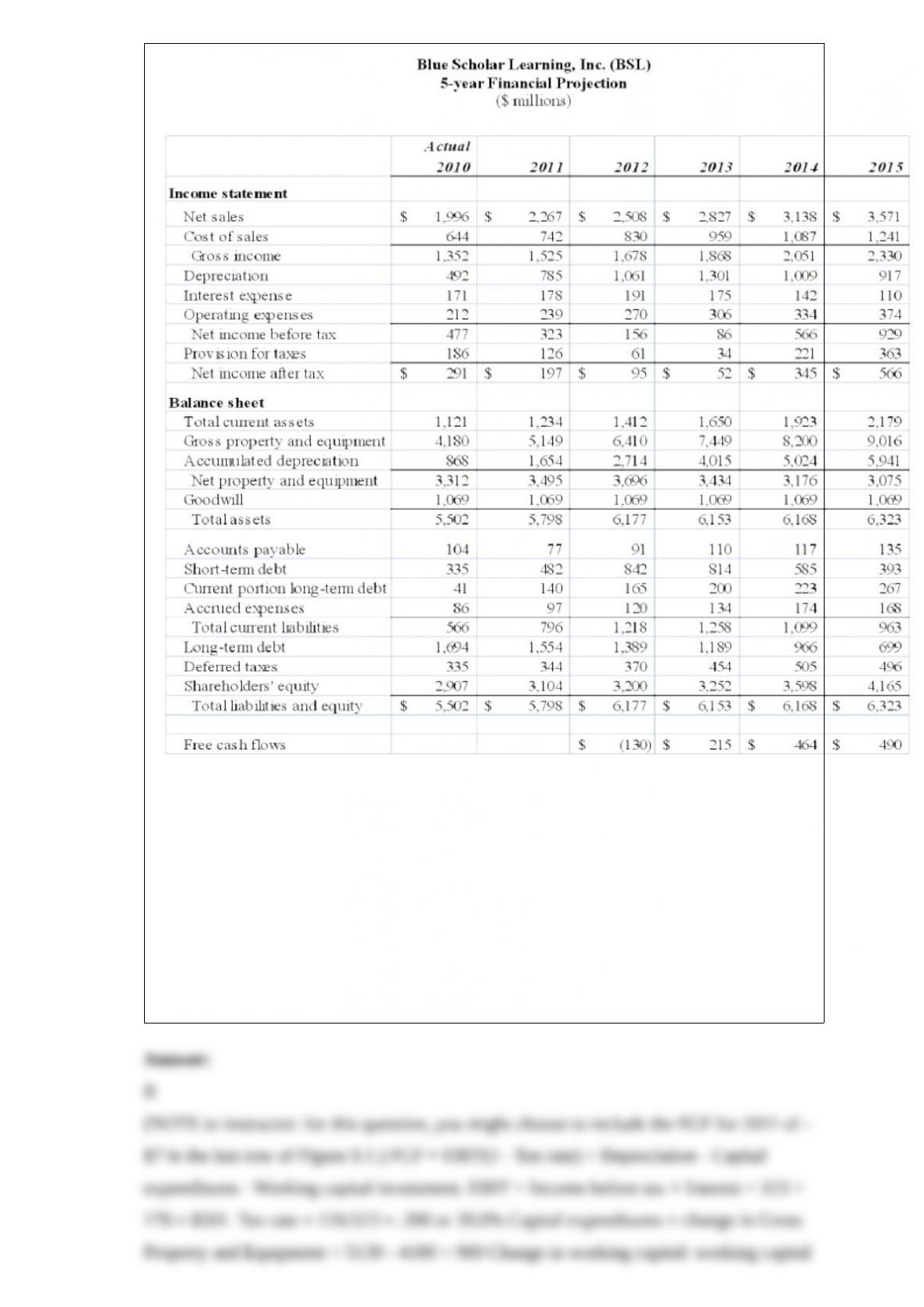
Estimate BSL’s value (in $ millions) at the end of 2010 assuming that in the years after
2015 the company’s free cash flow grows 4 percent per year in perpetuity.
Macklemore’s WACC is 8.0 percent. BSL’s WACC is 11.5 percent, and the average of
the two companies’ WACCs, weighted by sales, is 8.2 percent.
A.$4,297.25
B.$4,571.09
C.$4,686.78
D.$6,181.09
E.$5,351.19
F.$7,423.16
G.None of the above
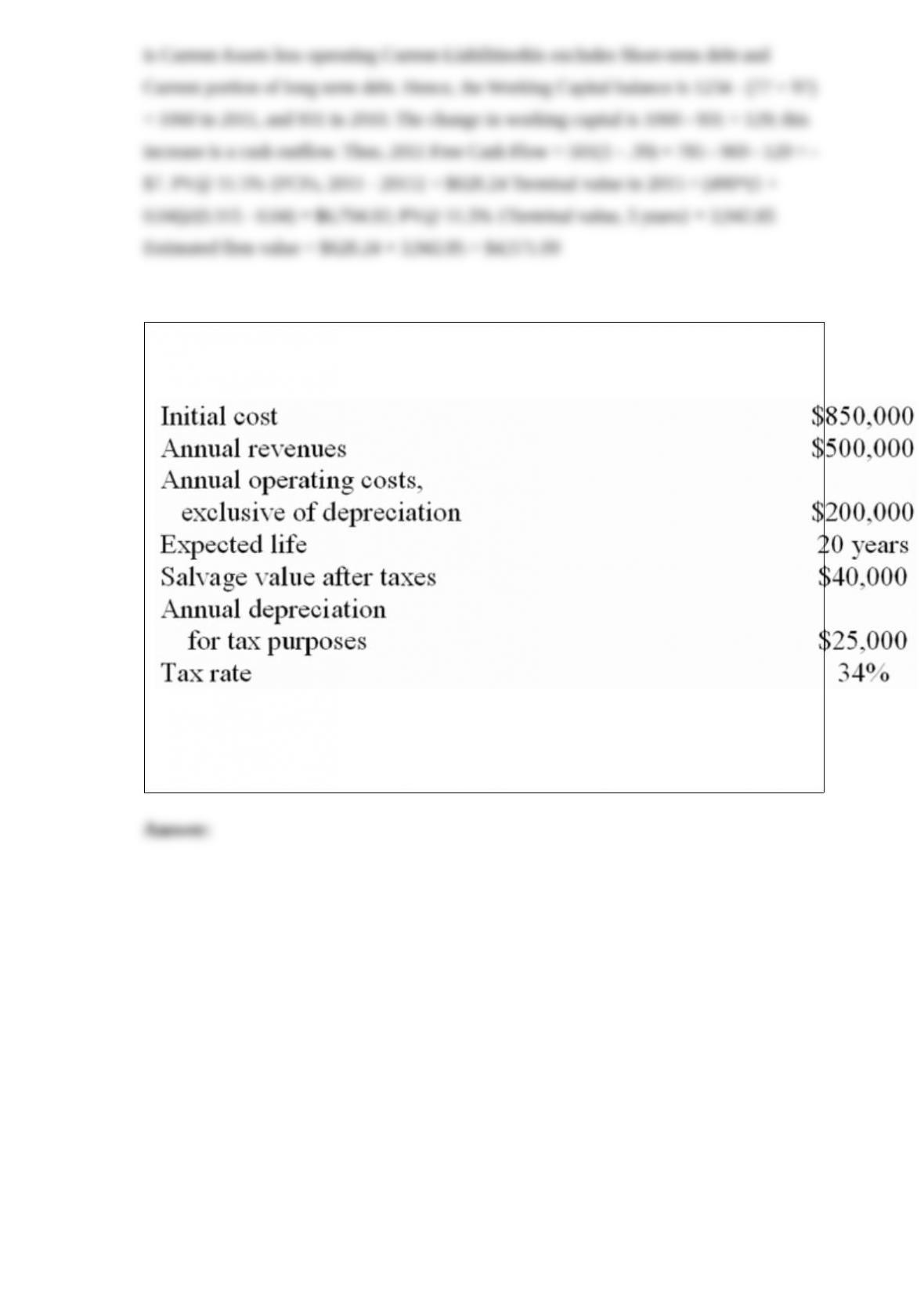
28) Consider the following investment opportunity.
Assume the annual figures are unchanged for the expected life of the investment. What
is the rate of return on this investment? Assuming the investor wants to earn at least 12
percent, is this investment an attractive one?
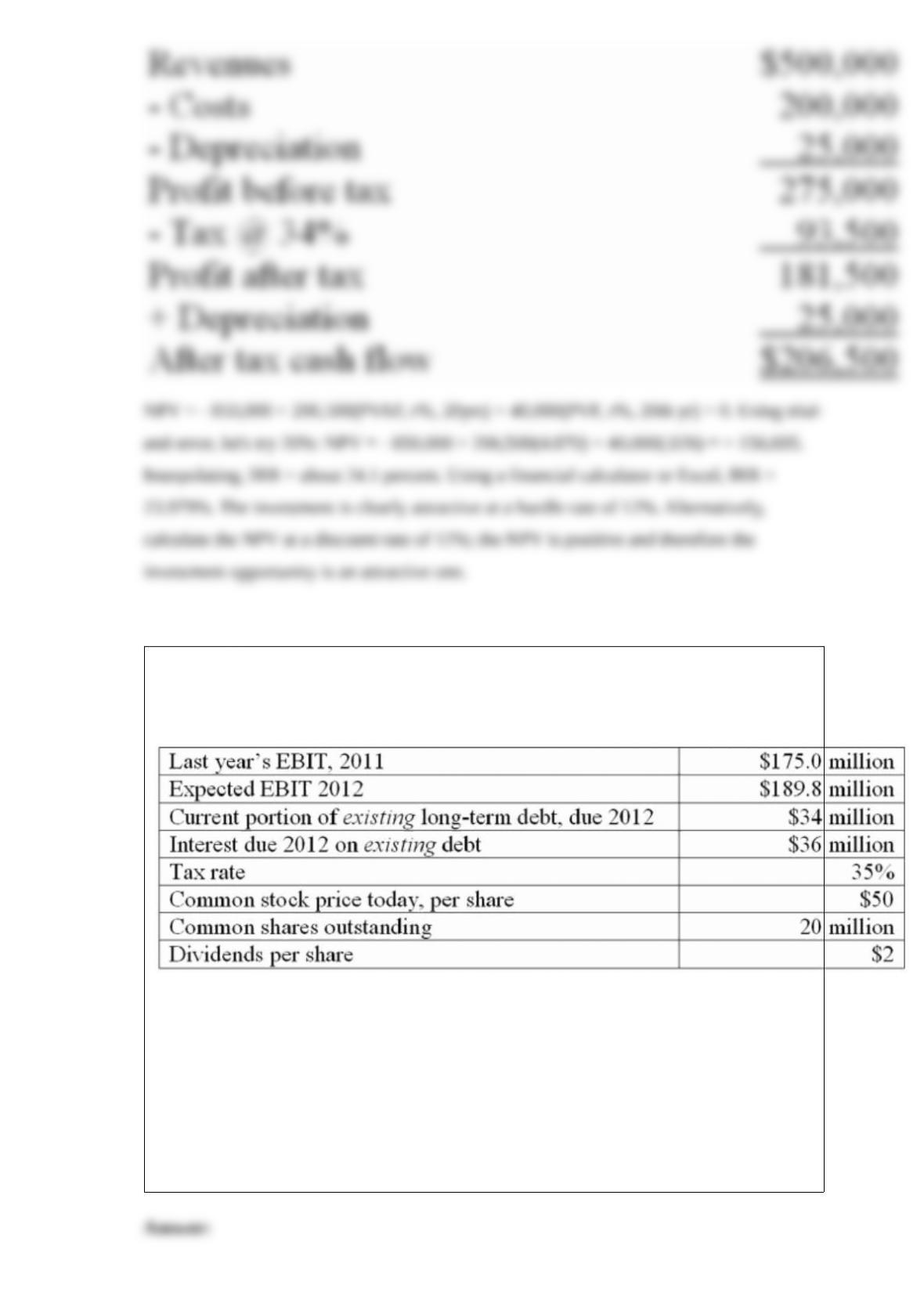
29) As CFO of Nile Holdings, a carpet wholesaler, you have the following information
as of December 2011:
Nile has an attractive investment opportunity, and to finance it, must decide whether to
issue $100 million in new debt or new equity.
Suppose Nile expects $4.52 in EPS next year if it does not go through with the
investment and associated financing. As a shareholder, to satisfy its funding needs for
the investment opportunity, do you prefer the company issues $100 million in new debt
at an interest rate of 7%, or issues 2 million shares of equity at a target price of $50?
Show supporting calculations, and provide arguments and potential counter-arguments
for your recommendation.
30) The book value of Little Statistic’s total assets is $400,000. Suppose Number
Crunching Inc. acquires Little Statistic’s assets for $1 million and finances the purchase
by selling $600,000 in new stock, $300,000 in new debt, and reducing cash by
$100,000. Describe how the acquisition affects Number Crunching’s balance sheet.
31) Investments A and B both cost $100,000 and each promises a single payoff in one
year. The distribution of payoffs for each investment appears below.
Ignoring possible differences in nondiversifiable risk, which investment would a
risk-averse investor prefer, and why?
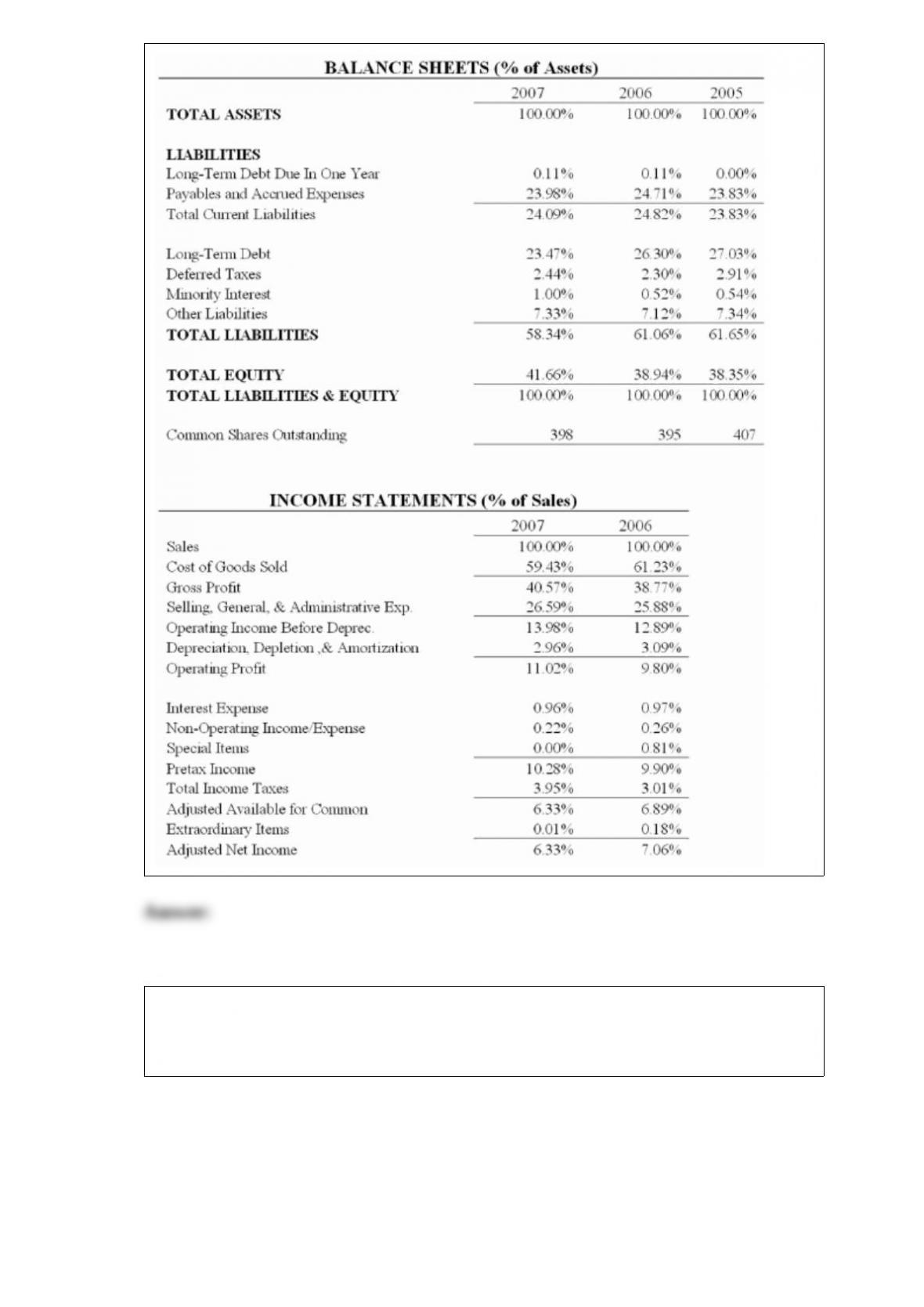
32) The financial statements for Limited Brands, Inc. follow (fiscal years ending
January):
Use Limited Brands, Inc.’s financial statements, above, to prepare common-size
financial statements for Limited Brands, Inc. for 2006 – 2007.
33) As CFO of Nile Holdings, a carpet wholesaler, you have the following information
as of December 2011:
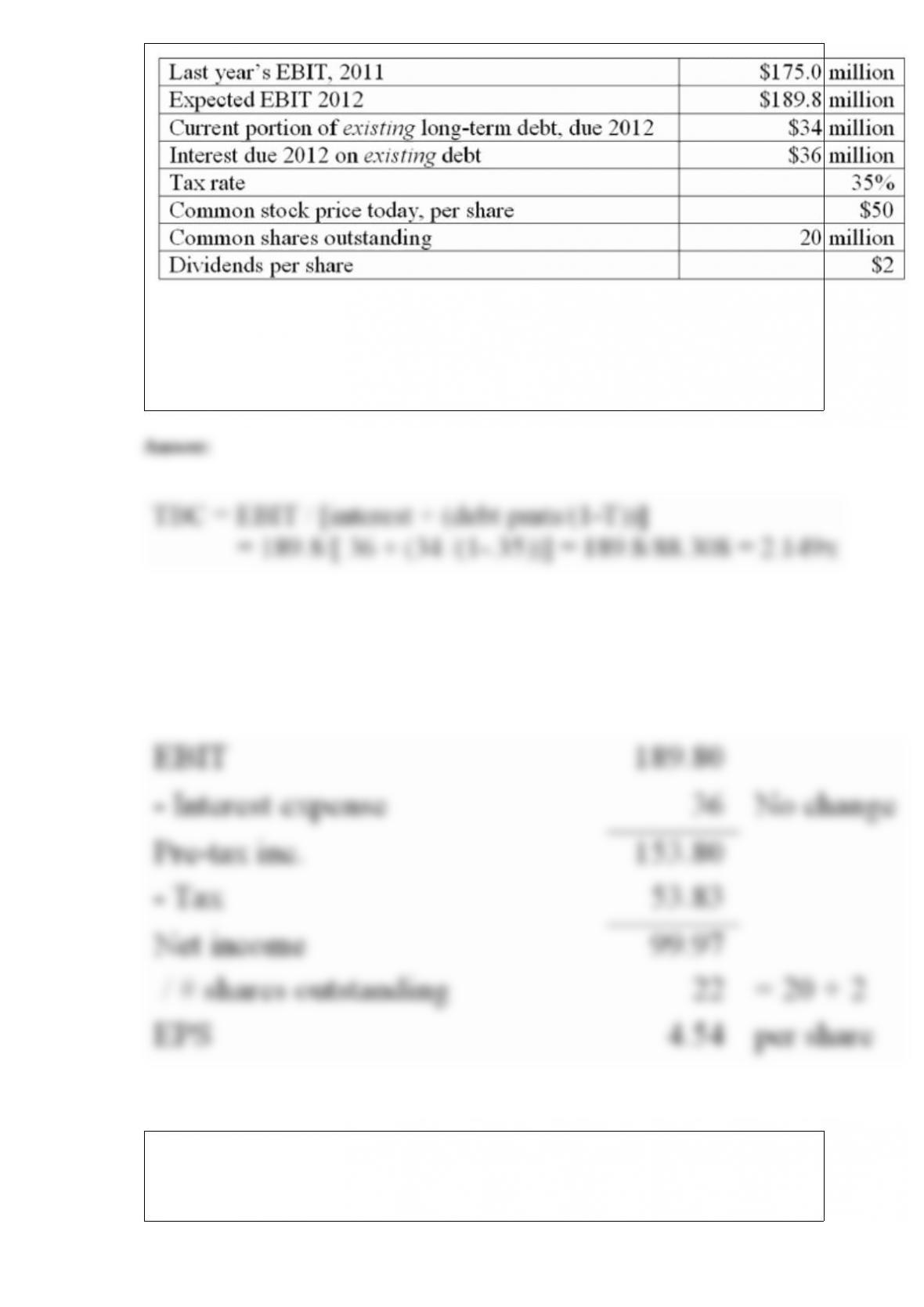
Nile has an attractive investment opportunity, and to finance it, must decide whether to
issue $100 million in new debt or new equity.
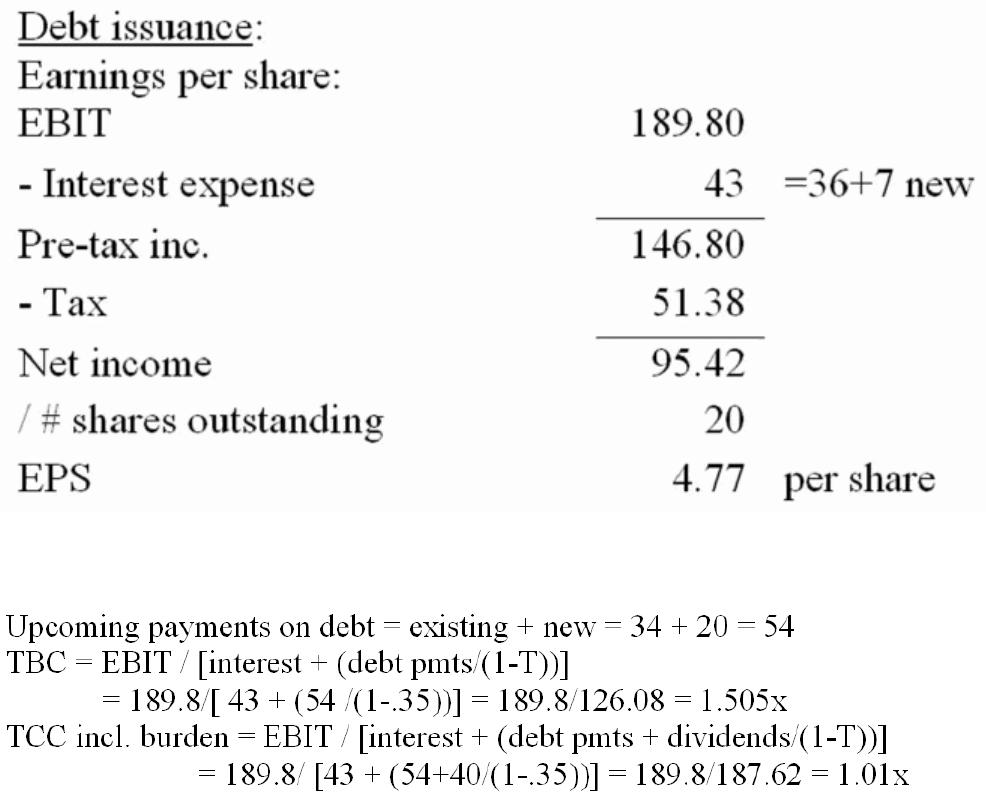
Calculate next year’s times burden covered ratio and earnings per share if Nile sells 2
million new shares at $50 a share instead of raising new debt.
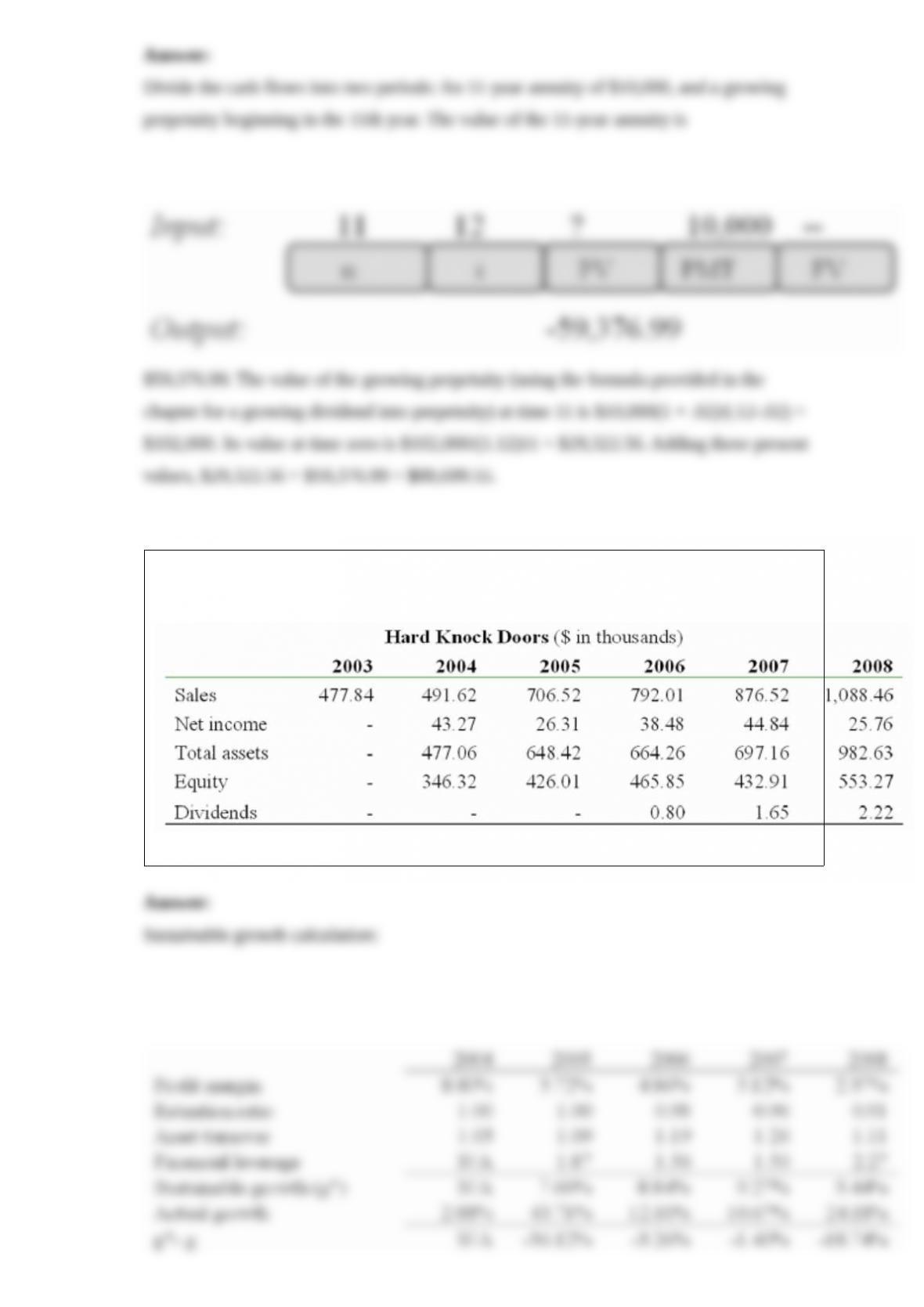
34) What is the present value of a cash flow stream of $10,000 per year annually for 11
years that then grows at 2 percent per year forever? Assume the appropriate discount
rate is 12 percent.
35) Selected financial information for Hard Knock Doors is presented below:
Calculate the actual and sustainable growth rate for each year.
36) Edna’s Laundry Services just completed pro forma statements using the percentage
of sales approach. The pro forma shows a projected external financing need of -$5,500.
Interpret this figure. What are the firm’s options in this case?