
An acquirer should be willing to pay a higher control premium for a poorly managed
company than for a well-managed company.
Answer:
All else equal, increasing the assumed payables period in a financial forecast will
decrease external funding required.
Answer:
When conducting a discounted cash flow analysis of a project, it is important to always
include a careful estimate of financing costs in the project’s cash flows.
Answer:

Acquisitions create shareholder value, on average.
Answer:
The accrual principle requires that revenue not be recognized until payment from a sale
is received.
Answer:
The accounting rate of return is deficient as a figure of merit because it is insensitive to
the timing of cash flows.

Answer:
The M&M irrelevance proposition assures financial managers that their choice between
equity or debt financing will ultimately have no impact on firm value.
Answer:
Which of the following statements regarding preferred stock is TRUE?
A. Holders of preferred stock have the same voting rights as common stockholders.
B. Preferred stock dividend payments are a deductible expense for corporate tax
purposes.
C. Almost all public corporations are at least partly financed with preferred stock.
D. None of the above.

Answer:
When reporting financial performance for tax purposes, U.S. companies prefer to use
accelerated depreciation methods over the straight-line method.
Answer:
A decline in the Net fixed assets account between year-end 2013 and year-end 2014 is a
clear indication that fixed assets were sold during 2014.
Answer:

You can construct a sources and uses statement for 2014 if you have a company’s
year-end balance sheets for 2014 and 201
Answer:
The IRR is the discount rate at which an investment’s NPV equals its initial cost.
Answer:
Debt financing results in lower after-tax earnings relative to equity financing.
Answer:

The only reason why the price would fall on a corporate bond is if market interest rates
increase.
Answer:
Please refer to Oscar’s financial statements above. Assume a constant profit margin and
dividend payout ratio, and further assume all of Oscar’s assets and current liabilities
vary directly with sales. Assume long-term debt and common stock remain unchanged.
Sales are projected to increase by 10 percent. What is Oscar’s external financing need
for next year?
A. -$410
B. -$260
C. $235
D. $1,320
E. $7,240
F. None of the above.
Answer:

Which one of the following is the financial statement that summarizes a firm’s revenue
and expenses over a period of time?
A. income statement
B. balance sheet
C. cash flow statement
D. sources and uses statement
E. market value statement
Answer:
A balance sheet reports the value of a firm’s assets, liabilities, and equity:

A. over an annual period.
B. over any period of time.
C. at any point in time.
D. at the end of the year.
Answer:
The sustainable growth rate of a firm is best described as the:
A. minimum growth rate achievable assuming a 100 percent retention ratio.
B. minimum growth rate achievable if the firm maintains a constant equity multiplier.
C. maximum growth rate achievable excluding external financing of any kind.
D. maximum growth rate achievable excluding any external equity financing while
maintaining a constant debt-equity ratio.
E. maximum growth rate achievable with unlimited debt financing.
F. None of the above.
Answer:

The book value of a firm is:
A. equivalent to the firm’s market value provided that the firm has some fixed assets.
B. based on historical cost.
C. generally greater than the market value when fixed assets are included.
D. more of a financial than an accounting valuation.
E. adjusted to the market value whenever the market value exceeds the stated book
value.
Answer:
Ginormous Oil entered into an agreement to purchase all of the outstanding shares of
Slick Company for $60 per share. The number of outstanding shares at the time of the
announcement was 82 million. The book value of liabilities on the balance sheet of
Slick Co. was $1.46 billion. What was the cost of this acquisition to the shareholders of
Ginormous Oil?
A. $1.46 billion
B. $3.46 billion
C. $4.92 billion
D. $6.38 billion
E. $8.38 billion
F. None of the above.
Answer:
Komatsu has a 4.5 percent profit margin and a 15 percent dividend payout ratio. The
asset turnover ratio is 1.6 and the assets-to-equity ratio (using beginning-of-period
equity) is 1.77. What is Komatsu’s sustainable rate of growth?
A. 1.91%
B. 6.12%
C. 10.83%
D. 11.26%
E. 12.74%
F. None of the above.
Answer:

Pro forma free cash flows for a proposed project should:
I. exclude the cost of employing existing assets that could be sold anyway.
II. exclude interest expense.
III. include the depreciation tax shield related to the project.
IV. exclude any required increase in operating current assets.
A. I and II only
B. II and III only
C. II and IV only
D. I, III, and IV only
E. I, II, III, and IV
F. None of the above.
Answer:
Ginormous Oil entered into an agreement to purchase all of the outstanding shares of
Slick Company for $60 per share. The number of outstanding shares at the time of the
announcement was 82 million. The book value of liabilities on the balance sheet of
Slick Co. was $1.46 billion. Immediately prior to the Ginormous Oil bid, the shares of
Slick Co. traded at $33 per share. What value did Ginormous Oil place on the control of
Slick Co.?
A. $2.21 billion
B. $2.71 billion
C. $4.17 billion
D. $6.38 billion
E. None of the above.
Answer:
Which of the following statements is correct if a firm’s pro forma financial statements
project net income of $12,000 and external financing required of $5,000?
A. Total assets cannot grow by more than $10,000.
B. Dividends cannot exceed $10,000.

C. Retained earnings cannot grow by more than $12,000.
D. Long-term debt cannot grow by more than $5,000.
Answer:
Please refer to the financial data for Link, Inc. above. Assume a 365-day year for your
calculations. Link’s payables period in days, based on cost of goods sold, at the end of
2014 is:
A. 5.2
B. 24.3
C. 28.8
D. 35.7
E. None of the above.
Answer:
Rainy City Coffee’s (RCC) free cash flow next year will be $100 million and it is
expected to grow at a 4 percent annual rate indefinitely. The company’s weighted
average cost of capital is 10 percent, the market value of its liabilities is $1 billion, and
it has 20 million shares outstanding.
a. Estimate the price per share of RCC’s common stock.
b. A hedge fund believes that by selling the company’s private jet and instituting other
cost savings, it can increase RCC’s free cash flow next year to $110 million and can add
a full percentage point to RCC’s growth rate without affecting its cost of capital. What
is the maximum price per share the hedge fund can justify bidding for control of RCC?
Answer:
Which one of the following is a source of cash?
A. decrease in accounts receivable
B. decrease in common stock

C. decrease in long-term debt
D. decrease in accounts payable
E. increase in inventory
Answer:
Which one of the following is the financial statement that shows a financial snapshot,
taken at a point in time, of all the assets the company owns and all the claims against
those assets?
A. income statement
B. creditor’s statement
C. balance sheet
D. cash flow statement
E. sources and uses statement
Answer:

Ruff Wear expects sales of $560, $650, $670, and $610 for the months of May through
August, respectively. The firm collects 20 percent of sales in the month of sale, 70
percent in the month following the month of sale, and 8 percent in the second month
following the month of sale. The remaining 2 percent of sales is never collected. How
much money does the firm expect to collect in the month of August?
A. $621
B. $628
C. $633
D. $639
E. $643
Answer:
Which of the following can affect a firm’s sustainable rate of growth?
I. Asset turnover ratio
II. Profit margin
III. Dividend policy
IV. Financial leverage

A. III only
B. I and III only
C. II, III, and IV only
D. I, II, and IV only
E. I, II, III, and IV
F. None of the above.
Answer:
At the end of 2014, Stacky Corp. had $500,000 in liabilities and a debt-to-assets ratio of
0.5. For 2014 Stacky had an asset turnover of 3.0. What were annual sales for Stacky in
2014?
A. $333,333
B. $1,200,000
C. $1,800,000
D. $3,000,000
Answer:

Which one of the following accurately orders the rate of return on financial securities
from highest to lowest over most of recorded market history (the 1928-2013 period)?
A. Short-term government bills, long-term corporate bonds, long-term government
bonds, common stocks
B. Long-term corporate bonds, long-term government bonds, common stocks,
short-term government bills
C. Common stocks, long-term government bonds, long-term corporate bonds,
short-term government bills
D. Common stocks, long-term corporate bonds, long-term government bonds,
short-term government bills
E. Long-term corporate bonds, common stocks, short-term government bills, long-term
government bonds
F. None of the above.
Answer:

The best financing choice is the one that:
A. sets the debt-to-assets ratio equal to 1.
B. trades off the tax disadvantage of debt against the signaling effects of equity.
C. maximizes expected cash flows.
D. ignores the false comfort of financial flexibility.
E. results in the lowest possible financial distress costs.
Answer:
Please refer to the information for FM Foods above. Estimate the appropriate weight of
equity to be used when calculating FM’s weighted-average cost of capital.
A. 11.5%
B. 19.3%
C. 80.7%
D. 88.5%
E. 100.0%
F. None of the above.
Answer:

Which of the following factors favor the issuance of equity in the financing decision?
I. Market signaling
II. Distress costs
III. Management incentives
IV. Financial flexibility
A. I and II only
B. I and III only
C. II and IV only
D. II, III, and IV only
E. I, II, and IV only
F. None of the above.
Answer:
Identify the sources and uses of cash for Blackhurst Corporation for 2014 based on the
following year-end balance sheets.
Answer:
Ten years ago you invested $1,000 for 10 shares of Providien, Inc. common stock. You
sold the shares recently for $2,000. While you owned the stock it paid $10.08 per share
in annual dividends. What was your rate of return on Providien stock?
Answer:
Chapter 5 presents evidence that the average annual rate of return on common stocks
over many years has exceeded the return on government bonds in the United States,
while returns on common stocks have also exhibited more volatility than returns on
U.S. government bonds. Suppose that last year, the realized rate of return on
government bonds exceeded the return on common stocks. Your colleague suggests that
“last year shows us that investors are now willing to settle for lower returns on stocks
than on bonds.” How would you interpret this result?
Answer:
If the stock market in the United States is efficient, how do you explain the fact that
some people make very high returns? Would it be more difficult to reconcile very high
returns with efficient markets if the same people made extraordinary returns year after
year?
Answer:
Edna’s Laundry Services just completed pro forma statements using the percentage of
sales approach. The pro forma shows a projected external financing need of -$5,500.
Interpret this figure. What are the firm’s options in this case?
Answer:
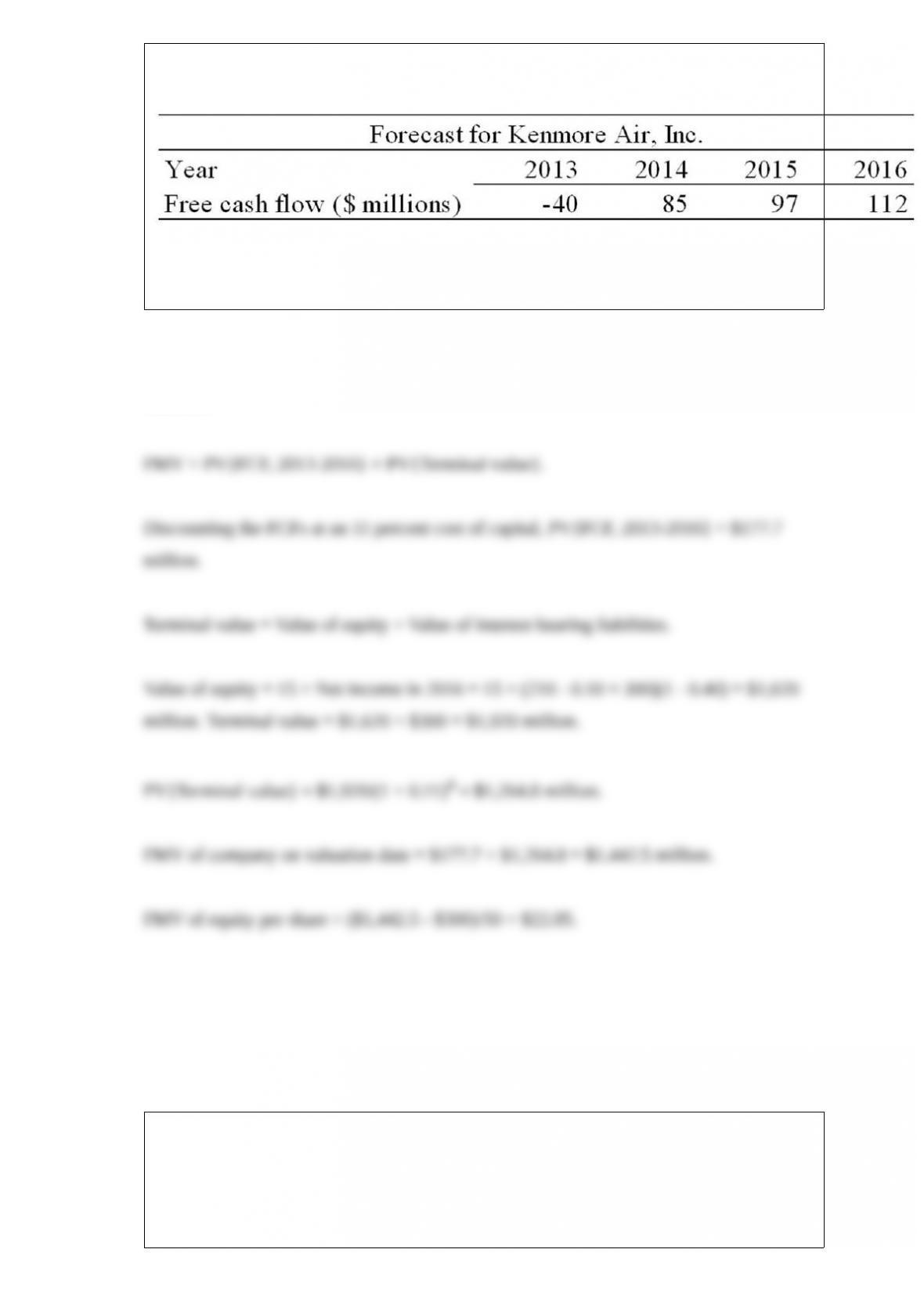
Given the forecast below, estimate the fair market value of Kenmore Air’s equity per
share at the end of 2012 under the following assumptions:
– EBIT in year 2016 will be $210 million.
– At year-end 2016, Kenmore Air has reached maturity, and analysts expect its equity
will sell for 15 times year 2016 net income.
– At year-end 2016, Kenmore Air has $300 million book value of interest-bearing
liabilities outstanding at an average interest rate of 10 percent.
– Kenmore Air’s weighted-average cost of capital is 11 percent and its tax rate is 40
percent.
– Kenmore Air has 50 million shares outstanding and the market value of its
interest-bearing liabilities on the valuation date equals $300 million.
Answer:
Please refer to the selected financial information for Law Specialists, Inc. above. Law
Specialists paid its first dividends in 2014. As an analyst, assess the company’s decision
to pay dividends.
Answer: