
1) When adding a randomly chosen new stock to an existing portfolio, the higher (or
more positive) the degree of correlation between the new stock and stocks already in
the portfolio, the less the additional stock will reduce the portfolio’s risk.
2) A firm can change its beta through managerial decisions, including capital budgeting
and capital structure decisions.
3) The cost of external equity capital raised by issuing new common stock (re) is
defined as follows, in words: “The cost of external equity equals the cost of equity
capital from retaining earnings (rs), divided by one minus the percentage flotation cost
required to sell the new stock, (1 – F).”
4) Because short-term interest rates are much more volatile than long-term rates, you
would, in the real world, generally be subject to much more interest rate price risk if
you purchased a 30-day bond than if you bought a 30-year bond.
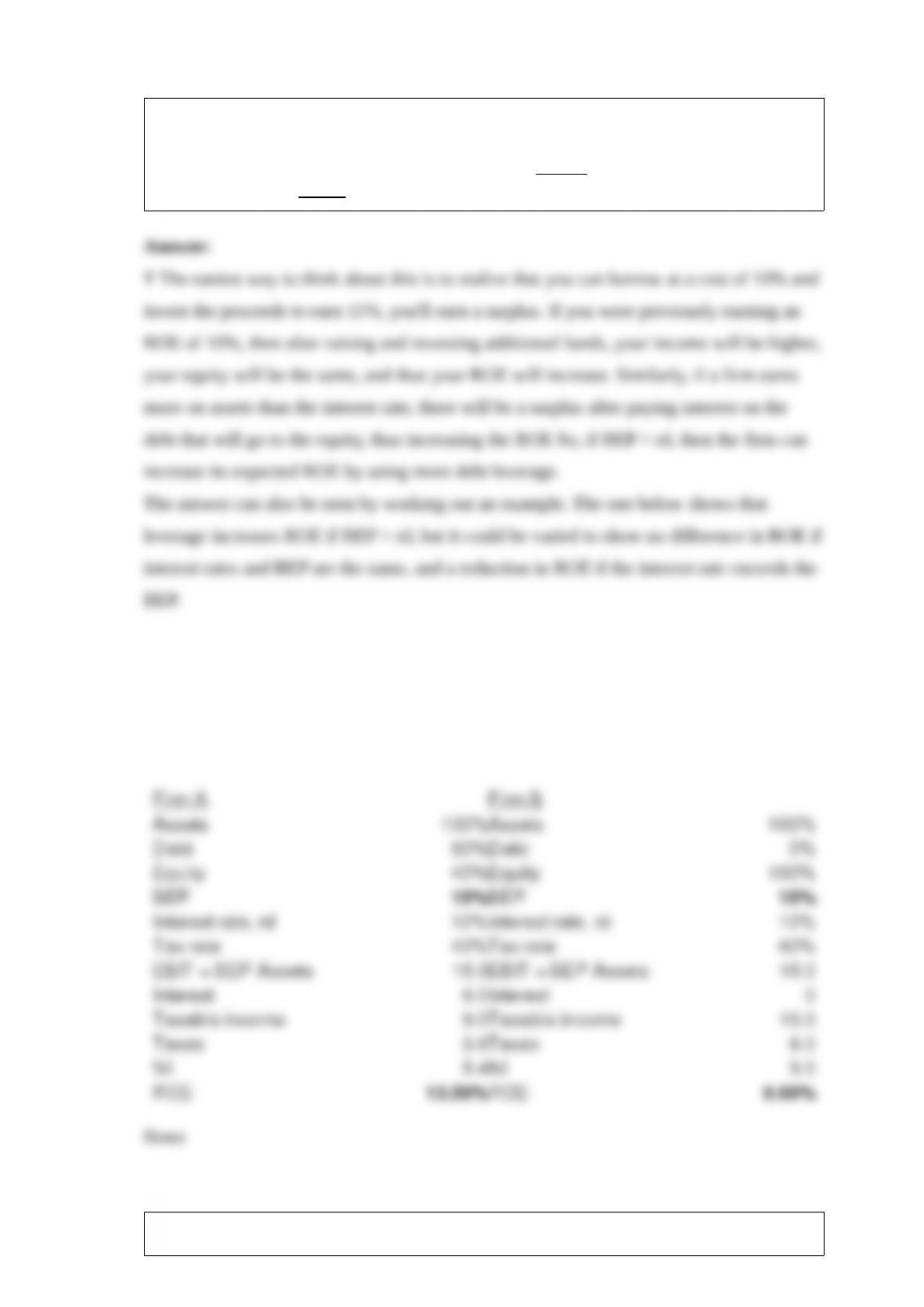
5) Suppose Firms A and B have the same amount of assets, pay the same interest rate on
their debt, have the same basic earning power (BEP), and have the same tax rate.
However, Firm A has a higher debt ratio. If BEP is greater than the interest rate on debt,
Firm A will have a higher ROE as a result of its higher debt ratio.
6) A firm’s business risk is largely determined by the financial characteristics of its

industry, especially by the amount of debt the average firm in the industry uses.
7) Since depreciation is a non-cash charge, it neither appears on nor has any effect on
the cash budget. Thus, if the depreciation charge for the coming year doubled or halved,
this would have no effect on the cash budget.
8) If investors’ aversion to risk rose, causing the slope of the SML to increase, this
would have a greater impact on the required rate of return on equity, rs, than on the
interest rate on long-term debt, rd, for most firms. Other things held constant, this
would lead to an increase in the use of debt and a decrease in the use of equity.
However, other things would not stay constant if firms used a lot more debt, as that
would increase the riskiness of both debt and equity and thus limit the shift toward debt.
9) Opportunity costs include those cash inflows that could be generated from assets the
firm already owns if those assets are not used for the project being evaluated.