1) Open market purchases by the Fed increase the supply of nonborrowed reserves.
2) Most private pension plans are insured by the Penny Benny, which pays benefits
when a plan’s sponsor goes bankrupt.
3) Regulatory forbearance reduces moral hazard because an operating but insolvent
S&L will take fewer risks than healthy S&Ls that can take risks and still remain
solvent.
4) A deferred load is a fee charged when shares in a mutual fund are redeemed.
5) When income and wealth are rising, the demand for bonds rises and the demand
curve shifts to the right.
6) If interest rates rise by 5 percentage points, then bank profits (measured using gap
analysis) will increase regardless of the income gap.
7) In the years just prior to the 2007-2009 financial crisis, mortgage loans were issued
to borrowers with no income or employment.
8) An increase in an asset’s expected return relative to that of an alternative asset,
holding everything else unchanged, raises the quantity demanded of the asset.
9) A balloon loan requires periodic payments of principle and interest.
10) Off-balance-sheet activities consist of trading financial instruments and generating
income from fees and loan sales, all of which affect bank profits but are not visible on
bank balance sheets.
11) Resisted takeovers are called hostile.
12) A sinking fund is a requirement in the bond indenture that the firm pay off a portion
of the bond issue each year.
13) Capital market securities are less liquid and have longer maturities than money
market securities.
14) The market segmentation theory is able to explain why interest rates on bonds of
different maturities move together over time.

15) The Washington, D.C. Fed bank, with over 30 percent of the system’s assets, is the
most important Federal Reserve Bank.
16) Although neither ________ nor the ________ is officially set by the Federal Open
Market Committee, decisions concerning these policy tools are effectively made by the
committee.
A) margin requirements; discount rate
B) margin requirements; federal funds rate
C) reserve requirements; discount rate
D) reserve requirements; federal funds rate
17) When a bond’s price falls, its yield to maturity ________ and its current yield
________.
A) falls; falls
B) rises; rises
C) falls; rises
D) rises; falls
18) A central bank sale of ________ to purchase ________ in the foreign exchange
market results in an equal decline in its international reserves and the monetary base.
A) foreign assets; domestic currency
B) foreign assets; foreign currency
C) domestic currency; foreign assets
D) domestic currency; domestic currency
19) From the peak of the high-tech bubble in 2000, the stock market ________ by over
________ by late 2002 .
A) collapsed; 75%
B) rose; 35%
C) collapsed; 30%
D) rose; 50%

20) Which of the following statements is correct?
A) current account balance = capital account balance
B) current account balance = capital account balance + net change in government
international reserves
C) current account balance + capital account balance = net change in government
international reserves
D) current account balance + net change in government international reserves = capital
account balance
21) In September 1992, the Bundesbank attempted to keep the mark from appreciating
relative to the British pound, but it failed because participants in the foreign exchange
market came to expect the
A) appreciation of the mark
B) depreciation of the mark
C) revaluation of the dollar
D) the end of the Exchange Rate Mechanism
22) Under a fixed exchange rate system,
A) an anchor country loses control over its monetary policy
B) a country that ties its currency to that of another country gains control of the other
country’s monetary policy
C) a country that ties its currency to that of another country loses control over its
monetary policy
D) a country that ties its currency to that of another country acquires greater control
over its monetary policy
23) Quotas
A) are restrictions placed on the quality of foreign goods that can be imported
B) are fees placed on imported goods
C) are restrictions placed on the quantity of foreign goods that can be exported
D) are none of the above

24) The major provisions of the Financial Institutions Reform, Recovery, and
Enforcement Act of 1989 included
A) expanding the responsibilities of the FDIC, which is now the sole administrator of
the federal deposit insurance system
B) establishing the Resolution Trust Corporation to manage and resolve insolvent thrifts
placed in conservatorship or receivership
C) directing the Federal Home Loan Bank Board to continue to pursue regulatory
forbearance
D) all of the above
E) only A and B of the above
25) During the 2007-2009 financial crisis, housing prices began to fall and subprime
mortgages began to default. Which of the following statements is true about the rating
of subprime mortgage products?
A) The rating agencies were way ahead of the market, giving many of the subprime
products junk ratings from the start
B) Rating agencies were not involved. Subprime mortgages could not be structured, by
law
C) Many AAA-rated subprime products had to be downgraded over and over again until
they reached junk status
D) None of the above are true
26) A bank that wants to monitor the check payment practices of its commercial
borrowers, so that moral hazard can be prevented, will require borrowers to
A) place a bank officer on their board of directors
B) place a corporate officer on the bank’s board of directors
C) keep compensating balances in a checking account at the bank
D) do all of the above
E) do only A and B of the above
27) The price paid for the rental of borrowed funds (usually expressed as a percentage
of the rental of $100 per year) is commonly referred to as the
A) inflation rate
B) exchange rate
C) interest rate
D) aggregate price level

28) Because of their ________ liquidity, ________ U.S. government securities are
called secondary reserves.
A) low; short-term
B) low; long-term
C) high; short-term
D) high; long-term
29) If a bank has $100,000 of deposits, a required reserve ratio of 20 percent, and
$40,000 in reserves, then the maximum deposit outflow it can sustain without altering
its balance sheet is
A) $30,000
B) $25,000
C) $20,000
D) $10,000
30) Instrument independence means the central bank is free from
A) political pressure regarding how it uses the tools of monetary policy
B) political pressure regarding the goals it pursues
C) both A and B of the above
D) neither A nor B of the above
31) If a $10,000 face value discount bond maturing in one year is selling for $9,000,
then its yield to maturity is approximately
A) 9 percent
B) 10 percent
C) 11 percent
D) 12 percent
32) An increase in the domestic interest rate shifts the expected return schedule for
________ deposits to the ________ and causes the domestic currency to appreciate.
A) domestic; right
B) domestic; left
C) foreign; right
D) foreign; left
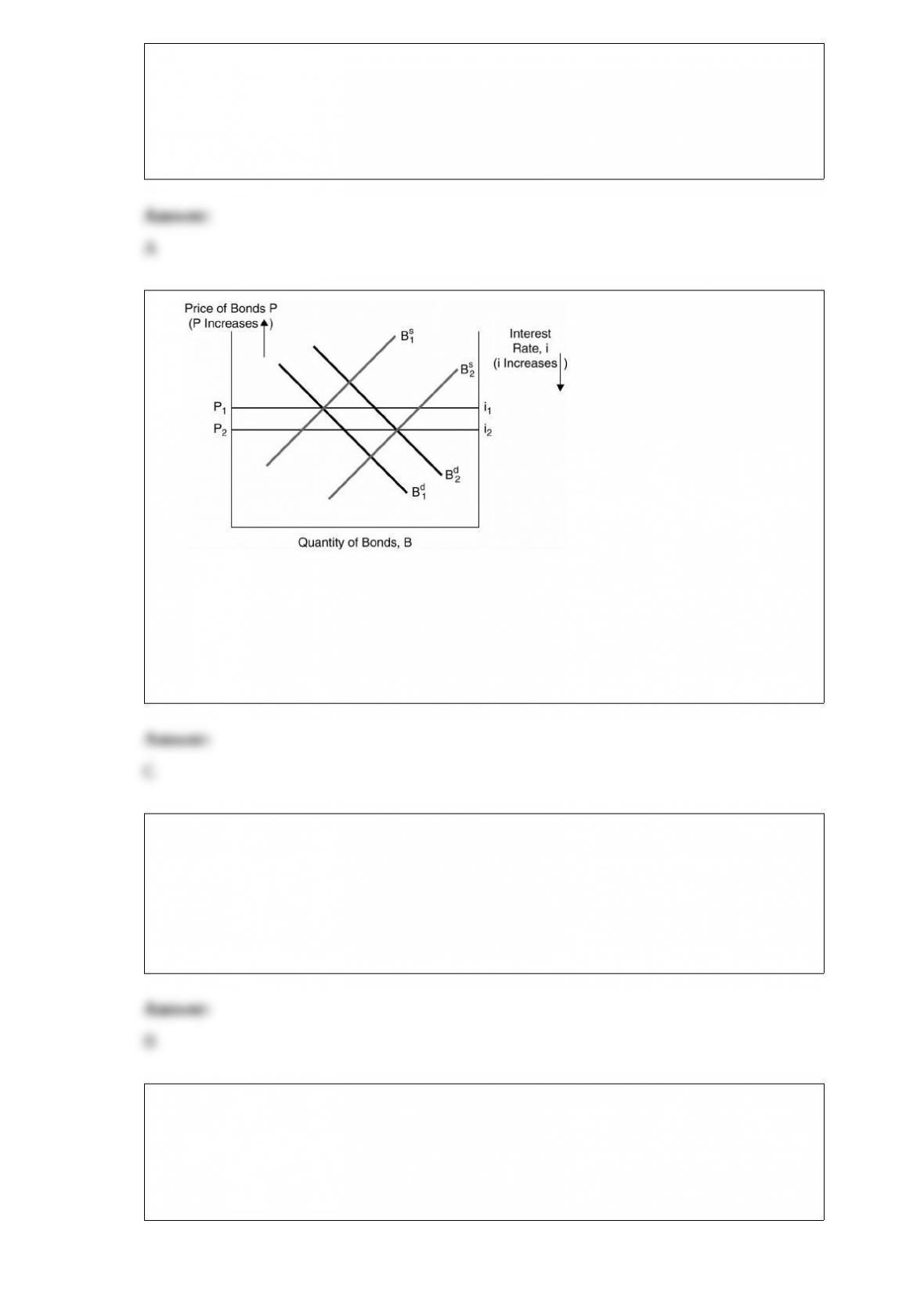
33)
Figure 4.2
In Figure 4.2, one possible explanation for a decrease in the interest rate from i2 to i1 is
A) an increase in government budget deficits
B) an increase in expected inflation
C) a decrease in economic growth
D) a decrease in the riskiness of bonds relative to other investments
34) In an emerging market economy, there are typically two paths to a financial crisis:
financial liberalization/globalization and ________.
A) asset pricing bubbles
B) severe fiscal imbalances
C) a global financial crisis
D) none of the above
35) Mutual funds hold about ________ of financial intermediaries’ total assets.
A) one-sixth
B) one-fourth
C) one-half
D) two-thirds

36) Milton Friedman contends that it is entirely possible that when the money supply
rises, interest rates may ________ if the ________ effect is more than offset by changes
in income, the price level, and expected inflation.
A) fall; liquidity
B) fall; risk
C) rise; liquidity
D) rise; risk
37) At its inception, the Federal Reserve was intended to be
A) the Treasury’s banker
B) the issuer of government debt
C) a lender of last resort
D) a regulator of bank holding companies
38) A swap that involves the exchange of one set of interest payments for another set of
interest payments is called a(n) ________.
A) interest-rate swap
B) currency swap
C) swaption
D) notional swap
39) The presence of transaction costs in financial markets explains, in part, why
A) financial intermediaries and indirect finance play such an important role in financial
markets
B) equity and bond financing play such an important role in financial markets
C) corporations get more funds through equity financing than they get from financial
intermediaries
D) direct financing is more important than indirect financing as a source of funds

40) (I) If a corporation suffers big losses, the demand for its bonds will rise because of
the higher interest rates the firm must pay.
(II) The spread between the interest rates on bonds with default risk and default-free
bonds is called the risk premium.
A) (I) is true, (II) false
B) (I) is false, (II) true
C) Both are true
D) Both are false
41) The change in the bond’s price relative to the initial purchase price is
A) the current yield
B) coupon payment
C) yield to maturity
D) rate of capital gain
42) Currently, there are ________ countries that are members of the European
Monetary Union.
A) 10
B) 12
C) 15
D) 20
43) The Federal Deposit Insurance Corporation Improvement Act of 1991
A) instructed the FDIC to come up with risk-based deposit insurance premiums
B) expanded the FDIC’s ability to use the “too-big-to-fail” policy
C) instructed the FDIC to wait longer before intervening when a bank gets into trouble
D) did all of the above
44) Insurance companies’ attempts to minimize adverse selection and moral hazard
explain which of the following insurance practices?
A) risk-assessment screening
B) risk-based premiums
C) restrictive provisions

D) all of the above
E) only A and B of the above
45) Investment banking activities of the commercial banks were blamed for many bank
failures. This led to
A) the passage of the National Bank Charter Amendments Act of 1918
B) the passage of the Garn-St. Germain Act of 1982
C) the passage of the National Bank Act of 1863
D) the passage of the Glass-Steagall Act of 1933
E) the establishment of the Federal Deposit Insurance Corporation in 1933
46) (I) Callable bonds usually have a higher yield than comparable noncallable bonds.
(II) Convertible bonds are attractive to bondholders and sell for a higher price than
comparable nonconvertible bonds.
A) (I) is true, (II) false
B) (I) is false, (II) true
C) Both are true
D) Both are false
47) When Americans and foreigners expect the return on dollar deposits to be high
relative to the return on foreign deposits, there is a ________ demand for dollar
deposits and a correspondingly ________ demand for foreign deposits.
A) higher; higher
B) higher; lower
C) lower; higher
D) lower; lower
48) Adjustable-rate mortgages
A) protect households against higher mortgage payments when interest rates rise
B) keep financial institutions’ earnings high even when interest rates are falling
C) have many attractive attributes, explaining why so few households now seek
fixed-rate mortgages
D) do only A and B of the above

E) do none of the above
49) If a bank has more rate-sensitive liabilities than rate-sensitive assets, then a(n)
________ in interest rates will ________ bank profits.
A) increase; increase
B) increase; reduce
C) decline; reduce
D) decline; not affect
50) The theory of bureaucratic behavior suggests that the Federal Reserve will
A) try to avoid a conflict with the president and Congress over increases in interest rates
B) try to gain regulatory power over more banks
C) devise clever strategies in an effort to avoid blame for poor economic performance
D) do all of the above