
1) In a defined contribution pension plan,
a. The plan does not promise to pay the retiree a specific income stream after
retirement.
b. The plan does promise to pay the retiree a specific income stream after retirement.
c. The employee’s retirement income is not an obligation of the firm.
d. The company carries the risk of paying future pension benefits to retirees.
e. Choices a and c
2) According to the semistrong-form efficient market hypothesis, which of the
following types of information are fully reflected in stock prices?
a.Rates of return, trading volume, and news about the economy.
b.Dividend and earnings announcements.
c.Rates of return, trading volume, and block trades.
d.Earnings announcements and rates of return.
e.All of the above.
3) Which of the following is not a U.S. government agency?
a.Federal National Mortgage Association
b.Federal Home Loan Bank
c.Government National Mortgage Association
d.Government Employees Insurance Company
e.Federal Housing Administration
4) Assume that the risk-free rate of return is 3% and the market portfolio on the Capital
Market Line (CML) has an expected return of 11% and a standard deviation of 14%.
How should you invest $100,000 if you are only willing to accept a total portfolio risk
of 8%?
a. Invest $140,000 in the market portfolio and by borrowing $40,000 at the risk-free
rate.
b. Invest $80,000 in the market portfolio and the remainder in the risk-free security.
c. Invest $63,636.36 in the market portfolio and the remainder in the risk-free security.
d. Invest $36,363.64 in the market portfolio and the remainder in the risk-free security.
e. Invest $100,000 on another portfolio on the CML that does not contain any of the
market portfolio or the risk-free security, but has a standard deviation of 8%.
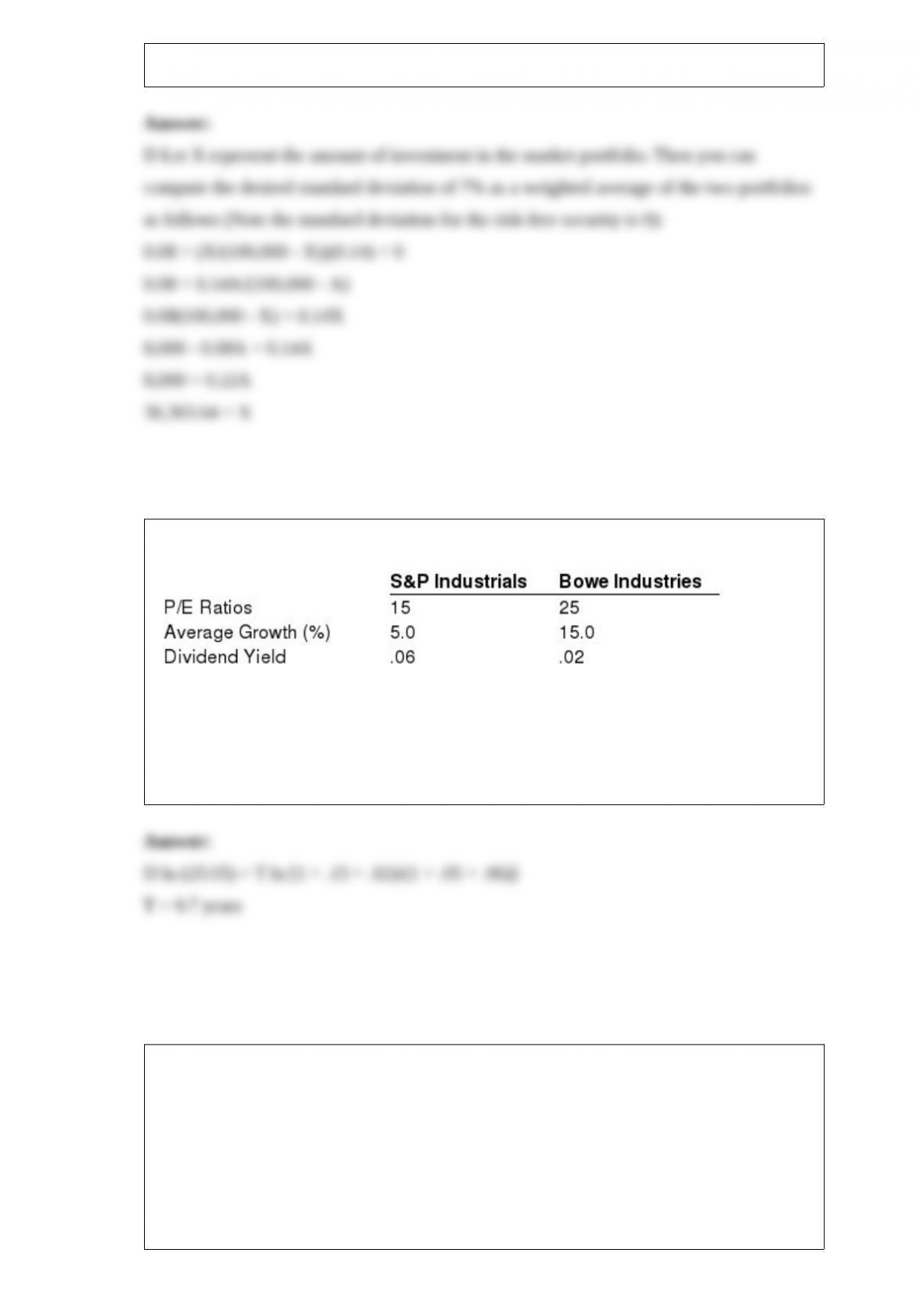
5) What is the implied growth duration of Bowe Industries given the following:
a. 3.2 years
b. 6.6 years
c. 8.6 years
d. 9.7 years
e. 10.6 years
6) Defensive companies are firms where
a. Sales, earnings and cash flows are extremely uncertain and not necessarily related to
the economy.
b. Sales, earnings and cash flows are likely to withstand changes caused by the
economic environment.
c. Sales, earnings and cash flows are heavily influenced by aggregate business activity.
d. Sales, earnings and cash flows are growing exponentially.
e. None of the above.
7) Based on the information provided, calculate the intrinsic value in 2010 of a share of
INV Corp. using the FCFF (free cash flow to the firm) model. For 2010 the FCFF was
$30,000, total debt was $20,000, and there were 12000 shares outstanding. The required
rate of return is 9% and the estimated growth rate in FCFF is 6.5%.
a. $104.83
b. $153.25
c. $112.50
d. $94.92
e. $80.45
8) Assume that you purchased shares of a stock at a price of $35 per share. At this time
you wrote a call option with a $35 strike and received a call price of $2. The stock
currently trades at $70. Calculate the dollar return on this option strategy.
a. $25
b. -$2
c. $2
d. -$25
e. $0
9) Which of the following is not a characteristic of warrants?
a. They are sweeteners added to other security issues.
b. After the initial sale, warrants are detachable.

c. They pay no dividends.
d. They provide no voting rights.
e. No dilution protection is offered in the event of stock dividends or stock splits.
10) A type of charting which normally disregards both time and volume is the
a. Bar chart.
b. Point and figure chart.
c. Pie chart.
d. Histogram.
e. A linear regression graph.