
Which of the following statements is FALSE?
A) When stocks are perfectly positively correlated, the set of portfolios is identified
graphically by a straight line between them.
B) An investor seeking high returns and low volatility should only invest in an efficient
portfolio.
C) When the correlation between securities is less than 1, the volatility of the portfolio
is reduced due to diversification.
D) Efficient portfolios can be easily ranked, because investors will choose from among
them those with the highest expected returns.
Suppose that the market portfolio is equally likely to increase by 24% or decrease by
8%. Security “X” goes up on average by 29% when the market goes up and goes down
by 11% when the market goes down. Security “Y” goes down on average by 16% when
the market goes up and goes up by 16% when the market goes down. Security “Z” goes
up on average by 4% when the market goes up and goes up by 4% when the market
goes down.
The expected return on the market portfolio is closest to:
A) 0%
B) 4%
C) 8%
D) 16%
Iota Industries is an all-equity firm with 50 million shares outstanding. Iota has $200
million in cash and expects future free cash flows of $75 million per year. Management
plans to use the cash to expand the firm’s operations, which in turn will increase future
free cash flows by 12%. Iota’s cost of capital is 10% and assume that capital markets are

perfect.
The price per share of Iota if they use the $200 million to expand is closest to:
A) $13.75
B) $16.50
C) $19.00
D) $16.80
Taggart Transcontinental is considering a $250 million investment to launch a new rail
line. The project is expected to generate a free cash flow of $32 million per year, and its
unlevered cost of capital is 8%. Taggart’s marginal corporate tax rate is 35%.Assume
that to fund the investment Taggart will take on $150 million in permanent debt with
the remainder of the investment funded through issuance of new equity. Assuming
Taggart will incur a 2% (after-tax) underwriting fee on the new debt issue and a 5%
underwriting fee on the issuance of new equity, the NPV of Taggart’s new rail line is
closest to:
A) $195 million
B) $200 million
C) $235 million
D) $240 million
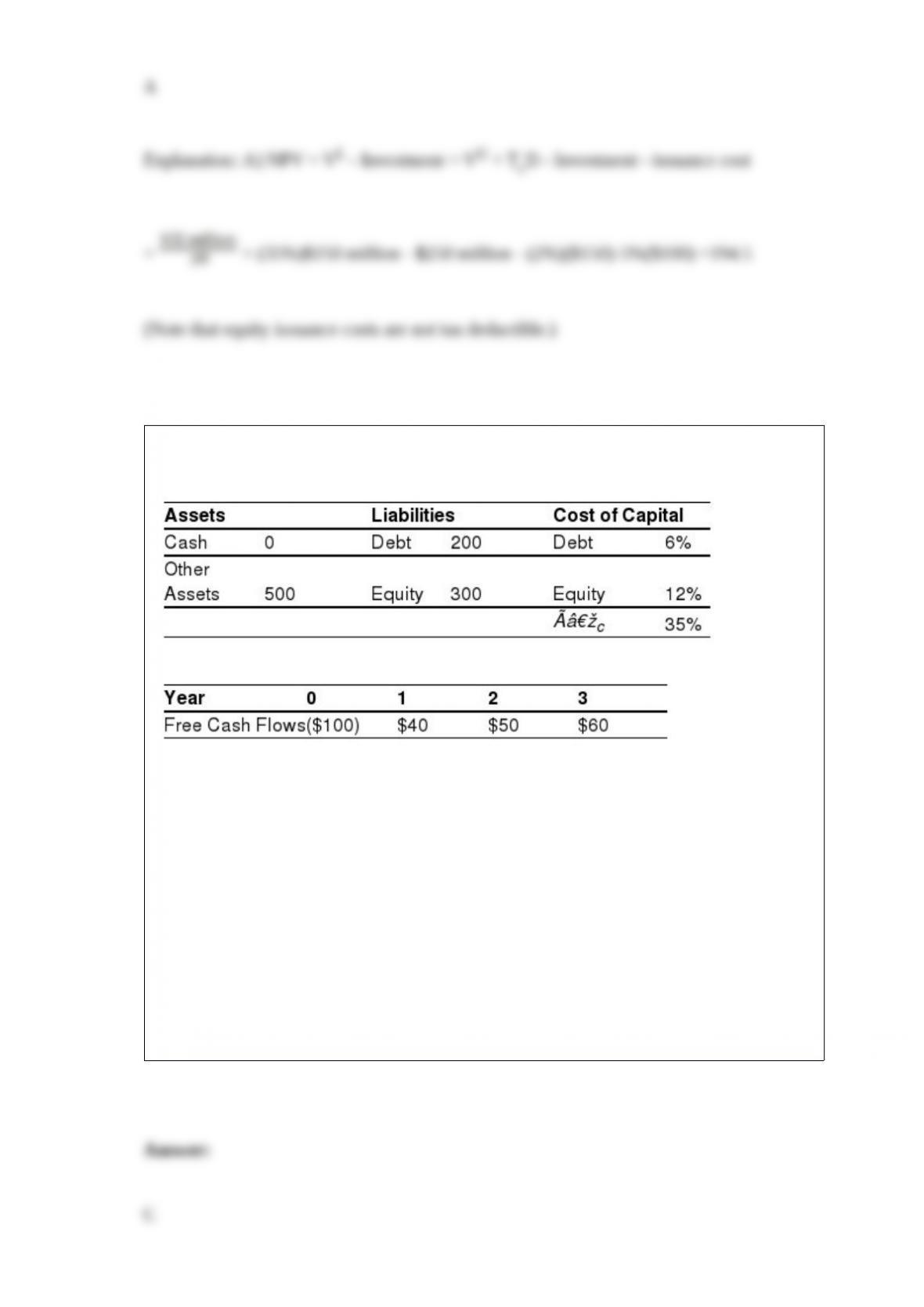
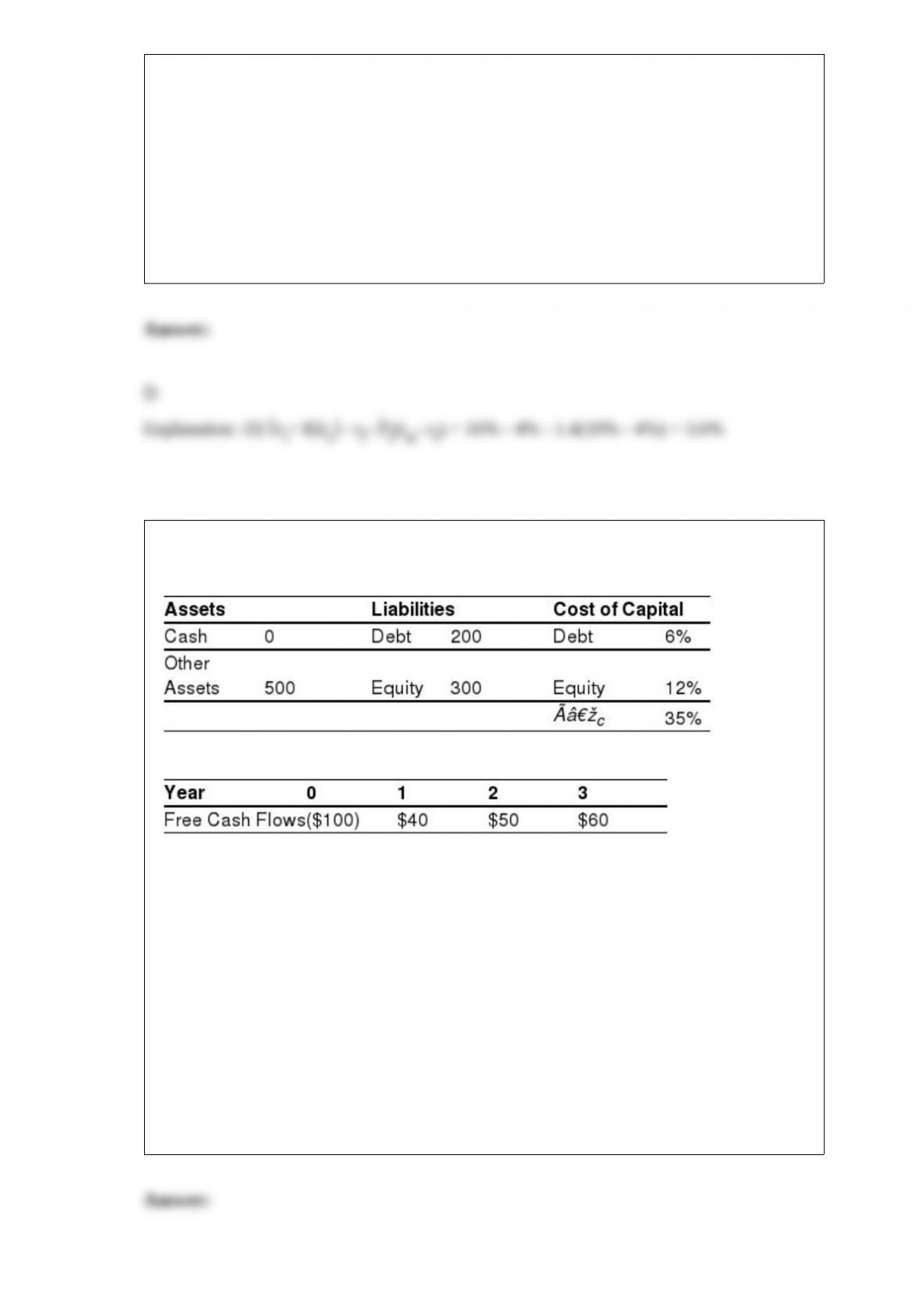
Omicron Industries’ Market Value Balance Sheet ($ Millions)
and Cost of Capital
Omicron Industries New Project Free Cash Flows
Assume that this new project is of average risk for Omicron and that the firm wants to
hold constant its debt to equity ratio.
The Debt Capacity for Omicron’s new project in year 0 is closest to:
A) $38.75
B) $75.50
C) $50.25
D) $10.25

Galt Industries has no debt, total equity capitalization of $600 million, and an equity
beta of 1.2. Included in Galt’s assets is $90 million in cash and risk-free securities.
Assume the risk-free rate is 4% and the market risk premium is 6%.
Galt’s enterprise value is closest to:
A) $90 million
B) $510 million
C) $600 million
D) $690 million
Which of the following statements is FALSE?
A) The unlevered beta measures the market risk of the firm’s business activities,
ignoring any additional risk due to leverage.
B) If a firm holds $1 in cash and has $1 of risk-free debt, then the interest earned on the
cash will equal the interest paid on the debt. The cash flows from each source cancel
each other, just as if the firm held no cash and no debt.
C) The unlevered beta measures the market risk of the firm without leverage, which is
equivalent to the beta of the firm’s assets.
D) When a firm changes its capital structure without changing its investments, its
levered beta will remain unaltered, however, its asset beta will change to reflect the

effect of the capital structure change on its risk.
Which of the following statements is FALSE?
A) The variance of a portfolio is equal to the weighted average correlation of each stock
within the portfolio.
B) The variance of a portfolio is equal to the sum of the covariances of the returns of all
pairs of stocks in the portfolio multiplied by each of their portfolio weights.
C) The variance of a portfolio is equal to the weighted average covariances of each
stock within the portfolio.
D) The volatility declines as the number of stocks in a portfolio grows.
Sarah Palin reportedly was paid a $11 million advance to write her book Going Rogue.
The book took one year to write. In the time she spent writing, Palin could have been
paid to give speeches and appear on TV news as a political commentator. Given her
popularity, assume that she could have earned $8 million over the year (paid at the end
of the year) she spent writing the book. Assume that she was unable to fulfill her media
commitments of appearing on TV news as a political commentator or give
speeches.while she was writing the book.
Assume that once her book is finished, it is expected to generate royalties of $5 million
in the first year (paid at the end of the year) and these royalties are expected to decrease
by 40% per year in perpetuity. Assuming that Palin’s cost of capital is 10% and given
these royalties payments, the NPV of Palin’s book deal is closest to:
A) $3.75 million
B) $12.20 million
C) $13.00 million
D) $13.75 million
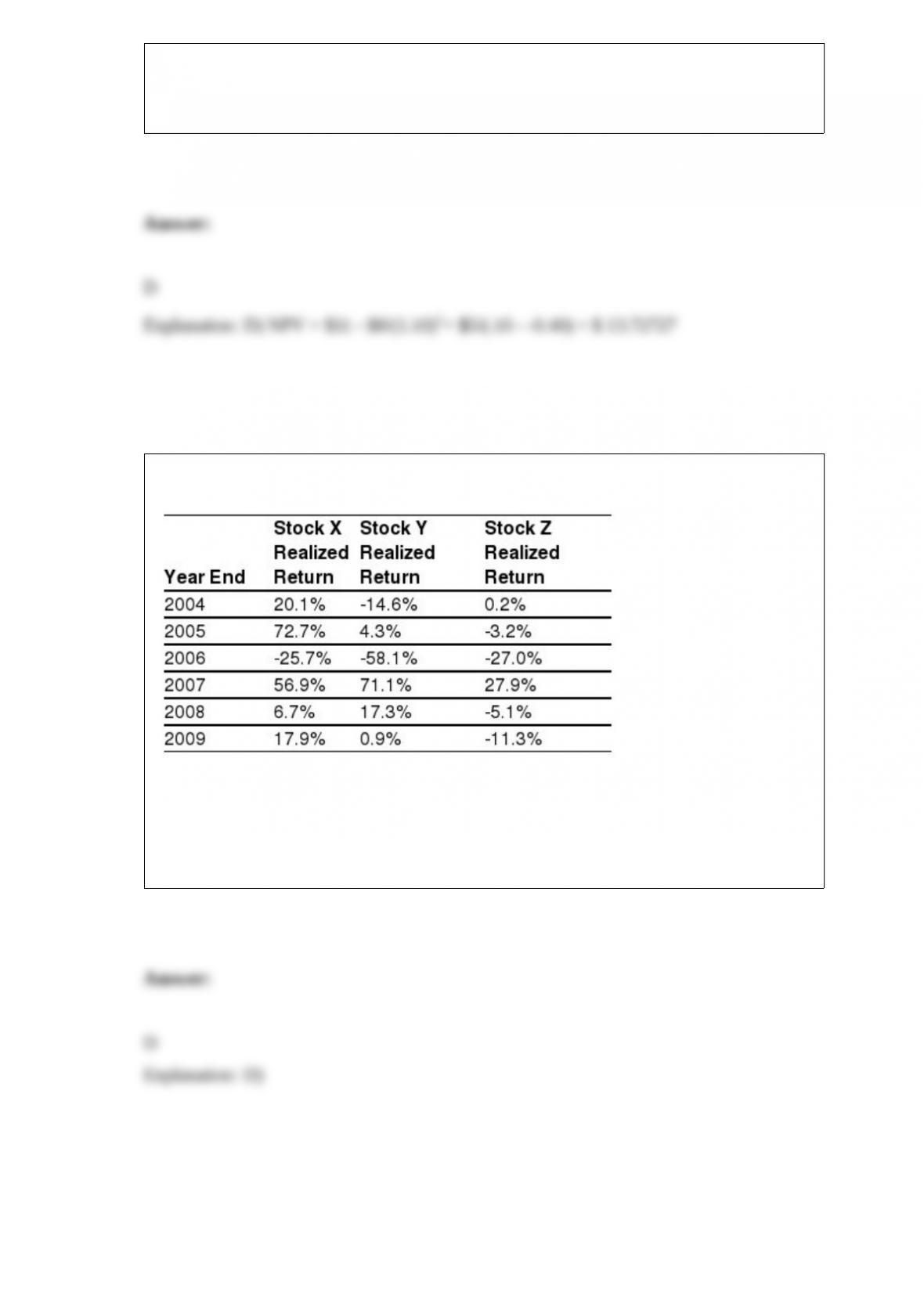
Consider the following returns:
The Volatility on Stock Z’s returns is closest to:
A) 3%
B) 13%
C) 16%
D) 18%
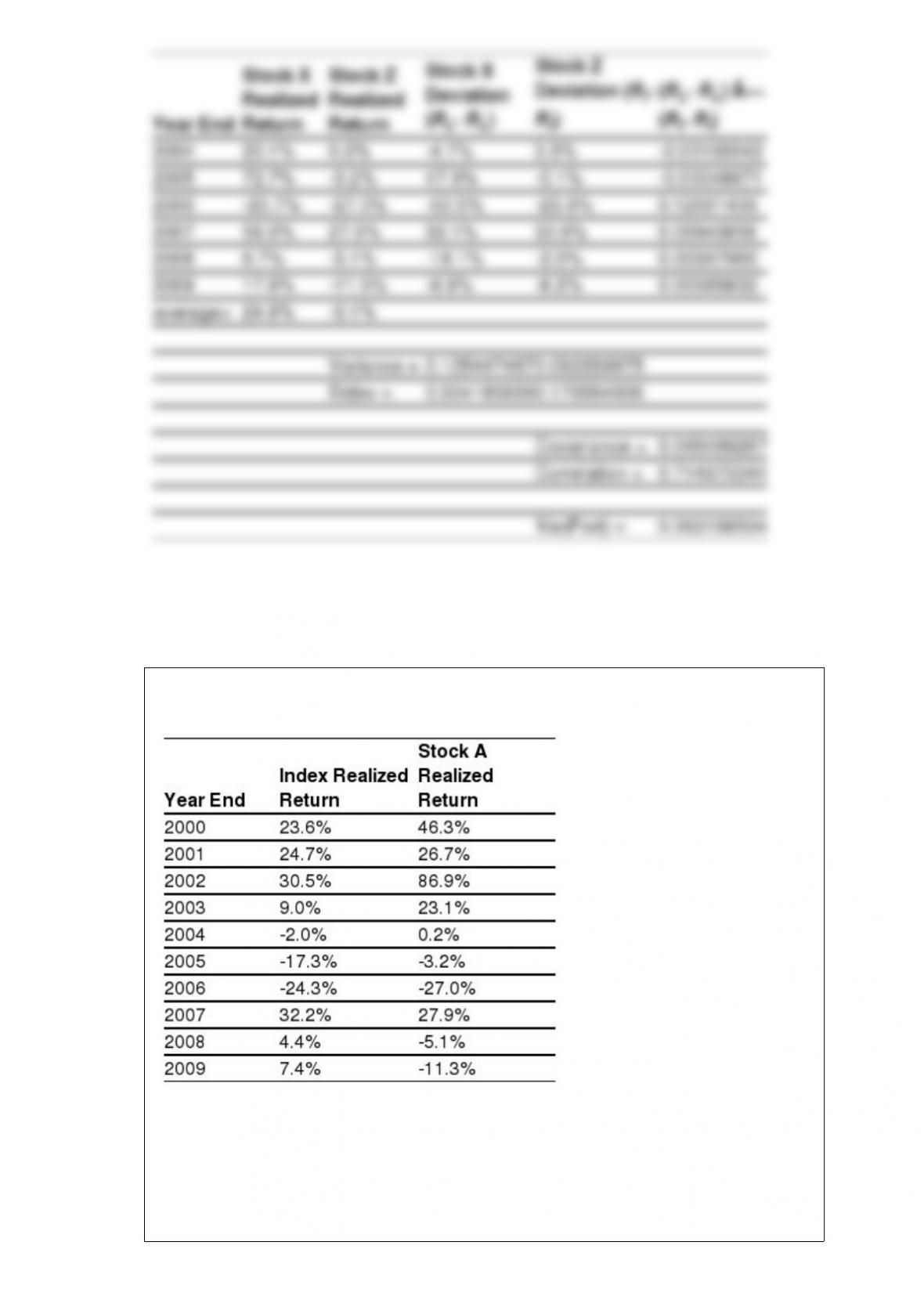
Consider the following realized annual returns:
Suppose that you want to use the 10 year historical average return on the Index to
forecast the expected future return on the Index. The 95% confidence interval for your
estimate of the expect return is closest to:
A) -9.6% to 27.3%
B) 6.8% to 10.7%
C) -3.5% to 21.1%
D) 4.9% to 12.7%
The Sisyphean Corporation is considering investing in a new cane manufacturing
machine that has an estimated life of three years. The cost of the machine is $30,000

and the machine will be depreciated straight line over its three-year life to a residual
value of $0.
The cane manufacturing machine will result in sales of 2,000 canes in year 1. Sales are
estimated to grow by 10% per year each year through year three. The price per cane that
Sisyphean will charge its customers is $18 each and is to remain constant. The canes
have a cost per unit to manufacture of $9 each.
Installation of the machine and the resulting increase in manufacturing capacity will
require an increase in various net working capital accounts. It is estimated that the
Sisyphean Corporation needs to hold 2% of its annual sales in cash, 4% of its annual
sales in accounts receivable, 9% of its annual sales in inventory, and 6% of its annual
sales in accounts payable. The firm is in the 35% tax bracket, and has a cost of capital
of 10%.
The required net working capital in the first year for the Sisyphean Corporation’s
project is closest to:
A) $3,600
B) $3,960
C) $2,880
D) $5,400
Assume that the economy has three types of people. 20% are fad followers, 75% are
passive investors, and 5% are informed traders. The portfolio consisting of all informed
traders has a beta of 1.4 and an expected return of 16%. The market has an expected
return of 10% and the risk-free rate is 4%.The alpha for the informed investors is
closest to:
A) -2.4%
B) -0.9%
C) 0.0%
D) 3.6%
Omicron Industries’ Market Value Balance Sheet ($ Millions)
and Cost of Capital
Omicron Industries New Project Free Cash Flows
Assume that this new project is of average risk for Omicron and that the firm wants to
hold constant its debt to equity ratio.
The Debt Capacity for Omicron’s new project in year 2 is closest to:
A) $55.25
B) $38.75
C) $22.00
D) $33.00

Glucose Scan Incorporated (GSI) currently sells its latest glucose monitor, the
Glucoscan 3000, to diabetic patients for $129. GSI plans on lowering their price next
year to $99 per unit. The cost of goods sold for each Glucoscan unit is $50, and GSI
expects to sell 100,000 units over the next year.
Suppose that if GSI drops the price on the Glucoscan 3000 immediately, it can increase
sales over the next year by 30% to 130,000 units. The incremental impact of this price
drop on the firms EBIT is closest to:
A) a decline of 1.5 million.
B) an increase of 1.5 million.
C) a decline of 2.4 million.
D) an increase of 2.4 million.
Luther Industries has no debt and expects to generate free cash flows of $48 million
each year. Luther believes that if it permanently increases its level of debt to $100
million, the risk of financial distress may cause it to lose some customers and receive
less favorable terms from its suppliers. As a result, Luther’s expected free cash flows
with debt will be only $44 million per year. Suppose Luther’s tax rate is 40%, the
risk-free rate is 6%, the expected return of the market is 14%, and the beta of Luther’s
free cash flows is 1.25 (with or without leverage).

The value of Luther with leverage is closest to:
A) $315 million
B) $340 million
C) $205 million
D) $300 million
Defenestration Industries plans to pay a $4.00 dividend this year and you expect that the
firm’s earnings are on track to grow at 5% per year for the foreseeable future.
Defenestration’s equity cost of capital is 13%.
Suppose that Defenestration decides to pay a dividend of only $2 per share this year and
use the remaining $2 per share to repurchase stock. If Defenestration maintains this
dividend and total payout rate, then the rate at which Defenestration’s dividends and
earnings per share are expected to grow is closest to:
A) 7%
B) 13%
C) 9%
D) 5%
The Dodd-Frank Wall Street Reform and Consumer Protection Act does the following:
A) Exempts firms with less than $75 million in publicly traded shares from some
provisions of SOX.
B) Requires the SEC to study ways to reduce the cost of SOX for firms with less than
$250 million in publicly traded shares.
C) Strengthens whistle-blower provisions of SOX.
D) All of the above.
Luther Industries needs to raise $25 million to fund a new office complex. The
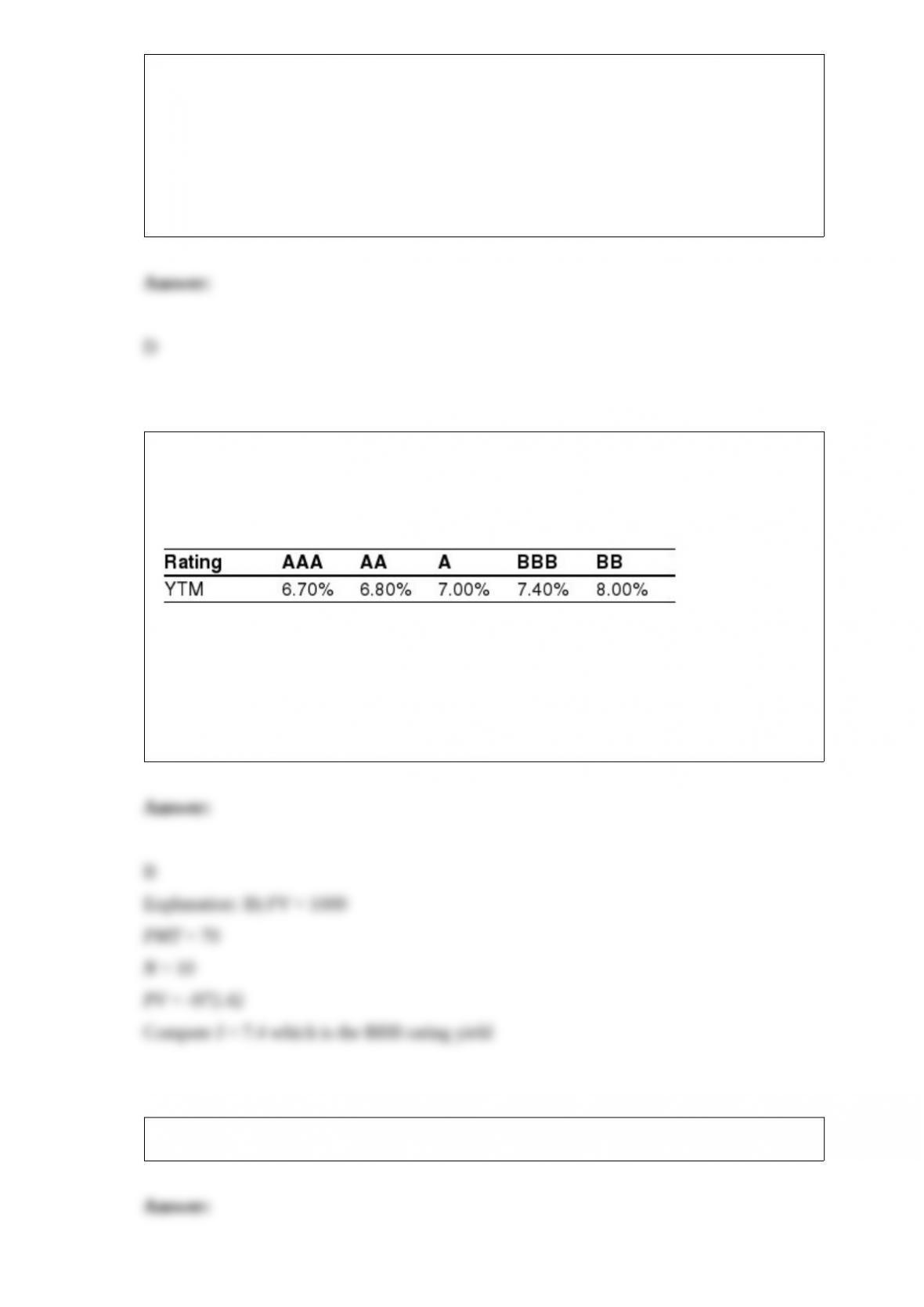
company plans on issuing ten-year bonds with a face value of $1000 and a coupon rate
of 7.0% (annual payments). The following table summarizes the YTM for similar
ten-year corporate bonds of various credit ratings:
Suppose that when these bonds were issued, Luther received a price of $972.42 for each
bond. What is the likely rating that Luther’s bonds received?
A) AA
B) BBB
C) B
D) A
What is the relationship between a bond’s price and its yield to maturity?
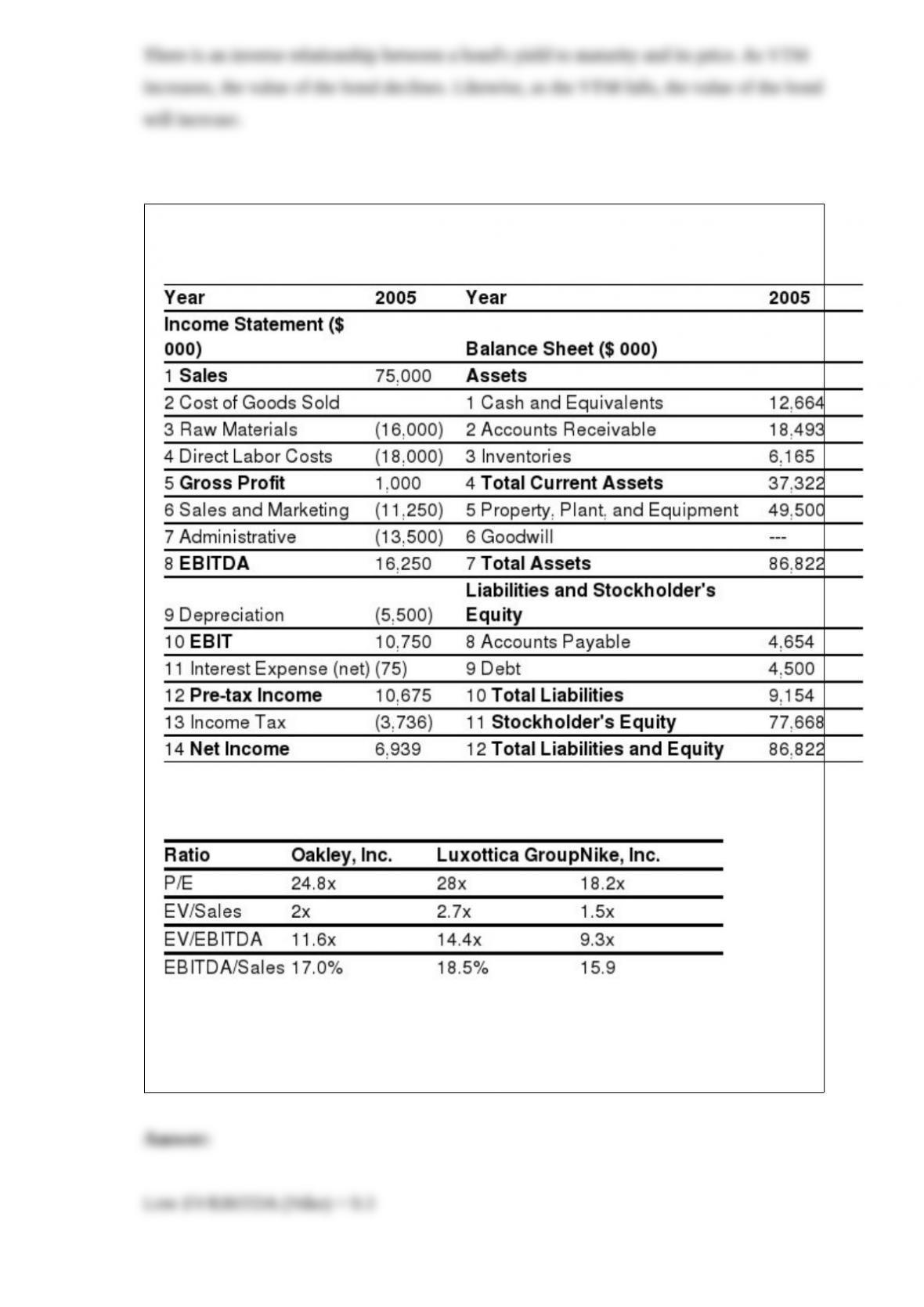
Estimated 2005 Income Statement and Balance Sheet Data for Ideko Corporation
The following are financial ratios for three comparable companies:
What range for the market value of equity for Ideko is implied by the range of
EV/EBITDA multiples for the comparable firms if Ideko holds $6.5 million of cash in
excess of its working capital needs?
If its YTM does not change, how does a bond’s cash price change between coupon
payments?
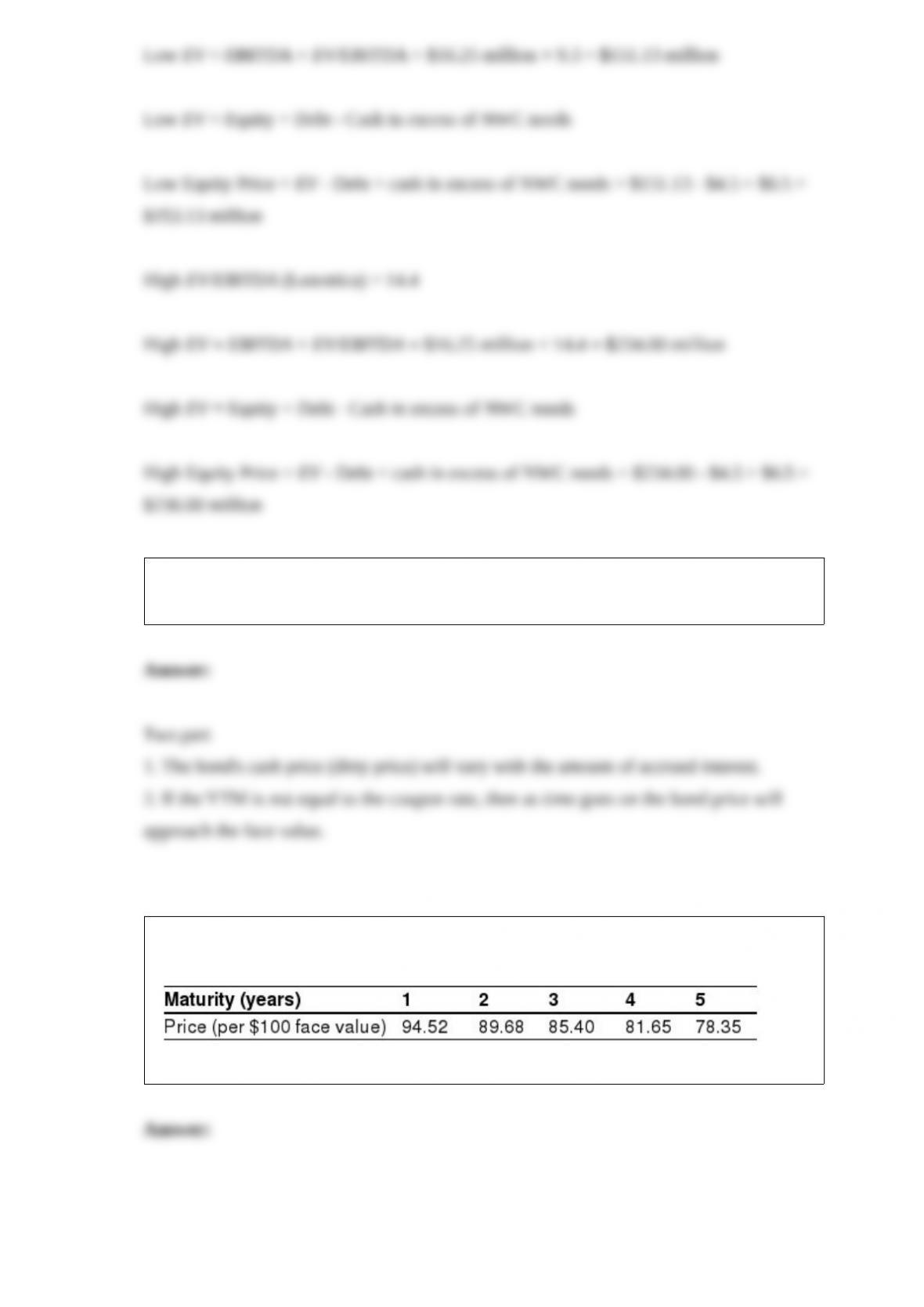
The following table summarizes prices of various default-free zero-coupon bonds
(expressed as a percentage of face value):
Plot the zero-coupon yield curve (for the first five years).

List five general categories of indirect costs associated with bankruptcy.
Monsters Incorporated (MI) in ready to launch a new product. Depending upon the
success of this product, MI will have a value of either $100 million, $150 million, or
$191 million, with each outcome being equally likely. The cash flows are unrelated to
the state of the economy (i.e. risk from the project is diversifiable) so that the project
has a beta of 0 and a cost of capital equal to the risk-free rate, which is currently 5%.
Assume that the capital markets are perfect.
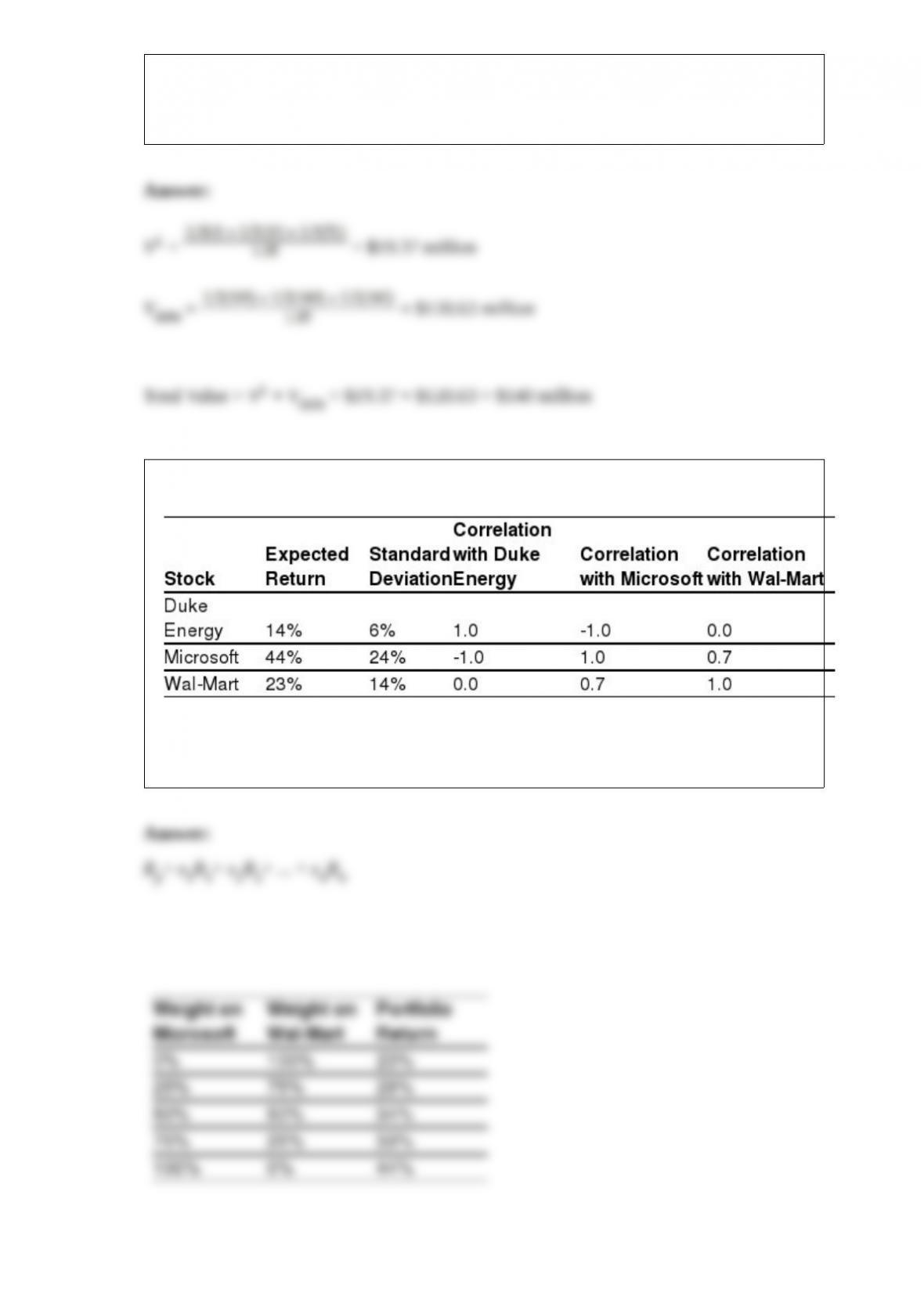
Suppose that MI has zero-coupon debt with a $140 million face value due next year.
Calculate the value of levered equity, the value of debt, and the total value of MI with
leverage.
Consider the following expected returns, volatilities, and correlations:
Consider a portfolio consisting of only Microsoft and Wal-Mart stock. Calculate the
expected return on such a portfolio when the weight on Microsoft stock is 0%, 25%,
50%, 75%, and 100%
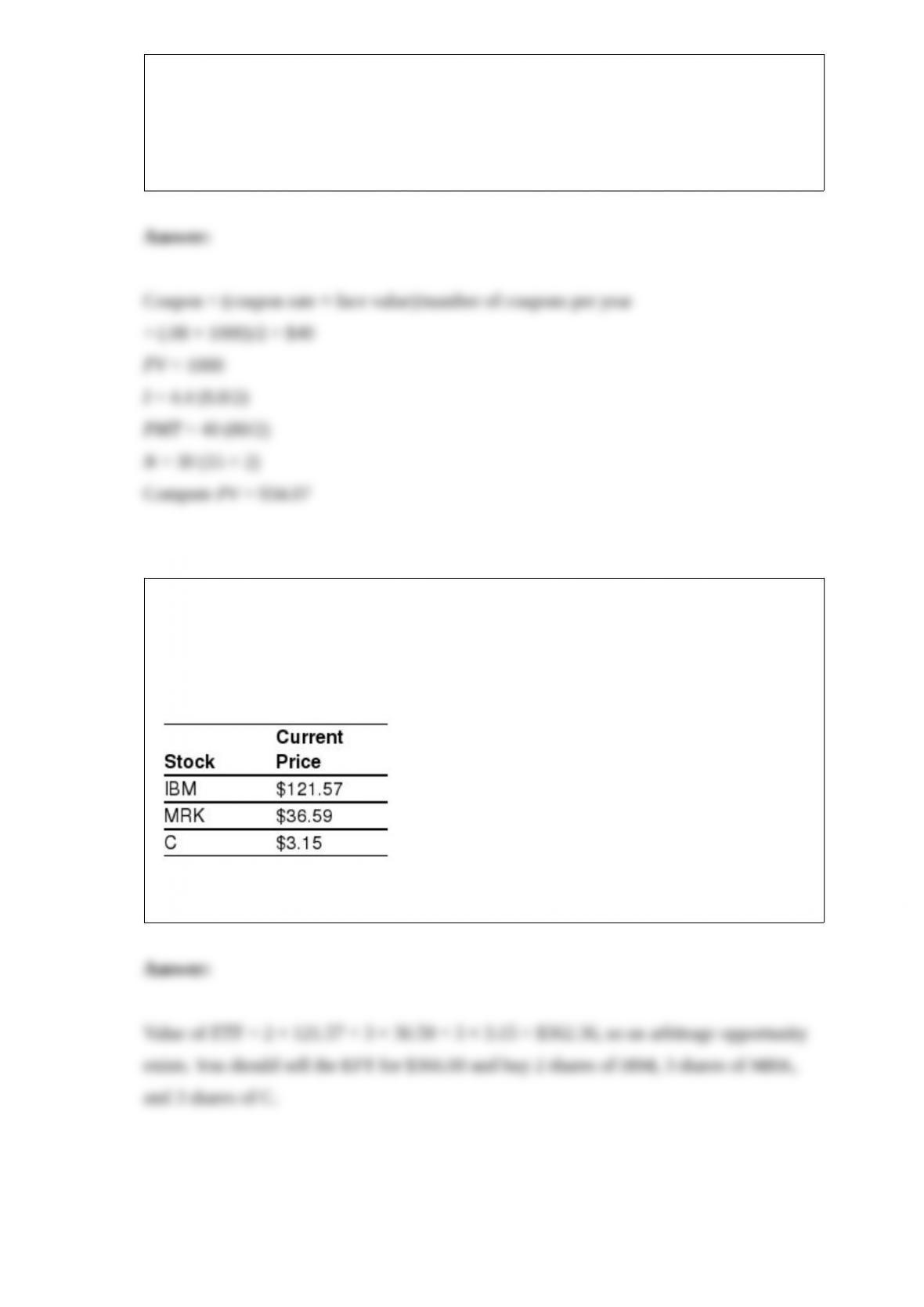
The Sisyphean Company has a bond outstanding with a face value of $1000 that
reaches maturity in 15 years. The bond certificate indicates that the stated coupon rate
for this bond is 8% and that the coupon payments are to be made semiannually.
How much are each of the semiannual coupon payments? Assuming the appropriate
YTM on the Sisyphean bond is 8.8%, then at what price should this bond trade for?
An exchange traded fund (ETF) is a security that represents a portfolio of individual
stocks. Consider an ETF for which each share represents a portfolio of two shares of
International Business Machines (IBM), three shares of Merck (MRK), and three shares
of Citigroup Inc. (C). Suppose the current market price of each individual stock are
shown below:
Assume that the ETF is trading for $366.00, what (if any) arbitrage opportunity exists?
What (if any) trades would you make?