
1) exercise of a currency futures option results in
a.a long futures position for the call buyer or put writer
b.a short futures position for the call buyer or put writer
c.a long futures position for the put buyer or call writer
d.a short futures position for the call buyer or put buyer
2) for question in this section, the notation is
y = gnp = national income
c = consumption
i = private investment
g = government spending
x = exports
m = imports
the current account balance is given by
a.c + i + g + x + m
b.x – m
c.i + x + m
d.m – x
3) a buy-back transaction
a.can be viewed as direct foreign investment in the purchasing country
b.can be viewed as direct foreign investment in the exporting country
c.can be viewed as indirect foreign investment in the purchasing country
d.none of the above
4) ecuador does not have its own national currency, circulating the u.s. dollar instead.
about how many countries do not have their own national currency?
a.10
b.20
c.30
d.40
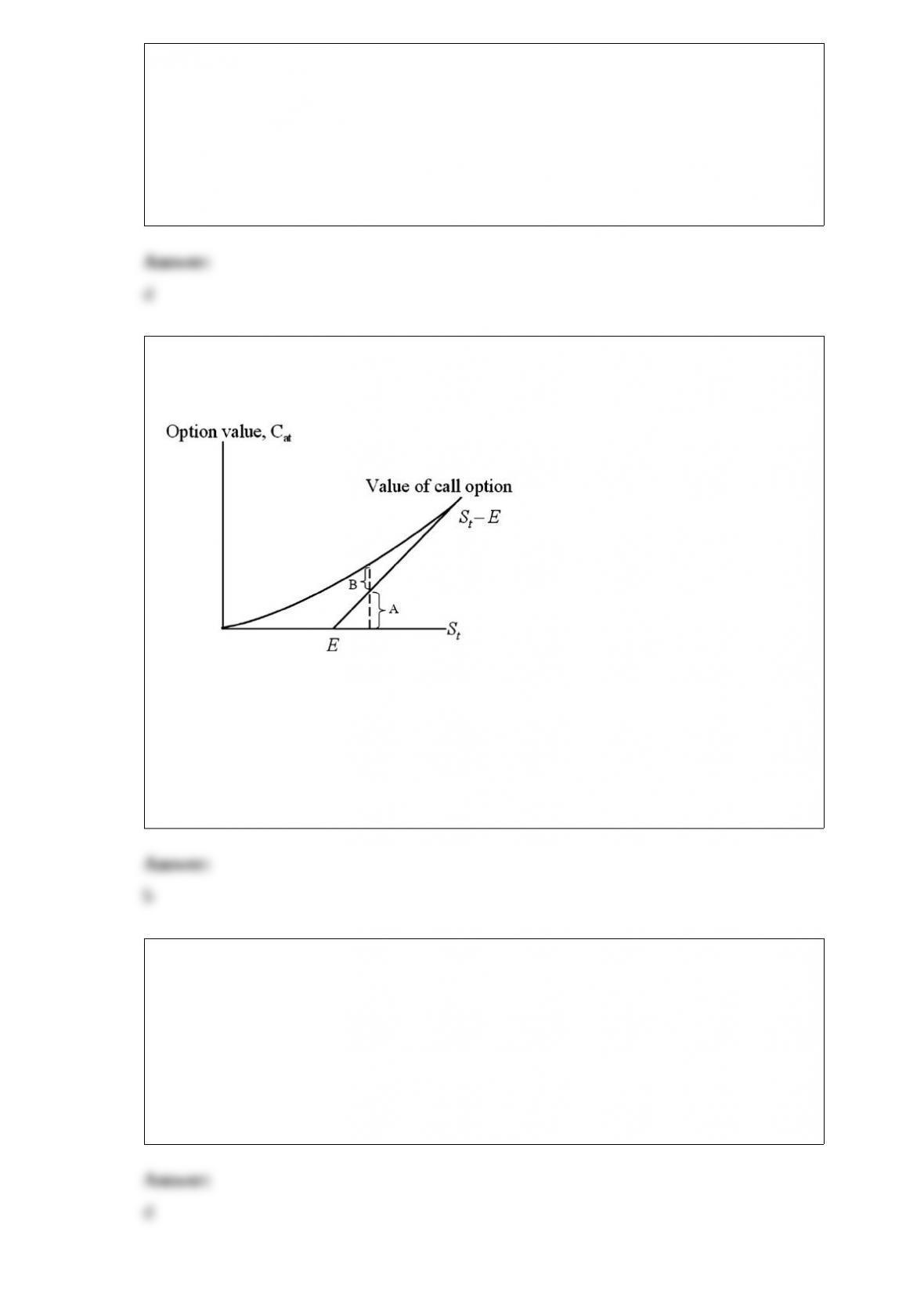
5) for an american call option, a and b in the graph are
a.time value and intrinsic value
b.intrinsic value and time value
c.in-the-money and out-of-the money
d.none of the above
6) salient economic factors for determining the functional currency include
a.cash flow indicators
b.sales price indicators
c.sales market indicators
d.all of the above

7) an overseas affiliate of a u.s. mnc can be organized
a.as a branch
b.as a subsidiary
c.both a and b
d.none of the above
8) a true mnc, with operations in dozens of different countries
a.must effectively manage foreign exchange risk
b.can ignore foreign exchange risk since it is diversified
c.will pay taxes in only its home county
d.none of the above
9) eurodollars refers to dollar deposits when the depository bank is located in
a.europe
b.europe, and the caribbean
c.outside the united states
d.united states
10) in evaluating the pros and cons of corporate risk management, “market
imperfections” refer to
a.information asymmetry, differential transaction costs, default costs, and progressive
corporate taxes
b.leading and lagging, receivables and payables, and diversification costs
c.economic costs, noneconomic costs, arbitrage costs, and hedging costs
d.management costs, corporate costs, liquidity costs, and trading costs

11) in evaluating political risk, experts focus their attention on a set of key factors such
as
a.integration of the host country into the world political/economic system
b.the host country’s ethnic and religious stability
c.the host country’s regional security, and key economic indicators
d.all of the above
12) the undistributed income of a minority foreign subsidiary of a u.s. mnc
a.is tax deferred until it is remitted via a dividend
b.is taxed as imputed income
c.is withheld under subpart u.s. income restrictions
d.none of the above
13) the coupon interest on eurobonds
a.is paid annually
b.is paid in cash
c.is paid in arrears
d.all of the above
14) compute the debt-to-total-value ratio for a firm that has a debt-to-equity ratio of 2.
a.1/3
b.2/5
c.3/2
d.2/3

e.none of the above
15) the two main objectives of taxation are
a.tax neutrality and tax equity
b.complexity and revenue
c.social engineering and tax equity
d.progressive taxation and tax neutrality
16) suppose that the pound is pegged to gold at £20 per ounce and the dollar is pegged
to gold at $35 per ounce. this implies an exchange rate of $1.75 per pound. if the
current market exchange rate is $1.80 per pound, how would you take advantage of this
situation? hint: assume that you have $350 available for investment.
a.start with $350. buy 10 ounces of gold with dollars at $35 per ounce. convert the gold
to £200 at £20 per ounce. exchange the £200 for dollars at the current rate of $1.80 per
pound to get $360
b.start with $350. exchange the dollars for pounds at the current rate of $1.80 per
pound. buy gold with pounds at £20 per ounce. convert the gold to dollars at $35 per
ounce
c.a and b both work
d.none of the above
17) assume that the firm will partially finance the project with a $3,000,000
interest-only 30-year loan at 10.0 percent apr with annual payments.
what is the levered after-tax incremental cash flow for year 30?
a.$9,027,390
b.$9,234,300
c.$9,134,300

d.$9,287,000
e.none of the above
18) a stop-limit order is an order to buy or sell a stock that combines the features of a
stop order and a limit order. once the stop price is touched in the market, the stop-limit
order becomes a limit order to buy or to sell at the limit price. which of the following
are true?
a.the benefit of a stop-limit order is that the investor can control the price at which the
trade will get executed
b.a stop-limit order may never get filled if the stock’s price never reaches the specified
limit price. this may happen especially in fast-moving markets where prices fluctuate
wildly
c.the use of stop limit orders is much more frequent for stocks that trade on an exchange
than in the over-counter (otc) market
d.in addition, your broker-dealer may not allow you to place a stop limit order on some
securities or accept a stop limit order for otc stocks
e.all of the above are true
19) the u.s. irs allows transfer prices to be set using the cost plus approach
a.finding the price that an unrelated willing seller would accept from an unrelated
willing buyer
b.the price at which the good is resold by the distribution affiliate is reduced by an
amount sufficient to cover overhead costs and a reasonable profit
c.an appropriate profit is added to the cost of the manufacturing affiliate
d.financial models and econometric techniques
20) company x wants to borrow $10,000,000 floating for 5 years; company y wants to
borrow $10,000,000 fixed for 5 years. their external borrowing opportunities are shown
below:
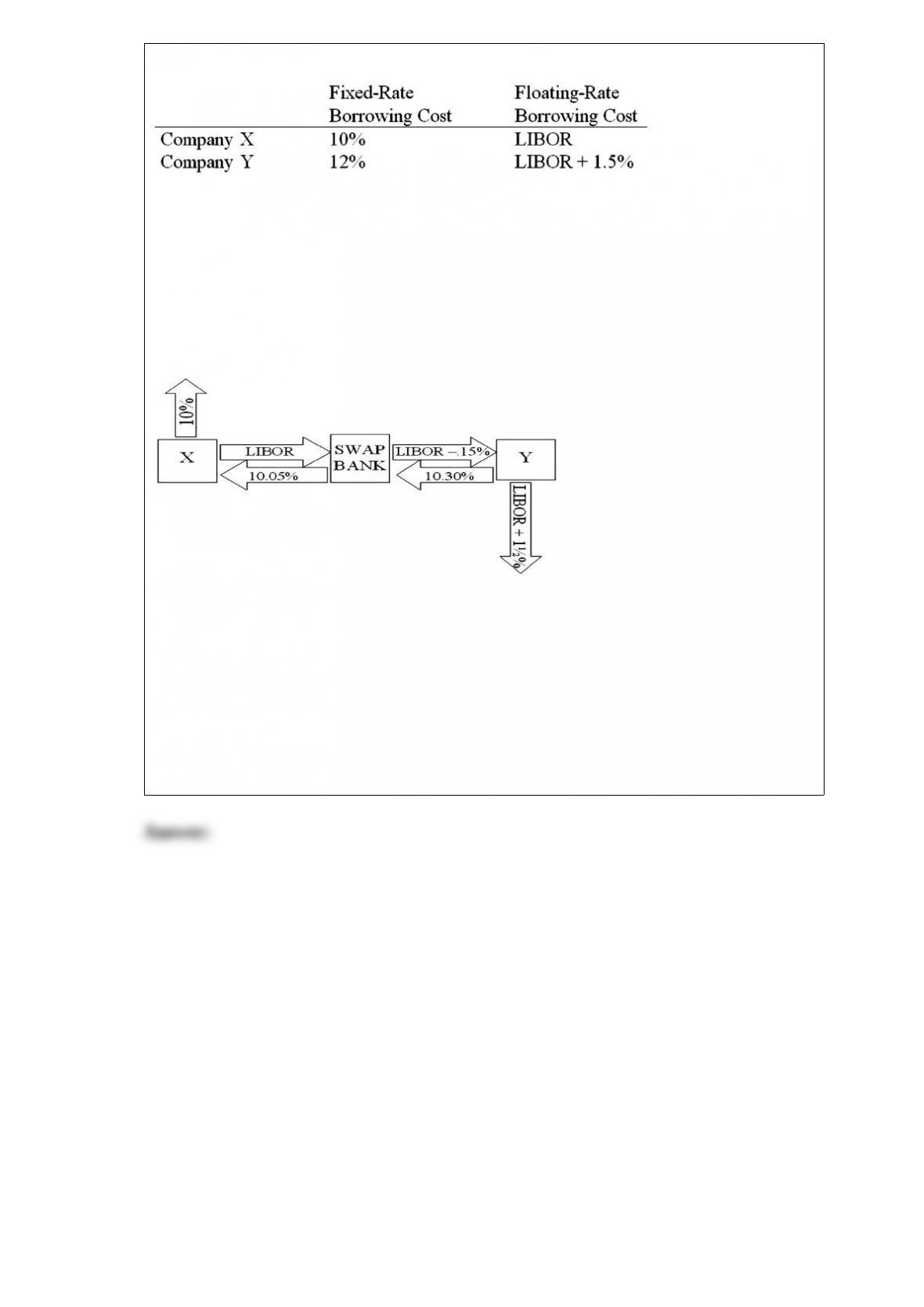
a swap bank proposes the following interest only swap:
x will pay the swap bank annual payments on $10,000,000 with the coupon rate of
libor; in exchange the swap bank will pay to company x interest payments on
$10,000,000 at a fixed rate of 10.05%. y will pay the swap bank interest payments on
$10,000,000 at a fixed rate of 10.30% and the swap bank will pay y annual payments on
$10,000,000 with the coupon rate of libor – 0.15%.
what is the value of this swap to the swap bank?
a.the swap bank will earn 40 basis points per year on $10,000,000 = $40,000 per year
b.the swap bank will earn 10 basis points per year on $10,000,000 = $10,000 per year
c.the swap bank will lose money
d.none of the above