
1) a borrower took out a 30-year fixed-rate mortgage of $2,250,000 at a 7.2% annual
rate. after five years, he wishes to pay off the remaining balance. interest rates have by
then fallen to 7%. how much must he pay to retire the mortgage (to the nearest dollar)?
a.$2,122,426
b.$2,225,330
c.$2,015,678
d.$2,212,041
e.$1,999,998
2) an fi’s balance sheet is characterized by long-term fixed-rate assets funded by
short-term variable-rate securities. most likely the bank has a
a.positive repricing gap and a positive duration gap
b.positive repricing gap and a negative duration gap
c.negative repricing gap and a positive duration gap
d.negative repricing gap and a negative duration gap
3) the fed funds rate is the rate that
a.banks charge for loans to corporate customers
b.banks charge to lend foreign exchange to customers
c.the federal reserve charges on emergency loans to commercial banks
d.banks charge each other on loans of excess reserves
e.banks charge securities dealers to finance their inventory
4) the primary federal banks regulators have established guidelines for derivatives
usage at banks including:
i. banks must establish internal guidelines regarding hedging activity.
ii. banks must establish trading limits.
iii. banks are prohibited from using derivatives to speculate.
iv. banks must disclose large derivatives positions that may materially affect
stakeholders in their financial statements.
a.i and ii only
b.i, iii, and iv only
c.i, ii, and iv only
d.ii, iii, and iv only

e.i, ii, iii, and iv
5) state chartered banks ________________ be members of the federal reserve system
and nationally chartered banks ________________ be members of the federal reserve
system.
a.must; may
b.must; must
c.may; must
d.may; may
6) the market value of a mutual fund’s assets divided by the number of fund shares
outstanding is equal to the
a.load charge
b.nav
c.expense ratio
d.12b-1 fee
e.management fee
7) which one of the following is the definition of the nim?
a.(net interest income – net noninterest income)/earning assets
b.net interest income/interest-bearing liabilities
c.(interest income – interest expense)/earning assets
d.(interest income – interest expense)/interest-bearing liabilities
e.(interest income/earning assets) – (interest expense/interest-bearing liabilities)
8) a 180 day $3 million cd has a 4.25% annual rate quote. if you buy the cd, how much
will you collect in 180 days?
a.$3,047,439
b.$3,045.678
c.$3,062,877
d.$3,063,750
e.$3,127,500

9) which of the following would normally be banking book assets rather than trading
book assets?
a.capital
b.short position in bonds
c.fx forward contracts
d.long-term loans
e.options on interest rates
10) you can buy or sell the yen spot at 102 to the dollar. you can buy or sell the yen
one-year forward at 104 to the dollar. if u.s. annual interest rates are 4%, what must be
the approximate one-year japanese interest rate if interest rate parity holds?
a.5.92%
b.3.20%
c.2.75%
d.4.73%
e.6.80%
11) one of the recent trading abuses in the mutual fund industry was allowing selected
investors to rapidly trade in and out of a mutual fund in order to profit on stale prices.
this practice is called
a.diluted brokerage
b.front running
c.directed order flow
d.soft dollar commissions
e.market timing
12) you bought a stock three years ago and paid $45 per share. you collected a $2
dividend per share each year you held the stock and then you sold the stock for $47 per
share. what was your annual compound rate of return?
a.8.89%
b.8.51%
c.5.84%
d.4.44%
e.2.96%
13) the p&c loss ratio on an insurance line contains
i. payouts on claims.
ii. brokerage commissions incurred to market the claims.
iii. costs associated with settling claims.
iv. dividend payouts to policyholders.
a.i and ii only
b.i, iii, and iv only
c.i and iii only
d.ii and iv only
e.iii and iv only
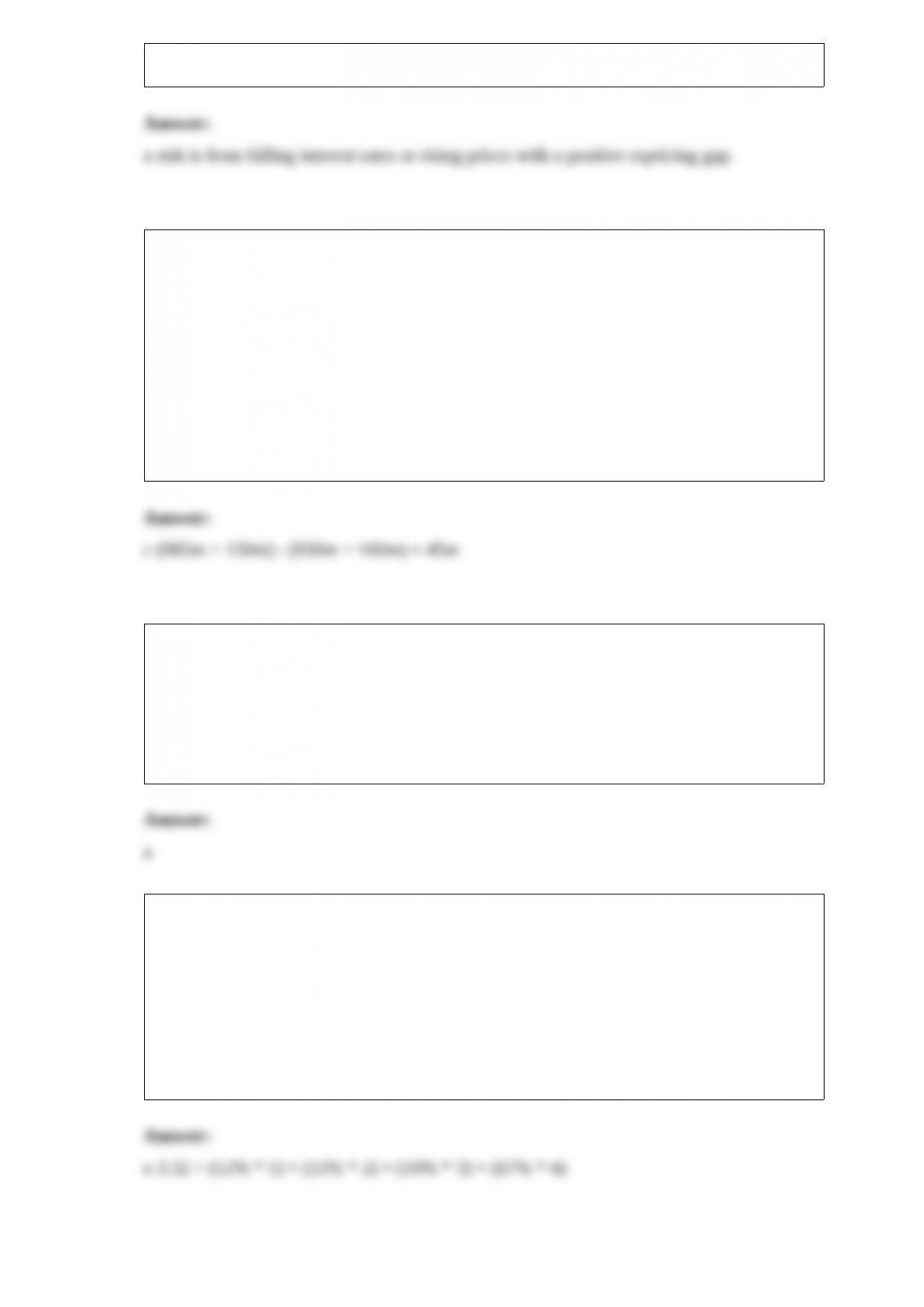
14) figure 23-1
after conducting a rate sensitive analysis, a bank finds itself with the following amounts
of rate- sensitive assets and liabilities (rsas and rsl) and fixed-rate assets and liabilities
(fras and frls), the rate of return and cost rates on the accounts are also given:
if we were to design a macrohedge, which of the following positions would help reduce
the bank’s interest rate risk?
i. long position in bond futures contracts
ii. buying put options on bonds
iii. purchasing an interest rate cap
a.i only
b.ii only
c.iii only
d.i and iii only
e.ii and iii only
15) a bank has on-balance-sheet assets with a book value of $940 million and a market
value of $985 million and on-balance-sheet liabilities with a book value of $900 million
and a market value of $930 million. the bank also has off-balance-sheet assets currently
valued at $150 million and off-balance-sheet liabilities worth $160 million.
stockholder’s net worth should be valued at _________________ million.
a.$30
b.$40
c.$45
d.$50
e.$55
16) the major result of the nsmia was to
a.reduce state regulatory powers over securities firms
b.establish the sipc
c.create the nasd
d.all of the above
e.none of the above
17) a corporate bond returns 12% of its cost (in pv terms) in the first year, 11% in the
second year, 10% in the third year and the remainder in the fourth year. what is the
bond’s duration in years?
a.3.68 years
b.2.50 years
c.4.00 years
d.3.75 years
e.3.32 years
18) important buyers of loans include all but which one of the following?
a.foreign banks
b.insurance companies
c.closed-end bank loan mutual funds
d.vulture funds
e.credit unions
19) a semiannual payment bond with a $1,000 par has a 7% quoted coupon rate, a 7%
promised ytm, and 10 years to maturity. what is the bond’s duration?
a.10.00 years
b.8.39 years
c.6.45 years
d.5.20 years
e.7.35 years
20) the nasdaq automatic order execution system for individual traders placing buy or
sell orders of 1000 or fewer shares is called the
a.ecn network
b.soe system
c.nasdaq/amex joint program
d.instinet network
e.e*trade online program