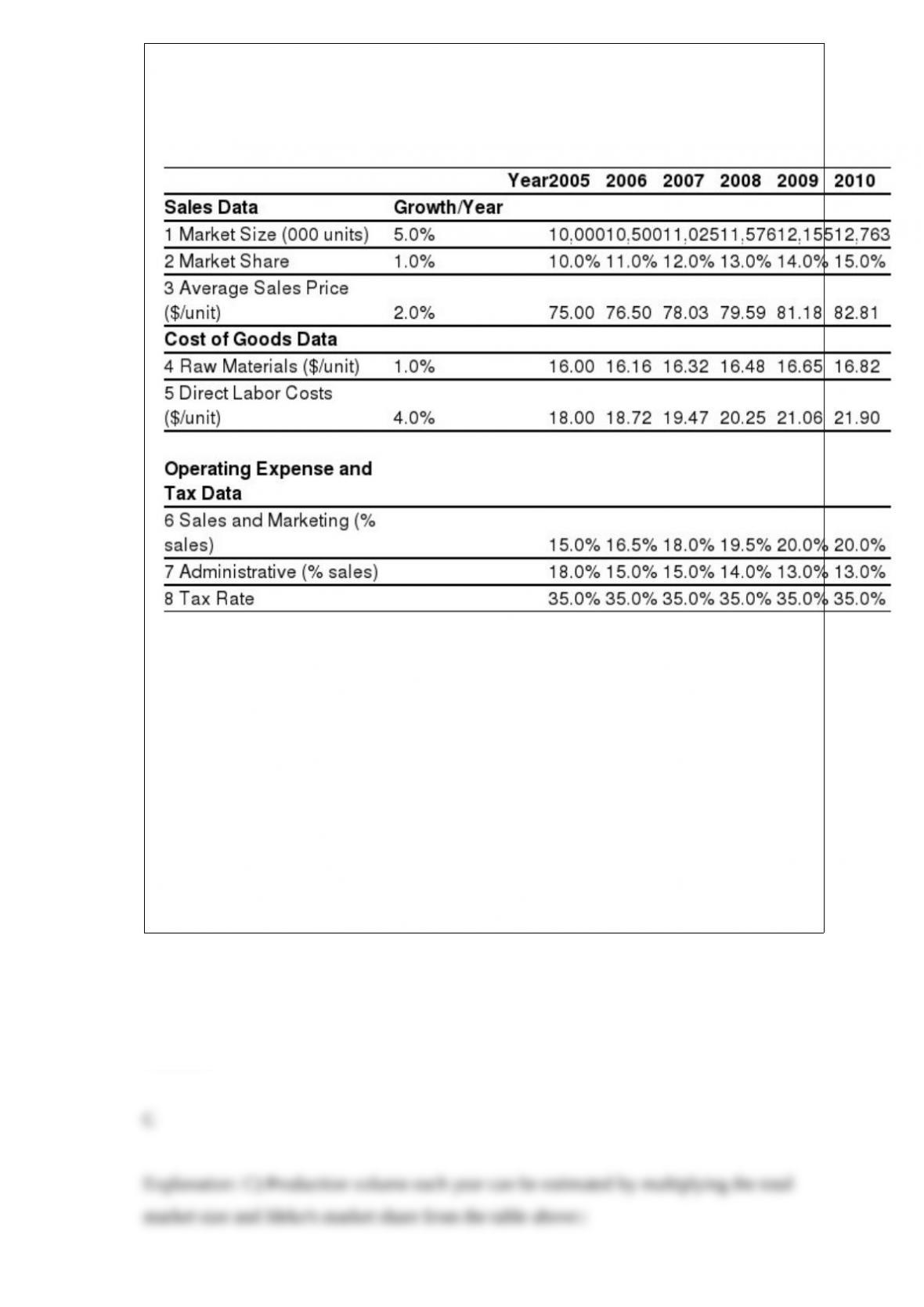
Use the table for the question(s) below.
Ideko Sales and Operating Cost Assumptions
Based upon Ideko’s Sales and Operating Cost Assumptions, what production capacity
will Ideko require in 2008?
A) 1,702 units
B) 1,323 units
C) 1,505 units
D) 1,914 units
E) 1,115 units
Answer:

Which of the following statements is false?
A) The plot of the relationship between the investment risk and the interest rate is call
the yield curve.
B) Each of the last six recessions in the United States was preceded by a period with an
inverted yield curve.
C) The nominal interest rate does not represent the increase in purchasing power that
will result from investing
D) A risk-free cash flow received in two years should be discounted at the two-year
interest rate.
Answer:
Use the information for the question(s) below.
Consider an economy with two types of firms, S and I. S firms always move together,
but I firms move independently of each other. For both types of firms there is a 70%
probability that the firm will have a 20% return and a 30% probability that the firm will
have a -30% return.
What is the expected return for an individual firm?

A) 14%
B) 3%
C) 5%
D) -5%
Answer:
Use the following information to answer the question(s) below.
Two years ago the Krusty Krab Restaurant purchased a grill for $50,000. The owner,
Eugene Krabs, has learned that a new grill is available that will cook Krabby Patties
twice as fast as the existing grill. This new grill can be purchased for $80,000 and
would be depreciated straight line over 8 years, after which it would have no salvage
value. Eugene Krab expects that the new grill will produce EBITDA of $50,000 per
year for the next eight years while the existing grill produces EBITDA of only $35,000
per year. The current grill is being depreciated straight line over its useful life of 10
years after which it will have no salvage value. All other operating expenses are
identical for both grills. The existing grill can be sold to another restaurant now for
$30,000. The Krusty Krab’s tax rate is 35%.
If the Krusty Krab’s opportunity cost of capital is 12%, then the NPV for upgrading to
the new grill is closest to:
A) -22,875
B) -15,025
C) 7,130
D) 10,630

Answer:
Suppose a risky security pays an average cash flow of $100 in one year. The risk-free
rate is 5%, and the expected return on the market index is 13%. If the returns on this
security are high when the economy is strong and low when the economy is weak, but
the returns vary by only half as much as the market index, then the price for this risky
security is closest to:
A) $88
B) $92
C) $93
D) $95
Answer:

d’Anconia Copper expects to produce 500 million pounds of copper next year, with
production costs of $0.75 per pound. Depending upon the economic conditions over the
next year, d’Anconia Copper expects the price of copper next year to be either $1.40,
$1.50, or $1.60 per pound, with each outcome being equally likely. d’Anconia Copper
expects to sell all of its copper at the going price.
If the going price next year is $1.60 per pound, d’Anconia Copper’s operating profit
next year will be closest to:
A) $365 million
B) $375 million
C) $425 million
D) $800 million
Answer:
Use the information for the question(s) below.
The JRN Corporation will pay a constant dividend of $3 per share, per year, in
perpetuity. Assume that all investors pay a 20% tax on dividends and that there is no
capital gains tax. The cost of capital for investing in JRN stock is 12%.
Assume that management makes a surprise announcement that JRN will no longer pay
dividends but will use the cash to repurchase stock instead. The price of a share of
JRN’s stock is now closest to:
A) $20.00

B) $25.00
C) $18.00
D) $24.00
Answer:
Use the equation for the question(s) below.
Consider the following regression model:
Rs – rf = as + (RF1 – rf) + (RF2 – rf) + e
The term is a(n)
A) measure of the expected percent change in the excess return of a security for a 1%
change in the excess return of the second factor portfolio.
B) constant term.
C) error term that has an expectation of zero and is uncorrelated with either factor.
D) measure of the expected percent change in the excess return of a security for a 1%
change in the excess return of the first factor portfolio.
Answer:
Using risk neutral probabilities, the calculated price of a one-year call option on KD
stock with a strike price of $20 is closest to:
A) $1.45
B) $2.40
C) $2.00
D) $2.15
Answer:
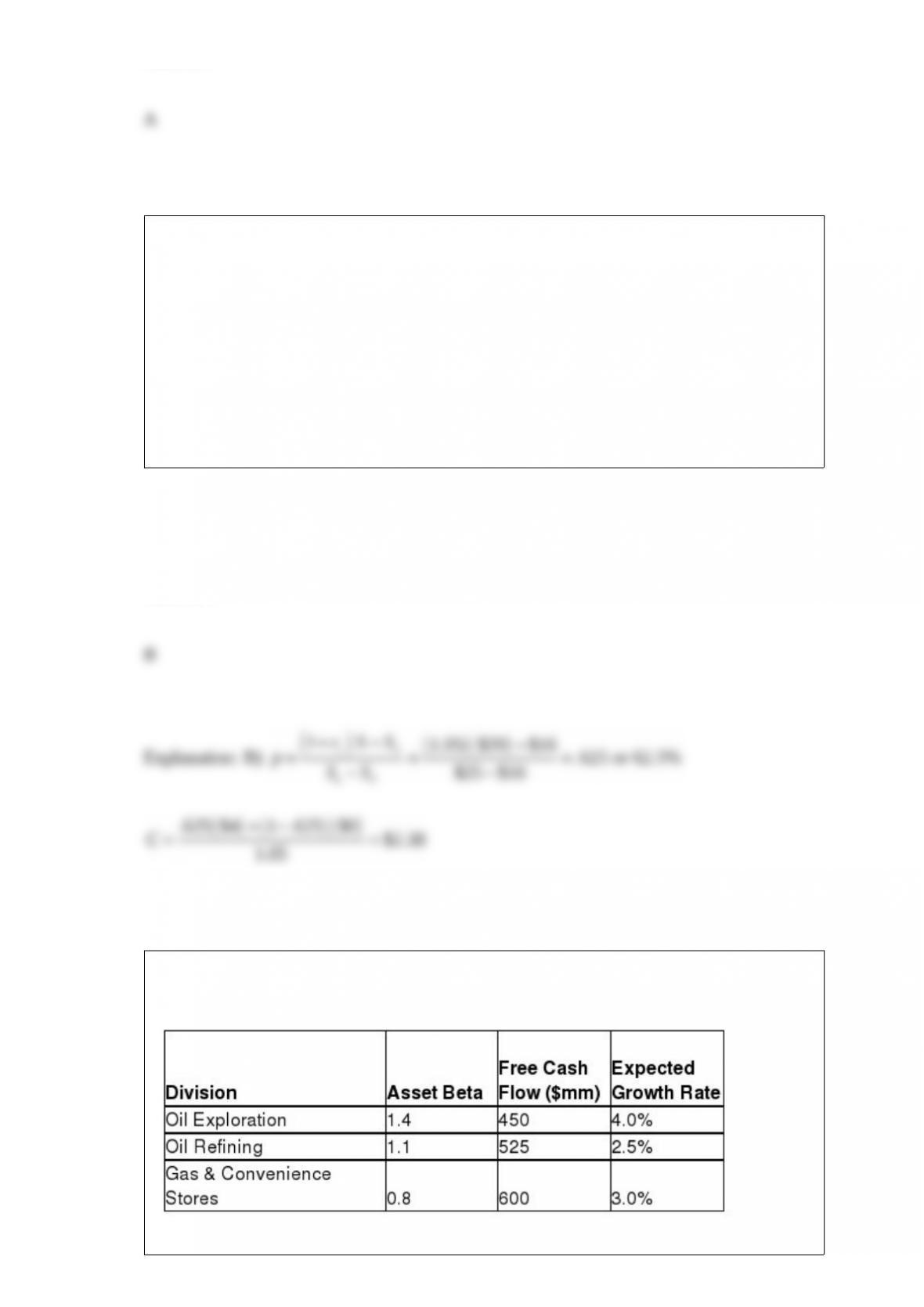
Use the following information to answer the question(s) below.

The risk-free rate of interest is 3% and the market risk premium is 5%.
The cost of capital for the oil exploration division is closest to:
A) 6.0%
B) 7.0%
C) 8.5%
D) 10.0%
Answer:
Which of the following is not a direct costs associated with inventory?
A) Acquisition costs
B) Order costs
C) Carrying costs
D) Stock out costs
Answer:
Which of the following statements is false?

A) After deciding to go public, managers of the company work with an underwriter, an
investment banking firm that manages the offering and designs its structure.
B) The shares that are sold in the IPO may either be new shares that raise new capital,
known as a secondary offering, or existing shares that are sold by current shareholders
(as part of their exit strategy), known as a primary offering.
C) Many IPOs, especially the larger offerings, are managed by a group of underwriters.
D) At an IPO, a firm offers a large block of shares for sale to the public for the first
time.
Answer:
Assume that MM’s perfect capital markets conditions are met and that you can borrow
and lend at the same 5% rate as with. You have $5000 of your own money to invest and
you plan on buying With stock. Using homemade (un)leverage, how much do you need
to invest at the risk-free rate so that the payoff of your account will be the same as a
$5000 investment in Without stock?
A) $5000
B) $0
C) $2,500
D) $4,000
Answer:

Use the information for the question(s) below.
The Sisyphean Company has a bond outstanding with a face value of $1000 that
reaches maturity in 15 years. The bond certificate indicates that the stated coupon rate
for this bond is 8% and that the coupon payments are to be made semiannually.
Assuming the appropriate YTM on the Sisyphean bond is 7.5%, then this bond will
trade at
A) par.
B) a discount.
C) a premium.
D) None of the above
Answer:
Which of the following statements is false?
A) Bond prices converge to the bond’s face value due to the time effect, but
simultaneously move up and down due to unpredictable changes in bond yields.
B) As interest rates and bond yields fall, bond prices will rise.
C) Bonds with higher coupon rates are more sensitive to interest rate changes.
D) Shorter maturity zero coupon bonds are less sensitive to changes in interest rates
than are longer-term zero coupon bonds.
Answer:
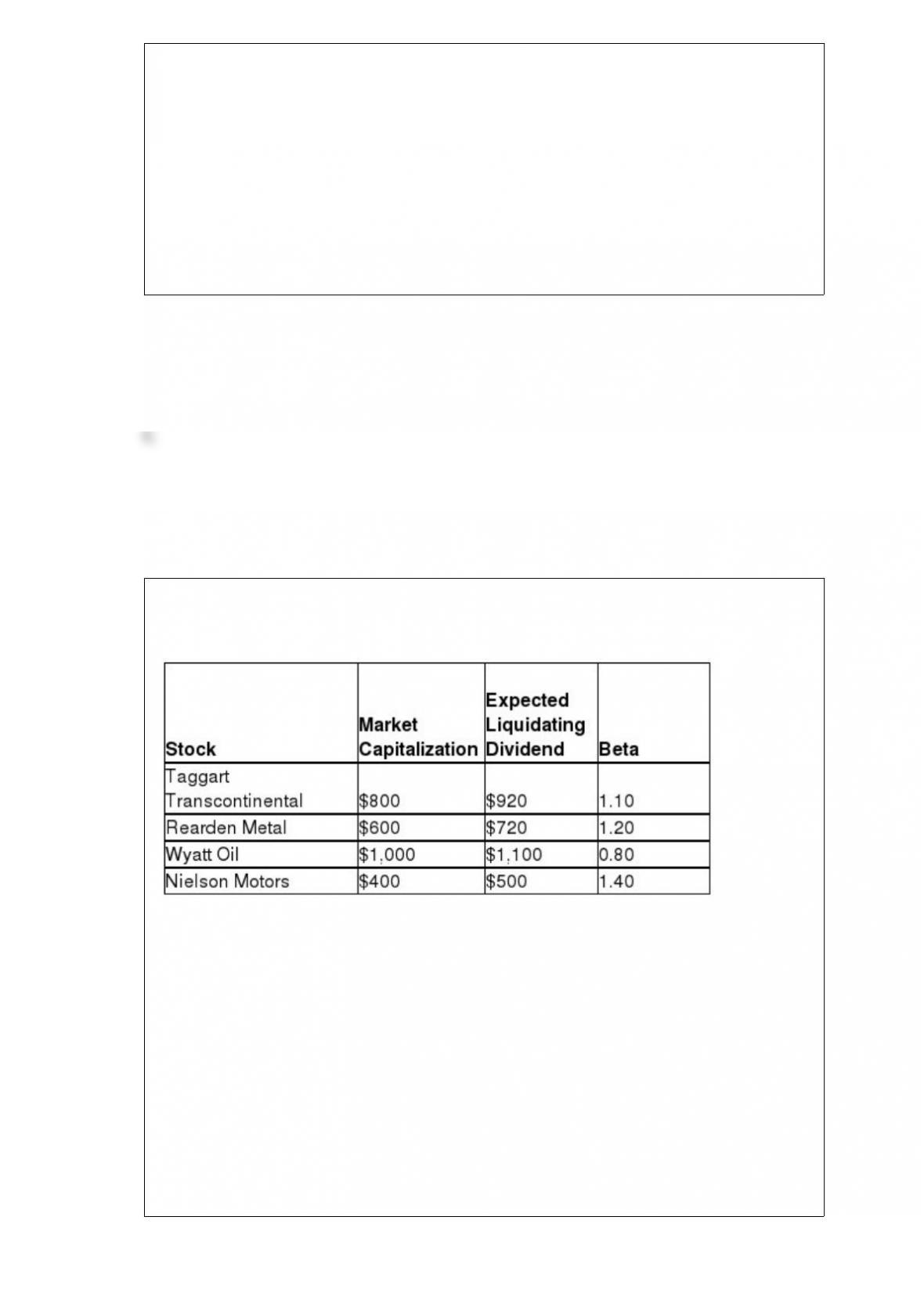
Use the following information to answer the question(s) below.
All amounts are in millions.
If the risk-free rate is 3% and the market risk premium is 5%, then the CAPM’s
predicted expected return for Wyatt Oil is closest to:
A) 7.0%
B) 8.5%
C) 9.0%
D) 9.5%

Answer:
Which of the following statements is false?
A) A portfolio costs nothing to construct is called a self-financing portfolio.
B) The most obvious portfolio to use in a multifactor model is the market portfolio
itself.
C) In general, a self-financing portfolio is any portfolio with portfolio weights that sum
to one rather than zero.
D) We can construct a self-financing portfolio by going long some stocks, and going
short other stocks with equal market value.
Answer:
Use the information for the question(s) below.
Monsters Incorporated (MI) in ready to launch a new product. Depending upon the
success of this product, MI will have a value of either $100 million, $150 million, or
$191 million, with each outcome being equally likely. The cash flows are unrelated to
the state of the economy (i.e. risk from the project is diversifiable) so that the project
has a beta of 0 and a cost of capital equal to the risk-free rate, which is currently 5%.
Assume that the capital markets are perfect.

Suppose that MI has zero-coupon debt with a $125 million face value due next year.
The yield to maturity of MI’s debt is closest to:
A) 12.5%
B) 7.8%
C) 25.0%
D) 5.0%
Answer:
Use the following information to answer the question(s) below.
Consider the price paths of the following stocks over a six-month period:
None of these stocks pay dividends.
Assume that you are an investor with the disposition effect and you bought each of
these stocks in January. Suppose that it is currently the end of March, which stocks are
you most inclined to sell?
1. Taggart Transcontinental

2. Rearden Metal
3. Wyatt Oil
4. Nielson Motors
A) 1 only
B) 1 & 3 only
C) 2 only
D) 2 & 4 only
Answer:
If the current inflation rate is 4.2% and you are earning a real rate of return on an
investment of 3.8%, then the nominal rate on this investment is closest to:
A) 3.8%
B) 4.2%
C) 8.0%
D) 8.2%
Answer:

Use the following information to answer the question(s) below.
The owner of the Krusty Krab is considering selling his restaurant and retiring. An
investor has offered to buy the Krusty Krab for $350,000 whenever the owner is ready
for retirement. The owner is considering the following three alternatives:
1. Sell the restaurant now and retire.
2. Hire someone to manage the restaurant for the next year and retire. This will require
the owner to spend $50,000 now, but will generate $100,000 in profit next year. In one
year the owner will sell the restaurant.
3. Scale back the restaurant’s hours and ease into retirement over the next year. This will
require the owner to spend $40,000 on expenses now, but will generate $75,000 in
profit at the end of the year. In one year the owner will sell the restaurant.
If the discount rate is 15%, the alternative with the lowest NPV is:
A) #1 with an NPV of approximately $350,000
B) #2 with an NPV of approximately $341,300
C) #3 with an NPV of approximately $329,570
D) #2 with an NPV of approximately $400,000
E) None of the above
Answer:

Which of the following statements is false?
A) Investors pay less for bonds with credit risk than they would for an otherwise
identical default-free bond.
B) Credit spreads fluctuate as perceptions regarding the probability of default change.
C) Credit spreads are high for bonds with high ratings.
D) We refer to the difference between the yields of the corporate bonds and the
Treasury yields as the default spread or credit spread.
Answer:
Which of the following statements is false?
A) Leverage can reduce the degree of managerial entrenchment because managers are
more likely to be fired when a firm faces financial distress.
B) When a firm is highly levered, creditors themselves will closely monitor the actions
of managers, providing an additional layer of management oversight.
C) According to the empire building hypothesis, leverage increases firm value because
it commits the firm to making future interest payments, thereby reducing excess cash
flows and wasteful investment by managers.
D) Managers of large firms tend to earn higher salaries, and they may also have more
prestige and garner greater publicity than managers of small firms. As a result,
managers may expand (or fail to shut down) unprofitable divisions, pay too much for
acquisitions, make unnecessary capital expenditures, or hire unnecessary employees.

Answer:
Use the following information to answer the question(s) below.
Wyatt Oil, an all-equity financed firm, has just reported EPS of $4.00 per share. Despite
an economic downturn, Wyatt is confident regarding its current investment
opportunities, but do to the current financial crisis, Wyatt does not wish to fund these
investments externally. Wyatt’s board has therefore decided to suspend its stock
repurchase plan and cut its dividend to $1 per share (from its current level of $2 per
share) and retain these funds instead. The firm just paid its current dividend of $1.00
per share and expects to keep its dividend at $1 per share next year as well. In
subsequent years, it expects its growth opportunities to slow, and it will still be able to
fund its growth internally with a target 40% dividend payout ratio, and reinitiating its
stock repurchase plan for a total payout rate of 60%. All dividends and repurchases
occur at the end of each year.
Wyatt’s existing operations are expected to generate the current level of earnings per
share in the future. Assume that the return on new investments is 16% and that
reinvestments will account for all future earnings growth. Wyatt’s current equity cost of
capital is 12%.
Wyatt’s expected EPS in two years is closest to:
A) $4.48
B) $4.64
C) $5.04
D) $5.38
Answer:
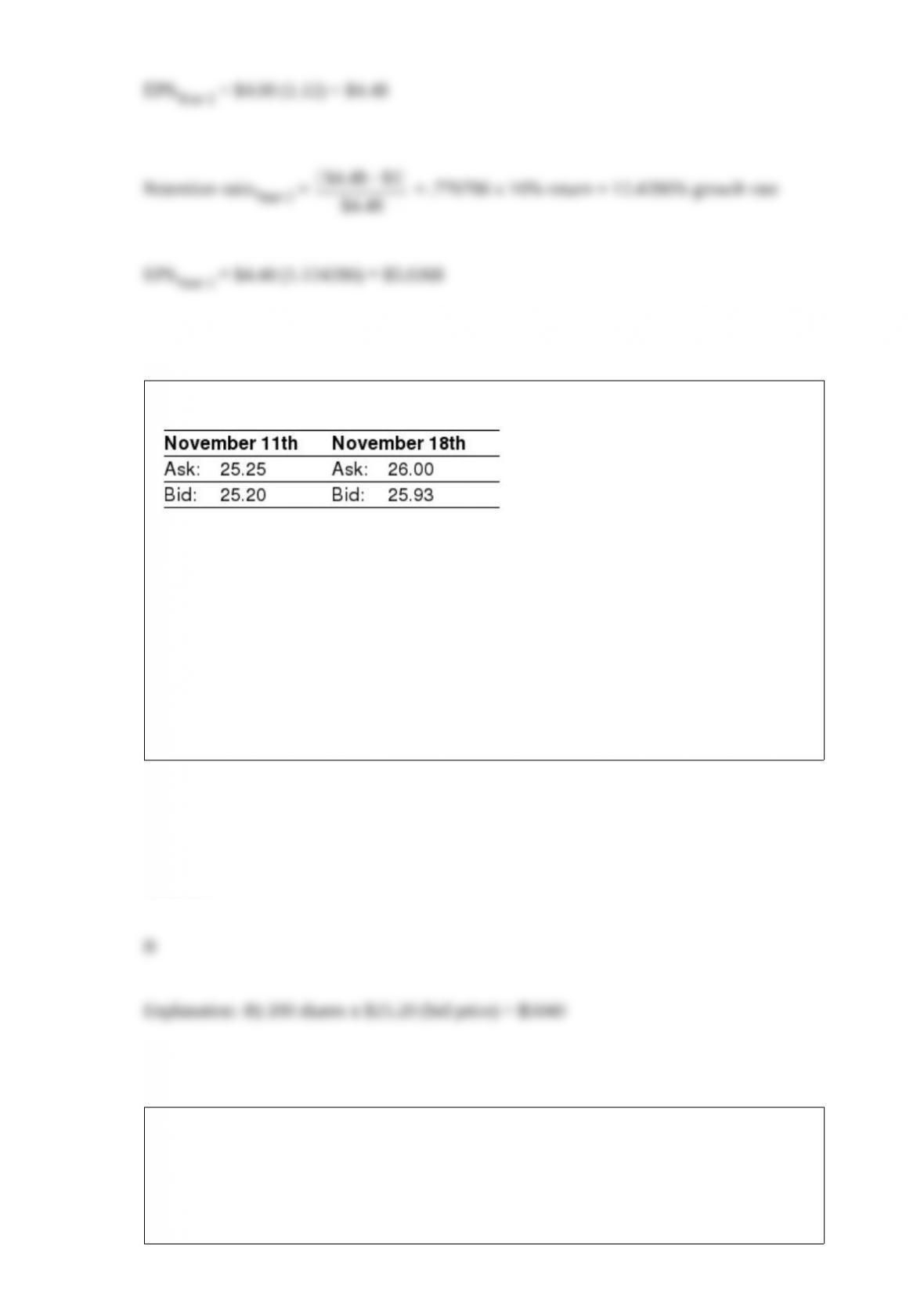
Consider the following two quotes for XYZ stock:
How much would you receive if you sold 200 shares of XYZ stock on November 11th?
A) $5050
B) $5040
C) $5186
D) $5200
Answer:
Frank Dewey Esquire from the firm of Dewey, Cheatum, and Howe, has been offered
an upfront retainer of $30,000 to provide legal services over the next 12 months to
Taggart Transcontinental . In return for this upfront payment, Taggart Transcontinental
would have access to 8 hours of legal services from Frank for each of the next 12
months. Frank’s normal billable rate is $250 per hour for legal services.

Assuming that Dewey’s cost of capital is 12% EAR, then the number of potential IRRs
that exist for this problem is equal to:
A) 0
B) 1
C) 2
D) 12
Answer:
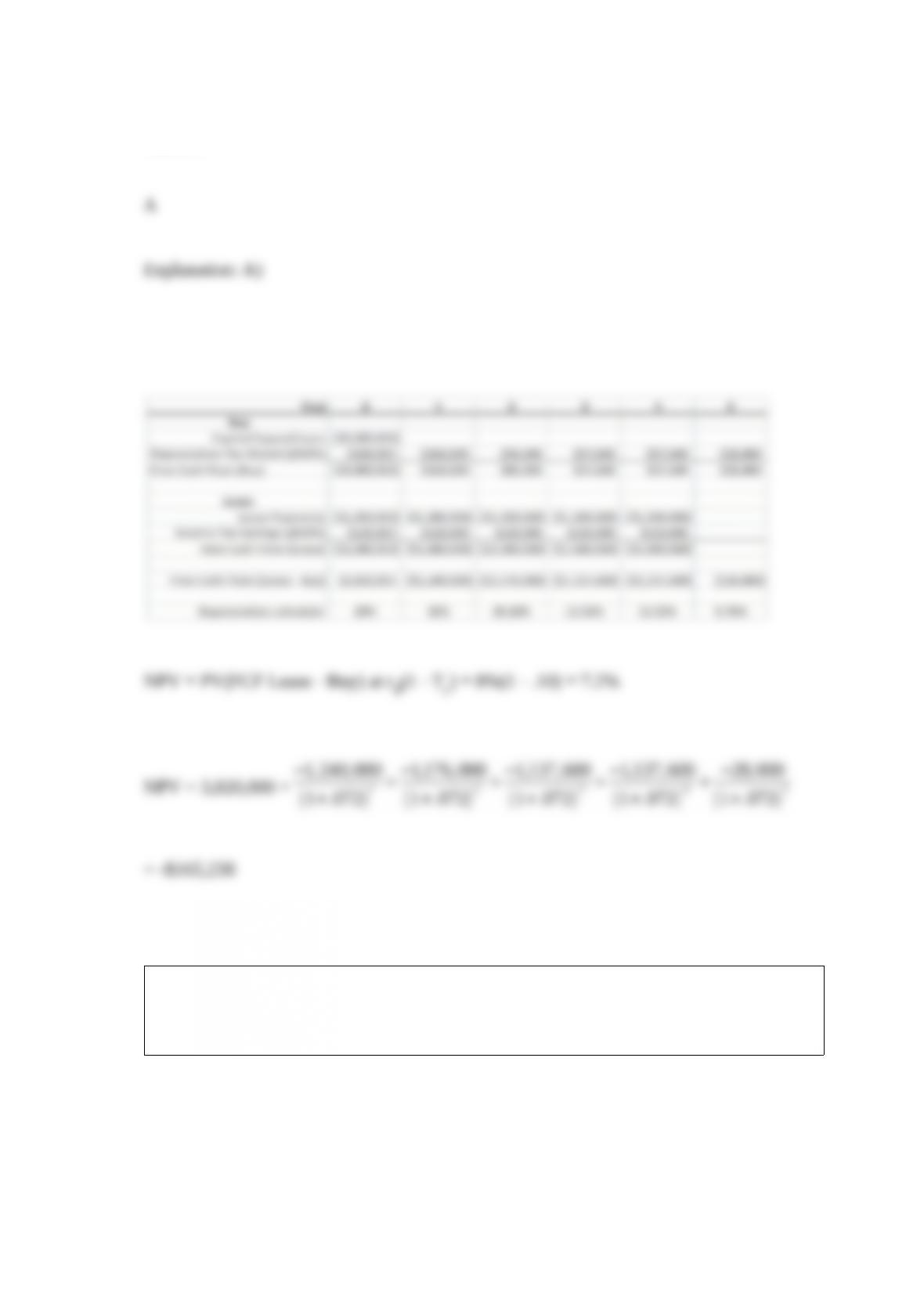
Rearden Metal is considering the purchase of a new blast furnace costing a total of $5
million dollars. This furnace will qualify for accelerated depreciation: 20% can be
expense immediately, followed by 32%, 19.2%, 11.52%, 11.52% and 5.76% over the
next five years. However, because of Rearden’s substantial tax loss carry forwards,
Rearden estimates its marginal tax rate to be only 10% over the next five years. Since
Rearden will get very little tax benefit from the depreciation expense, they consider
leasing the furnace instead. Suppose that Rearden and the lessor face the same 8%
borrowing rate, but the lessor has a 40% marginal tax rate. Assume that the furnace is
worthless after five years, the lease term is five years, and a lease would qualify as a
true tax lease.
Assuming that Rearden’s annual lease payments are $1.2 million, then use the direct
method, the NPV of leasing is closest to:
A) ($165,000)
B) ($95,000)
C) $0
D) $95,000
Answer:
Use the information for the question(s) below.
Omicron Industries’ Market Value Balance Sheet ($ Millions) and Cost of Capital
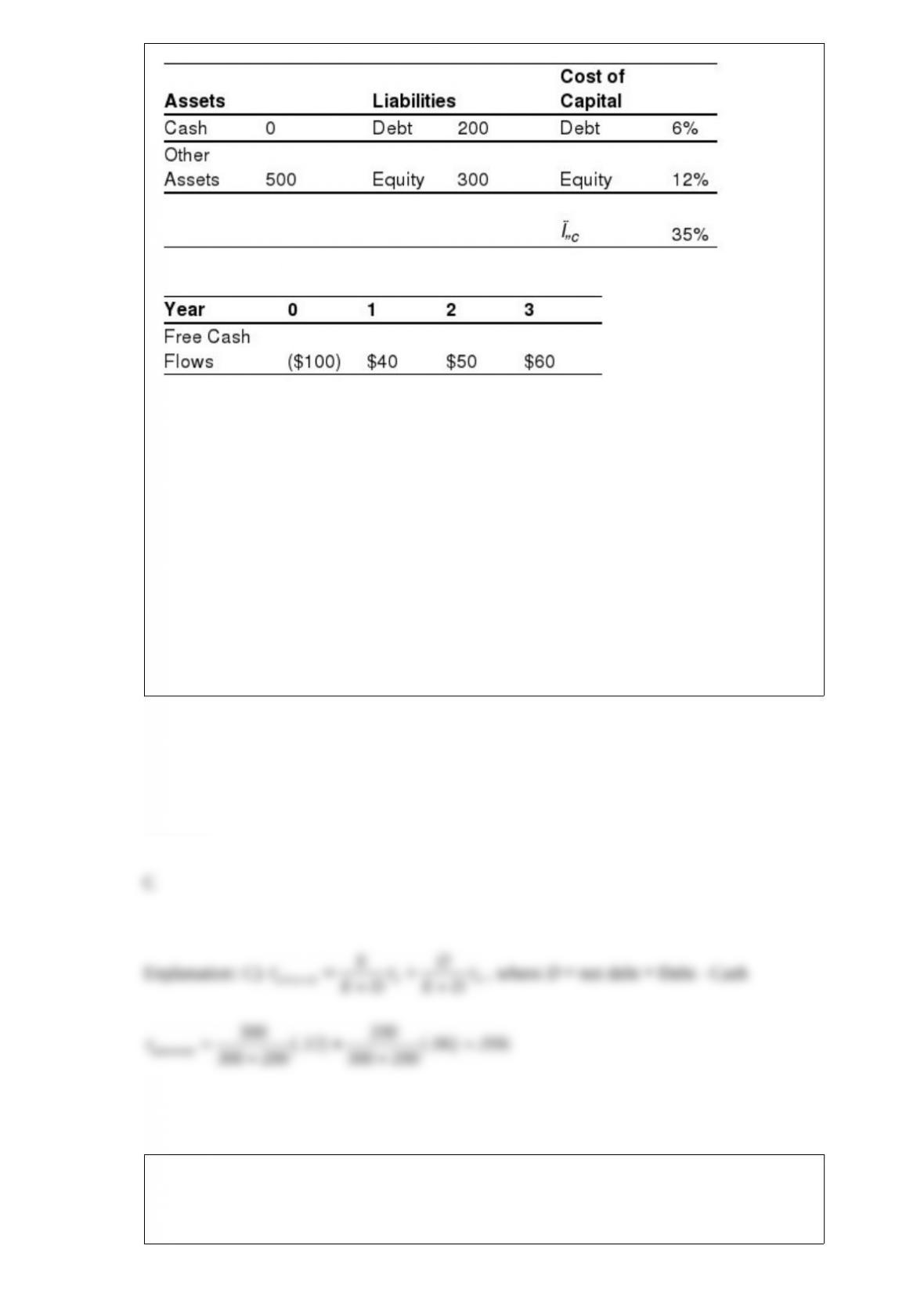
Omicron Industries New Project Free Cash Flows
Assume that this new project is of average risk for Omicron and that the firm wants to
hold constant its debt to equity ratio.
Omicron’s Unlevered cost of capital is closest to:
A) 8.75%
B) 7.10%
C) 9.60%
D) 7.50%
Answer:
Assume that MM’s perfect capital markets conditions are met and that you can borrow
and lend at the same 5% rate as with. You have $5000 of your own money to invest and
you plan on buying With stock. Using homemade (un)leverage you invest enough at the
risk-free rate so that the payoff of your account will be the same as a $5000 investment
in Without stock? The number of shares of With stock you purchased is closest to:
A) 100
B) 425
C) 1650
D) 825
Answer:
A short-term bank loan that is often used until a firm can arrange for long-term
financing is called
A) a committed line of credit.

B) a short-term mortgage loan.
C) a bridge loan.
D) a single, end-of-period-payment loan.
Answer:
Use the information for the question(s) below.
Von Bora Corporation is expected pay a dividend of $1.40 per share at the end of this
year and a $1.50 per share at the end of the second year. You expect Von Bora’s stock
price to be $25.00 at the end of two years. Von Bora’s equity cost of capital is 10%
Suppose you plan to hold Von Bora stock for only one year. Your dividend yield from
holding Von Bora stock for the first year is closest to:
A) 6.0%
B) 4.0%
C) 6.5%
D) 5.5%
Answer: