
1) A well-diversified portfolio typically has systematic risk equal to about 40% of the
portfolio’s total risk.
2) If a U.S. company enters into a purchase agreement with a European company and
the contract is denominated in euros, then direct exchange rate risk exists for both
companies.
3) Marketable securities are purchased when excess cash is temporarily available and
sold when cash is needed.
4) Beta is a measurement of the relationship between a security’s returns and the general
market’s returns.
5) Diversifying among different kinds of assets is called asset allocation.
6) A common protective provision in a bond indenture is the limitation of dividends on
the issuing firm’s common stock.
7) Other things equal, individuals in high-income tax brackets should have a preference
for firms that retain their earnings rather than pay dividends.

8) Minimum levels of inventory and accounts receivable that will be maintained
throughout the year are current assets, and therefore considered temporary investments.
9) The cost of internal common equity is already on an after-tax basis since dividends
paid to common stockholders are not tax deductible.
10) Operating cash flow is equal to the change in EBIT less the change in interest
expense, less the change in taxes, plus the change in depreciation.
11) Finished goods held for sale are inventory, but raw materials to be used in the
production process are considered other assets.
12) Fixed operating costs include charges incurred from the firm’s use of debt financing.
13) Bondholders and preferred stockholders can be viewed as creditors, whereas the
common stockholders are the TRUE owners of the firm.
14) Three types of arbitrage are simple arbitrage, rectangular arbitrage, and
covered-expense arbitrage.

15) Your company is considering the replacement of an old delivery van with a new one
that is more efficient. The old van cost $40,000 when it was purchased 5 years ago. The
old van is being depreciated using the simplified straight-line method over a useful life
of 8 years. The old van could be sold today for $7,000. The new van has an invoice
price of $80,000, and it will cost $6,000 to modify the van to carry the company’s
products. Cost savings from use of the new van are expected to be $28,000 per year for
5 years, at which time the van will be sold for its estimated salvage value of $18,000.
The new van will be depreciated using the simplified straight-line method over its
5-year useful life. The company’s tax rate is 35%. Working capital is expected to
increase by $5,000 at the inception of the project, but this amount will be recaptured at
the end of year five. What is the tax effect of selling the old machine?
A) a savings of $2,800
B) a savings of $2,450
C) additional taxes paid of $2,450
D) a tax savings of $1,400
16) The prime rate of interest is
A) the rate the bank charges its most credit-worthy borrowers
B) the rate the bank charges for money it borrows from the Federal Reserve Board
C) the rate the bank charges its average borrower
D) the rate the bank charges on home mortgages
17) What is the economic difference between a stock dividend and a stock split?
A) Stock splits create greater economic benefits to shareholders than stock dividends.
B) Stock splits increase EPS more than stock dividends.
C) There is no economic difference between a stock dividend and a stock split.
D) Stock dividends create greater economic benefits to shareholders than stock splits.
18) Which of the following is NOT considered to be a disadvantage of the sole
proprietorship form of business organization?
A) limited ability to raise capital
B) life is limited to that of the owner
C) unlimited liability of business owners
D) fewer regulations and reporting requirements

19) What differentiates “discretionary financing needs” from “external financing
needs”?
A) assets
B) retained earnings
C) sales
D) spontaneous liabilities
20) Which of the following accounts does NOT belong on the asset side of a balance
sheet?
A) accounts receivable
B) marketable securities
C) cash
D) common stock
21) What provision entitles the common shareholder to maintain a proportionate share
of ownership in a firm?
A) the cumulative feature
B) the convertible feature
C) the proportionality clause
D) the preemptive right
22) In order to reduce agency problems, managers may be provided compensation that
includes
A) a fixed salary so managers’ pay is not at risk, allowing managers to focus on the
company’s business
B) a bonus based on the level of profit achieved during the year
C) an option to buy the company’s stock
D) incentive pay for achieving higher sales than last year
23) Terminal warehouse agreements
A) are particularly useful where large bulky items are used as collateral
B) give the lender a lien against all inventories while only removing representative
items
C) remove control of the inventory from the borrower
D) are less costly than field warehouse agreements
24) Solar Confectionary develops a new candy bar and plans to sell each bar for $1.
Solar predicts that 1 million candy bars will be sold in the first year if the new candy
bar is produced and sold, and includes $1 million of incremental revenues in its capital
budgeting analysis. A senior executive in the company believes that 1 million candy
bars will be sold, but lowers the estimate of incremental revenue to $700,000. What
would explain this change?
A) cannibalization of 300,000 of Solar Confectionary’ other candy bars
B) excessive marketing costs to sell the 1 million candy bars
C) a lower discount rate
D) a higher selling price for the new candy bars
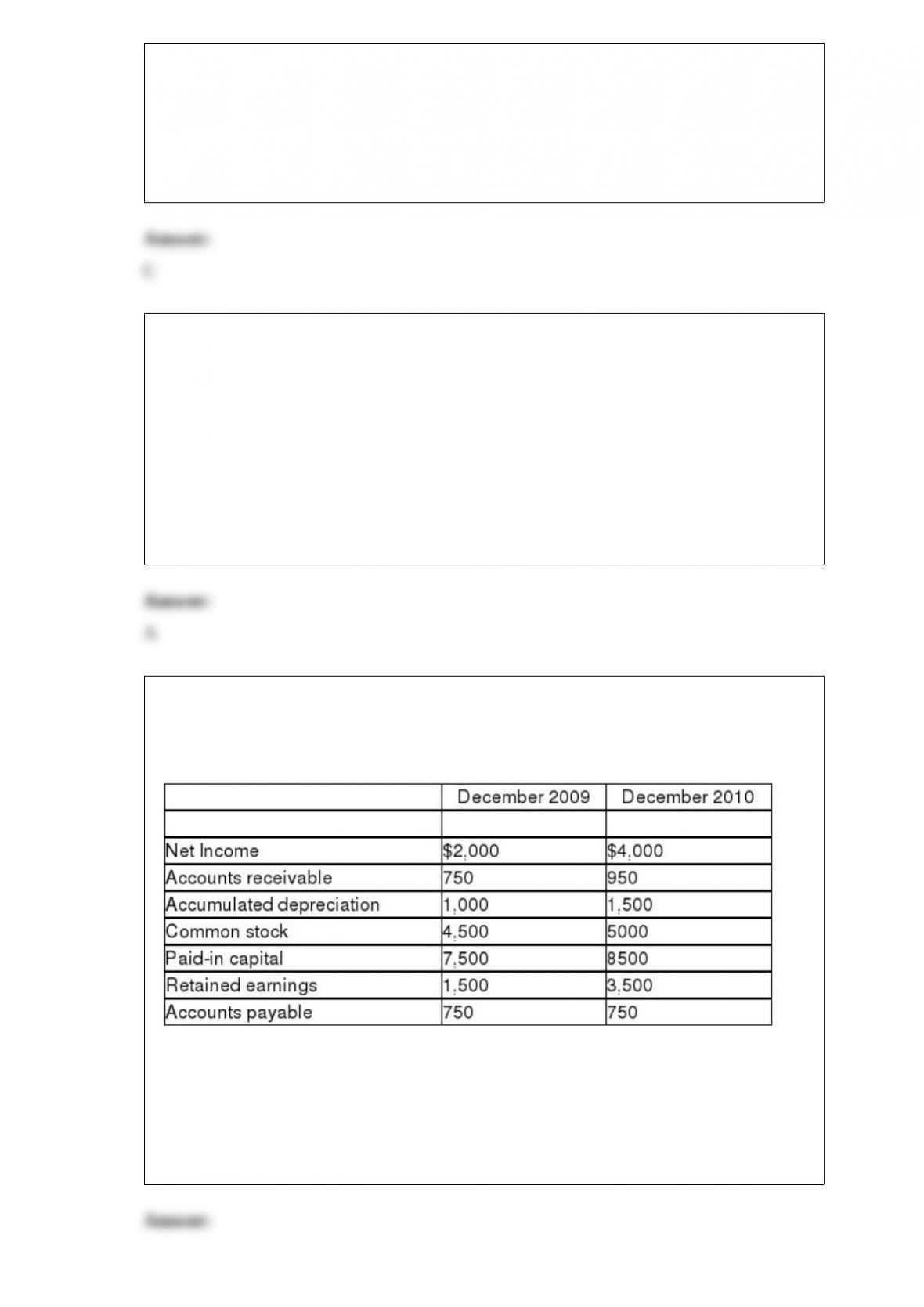
25) Table 3-1
Jones Company
Financial Information
Calculate the after tax cash flow from operations for 2008 (no assets were disposed of
during the year, and there was no change in interest payable or taxes payable).
A) $4,300
B) $1,450
C) $5,500
D) $6,250

26) Arguments against using the net present value and internal rate of return methods
include that
A) they fail to use accounting profits
B) they require detailed long-term forecasts of the incremental benefits and costs
C) they fail to consider how the investment project is to be financed
D) they fail to use the cash flow of the project
27) While checking the Wall Street Journal bond listings you notice that the price of an
AT&T bond is the same as the price of a K-Mart bond. Based on this information you
know that
A) the bond with the lower coupon rate will have the lower current yield
B) both bonds have the same yield to maturity
C) both bonds will have the same bond rating
D) the bond with the longest time to maturity will have the highest yield to maturity
28) Which of the following would be an example of the ‘speculative motive” for a firm
holding cash balances?
A) make dividend payments
B) anticipating a strike
C) purchase of inventory
D) take advantage of an anticipated decline in the price of raw materials
29) Which of the following financial ratios is the best measure of the operating
effectiveness of a firm’s management?
A) times interest earned
B) net profit margin
C) operating return on assets
D) operating efficiency quotient
30) Use the “percent of sales method” of preparing pro forma financial statements to

determine the projection for next year’s cost of goods sold. Make the following
assumptions: current year’s sales are $27,800,000; current year’s cost of goods sold is
$17,528,000; sales are expected to rise by 30%. What is the projection for next year’s
cost of goods sold?
A) $20,481,000
B) $21,138,900
C) $21,459,200
D) $22,786,400
31) The beta of ABC Co. stock is the slope of
A) the security market line
B) the characteristic line for a plot of returns on the S&P 500 versus returns on
short-term Treasury bills
C) the arbitrage pricing line
D) the characteristic line for a plot of ABC Co. returns against the returns of the market
portfolio for the same period
32) General Motors raises money by selling a new issue of common stock. This
transaction occurs in
A) the secondary market
B) the capital market
C) the money market
D) the futures market
33) The yield to maturity on long-term bonds
A) is equal to the current yield if the bond is selling for face value
B) is equal to the coupon rate on the bond
C) is equal to the net present value of the bond’s future cash flows
D) is set by the indenture agreement and will not change over the life of the bond
34) EveningFall, Inc. pays a quarterly dividend of $3.40 per share. Which of the
following statements is most accurate concerning which shareholders will receive the
dividend payment?

A) The shareholders who own the stock on the date the dividend is declared will receive
the dividend, even if they sell their stock before the dividend checks are mailed.
B) The shareholders who are identified as owning the stock on the record date will
receive the dividend, even if they sell their stock before the dividend checks are mailed.
C) The shareholders who own the stock the day the dividend is paid will receive the
dividend.
D) All shareholders who own the stock on the record date, but sell the stock before the
dividend checks are mailed, forfeit their right to receive the dividend and the money
reverts back to the corporation.
35) Which of the following forms of business organizations provide limited liability to
all its owners?
A) general partnership
B) limited partnership
C) corporation
D) both B and C
36) Which of the following statements about combined (operating & financial) leverage
is TRUE?
A) If a firm employs both operating and financial leverage, any percent change in sales
will produce a larger percent change in earnings per share
B) A firm that is in a capital-intensive industry should use a higher level of financial
leverage than a firm that employs low levels of operating leverage
C) Usage of both operating and financial leverage reduces a firm’s risk
D) High operating leverage and high financial leverage offset one another, meaning that
if sales increase by 10%, then EPS will also increase by 10%
37) Fielding Wilderness Outfitters had projected its sales for the first six months of
2010 to be as follows:
Jan.$250,000April$300,000
Feb.$340,000May$350,000
Mar.$280,000June$380,000
Cost of goods sold is 60% of sales. Purchases are made and paid for two months prior
to the sale. 40% of sales are collected in the month of the sale, 40% are collected in the
month following the sale, and the remaining 20% in the second month following the
sale. Total other cash expenses are $40,000/month. The company’s cash balance as of
March 1st, 2010 is projected to be $40,000, and the company wants to maintain a

minimum cash balance of $15,000. Excess cash will be used to retire short-term
borrowing (if any exists). Fielding has no short-term borrowing as of March 1st, 2010 .
Assume that the interest rate on short-term borrowing is 1% per month. What is
Fielding’s projected total receipts (collections) for April?
A) $124,000
B) $180,000
C) -$4,000
D) $36,000
38) Lithium, Inc. is considering two mutually exclusive projects, A and B. Project A
costs $95,000 and is expected to generate $65,000 in year one and $75,000 in year two.
Project B costs $120,000 and is expected to generate $64,000 in year one, $67,000 in
year two, $56,000 in year three, and $45,000 in year four. Lithium, Inc.’s required rate
of return for these projects is 10%. The profitability index for Project B is
A) 1.55
B) 1.48
C) 1.39
D) 1.33
39) Grandview Inc. will issue new common stock to finance an expansion. The existing
common stock just paid a $1.50 dividend, and dividends are expected to grow at a
constant rate 8% indefinitely. The stock sells for $45, and flotation expenses of 5% of
the selling price will be incurred on new shares. What is the cost of retained earnings
for Grandview?
A) 11.33%
B) 11.51%
C) 11.60%
D) 11.79%
E) 12.53%
40) Assume that you have $165,000 invested in a stock whose beta is 1.25, $85,000
invested in a stock whose beta is 2.35, and $235,000 invested in a stock whose beta is
1.11 . What is the beta of your portfolio?
A) 1.37
B) 2.01
C) 1.85
D) 1.57

41) According to the hedging principle, plant and equipment should be financed with
A) commercial paper
B) long-term funds
C) short-term bank loans
D) spontaneous financing
42) If market interest rates decline
A) short-term bonds will decline in value more than long-term bonds
B) short-term bonds will rise in value more than long-term bonds
C) long-term bonds will decline in value more than short-term bonds
D) long-term bonds will rise in value more than short-term bonds
43) A Bristal Boats, Inc. reports sales of $4,000,000, variable costs of $500,000, fixed
operating costs of $1,250,000, and interest expense of $350,000. The corporation’s
EBIT is $3,250,000 and its marginal tax rate is 30%. If the corporation is able to
increase its sales by 25%, then
A) its EBIT will increase by 25% and its EPS will increase by 25%
B) its EBIT will increase by more than 25% and its EPS will increase by less than 25%
C) its EBIT and EPS will both increase, but less than 25% due to fixed costs and taxes
D) its EBIT will increase by more than 25% and its EPS will increase by more than the
percentage increase in EBIT
44) Lithium Lakes Industries preferred stock has a par value of $100 and pays a
dividend of $6.00 per share. It presently sells for $87 per share. What do investors
require as a rate of return on this stock? Round off to the nearest .10%.
A) 14.5%
B) 9.3%
C) 6.9%
D) 6.0%

45) You own an ordinary annuity contract that will pay you $3,000 per year for 12
years. You need money to pay back a loan in 6 years, and you are afraid if you get the
annuity payments annually you will spend the money and not be able to pay back your
loan. You decide to sell your annuity for a lump sum of cash to be paid to you five years
from today. If the interest rate is 8%, what is the equivalent value of your 12-year
annuity if paid in one lump sum five years from today?
A) $22,008
B) $18,000
C) $35,876
D) $38,880