
Which of the following statements is FALSE?
A) Investments with higher volatility have rewarded investors with higher average
returns.
B) Investments with higher volatility should have a higher risk premium and therefore
higher returns.
C) Volatility seems to be a reasonable measure of risk when evaluating returns on large
portfolios and the returns of individual securities.
D) Riskier investments must offer investors higher average returns to compensate them
for the extra risk they are taking on.
The Sisyphean Corporation is considering investing in a new cane manufacturing
machine that has an estimated life of three years. The cost of the machine is $30,000
and the machine will be depreciated straight line over its three-year life to a residual
value of $0.
The cane manufacturing machine will result in sales of 2,000 canes in year 1. Sales are
estimated to grow by 10% per year each year through year three. The price per cane that
Sisyphean will charge its customers is $18 each and is to remain constant. The canes
have a cost per unit to manufacture of $9 each.
Installation of the machine and the resulting increase in manufacturing capacity will
require an increase in various net working capital accounts. It is estimated that the
Sisyphean Corporation needs to hold 2% of its annual sales in cash, 4% of its annual
sales in accounts receivable, 9% of its annual sales in inventory, and 6% of its annual
sales in accounts payable. The firm is in the 35% tax bracket, and has a cost of capital
of 10%.
The required net working capital in the second year for the Sisyphean Corporation’s
project is closest to:
A) $3,960
B) $4,360
C) $3.190
D) $5,940

If you want to value a firm that consistently pays out its earnings as dividends, the
simplest model for you to use is the:
A) enterprise value model.
B) total payout model.
C) dividend discount model.
D) discounted free cash flow model.
Which of the following statements is FALSE?
A) If two stocks move in opposite directions, one will tend to be above average when to
other is below average, and the covariance will be negative.
B) The correlation between two stocks has the same sign as their covariance, so it has a
similar interpretation.
C) The covariance of a stock with itself is simply its variance.
D) The covariance allows us to gauge the strength of the relationship between stocks.
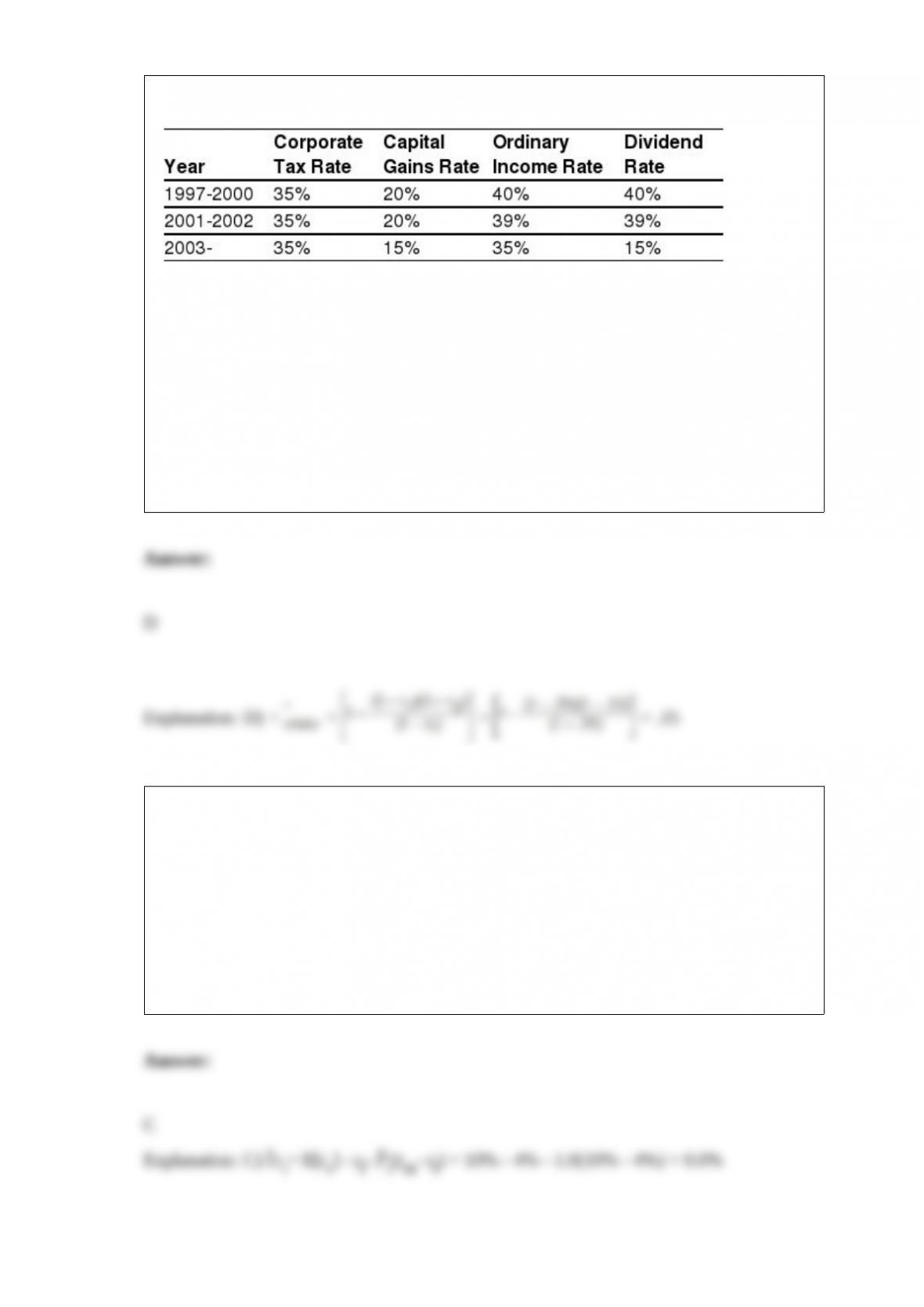
The effective tax disadvantage for retaining cash in 2006 is closest to:
A) 14.75%
B) 12.50%
C) 35.00%
D) 15.00%
Assume that the economy has three types of people. 20% are fad followers, 75% are
passive investors, and 5% are informed traders. The portfolio consisting of all informed
traders has a beta of 1.4 and an expected return of 16%. The market has an expected
return of 10% and the risk-free rate is 4%.The alpha for the passive investors is closest
to:
A) -2.4%
B) -0.9%
C) 0.0%
D) 3.6%

If Moon Corporation has depreciation or amortization expense, which of the following
is TRUE?
A) Its EBITDA /Interest Coverage ratio will be greater than its EBIT/Interest Coverage
ratio.
B) Its EBITDA /Interest Coverage ratio will be less than its EBIT/Interest Coverage
ratio.
C) Its EBITDA /Interest Coverage ratio will be equal to its EBIT/Interest Coverage
ratio.
D) Not enough information to answer the question.
Which of the following statements is FALSE?
A) The WACC can be used throughout the firm as the company wide cost of capital for
new investments that are of comparable risk to the rest of the firm and that will not alter
the firm’s debt-equity ratio.
B) A disadvantage of the WACC method is that you need to know how the firm’s
leverage policy is implemented to make the capital budgeting decision.
C) The intuition for the WACC method is that the firm’s weighted average cost of
capital represents the average return the firm must pay to its investors (both debt and
equity holders) on an after-tax basis.
D) To be profitable, a project should generate an expected return of at least the firm’s
weighted average cost of capital.
When discounting dividends you should use:
A) the weighted average cost of capital.
B) the after tax weighted average cost of capital.
C) the equity cost of capital.
D) the before tax cost of debt.

Which of the following statements is FALSE?
A) The profitability index measures the value created in terms of NPV per unit of
resource consumed.
B) The profitability index is the ratio of value created to resources consumed.
C) The profitability index can can be easily adapted for determining the correct
investment decisions when multiple resource constraints exist.
D) The profitability index measures the “bang for your buck.”
Which of the following statements is FALSE?
A) Managers are much less committed to dividend payments than to share repurchases.
B) Share repurchases are a credible signal that the shares are under-priced, because if
they are over-priced a share repurchase is costly for current shareholders.
C) While an increase of a firm’s dividend may signal management’s optimism regarding
its future cash flows, it might also signal a lack of investment opportunities.
D) Managers will clearly be more likely to repurchase shares if they believe the stock to
be under-valued.
Your investment portfolio consists of $10,000 worth of Google stock. Suppose that the
risk-free rate is 4%, Google stock has an expected return of 14% and a volatility of
35%, and the market portfolio has an expected return of 12% and a volatility of 18%.
Assume that the CAPM assumptions hold.
What alternative investment has the lowest possible volatility while having the same
expected return as Google?
A) -25% in the risk-free asset and +125% in the market portfolio
B) -20% in the risk-free asset and +120% in the market portfolio
C) 0% in the risk-free asset and +100% in the market portfolio
D) 20% in the risk-free asset and +80% in the market portfolio

Consider the following factor model:
E[Rs] – rf= (E[RMkt] – rf) + E[RSMB] + E[RHML] + E[RPR1
YR]
The term measures the sensitivity of the securities returns to:
A) size.
B) book to market.
C) momentum.
D) the overall market.
You own your own firm and you need to raise $50 million to fund an expansion.
Following the expansion, your firm will be worth $75 million in its unlevered form.
You want to go ahead with the expansion, but you are concerned that you may not be
able to maintain ownership of over 50% of your firm’s equity. In other words, you are
concerned that if you use equity to finance the expansion, you may lose control of your
firm.
Assume that capital markets are perfect, you issue $25 million in new debt, and you
issue $25 million in new equity. You ownership stake in the firm following these new
issues of debt and equity is closest to:
A) 50%
B) 55%
C) 58%
D) 33%
Which of the following statements is FALSE?
A) The standard error provides an indication of how far the sample average might
deviate from the expected return.
B) The 95% confidence interval for the expected return is defined as the Historical
Average Return plus or minus three standard errors.
C) We can use a security’s historical average return to estimate its actual expected
return.
D) The standard error is the standard deviation of the average return.
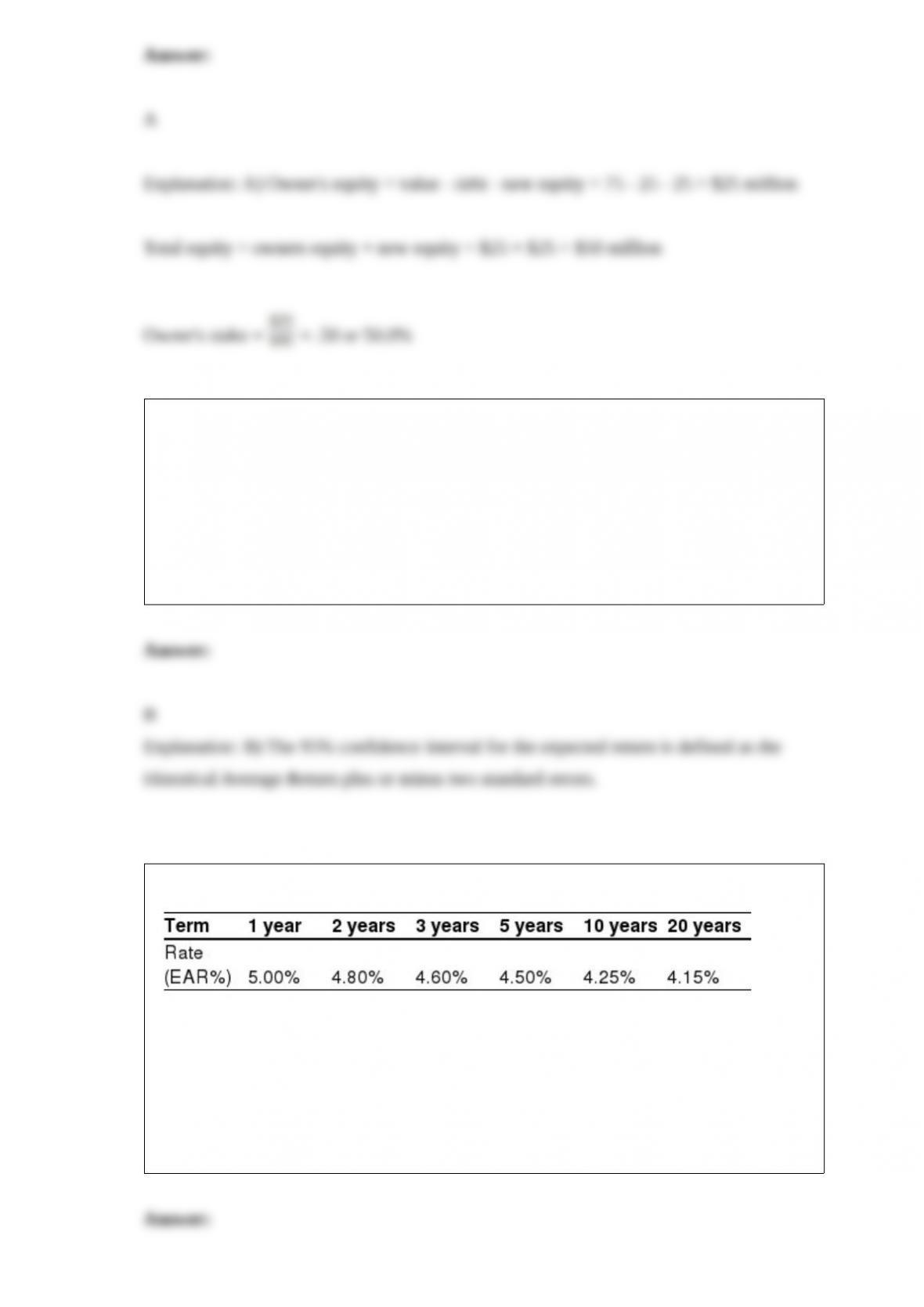
Suppose the term structure of interest rates is shown below:
Consider an investment that pays $1000 certain at the end of each of the next four
years. If the investment costs $3,500 and has an NPV of $74.26, then the four year
risk-free interest rate is closest to:
A) 4.50%
B) 4.58%
C) 4.55%
D) 4.53%

You expect CCM Corporation to generate the following free cash flows over the next
five years:
Following year five, you estimate that CCM’s free cash flows will grow at 5% per year
and that CCM’s weighted average cost of capital is 13%.
The enterprise value of CCM corporation is closest to:
A) $396 million
B) $290 million
C) $382 million
D) $350 million
Consider the following returns:
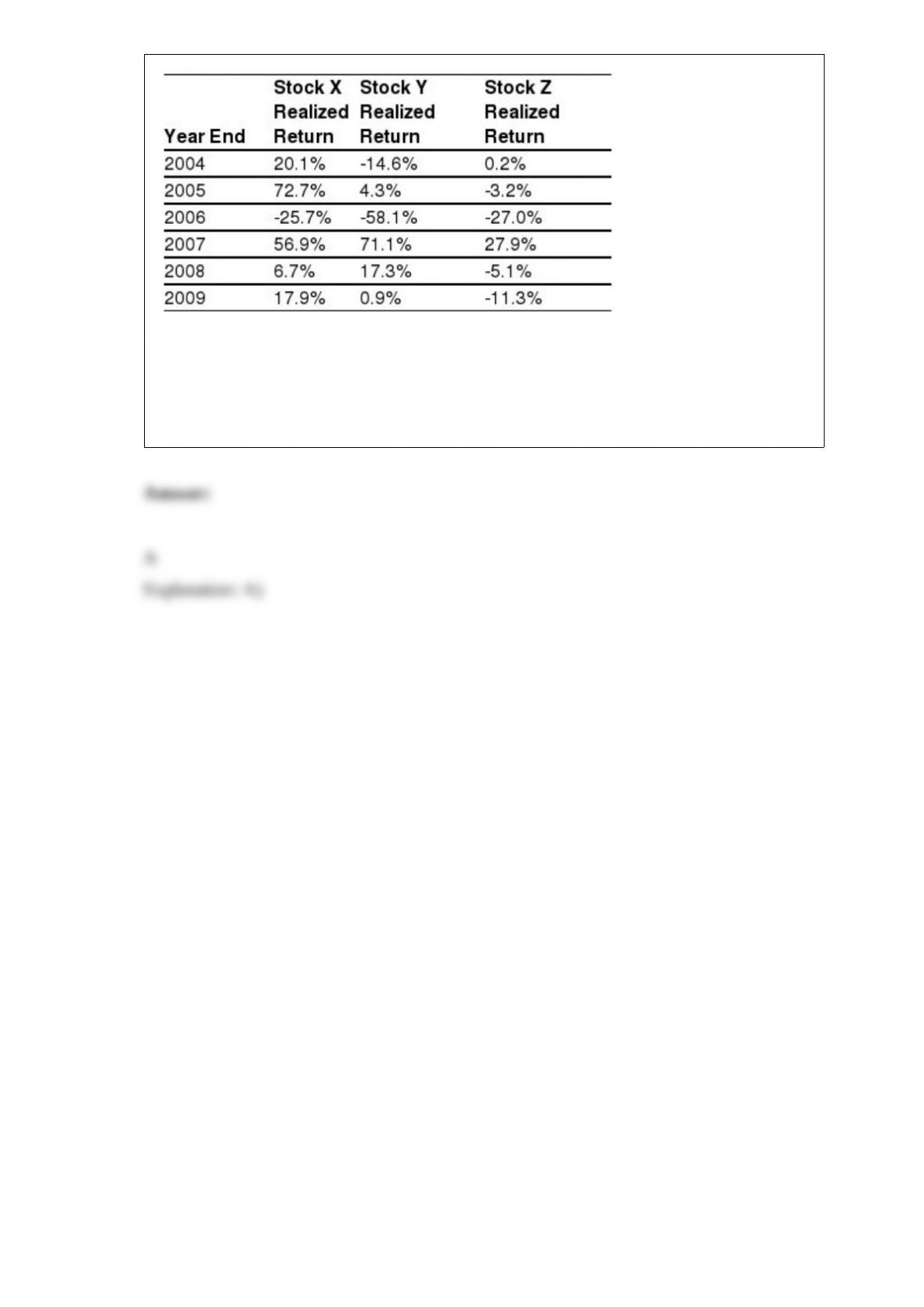
The Correlation between Stock X’s and Stock Z’s returns is closest to:
A) 0.71
B) 0.60
C) 0.62
D) 0.05
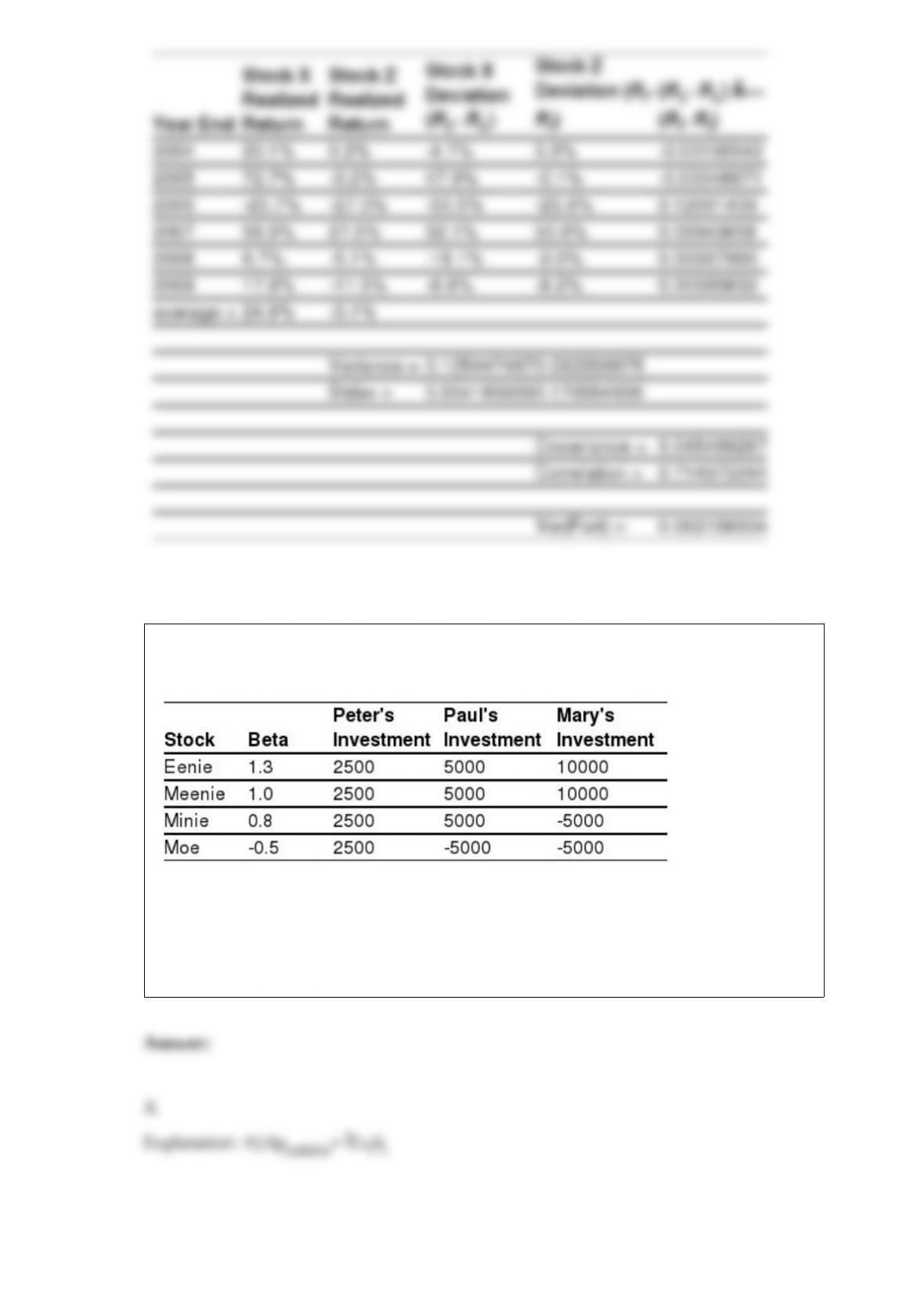
Consider the following three individuals portfolios consisting of investments in four
stocks:
The beta on Peter’s Portfolio is closest to:
A) 0.7
B) 0.8
C) 1.8
D) 1.0

Assets $200 million
Shareholder Equity $100 million
Sales $300 million
Net Income $15 million
Interest Expense $2 million
IECE’s Return on Assets (ROA) is:
A) 5.0%
B) 8.5%
C) 7.5%
D) 15.0%
Taggart Transcontinental is considering a $250 million investment to launch a new rail
line. The project is expected to generate a free cash flow of $32 million per year, and its
unlevered cost of capital is 8%. Taggart’s marginal corporate tax rate is 35%.Assume
that to fund the investment Taggart will take on $150 million in permanent debt with
the remainder of the investment funded by a cut in dividends. Assuming Taggart will
incur a 2% (after-tax) underwriting fee on the new debt issue, the NPV of Taggart’s new
rail line is closest to:
A) $195 million
B) $200 million

C) $235 million
D) $240 million
You are considering adding a microbrewery on to one of your firm’s existing
restaurants. This will entail an investment of $40,000 in new equipment. This
equipment will be depreciated straight line over five years. If your firm’s marginal
corporate tax rate is 35%, then what is the value of the microbrewery’s depreciation tax
shield in the first year of operation?
A) $2,800
B) $14,000
C) $5,200
D) $26,000