
Which of the following reduces the investor’s risk associated with investing in bonds?
a. 1 and 2
b. 1 and 3
c. 2 and 3
d. 1, 2, and 3
Convertible bonds have a call feature to
a. protect stockholders from early conversions
b. protect bondholders from conversions by stockholders
c. force stockholders to convert
d. force bondholders to convert
A firm has two $1,000, mutually exclusive investment alternatives with the following
cash inflows. The cost of capital is 6 percent.
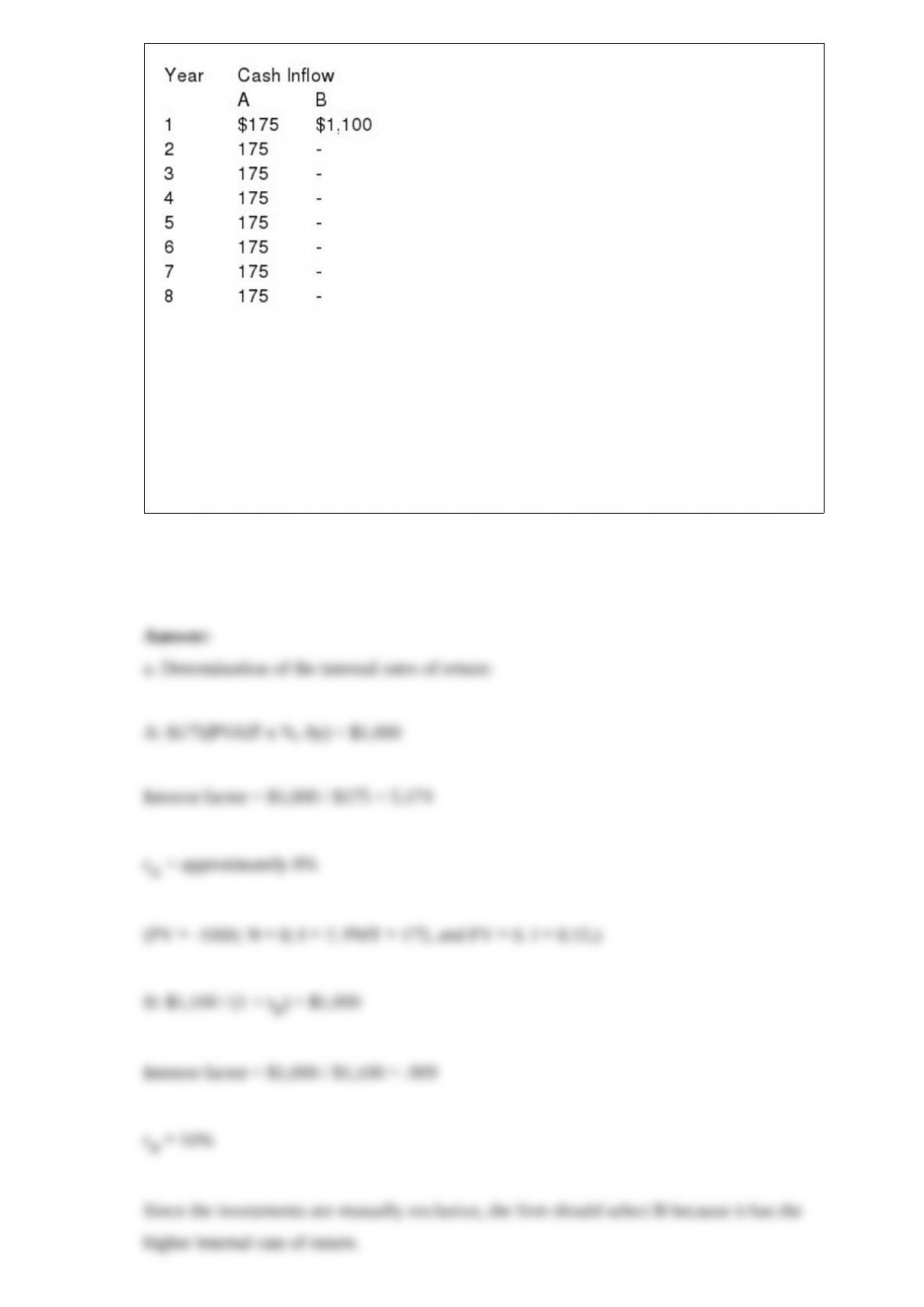
a. What is the internal rate of return on each investment? Which investment should the
firm make?
b. What is the net present value of each investment? Which investment should the firm
make?
c. If the cash inflows can be reinvested at 8 percent, which investment should be made?
Advantages of the corporate form of business include
a. limited liability for stockholders
b. avoidance of state taxation
c. limited life
d. deductibility of dividends

Advantages of investing in mutual funds include
a. avoiding brokerage fees
b. diversification
c. tax avoidance
d. capital losses
The lower the debt ratio,
a. the higher is the use of financial leverage
b. the lower is the use of financial leverage
c. the lower are the firm’s total assets
d. the higher are the firm’s total assets
The payback method fails to consider

a. 1 and 2
b. 1 and 3
c. 2 and 3
d. 1, 2, and 3
Debt financing is more risky for firms than preferred stock financing because
a. preferred dividend payments are legal obligations
b. interest payments are legal obligations
c. preferred stock must be retired
d. debt need not be refinanced
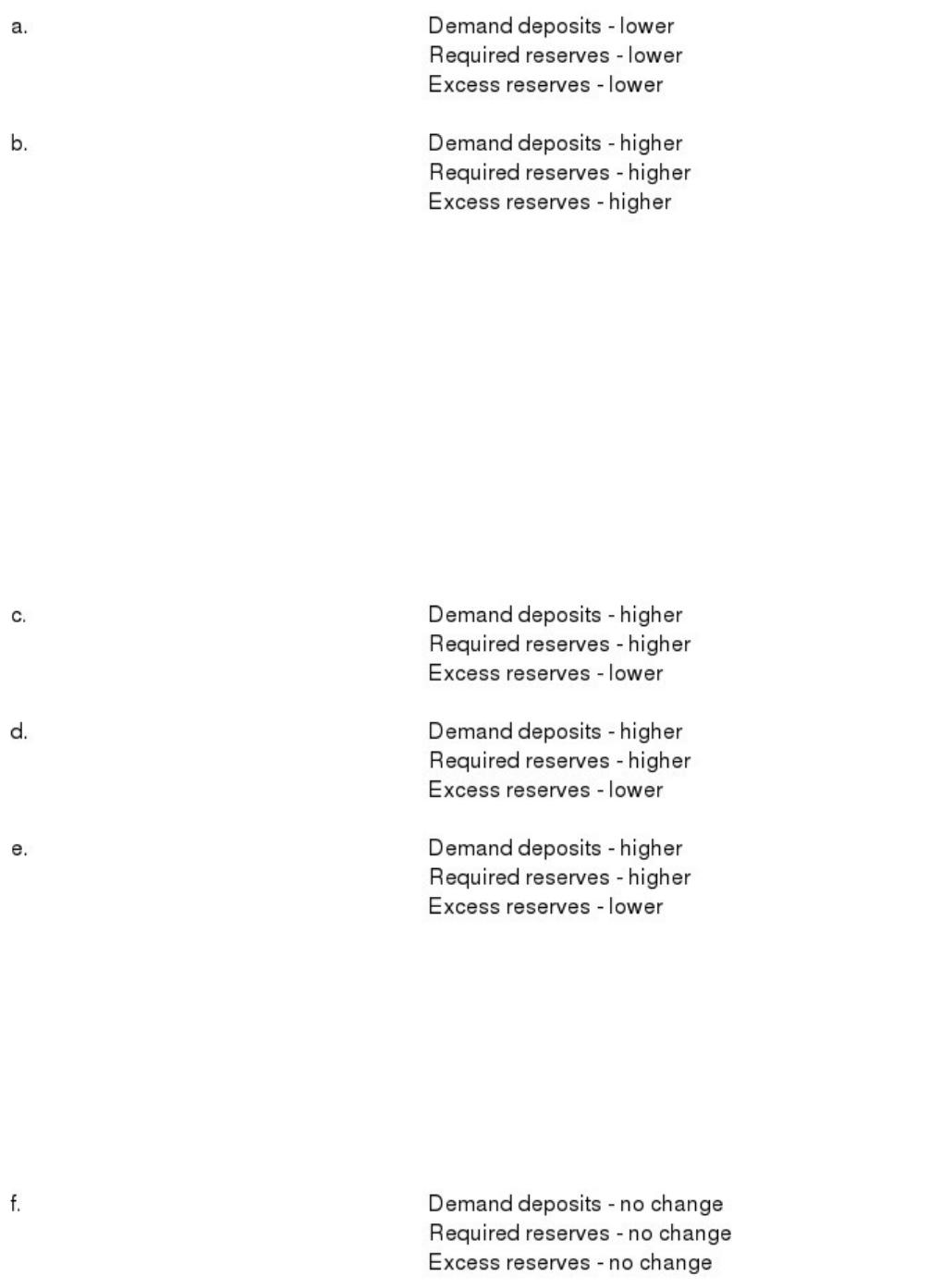
What is the effect on (1) demand deposits, (2) required reserves, and (3) excess reserves
of banks given the following transactions?
a. The general public builds up its holdings of cash by withdrawing funds in checking

accounts.
b. After Christmas the general public deposits cash in checking accounts in commercial
banks. (How may seasonal changes in the public’s need for cash alter banks’ ability to
lend?)
c. Corporations borrow from commercial banks.
d. State and local governments issue debt securities that are purchased by commercial
banks.
e. Homeowners borrow from commercial banks to finance home improvements. (Are
there any differences on the expansion of the money supply in questions (c), (d), and
(e)?)
f. A bank in California with excess reserves lends these funds through the federal funds
market to a bank in Maine that has insufficient reserves.
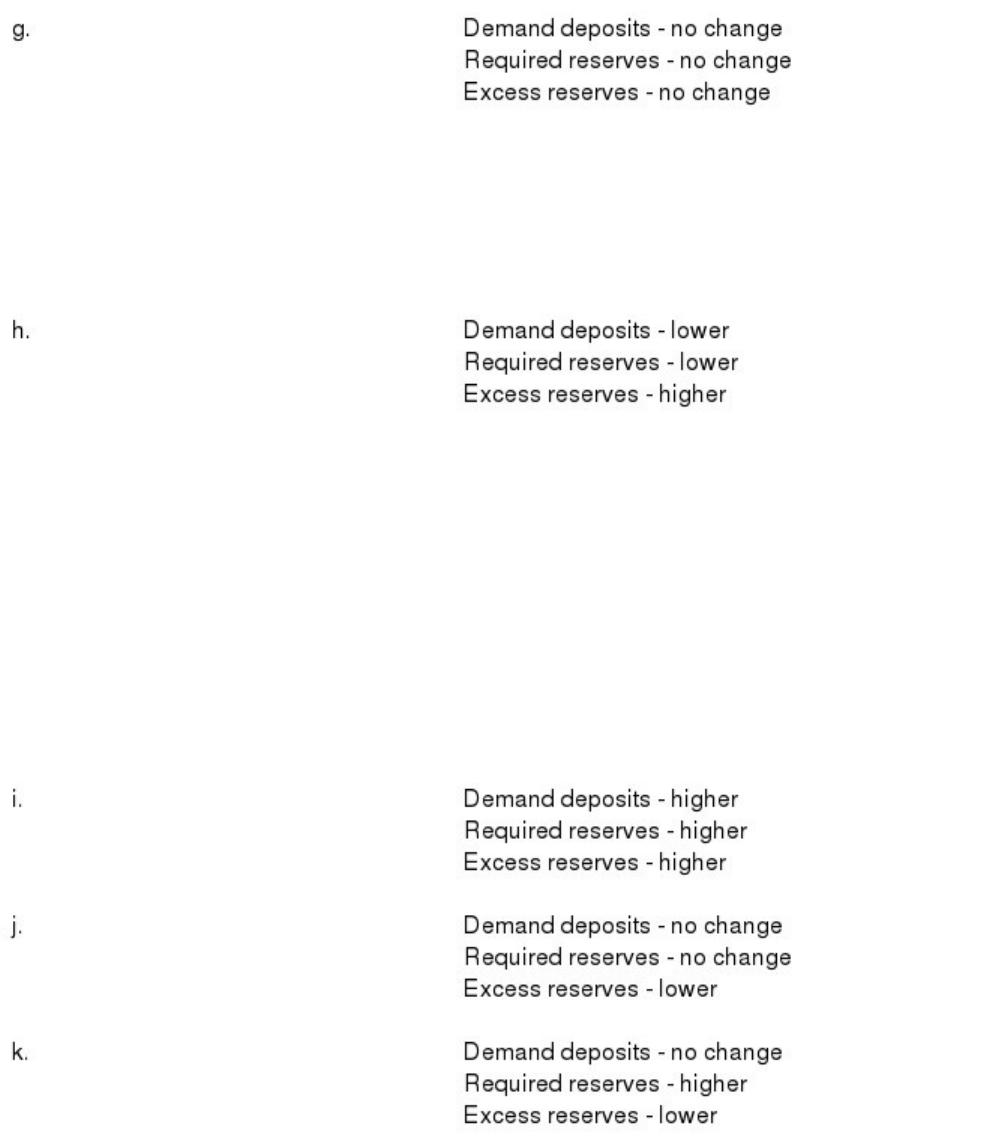
g. Corporations issue short-term securities that are purchased by the general public.
h. Corporations retire (i.e., pay off) loans from commercial banks.
i. The Federal Reserve buys Treasury bills that are sold by the general public.
j. The Federal Reserve raises the discount rate, and banks retire debt owed the Federal
Reserve.
k. The Federal Reserve raises the reserve requirement on demand deposits.
l. The Treasury borrows from the banks to finance payments.
m. The federal government runs a deficit and borrows the funds from the general
public.
n. The federal government runs a deficit and borrows the funds from the Federal
Reserve.

Operating income does not consider
a. depreciation
b. cost of goods sold
c. taxes paid
d. salaries
An investment banker

a. 1 and 2
b. 1 and 3
c. 2 and 3
d. only 3
If you expect a stock’s price to fall, you may
a. 1 and 3
b. 1 and 4
c. 2 and 3
d. 2 and 4
Regression analysis estimates
a. the relationship between inventory and receivables

b. the tendency of firms to retain earnings
c. an equation relating sales and receivables
d. the firm’s excess use of debt financing
Discounting is
1) the determination of present value
2) the determination of future value
3) expressing the present in the future
4) expressing the future in the present
a. 1 and 3
b. 1 and 4
c. 2 and 3
d. 2 and 4
The intrinsic value of a call option is
a. the strike price plus the stock price

b. the strike price minus the stock price
c. the stock price minus the strike price
d. the stock price minus the call’s market price
Dividends come at the expense of
a. interest
b. retained earnings
c. liabilities
d. stock
Owners in which of the following forms of business have unlimited liability?
a. LLCs
b. corporations
c. sole proprietorships
d. limited partnerships

An investor may reduce risk by selecting
a. high beta stocks
b. stocks with poorly correlated returns
c. a cross-section of firms in the same industry
d. stocks traded on organized exchanges
The present value of an annuity due
a. is less than the present value of an ordinary annuity
b. is greater than the present value of an ordinary due
c. is less than the cost of the annuity
d. is greater than the cost of the annuity
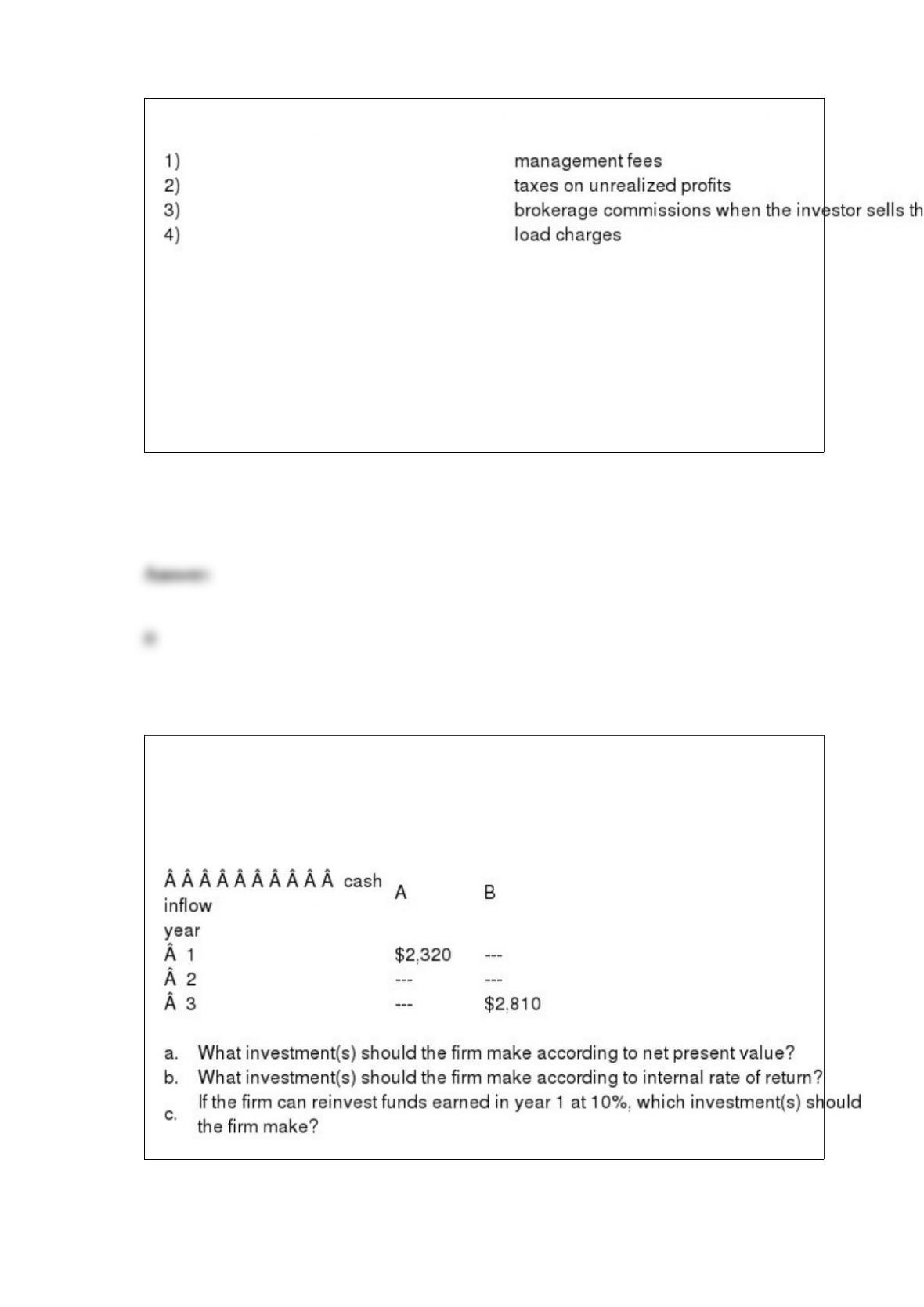
Costs associated with investing in mutual funds include
a. 1 and 3
b. 1 and 4
c. 2 and 3
d. 2 and 4
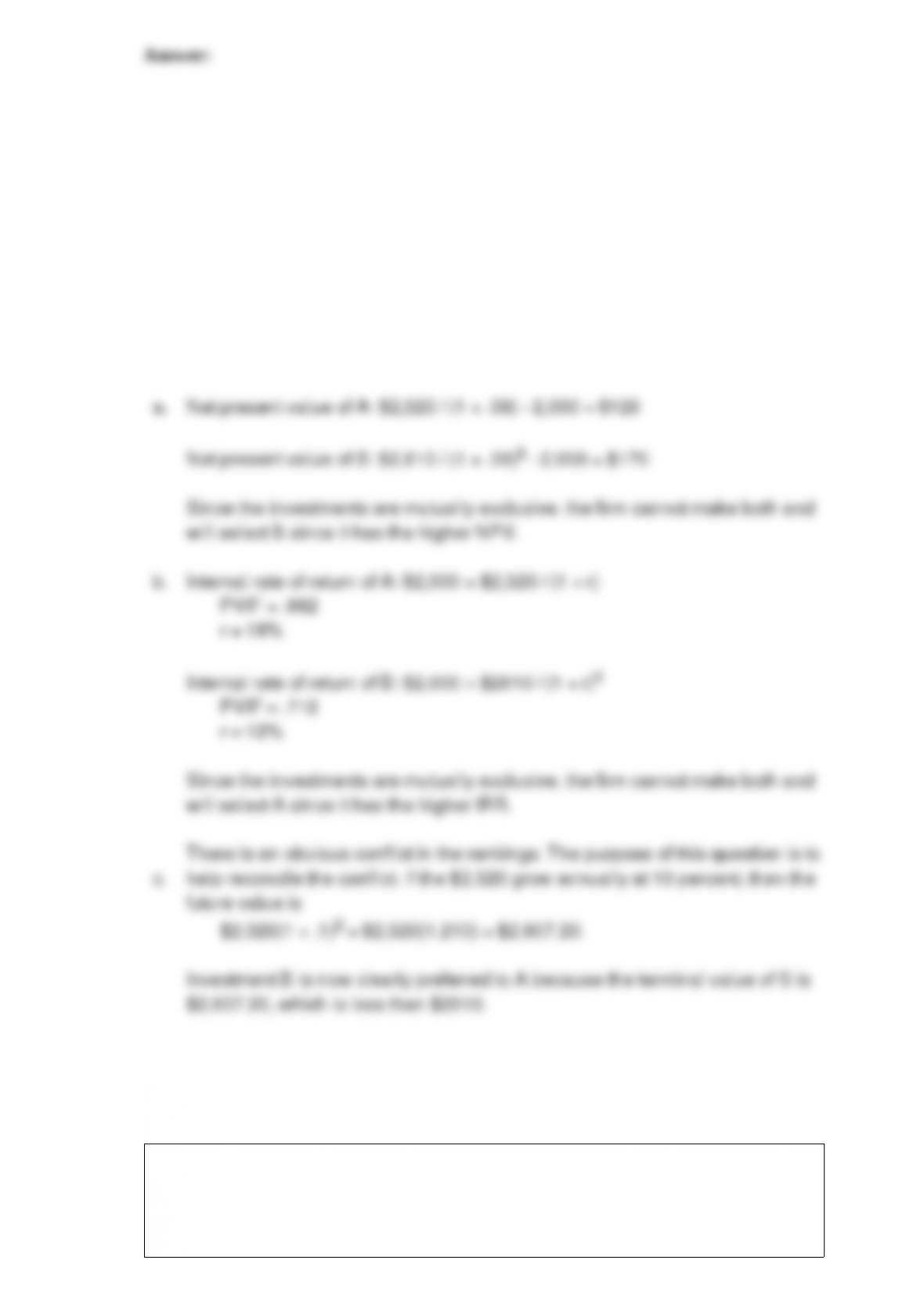
Investments A and B are mutually exclusive and cost $2,000 each. The firm’s cost of
capital is 9%, and the investments’ estimated cash inflows are
Which of the following is a cash outflow?
a. a stock repurchase
b. a decrease in inventory
c. an increase in accounts payable
d. a stock dividend
Excess reserves are affected by
a. 1 and 2
b. 1 and 3
c. 2 and 3
d. 1, 2, and 3
Debt instruments subject their owners to risk from

a. 1 and 2
b. 1 and 3
c. 2 and 3
d. 1, 2, and 3
If interest rates in general fall,
a. the prices of existing bonds rise
b. the prices of existing bonds fall
c. the prices of existing bonds are unaffected
d. the coupon rate adjusts for the change in interest rates
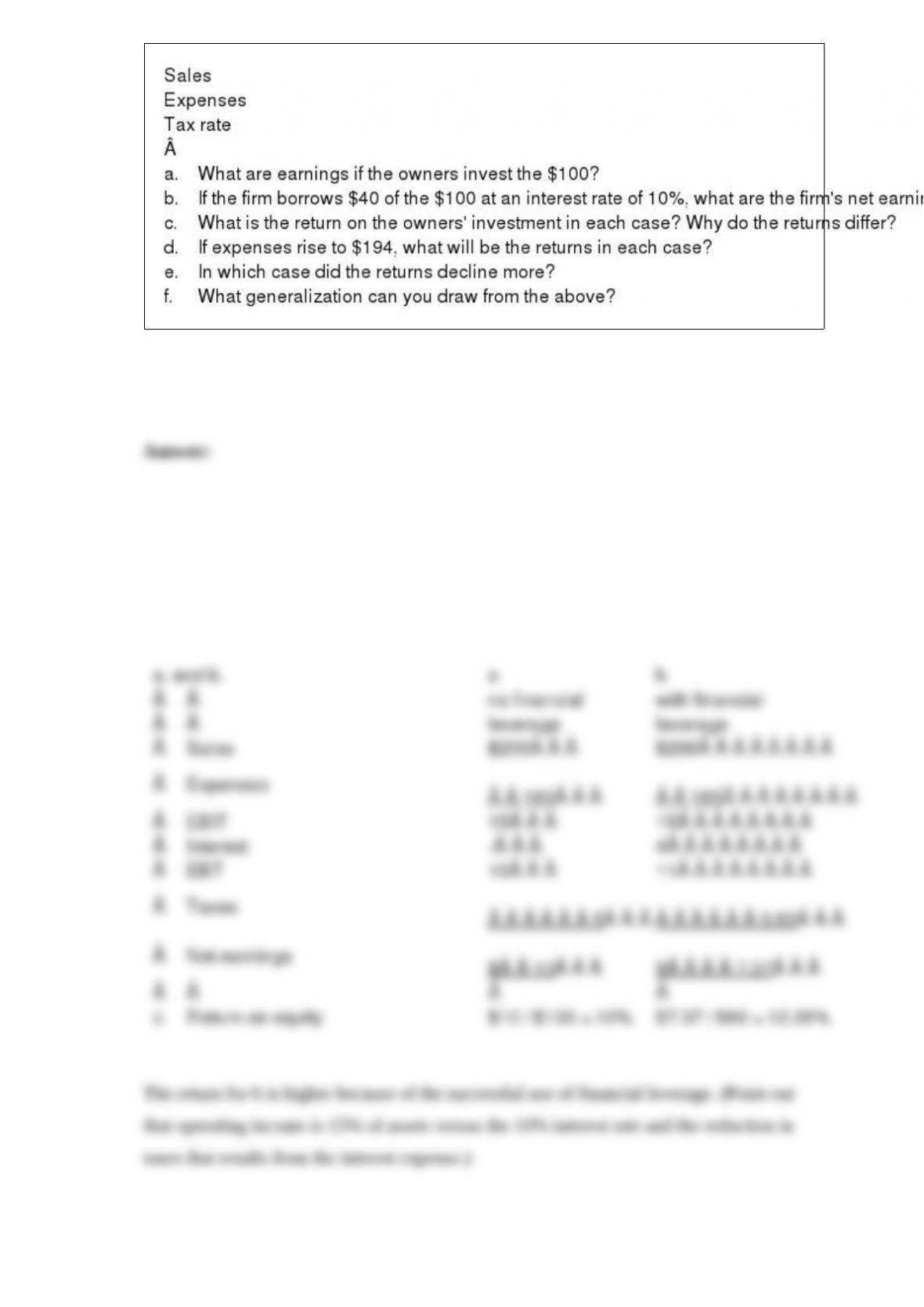
(This is a simple problem that replicates the example in the chapter.) A firm needs $100
to start and expects

Anticipation of inflation encourages
a. lending
b. borrowing
c. retiring debt
d. saving
The cash budget is constructed using
a. regression analysis
b. the percent of sales

c. revenues and expenses
d. receipts and disbursements
A put is the option to sell stock at $35. The price of the stock is $34, and the price of the
put is $2.
a. What is the intrinsic value of the put?
b. What is the time premium paid for the put?
c. What is the percentage return on an investment in the put if at the expiration of the
put the price of the stock is $31?
In a sale and leaseback
a. the lessee sells its equipment back to the lessor after a period of time
b. the lessee sells equipment to a lessor and leases back the equipment

c. the lessor borrows funds to purchase the asset from the lessee
d. the lessor sells the asset to the lessee
The greater the usage of financial leverage, the larger is the variability of
a. revenues
b. gross profits
c. operating earnings
d. net earnings
The dividend paid by a preferred stock is usually
a. tax deductible
b. variable
c. paid in stock
d. fixed

One means by which a commercial bank may increase the effective cost of a loan is to
a. 1 and 2
b. 1 and 3
c. 2 and 3
d. 1, 2, and 3
Commercial paper is issued by
a. all firms
b. large firms with excellent credit ratings
c. the federal government
d. small firms with excellent credit ratings

Which of the following bonds is supported by collateral?
a. unsecured bonds
b. income bonds
c. equipment trust certificates
d. debentures
If interest rates fall after a bond is issued, the yield to maturity rises.
If an investor buys shares in a closed-end investment company for $46 and the net asset
value is $53, what is the discount? If the company distributes $1, the net asset value
rises to $58, and the investor sells the shares for a premium of 5 percent over the net
asset value, what is the percentage earned on the investment?

Retained earnings are more expensive than issuing new shares because of flotation
costs.
The effect on earnings per share will be the same if a firm issues bonds with a 9 percent
interest rate or preferred stock with a 9 percent dividend yield.
Intermediate term loans acquired by insurance companies usually are secured by
collateral.

Trade credit is primarily used by retailers to finance inventory.
When the Federal Reserve sells securities, the money supply is increased.
Since high use of financial leverage is associated with less risk, higher financial
leverage may also result in higher stock prices.
If a bank pays 5 percent compounded semi-annually, the true rate of interest is less than
5 percent annually.

Corporations pay a straight 25 percent tax rate on their earnings.
Firms with substantial amounts of interest expense have a higher operating leverage.
The federal funds rate is the interest rate the Federal Reserve charges banks when they
borrow reserves.
The weighted cost of capital includes the cost of debt and the cost of equity.

If regression analysis estimates that assets exceed liabilities and equity, the firm will
require external sources of finance.
A periodic payment to retire a debt is illustrative of a sinking fund.
A beta coefficient is an index of an asset’s unsystematic risk.

If an individual enters a contract to accept future delivery of Treasury bonds, that is a
long position.