
1) Western Steer purchased some three-year MACRS property three years ago. What is
the current book value of this equipment if the original cost was $58,000? The MACRS
allowance percentages are as follows, commencing with year 1: 33.33, 44.45, 14.81,
and 7.41 percent.
A.$0
B.$1,122
C.$4,298
D.$7,863
E.$8,886
2) The amount by which a firm’s tax bill is reduced as a result of the depreciation
expense is referred to as the depreciation:
A.tax shield
B.credit
C.erosion
D.opportunity cost
E.adjustment
3) The relationship between the present value and the time period is best described as:
A.direct
B.inverse
C.unrelated
D.ambiguous
E.parallel
4) Which one of the following is a payment of either cash or shares of stock that is paid
out of earnings to a firm’s shareholders?
A.Interest
B.Distribution
C.Retained earnings
D.Dividend
E.Stock repurchase

5) Northwestern Lumber Products currently has 15,000 shares of stock outstanding.
Patricia, the financial manager, is considering issuing $120,000 of debt at an interest
rate of 6.75 percent. Given this, how many shares of stock will be outstanding once the
debt is issued if the break-even level of EBIT between these two capital structure
options is $60,000? Ignore taxes.
A.12,975 shares
B.13,650 shares
C.14,025 shares
D.14,550 shares
E.15,000 shares
6) A project has an initial requirement of $698,700 for fixed assets and $61,000 for net
working capital. The fixed assets will be depreciated to a zero book value over the
four-year life of the project and will be worthless at the end of the project. All of the net
working capital will be recouped after four years. The expected annual operating cash
flow is $218,000. What is the project’s internal rate of return if the tax rate is 35
percent?
A.7.72 percent
B.8.41 percent
C.8.69 percent
D.9.11 percent
E.9.97 percent
7) The profitability index reflects the value created per dollar:
A.invested
B.of sales
C.of net income
D.of taxable income
E.of shareholders’ equity
8) The NYSE:
A.presently conducts all of its trading through SuperDOT.
B.is a dealer market
C.is in the business of attracting order flow
D.is solely a primary market
E.is based on a multiple market maker system
9) Six years ago, China Exporters paid cash for a new packaging machine that cost
$287,000. Three years ago, the firm spent $3,900 on repairs and modifications to the
machine. The machine is now fully depreciated and has just sat idly in a back corner of
the shop for the past seven months. The estimated value of the machine today is
$125,500. The firm is considering using this machine in a new project. If it does so,
what value should be assigned to this machine and included in the initial costs of the
new project?
A.$0
B.$3,900
C.$125,500
D.$127,400
E.$143,500
10) Which one of the following is most likely the fastest method of collecting cash?
A.Requiring customers to submit all payments to a lockbox
B.Requiring customers to submit all payments to the home office
C.Initiating a financial electronic data interchange at the time of sale
D.Offer customers credit terms of 1/5, net 15
E.Eliminating all disbursement float
11) Which one of the following would tend to favor a low-dividend payout?
A.Higher tax rates on capital gains than on dividend income
B.High flotation cost for equity issues
C.Endowment fund investors who cannot spend principal
D.Investors’ desire for a high-dividend yield
E.Elimination of the tax deferral on capital gains
12) The Food Store is planning a major expansion for four years from today. In
preparation for this, the company is setting aside $35,000 each quarter, starting today,
for the next four years. How much money will the firm have when it is ready to expand
if it can earn an average of 6.25 percent on its savings?
A.$528,409.29
B.$540,288.16
C.$610,411.20
D.$640,516.63
E.$662,009.14
13) What is the market called that allows shareholders to resell their shares to other
investors?
A.Primary
B.Proxy
C.Secondary
D.Inside
E.Initial
14) A bond has an average return of 6.3 percent and a standard deviation of 3.8 percent.
What range of returns would you expect to see 68 percent of the time on this security?
A.-1.30 percent to 13.9 percent
B.-1.30 percent to 10.1 percent
C.2.5 percent to 7.8 percent
D.2.5 percent to 10.1 percent
E.2.5 percent t0 13.9 percent
15) The Greenbriar is an all-equity firm with a total market value of $520,000 and
20,000 shares of stock outstanding. Management is considering issuing $120,000 of
debt at an interest rate of 10 percent and using the proceeds on a stock repurchase.
Ignore taxes. How many shares will the firm repurchase if it issues the debt securities?
A.2,871 shares
B.3,516 shares
C.4,521 shares
D.4,607 shares
E.4,615 shares
16) The capital asset pricing model:
A.assumes the market has a beta of zero
B.rewards investors based on total risk
C.considers the time value of money
D.applies to portfolios but not to individual securities
E.assumes the market risk premium is constant over time
17) Financial statement analysis:
A.is primarily used to identify account values that meet the normal standards
B.is limited to internal use by a firm’s managers
C.provides useful information that can serve as a basis for forecasting future
performance
D.provides useful information to shareholders but not to debtholders
E.is enhanced by comparing results to those of a firm’s peers but not by comparing
results to prior periods
18) Rembrandt, Samurai, Yankee, and Bulldog are all names associated with which one
of the following?
A.Eurobonds
B.Currencies
C.Cross-rate
D.Foreign bonds
E.Foreign interest rates
19) Today, you are purchasing a 20-year, 6 percent annuity at a cost of $120,000. The
annuity will pay annual payments starting 1 year from today. What is the amount of
each payment?
A.$9,511.08
B.$10,462.15
C.$10,754.40
D.$11,013.20
E.$12,208.19
20) Which one of the following terms is defined as having international operations in a
world where relative currency values change?
A.Political risk
B.Relative purchasing power parity
C.Interest rate parity
D.Absolute purchasing power parity
E.Exchange rate risk
21) Compass Bank is offering 0.8 percent compounded daily on its savings accounts. If
you deposit $2,500 today, how much will you have in the account in 15 years?
A.$2,567.15
B.$2,675.10
C.$2,761.32
D.$2,818.74
E.$2,890.62

22) Nu Tek is comprised of four separate operating divisions. For this year, the firm has
decided to allocate capital funds using a soft rationing approach. Which one of the
following applies to this situation?
A.Division managers will be limited to accepting a single new project each
B.Division managers are being given blanket approval to accept all positive net present
value projects
C.Divisions managers will vie with each other for additional capital allocations
D.Division managers will not receive any funding for new projects but will be allowed
to expand current operations
E.Division managers will not receive capital funding for any project
23) According to the efficient markets hypothesis, professional investors will earn:
A.excess profits over the long-term
B.excess profits, but only on short-term investments
C.a dollar return equal to the value paid for an investment
D.a return that cannot be accurately predicted because investments are subject to the
random movements of the markets
E.a return that “beats the market”
24) The Golden Goose is considering a project with an initial cost of $46,700. The
project will produce cash inflows of $10,000 a year for the first two years and $12,000
a year for the following three years. What is the payback period?
A.2.87 years
B.3.23 years
C.3.41 years
D.3.79 years
E.4.23 years
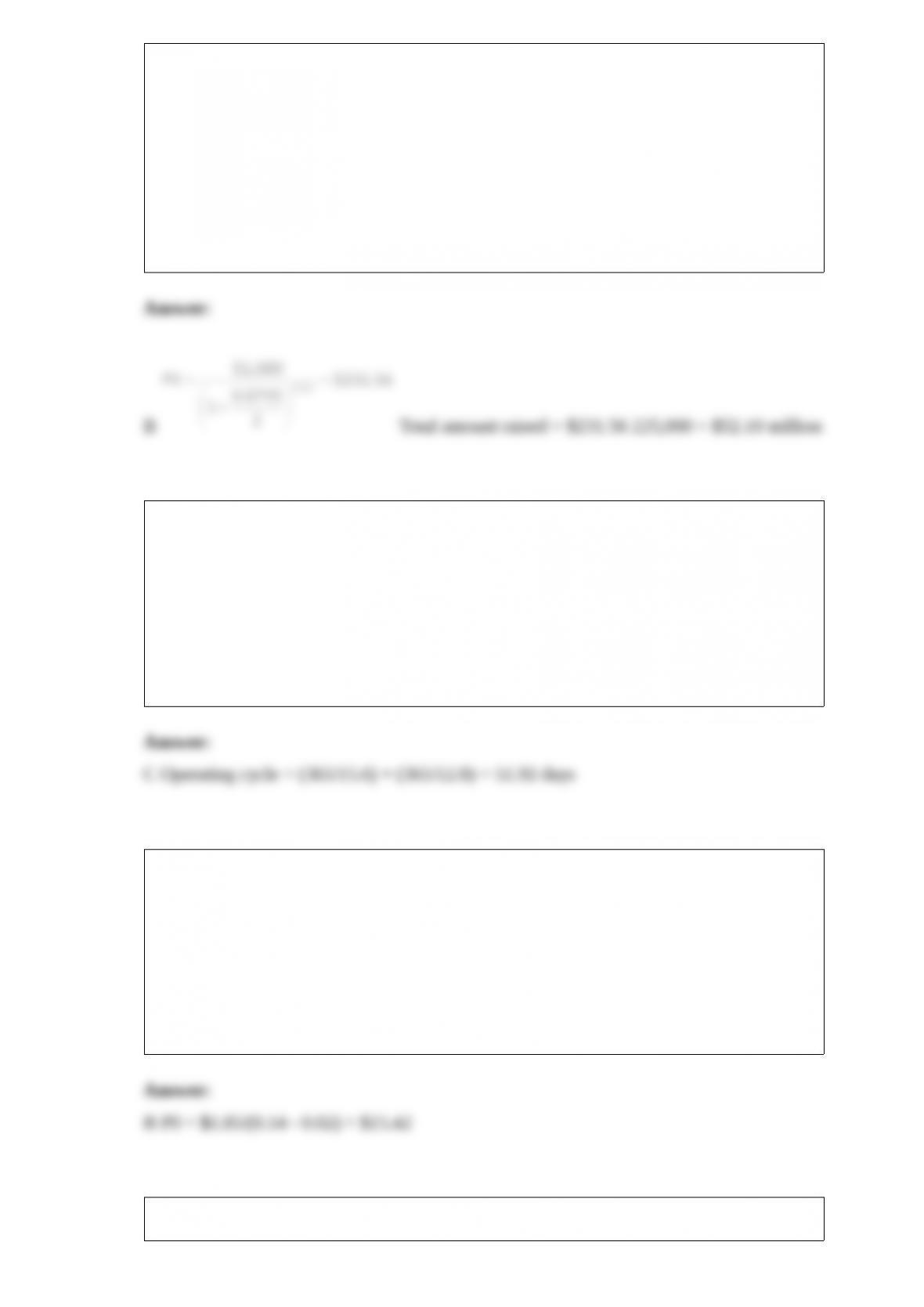
25) Deltona Motors just issued 225,000 zero coupon bonds. These bonds mature in 20
years, have a par value of $1,000, and have a yield to maturity of 7.45 percent. What is
the approximate total amount of money the company raised from issuing these bonds?
(Assume semiannual compounding.)
A.$48.20 million
B.$52.10 million
C.$55.14 million
D.$162.08 million
E.$225.00 million
26) Captain Kurt’s Enterprises has a receivables turnover rate of 12.8, a payables
turnover rate of 11.9, and an inventory turnover rate of 15.6 . What is the length of the
firm’s operating cycle?
A.24.89 days
B.39.80 days
C.51.92 days
D.62.56 days
E.83.77 days
27) Solar Energy, Inc. will pay an annual dividend of $1.85 next year. The company just
announced that future dividends will be increasing by 2 percent annually. How much
are you willing to pay for one share of this stock if you require a 14 percent return?
A.$15.14
B.$15.42
C.$15.78
D.$16.12
E.$16.62
28) The ratios that are based on financial statement values and used for comparison

purposes are called:
A.financial ratios
B.industrial statistics
C.equity standards
D.accounting returns
E.analytical standards
29) Christmas Ornaments, Inc. is an all-equity firm with a total market value of
$386,000 and 15,000 shares of stock outstanding. Management is considering issuing
$75,000 of debt at an interest rate of 8 percent and using the proceeds on a stock
repurchase. As an all-equity firm, management believes the earnings before interest and
taxes (EBIT) will be $31,000 if the economy is normal, $12,000 if it is in a recession,
and $37,000 if the economy booms. Ignore taxes. What will the EPS be if the economy
falls into a recession and the firm maintains its all-equity status?
A.$0.78
B.$0.80
C.$1.21
D.$1.67
E.$2.07
30) Bob’s is a retail chain of specialty hardware stores. The firm has 21,000 shares of
stock outstanding that are currently valued at $68 a share and provide a 13.2 percent
rate of return. The firm also has 500 bonds outstanding that have a face value of $1,000,
a market price of $1,068, and a 7 percent coupon. These bonds mature in 6 years and
pay interest semiannually. The tax rate is 35 percent. The firm is considering expanding
by building a new superstore. The superstore will require an initial investment of $12.3
million and is expected to produce cash inflows of $1.1 million annually over its
10-year life. The risks associated with the superstore are comparable to the risks of the
firm’s current operations. The initial investment will be depreciated on a straight line
basis over the life of the project. At the end of the 10 years, the firm expects to sell the
superstore for $6.7 million. Should the firm accept or reject the superstore project and
why?
A.Accept; the project’s NPV is $1.27 million
B.Accept; the NPV is $4.89 million
C.Reject; the NPV is $1.06 million
D.Reject; the NPV -$3.27 million
E.Reject; the NPV is -$5.71 million
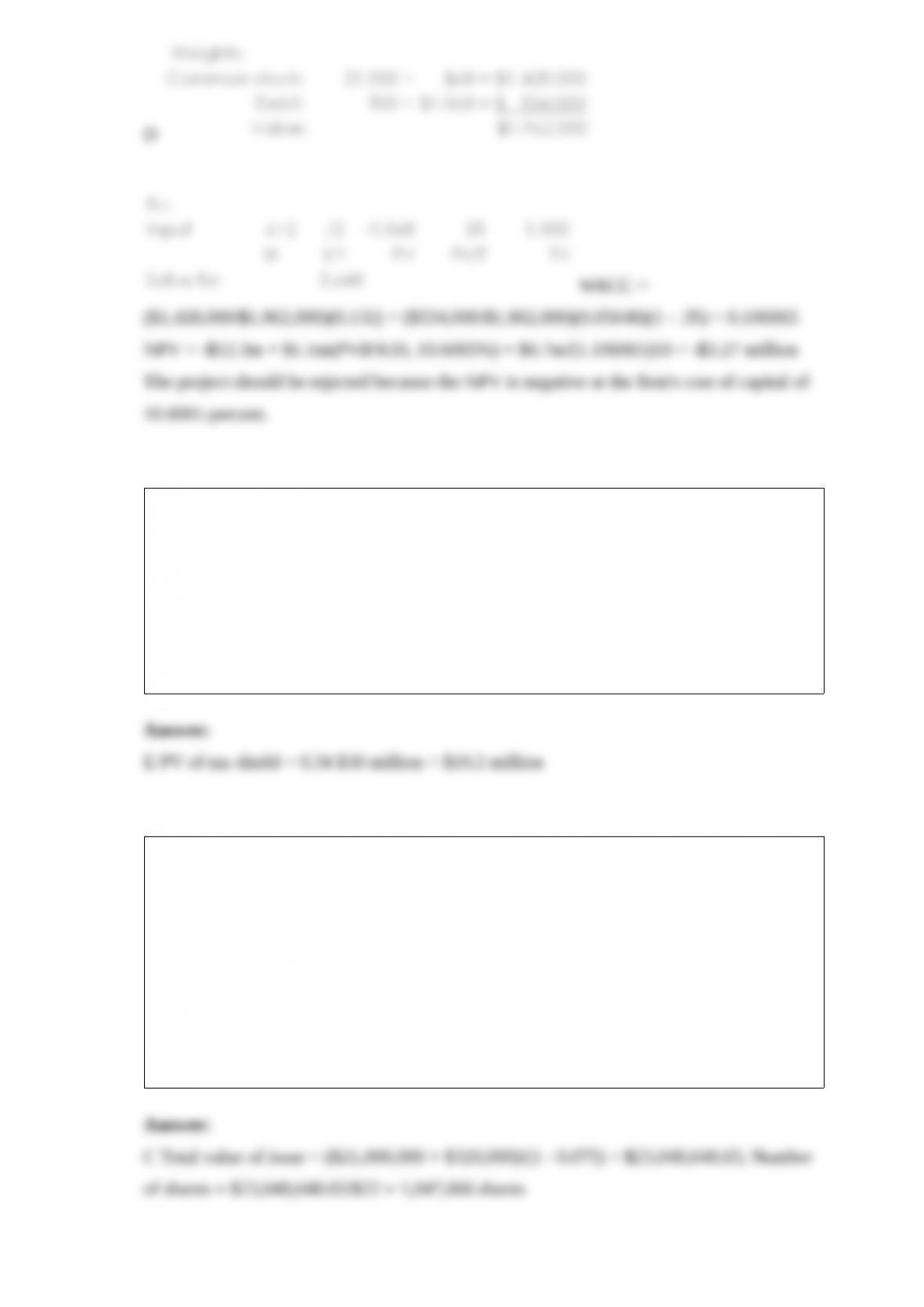
31) Granny’s Home Remedy has a $30 million bond issue outstanding with a coupon
rate of 7.75 percent and a current yield of 7.67 percent. What is the present value of the
tax shield if the tax rate is 34 percent?
A.$632,400
B.$625,872
C.$1.20 million
D.$8.16 million
E.$10.2 million
32) Quali Tech wants to raise $21 million to purchase equipment by issuing new
securities. Management estimates the issue will cost the firm $320,000 for accounting,
legal, and other costs. The underwriting spread is 7.5 percent and the issue price is $22
per share. How many shares of stock must be sold if Quali Tech is to receive sufficient
funds to purchase all the desired equipment?
A.1,008,010 shares
B.1,021,121 shares
C.1,047,666 shares
D.1,147,666 shares
E.1,110,333 shares

33) Decatur Arts Center writes 158 checks a day for an average amount of $211 each.
These checks generally clear the bank 3.5 days after they are written. In addition, the
firm generally receives an average of $50,000 a day in checks. The checks that are
received are deposited immediately and the funds are generally available the following
day. What is the amount of the firm’s disbursement float?
A.$104,625.00
B.$116,683.00
C.$155,255.50
D.$170,450.00
E.$50,000.00
34) Juno’s has projected its first quarter sales at $42,000 and its second quarter sales at
$45,000. The firm’s cost of goods sold is equal to 70 percent of the next quarter’s sales.
The accounts receivable period is 30 days and the accounts payable period is 45 days.
As of the beginning of the first quarter, the accounts receivable balance is $13,200 and
the accounts payable balance is $14,500. The firm pays $1,800 a month in cash
expenses and $100 a month in taxes. At the beginning of the first quarter, the cash
balance is $380 and the short-term loan balance is zero. The firm maintains a minimum
cash balance of $50. Assume each month has 30 days. What is the cumulative cash
surplus (deficit) at the end of the first quarter, prior to any short-term borrowing?
A.-$5,210
B.-$4,620
C.-$3,615
D.$7,880
E.$9,380
35) Which one of the following statements is correct?
A.The net present value is a measure of profits expressed in today’s dollars
B.The net present value is positive when the required return exceeds the internal rate of
return
C.If the initial cost of a project is increased, the net present value of that project will
also increase
D.If the internal rate of return equals the required return, the net present value will
equal zero
E.Net present value is equal to an investment’s cash inflows discounted to today’s
dollars

36) Your portfolio is 240 shares of Rising Sun Co. The stock currently sells for $62 a
share. The company has announced a dividend of $1.10 per share with an ex-dividend
date of May 6 . Assume there are no taxes. What will your portfolio value be on May 7?
A.$14,616
B.$14,880
C.$15,026
D.$15,144
E.$15,210
37) Belk Department Store charges a daily rate of 0.01 percent on its store credit cards.
What interest rate is the company required by law to report to potential customers?
A.35.98 percent
B.36.50 percent
C.39.00 percent
D.40.04 percent
E.40.48 percent
38) Which one of the following tends to be true for the average investor?
A.They frequently earn initially high returns on IPOs when shares are undersubscribed
B.They generally receive their full allocation of shares even when an IPO is
oversubscribed
C.They often encounter the “winner’s curse”
D.They are protected from losses by the Green Shoe provision
E.Average investors are not allowed to purchase IPOs at the offer price