
1) Contract terms can be designed to eliminate or reduce conflicting incentives that
arise in business relationships.
2) The quick ratio measures the most immediate liquidity of a company.
3) In the United Kingdom and Germany (and some other European countries) fixed
assets are presented first on the balance sheet followed by the current assets displayed
in increasing order of liquidity.
4) To remain in accordance with GAAP, operating leases require note disclosure of the
future cash flows arising from operating leases.
5) Under both IFRS and GAAP special purpose entities are consolidated when the firm
is the “primary beneficiary”.
6) The upward or downward adjustment to reflect fair value of trading securities is a
direct debit or credit to a market adjustment account.
7) A component that is unrelated to future free cash flows or future earnings and is not
pertinent to assessing current share price is a noise component.
8) An increase in cash flows from financing activities will occur when a company
distributes a stock dividend.
9) The amount of the cumulative gain or loss in excess of the corridor threshold is
amortized to the pension expense over the average remaining service period of the
employees.
10) Under U. S. GAAP, software development costs are expensed as research and
development costs up until the time the software is released to customers.
11) For a firm using the indirect method, a loss on the sale of equipment should be
added back to net income to arrive at cash flow from operations.
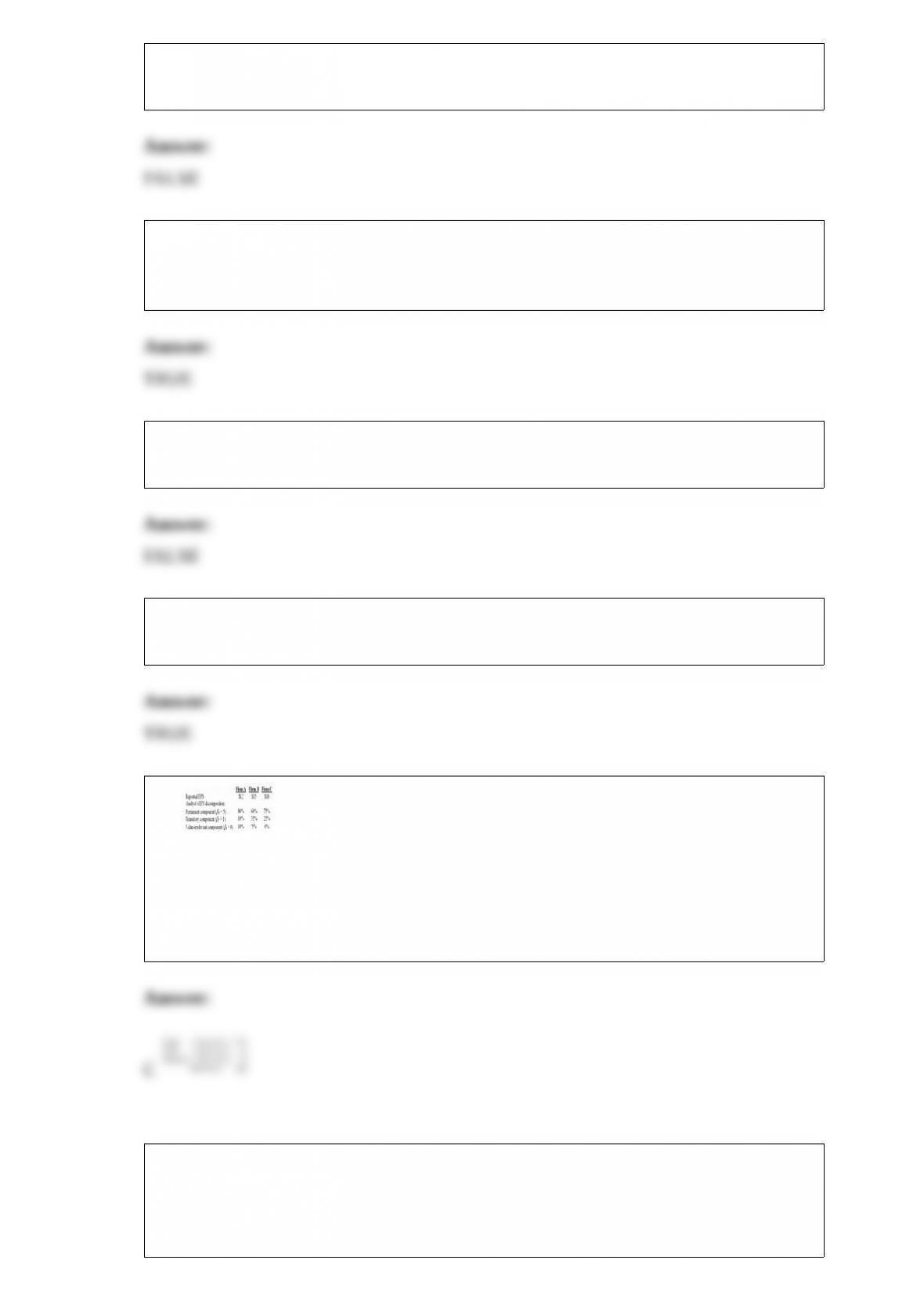
12)
The implied share price of Firm C’s stock is
A.$18.00
B.$63.00
C.$72.00
D.$90.00
13) Financial reporting controversies are typified by all of the following except
A.When one accounting option for a controversial reporting situation results in higher
net income than the other available options, that option will be preferred by
management of the reporting entity and the securities market
B.The debate regarding the two alternative accounting treatments is endlessthere is no
“right” or “wrong” answer
C.The reporting options have the potential to influence managerial behavior
D.The securities market appears to recognize that the differing managerial incentives
have implications for valuing firms
14) If most firms’ price/earnings ratios are between 10 and 15, what is the range of
average risk-adjusted equity cost of capital?
A.6.67% to 10%
B.6.67% to 15%
C.10% to 15%
D.10% to 16.67%
15) Harry’s Clothing, Inc. used the following headings on the company’s December 31,
2011 balance sheet:
(A) Current assets
(B) Long-term investments
(C) Property and equipment
(D) Intangible assets
(E) Other assets
(F) Current liabilities
(G) Long-term debt
(H) Shareholders’ equity
For each of the following items, indicate its normal balance sheet classification
category. Use (NA) for items that would not appear on the face of the balance sheet, but
would be discussed in the notes to the financial statements.
_______ 1> Accounts receivable
_______ 2> Accrued interest on notes payable (2012 maturity)
_______ 3> Accumulated depreciation
_______ 4> Goodwill
_______ 5> Preferred stock
_______ 6> Common stock
_______ 7> Customer deposits on products to be shipped in a few months
_______ 8> Depreciation methods and estimated lives of equipment
_______ 9> Prepaid insurance
_______ 10> Assets (surplus production equipment) held for sale

16) Convertible bonds are usually
A.mortgage bonds
B.senior bonds
C.subordinated debentures
D.real estate bonds
17) Risky firms have a higher risk-adjusted cost of capital. Which one of the following
factors would contribute to that firm also having a high price/earnings ratio?
A.High earnings per share
B.Low earnings per share
C.Growth opportunities
D.High risk and high P/E ratio cannot occur simultaneously
18) When the outcome of a fixed-price contract cannot be reliably estimated, IFRS
A.permits firms to use either the completed contract method or the cost-recovery
method to account for the contract
B.rules do not permit firms to use the completed contract method
C.follows the same accounting method required by U.S. GAAP
D.permits considerable latitude when accounting for the contract
19) In an actual business, which of the following inventory accounting issues frequently
arise?
A.How should physical quantities in inventory be determined?
B.What items should be included in ending inventory?
C.What costs should be included in inventory purchases?
D.All of the above are inventory accounting issues that frequently arise.

20) Which of the following statements does not correctly describe an issue pertaining to
the comparability of the cash flow statement across firms?
A.The proportion of leases treated as operating leases versus capital leases varies
substantially across firms
B.GAAP requires computer software development companies to expense all software
development costs until the software reaches technological feasibility. However, GAAP
does not have any criteria for determining technological feasibility which therefore
allows companies flexibility with respect to this determination
C.Companies selling their accounts receivable at year-end are distorting their cash
flows in the current year relative to their competitors that do not sell their receivables at
year-end
D.Companies that aggressively manage their working capital can’t easily manage the
short-run appearance of their operating cash flows relative to those companies that do
not aggressively manage their working capital
21) The steps involved in business valuation are forecasting future values of some
financial attribute that drives a company’s value, determining the risk associated with
that forecasted value, and determining the
A.future values of the value-relevant attribute
B.certain future value of earnings
C.present value of a company’s earnings
D.discounted present value of the expected future amounts using a discount rate that
reflects the risk or uncertainty
22) Foreign currency nonmonetary assets and liabilities for non-free-standing
subsidiaries are translated using the
A.historic rate of exchange in effect when the asset or liability was acquired or incurred
B.current rate of exchange on the balance sheet date
C.temporal rate of exchange on the balance sheet date
D.present value rate of exchange when the translation takes place
23) Which one of the following equations explains why successive balance sheets can
be used to prepare a firm’s cash flow statement?
A.Assets = Liabilities – Equity
B.Cash – Noncash assets = Liabilities – Equity
C. Cash = Liabilities – Noncash assets + Stockholders’ equity
D. Cash = Liabilities + Stockholders’ equity

24) On December 31, 2011, Barbie Bank securitized $3,000,000 of notes receivable
using a special purpose entity it had established. The cash received from the special
purpose entity was exactly $3,000,000, so it recognized no gain or loss on the
transaction. Barbie Bank has the following account balances at December 31, 2011
before the securitization was recorded:
Required:
a. Compute Barbie Bank’s return-on-assets ratio and debt-to-equity ratio after
completing this transaction assuming that the transaction was viewed as a sale under
authoritative literature.
b. Compute Barbie Bank’s return-on-assets ratio and debt-to-equity ratio after
completing this transaction assuming that the transaction was viewed as a
collateralized borrowing under authoritative literature.
The following table contains the data needed to compute the required ratios.
25) Selected information taken from the 2011 annual report of Aardvark Company
follows. During 2011, the company had no nonoperating or nonrecurring items included
in income and had no outstanding preferred stock.
Required:
a. For 2011, calculate: ROA, ROCE, operating profit margin, asset turnover, common
earnings leverage, and financial structure leverage. Round your percentage answers to
one decimal place. For example, .1234 = 12.3%.
b. Based on the industry data provided, does Aardvark appear to have a competitive
advantage (briefly explain your answer)? If so, what strategy is the firm apparently
following?
26) The FASB’s exposure draft on financial statement presentation sets forth these two
presentation principles:
A.cohesiveness and nature
B.disaggregation and measurement
C.cohesiveness and disaggregation
D.function and nature
27) Common justifications for changing accounting methods include all of the
following except:
A.to conform to industry practice
B.to more accurately represent the company’s activities
C.a new pronouncement by the FASB necessitated the change
D.the company’s financial position appears significantly better when reported under the
new method than under the old one
28)
Assume that Firm B can divest itself of $20,000 of unproductive capital with earnings
falling by only $3,000. Abnormal earnings are
A.$200
B.$400
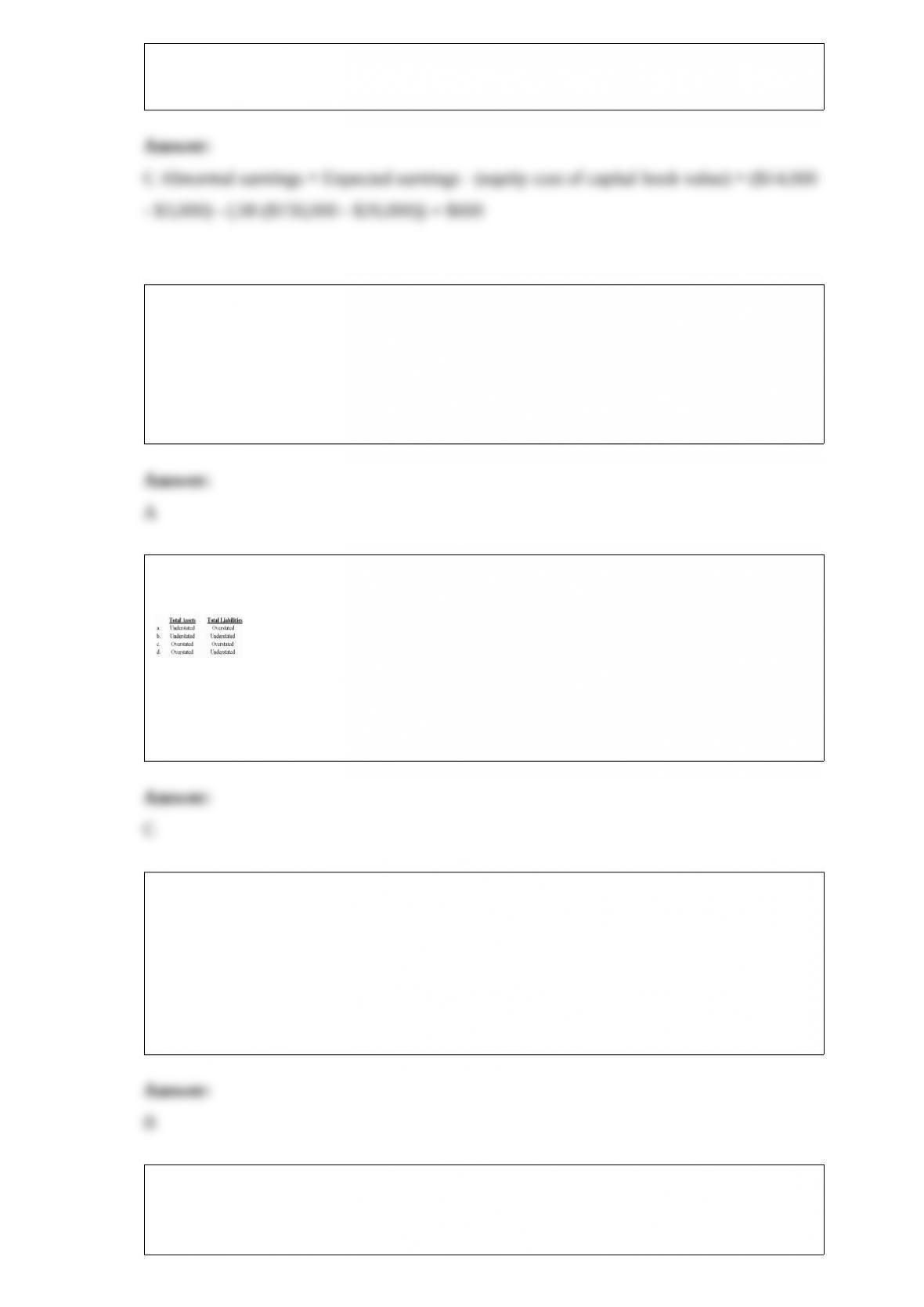
C.$600
D.$800
29) Analysts must recognize that the use of the specific identification method to value
inventory has a serious deficiency because it
A.allows manipulation of net income
B.allows manipulation of period costs
C.allows manipulation of selling expenses
D.allows manipulation of administrative expenses
30) A lessee mistakenly treated an operating lease as a capital lease. How does this
mistake impact the following at the inception of the lease?
A.Option a
B.Option b
C.Option c
D.Option d
31) The proposed changes to the statement of cash flows put forth by the IASB and the
FASB would require firms to
A.Use the indirect method for presenting operating cash flows
B.Separately disclose cash paid for labor, materials and other business related outflows
C.Include cash flows from discontinued operations as part of investing activities
D.Report changes in cash, cash equivalents, and overdrafts repayable on demand on the
statement of cash flows
32) Analytical review procedures include all of the following except
A.simple ratio and trend analysis
B.complex statistical techniques

C.general reasonableness tests
D.comparison of the company’s reported financial results to benchmarks established by
the SEC
33) The financial statement reporting “filter” is
A.SEC reporting regulations that vary from GAAP for publicly traded companies
B.SEC required reporting regulations for all entities
C.management’s manipulation of accounting data
D.management’s discretion to choose alternative accounting procedures within GAAP
34) The basic accounting equation may be expressed as
A.assets = liabilities – owners’ equity
B.liabilities = assets + owners’ equity
C.owners’ equity = assets – liabilities
D.assets = owners’ equity – liabilities
35) Under IFRS, a lessee may classify some assets held under leases as investment
property which allows the lessee to
A.Avoid recording depreciation expense for the assets
B.Account for the assets using either historical cost or fair value
C.Use the higher of the implicit or the incremental borrowing rate when computing the
present value of the minimum lease payments
D.All of the choices are correct
36) If Edsel uses the gross accounts receivable approach for estimating bad debt
expense, the income statement will show an expense of
A.$2,100
B.$3,600
C.$5,100
D.$8,500
37) To adjust for distortions that arise from off-balance sheet leases when comparing
among firms, analysts rely on
A.the balance sheet
B.the income statement
C.the statement of stockholders’ equity
D.required note disclosures
38) A corporation that incurs a pre-tax operating loss must
A.carryback the loss for tax purposes
B.carryforward the loss for tax purposes
C.choose to both carryback and carryforward the loss or to only carryback the loss
D.choose to both carryback and carryforward the loss or to only carryforward the loss
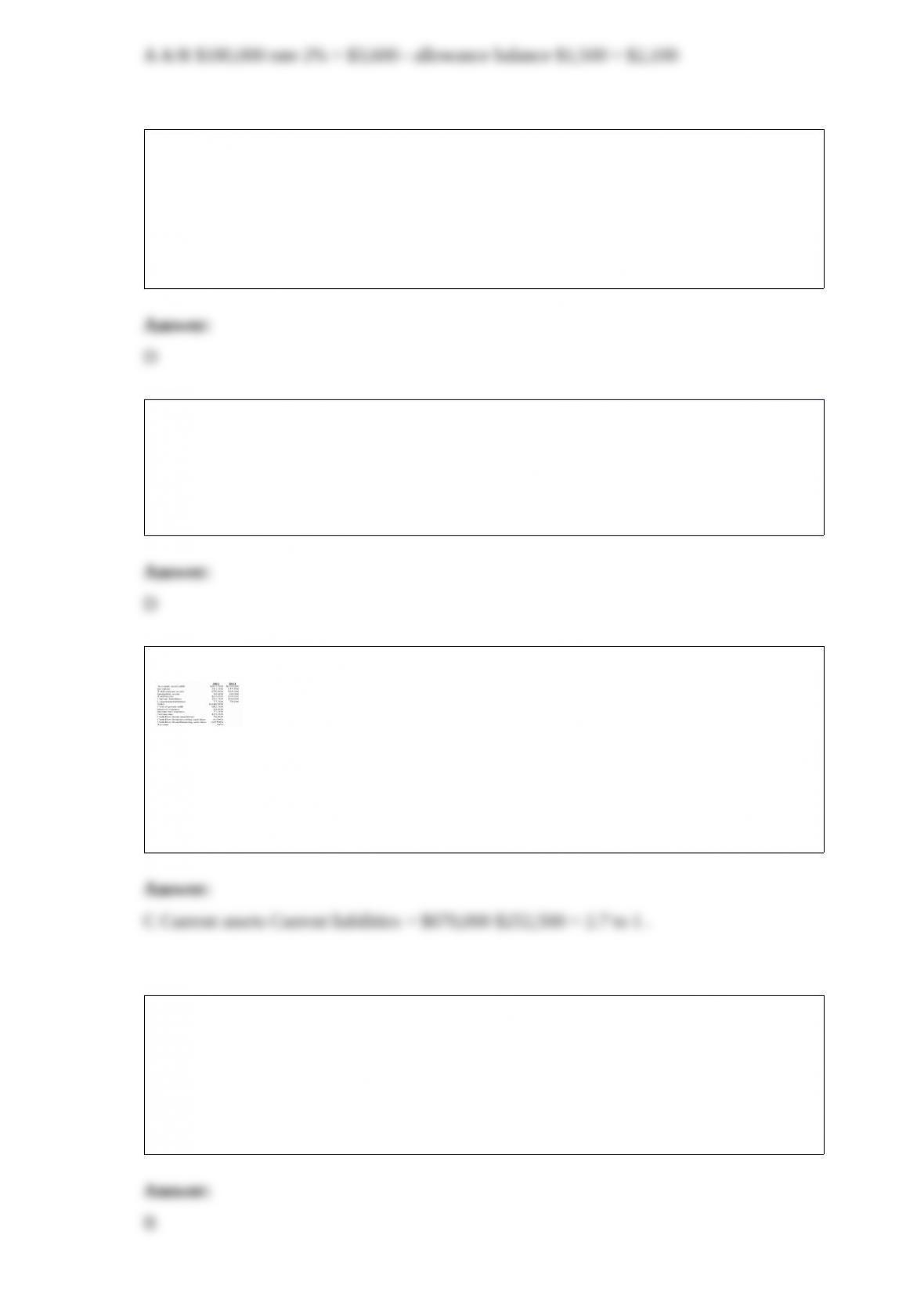
39) Condensed financial data are presented below for the Phoenix Corporation:
The current ratio for 2012 is (rounded):
A.1.4 to 1
B.2.0 to 1
C.2.7 to 1
D.3.4 to 1
40) According to the SEC any breach of a loan covenant that existed at the balance
sheet date that has not subsequently been cured should
A.be recorded as an adjustment to the financial statements
B.be disclosed in the notes to the financial statements
C.be disclosed in the audit report
D.not be disclosed

41) When a financial statement contains omissions or misstatements that would alter the
judgment of a reasonable person, it violates
A.neutrality
B.consistency
C.conservatism
D.materiality
42) If a note receivable is discounted with recourse and the customer defaults at final
payment, the seller
A.has no obligation to the bank
B.must repay the full amount of the note plus interest to the bank
C.must refund the proceeds of the discounting to the bank
D.must repay the principal only to the bank
43) Pepper, Inc. agrees to lease equipment from the Blue Corporation for 10 years at
$25,000 at the end of each year. The equipment has a fair value of $175,000 and an
estimated useful life of 10 years. The lease includes a guaranteed residual value of
$10,000. In addition to the lease payments, Pepper will pay $5,000 per year for a
maintenance agreement. Pepper can finance this lease with its bank at a 12% rate. The
lessor’s implicit lease rate, known to the lessee, is 10%.
Present value interest factors are:
To value the lease asset, Pepper should use a discount rate of
A.10%
B.11%
C.12%
D.prime rate
44) How far into the future the obligations of a company will come due refers to the
company’s
A.capital structure
B.maturity structure
C.solvency
D.liquidity

45) In comparison of 2011 to 2010 performance, Weir Company’s inventory turnover
decreased substantially, although sales and inventory amounts were essentially
unchanged.
Required:
Which of the following statements best explains the decreased inventory turnover ratio?
Explain your answer choice.
a. Cost of goods sold increased.
b. Gross profit percentage increased.
c. Accounts receivable turnover decreased.
d. Total asset turnover decreased.
46) Trans Fat Express, Inc. entered into an agreement with a franchisee on July 1,
2011 . The agreement specified that Trans Fat Express receive an initial franchise fee of
$200,000 (30% due at signing; the balance to be paid in equal annual installments plus
interest at 8% of the unpaid balance beginning July 1, 2012). The franchise fee is
comprised of (1) consideration for the right to operate the franchise, and (2) payment
for services to be performed by Trans Fat Express that include site selection and
building design, employee training, and management training. Substantial performance
of these services is deemed to have occurred when the franchise opens for business in
April 2012 . Trans Fat Express allocates 60% of the fee to the right to operate the
franchise and the remainder to the subsequently performed services.
Required:
a. Prepare the entry to record the signing of the franchise agreement and receipt of the
payment due at that time.
b. Prepare any adjusting journal entries necessitated at December 31, 2011 by this
agreement.
c. Prepare the entry Trans Fat Express should make when the franchisee opens the
location in April 2012 .

47) According to the discounted free cash flow valuation model, the market value of
common shares depends upon investors’
A.future expectations about the future economic prospects of free cash flows
B.current expectations about the future economic prospects of free cash flows
C.future expectations about the current economic prospects of free cash flows
D.current expectations about the current economic prospects of free cash flows
48) Companies that have projected operating cash flows that are more than sufficient to
meet debt payments are
A.financially flexible
B.good credit risk companies
C.undervalued
D.overvalued
49) Under the cost recovery method of revenue recognition
A.income is recognized on a proportionate basis as the cash is received from the sale
B.income is recognized immediately
C.income is recognized when the cash received from the sale exceeds the cost of the
product sold
D.income is recognized when all of the cash has been received
50) International accounting rules are currently established by the
A.IASC
B.IASB
C.FASB
D.none of the above