
1) which of the following is generally thought to haveestablished the highest tariffs in
u.s. history?
a. trade act of 1974
b. reciprocal trade agreements act of 1934
c. tariff act of 1930 (smoot-hawley tariff)
d. general agreement on tariffs and trade
2) a situation where a country announces a parity value for its currency and permits
small variations around that value, but also adjusts the parity regularly by small
amounts according to various indicators, is known as
a. a dirty float
b. a crawling peg
c. a managed float strategy of leaning against the wind
d. a wider band
3) when considering the change in price of a countrys imports when foreign currencies
depreciate by 10 percent relative to the home country, the elasticity of exchange rate
pass-through would be equal to
a. 1.0 if there were no pass-through
b. 1.0 if there were complete pass-through
c. zero if there were complete pass-through
d. 10 percent if there were complete pass-through
4) if two countries remove all tariff and nontariff barriers to trade between them, adopt
a common external tariff on imports from the outside world, and permit free factor
movements between themselves, but take no further steps toward economic integration,
this economic coalition that has been formed is a
a. free-trade area
b. common market
c. economic union
d. customs union
5) the following diagram shows a reaction function graph for two firms selling in an
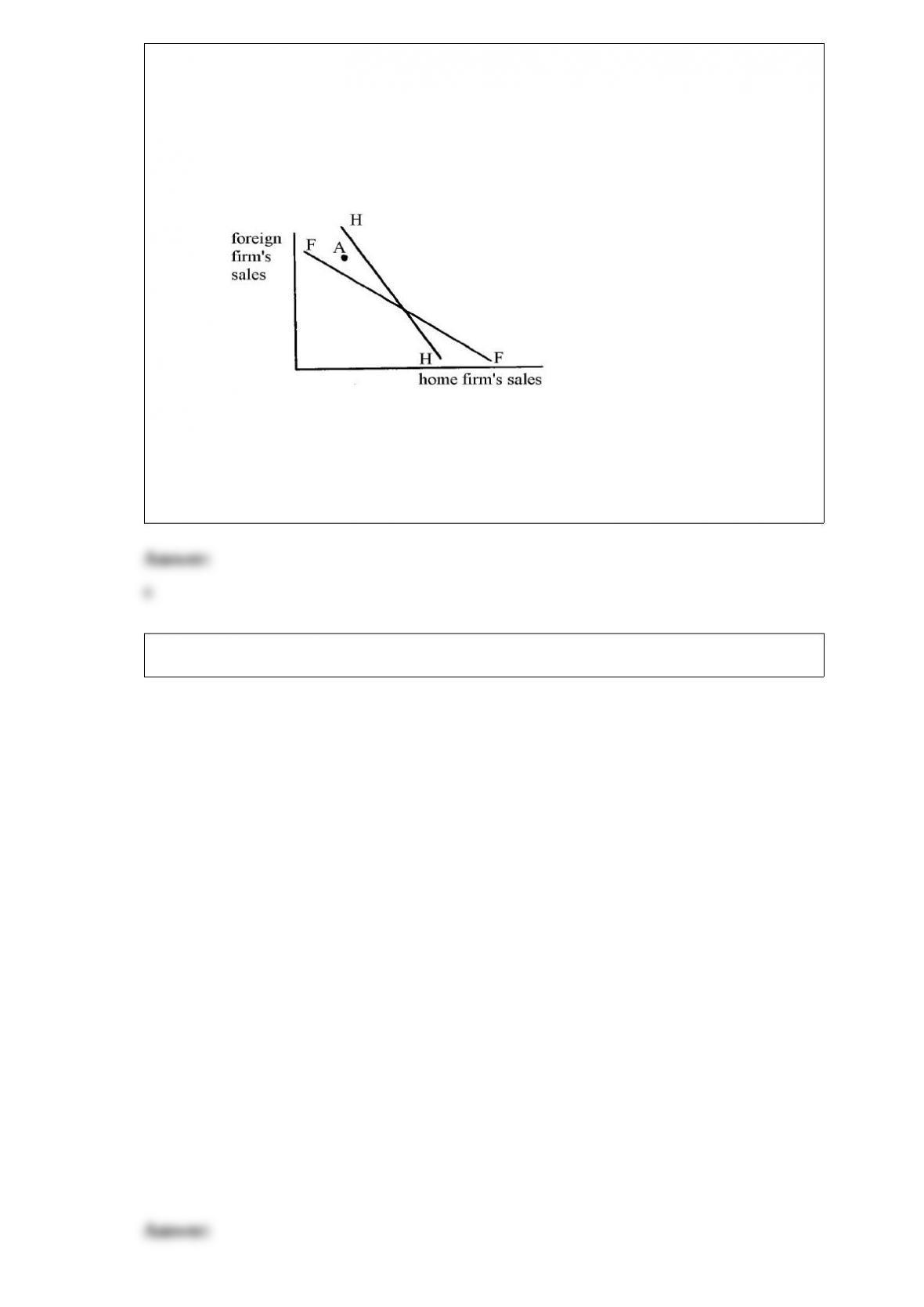
export market, where hh is the home firms reaction function and ff is the foreign firms
reaction function. reaction function hh reflects the fact that, if the foreign firm increases
its quantity sold in this market, then the home firm will __________ its sales level in
the market; reaction function ff reflects the fact that, if the home firm increases its
quantity sold in this market, the foreign firm will __________ its sales level in the
market.
a. decrease; decrease
b. decrease; increase
c. increase; decrease
d. increase; increase
6)
suppose that a countrys nominal tariff rate on imports of good x is 20% and that the
countrys nominal tariff rate on good a [a raw material and the only input (an imported
input) used in making good x] is 5%. in this situation, the effective rate of protection (erp
or effective tariff rate) for the countrys domestic x industry will be __________, and this
type of escalated tariff structure __________ the type of tariff structures that high-income,
developed countries actually have in place on goods imported from low-income,
developing countries.
a. less than 20%; characterizes
b. less than 20%; does not characterize
c. greater than 20%; characterizes
d. greater than 20%; does not characterize

7) if, because of japans high saving rate (in excess of domestic investment spending),
japan invests overseas, then this investment can cause __________ of the japanese yen
and thus a consequent trade __________ for japan.
a. a depreciation; deficit
b. a depreciation; surplus
c. an appreciation; deficit
d. an appreciation; surplus
8) according to the department of commerce information given in the textbook, the
industry in which the united states has made the largest amount of foreign direct
investment (fdi) abroad is __________.
a. finance (except depository institutions) and insurance
b. information
c. manufacturing
d. mining
9) in the two-commodity context, you are given the following information pertaining to
country i in the year 2009 and the year 2014:
production of good x in 2009 = 200 units
production of good x in 2014 = 198 units
consumption of good x in 2009 = 160 units
consumption of good x in 2014 = 176 units
production of good y in 2009 = 100 units
production of good y in 2014 = 120 units
consumption of good y in 2009 = 120 units
consumption of good y in 2014 = 131 units
given the information above, it can be validly concluded that the type of consumption
effect that takes place between 2009 and 2014 in country i is __________ consumption
effect.
a. an ultra-antitrade (ua)
b. an antitrade (a)
c. a protrade (p)
d. an ultra-protrade (up)
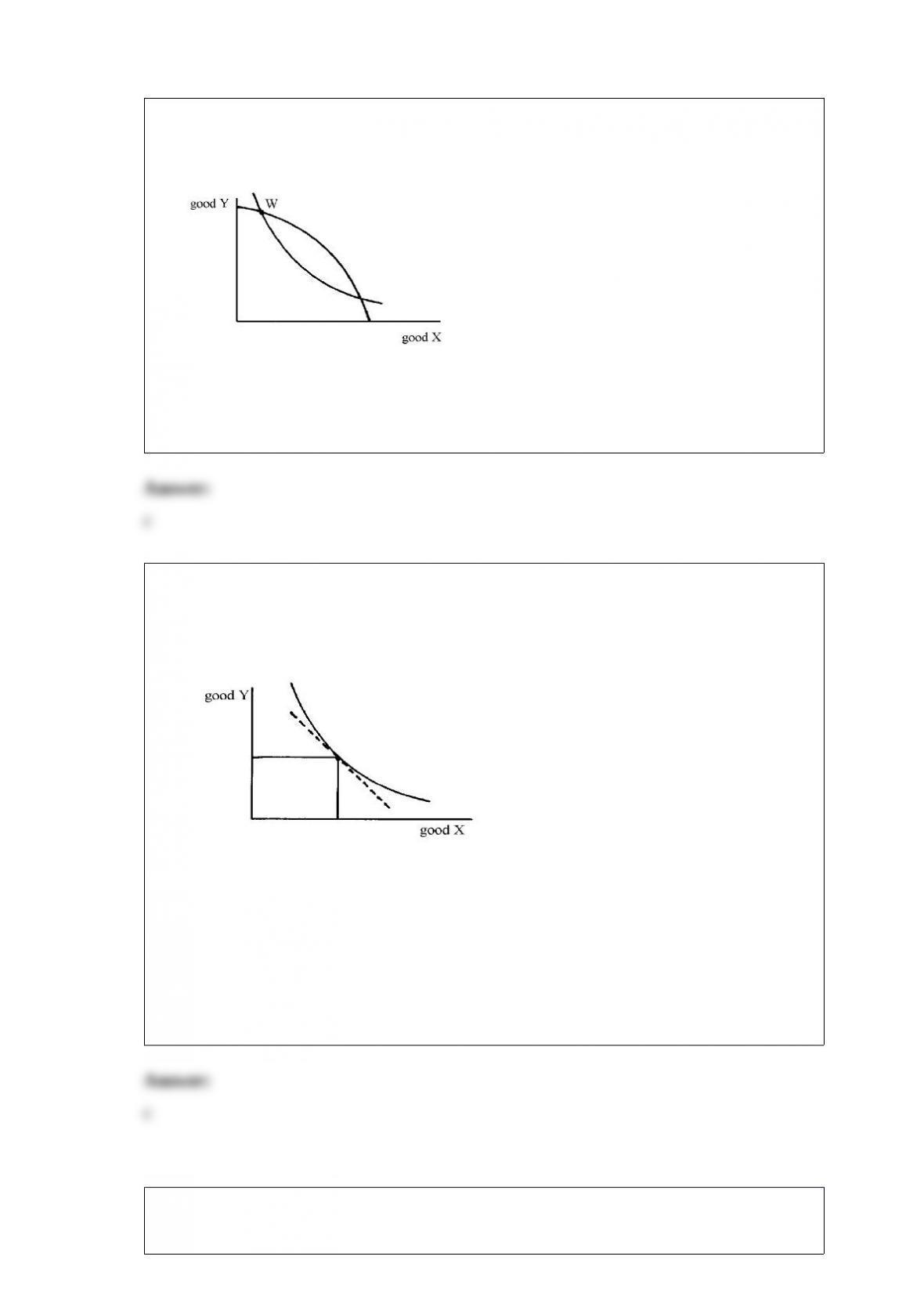
10) in the following graph, at point w (and ignoring the negative signs), the marginal
rate of transformation (mrt) in production __________ the marginal rate of substitution
(mrs) in consumption.
a. is greater than
b. is equal to
c. is less than
d. has no determinate relationship to
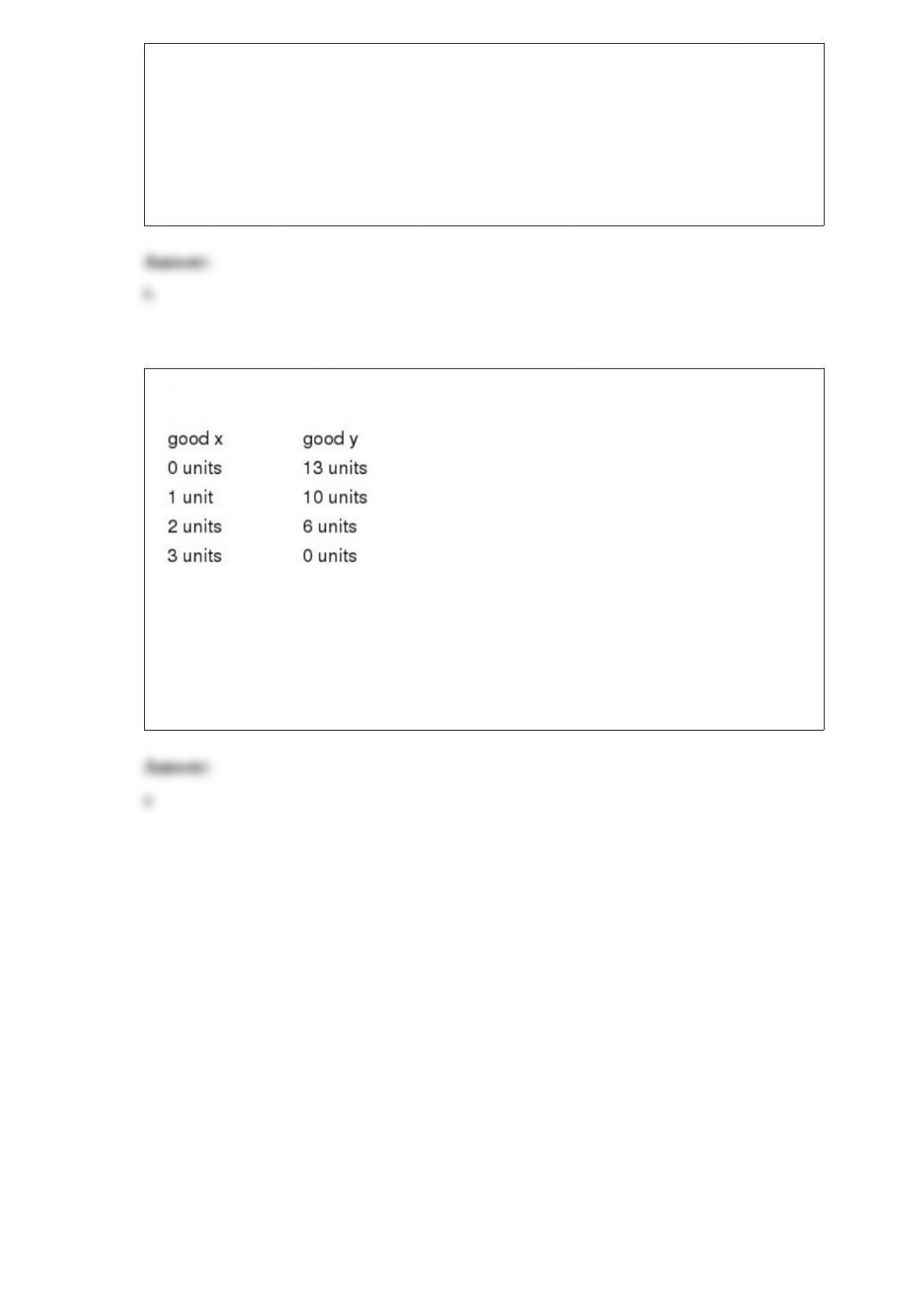
11) given the following diagram showing a fixed-quantity production-possibilities
frontier, a community indifference curve, and the associated autarky price line, if this
country is opened to trade through exposure to different relative prices, the country can
attain
a. both a production gain (gains from specialization) and a consumption gain (gains
from exchange)
b. neither a production gain (gains from specialization) nor a consumption gain (gains
from exchange)
c. a consumption gain (gains from exchange) but not a production gain (gains from
specialization)
d. a production gain (gains from specialization) but not a consumption gain (gains from
exchange)
12) in a situation of flexible exchange rates and where the bp curve is steeper than the
lm curve,
a. monetary policy is less effective in raising national income than would be the case
under fixed exchange rates
b. expansionary fiscal policy will be more effective in raising the level of national
income than would be the case under fixed exchange rates
c. expansionary fiscal policy will lead to an appreciation of the countrys currency
d. the bp curve stays fixed in the same position irrespective of any shifts that occur in
the is and lm curves
13) in the following table of production possibilities for a country,
there are __________ opportunity costs in the production of good x, and there are
__________ opportunity costs in the production of good y.
a. increasing; increasing
b. increasing; constant
c. constant; increasing
d. constant; decreasing