Which of the following statements is FALSE?
A) The long-run growth rate gFCFis typically based on the expected long-run growth
rate of the firm’s revenues.
B) Because the firm’s free cash flow is equal to the sum of the free cash flows from the
firm’s current and future investments, we can interpret the firm’s enterprise value as the
total NPV that the firm will earn from continuing its existing projects and initiating new
ones.
C) If the firm has no debt then rwacc= the risk-free rate of return.
D) When using the discounted free cash flow model, we forecast the firm’s free cash
flow up to some horizon, together with some terminal (continuation) value of the
enterprise.
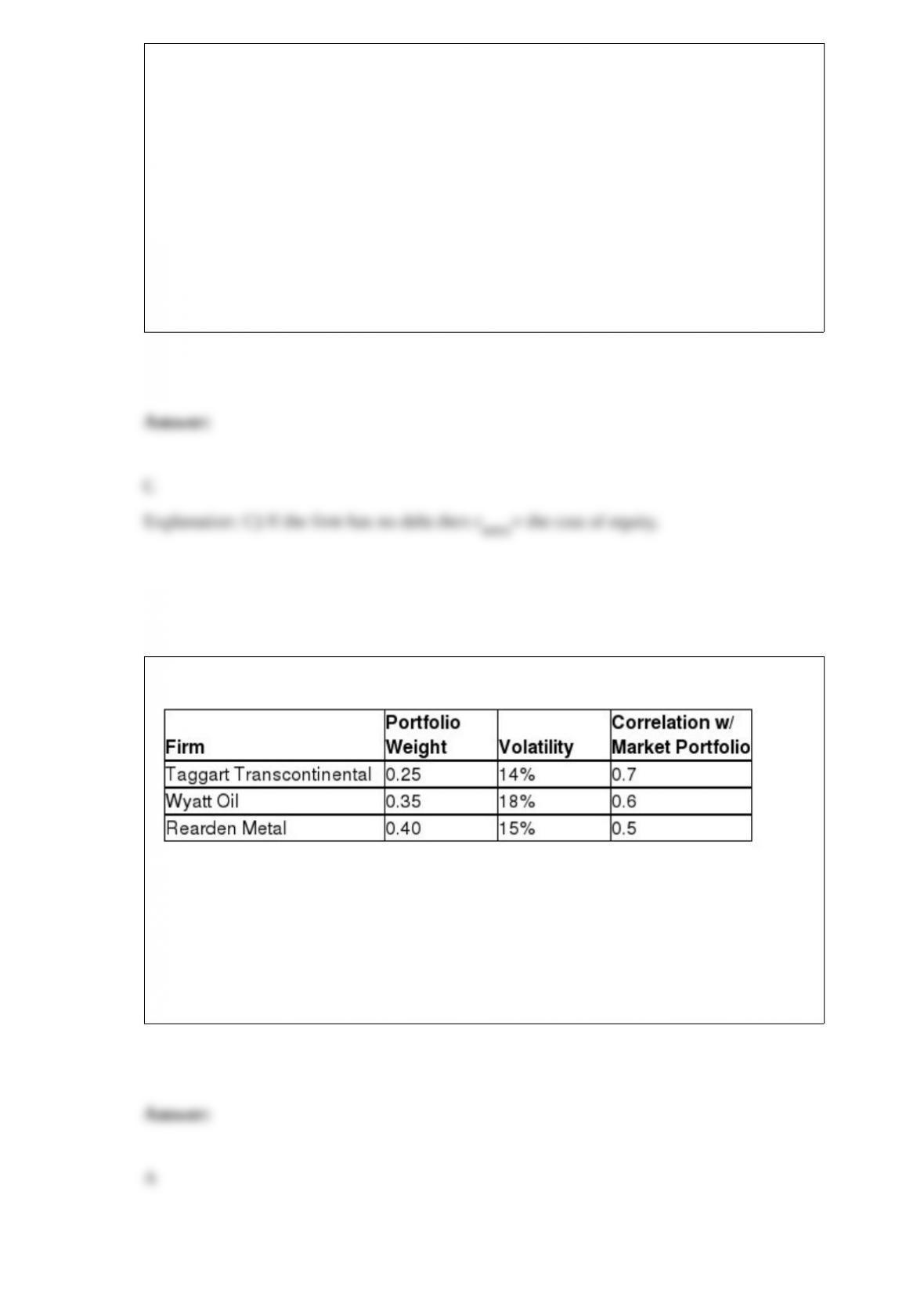
The volatility of the market portfolio is 10%, the expected return on the market is 12%,
and the risk-free rate of interest is 4%The beta for the portfolio of the three stocks is
closest to:
A) 0.92
B) 0.94
C) 1.00
D) 1.02
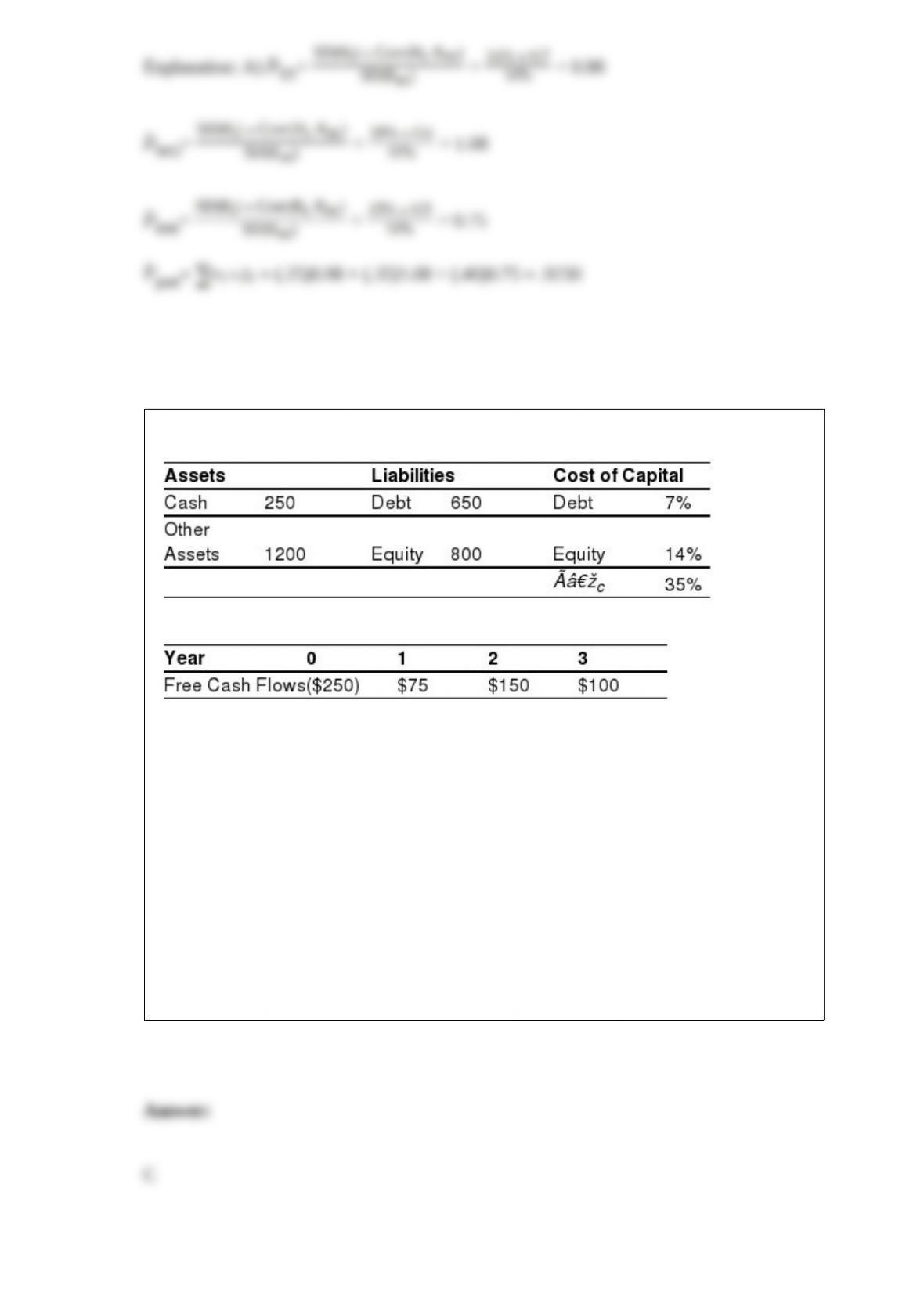
Iota Industries Market Value Balance Sheet ($ Millions) and Cost of Capital
Iota Industries New Project Free Cash Flows
Assume that this new project is of average risk for Iota and that the firm wants to hold
constant its debt to equity ratio.
Iota’s weighted average cost of capital is closest to:
A) 8.40%
B) 9.75%
C) 10.85%
D) 11.70%

Consider the following equation:
βU= βE+ βD
The term βDin the equation is:
A) the same as the beta of the firm’s assets.
B) the required return on the firm’s equity.
C) the proportion of the firm financed with equity.
D) equal to zero if the firm’s debt is riskless.
The Sisyphean Corporation is considering investing in a new cane manufacturing
machine that has an estimated life of three years. The cost of the machine is $30,000
and the machine will be depreciated straight line over its three-year life to a residual
value of $0.
The cane manufacturing machine will result in sales of 2,000 canes in year 1. Sales are
estimated to grow by 10% per year each year through year three. The price per cane that
Sisyphean will charge its customers is $18 each and is to remain constant. The canes
have a cost per unit to manufacture of $9 each.
Installation of the machine and the resulting increase in manufacturing capacity will
require an increase in various net working capital accounts. It is estimated that the
Sisyphean Corporation needs to hold 2% of its annual sales in cash, 4% of its annual
sales in accounts receivable, 9% of its annual sales in inventory, and 6% of its annual
sales in accounts payable. The firm is in the 35% tax bracket, and has a cost of capital
of 10%.
The depreciation tax shield for the Sisyphean Corporation’s project in the first year is
closest to:
A) $8,000
B) $3,500
C) $2,800
D) $5,200

Suppose a risky security pays an average cash flow of $100 in one year. The risk-free
rate is 5%, and the expected return on the market index is 13%. If the returns on this
security are high when the economy is strong and low when the economy is weak, but
the returns vary by only half as much as the market index, then the price for this risky
security is closest to:
A) $88
B) $92
C) $93
D) $95
Galt Motors currently produces 500,000 electric motors a year and expects output levels
to remain steady in the future. It buys armatures from an outside supplier at a price of
$2.50 each. The plant manager believes that it would be cheaper to make these
armatures rather than buy them. Direct in-house production costs are estimated to be
only $1.80 per armature. The necessary machinery would cost $700,000 and would be
obsolete in 10 years. This investment would be depreciated to zero for tax purposes
using a 10-year straight line depreciation. The plant manager estimates that the
operation would require additional working capital of $40,000 but argues that this sum
can be ignored since it is recoverable at the end of the ten years. The expected proceeds

from scrapping the machinery after 10 years are estimated to be $10,000. Galt Motors
pays tax at a rate of 35% and has an opportunity cost of capital of 14%.
The incremental cash flow that Galt Motors will incur in year 4 if they elect to
manufacture armatures in house is closest to:
A) 25,000
B) 350,000
C) 375,000
D) 1,250,000
Which of the following statements is FALSE?
A) In general, the difference between the cost of capital and the IRR is the maximum
amount of estimation error in the cost of capital estimate that can exist without altering
the original decision.
B) The IRR can provide information on how sensitive your analysis is to errors in the
estimate of your cost of capital.
C) If you are unsure of your cost of capital estimate, it is important to determine how
sensitive your analysis is to errors in this estimate.
D) If the cost of capital estimate is more than the IRR, the NPV will be positive.
Two years ago you purchased a new SUV. You financed your SUV for 60 months (with
payments made at the end of the month) with a loan at 5.9% APR. You monthly
payments are $617.16 and you have just made your 24th monthly payment on your
SUV.Assuming that you have made all of the first 24 payments on time, then the
outstanding principal balance on your SUV loan is closest to:
A) $14,808
B) $20,300
C) $22,212
D) $32,000
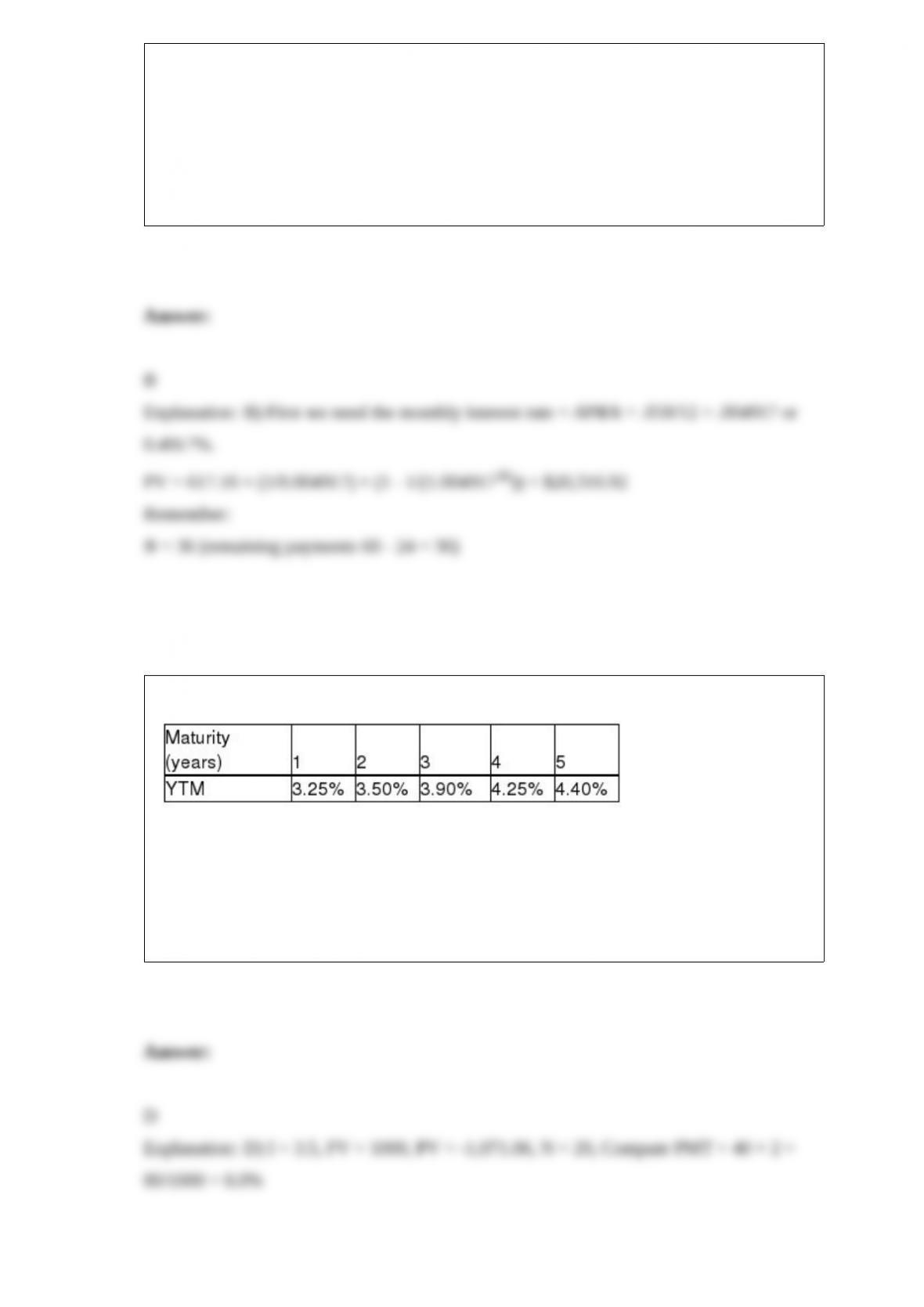
Suppose the current zero-coupon yield curve for risk-free bonds is as follows:
Suppose a ten-year bond with semiannual coupons has a price of $1,071.06 and a yield
to maturity of 7%. This bond’s coupon rate is closest to:
A) 3.5%
B) 6.0%
C) 7.0%
D) 8.0%

LCMS Industries has $70 million in debt outstanding. The firm will pay only interest on
this debt (the debt is perpetual). LCMS’ marginal tax rate is 35% and the firm pays a
rate of 8% interest on its debt.
Assuming that the risk of the tax shield is only 6% even though the debt pays 8%, then
the present value of LCMS’ interest tax shield is closest to:
A) $24.5 million
B) $18 million
C) $33.0 million
D) $20.0 million
You are considering purchasing a new home. You will need to borrow $250,000 to
purchase the home. A mortgage company offers you a 15 year fixed rate mortgage (180
months) at 9% APR (0.75% month). If you borrow the money from this mortgage
company, your monthly mortgage payment will be closest to:
A) $2,585
B) $660
C) $2,535
D) $1,390
Rearden Metal currently has no debt and an equity cost of capital of 14%. Suppose that
Rearden decides to increase its leverage and maintain a market debt-to-value ratio of
1/2. Suppose Rearden’s debt cost of capital is 8% and its corporate tax rate is 40%.
Assuming that Rearden’s pre-tax WACC remains constant, then with the addition of
leverage its effective after-tax WACC will be closest to:
A) 10.8%
B) 12.4%
C) 12.8%
D) 13.4%

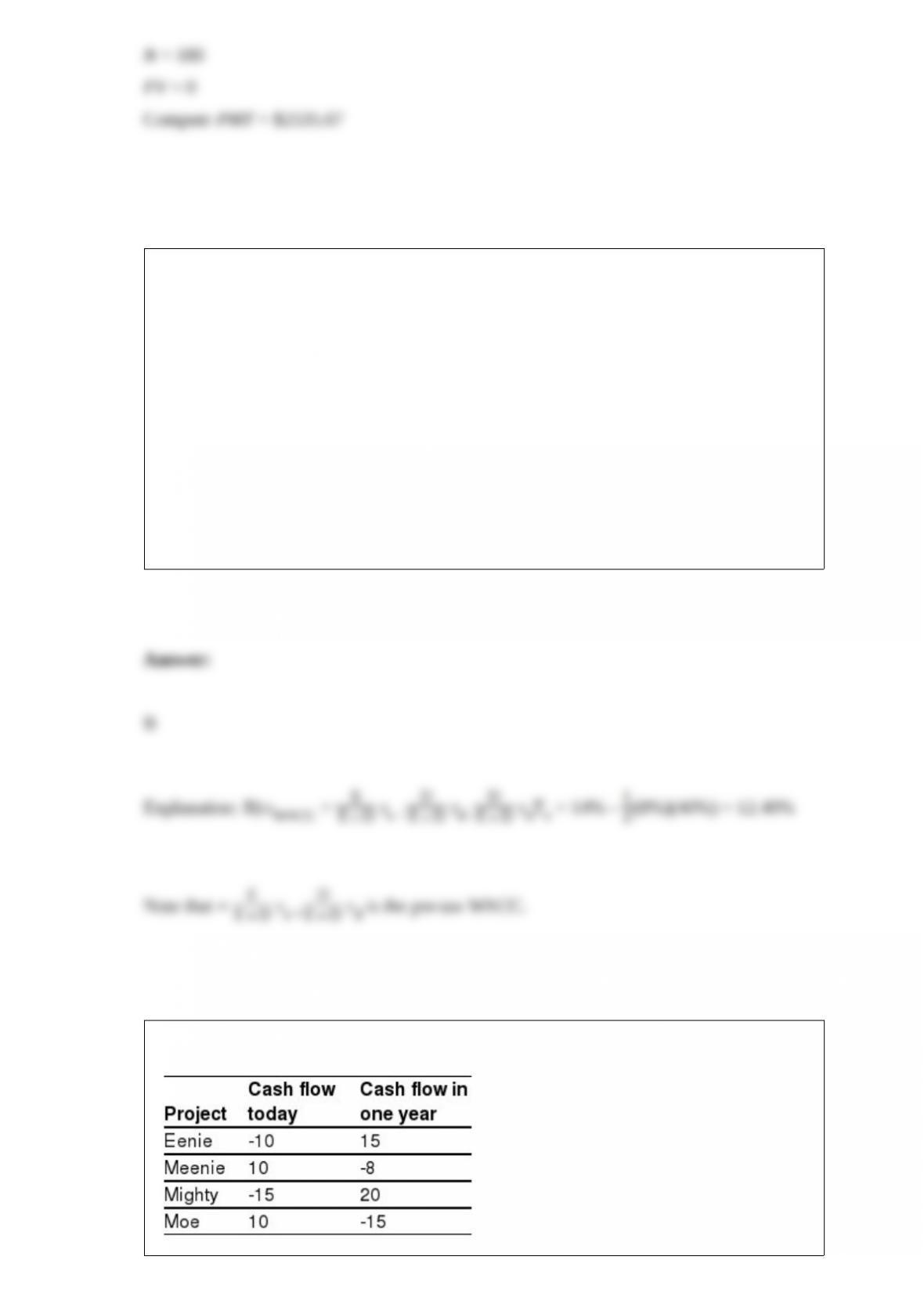
If the risk-free interest rate is 10%, then the NPV for Eenie is closest to:
A) -3.64
B) 2.73
C) 3.18
D) 3.64
Which of the following statements is FALSE?
A) Financial transactions are not sources of value, but merely serve to adjust the timing
and risk of the cash flows to best suit the needs of the firm or its investors.
B) The NPV of trading a security in a normal market is zero.
C) We cannot separate a firm’s investment decision from the decision of how to finance
the investment.
D) In normal markets, trading securities neither creates nor destroys value.
Pro Forma Income Statement for Ideko, 2005-2010
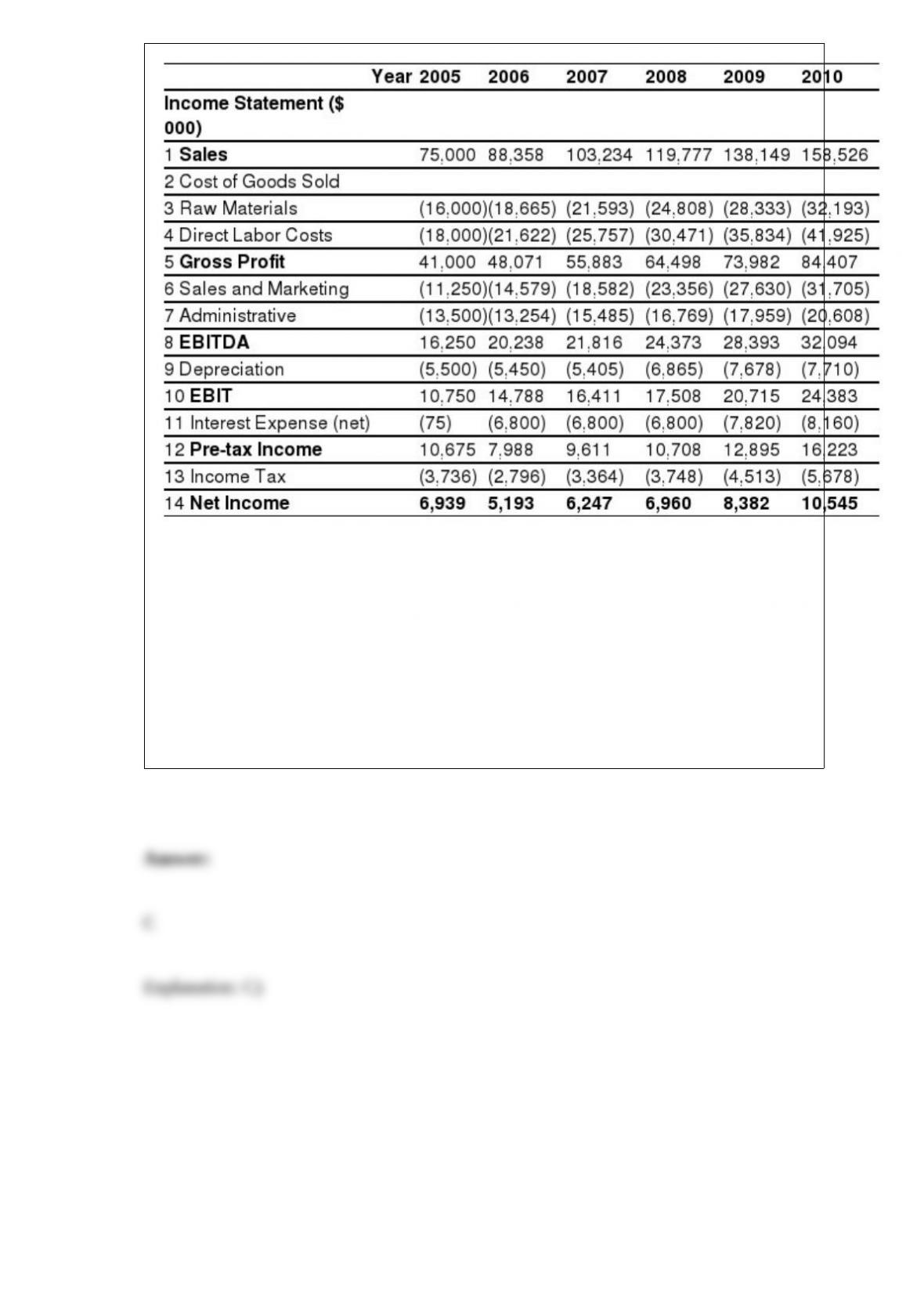
The amount of the increase in net working capital for Ideko in 2008 is closest to:
A) $4,685
B) $3,665
C) $4,090
D) $5,230
Which of the following statements is FALSE?
A) A capital budget lists the projects and investments that a company plans to undertake
during the coming year.
B) Income Tax = EBIT × (1 – Ï„c).
C) When sales of a new product displace sales of an existing product, the situation is
often referred to as cannibalization.
D) Overhead expenses are often allocated to the different business activities for
accounting purposes.
Von Bora Corporation (VBC) is expected to pay a $2.00 dividend at the end of this year.
If you expect VBC’s dividend to grow by 5% per year forever and VBC’s equity cost of
capital is 13%, then the value of a share of VBS stock is closest to:
A) $25.00

B) $40.00
C) $15.40
D) $11.10
Consider a project with free cash flows in one year of $90,000 in a weak economy or
$117,000 in a strong economy, with each outcome being equally likely. The initial
investment required for the project is $80,000, and the project’s cost of capital is 15%.
The risk-free interest rate is 5%.
Suppose that to raise the funds for the initial investment the firm borrows $40,000 at the
risk free rate and issues new equity to cover the remainder. In this situation, the value of
the firm’s levered equity from the project is closest to:
A) $0
B) $50,000
C) $90,000
D) $40,000